
What Percentage of Testosterone Should Be Free?
This post contains affiliate links. As an Amazon Associate, we earn from qualifying purchases.
Only 1% to 4% of your total testosterone is the free, biologically active form. This tiny fraction is what your body’s cells can actually use. The exact percentage within that range depends on your levels of sex hormone-binding globulin (SHBG), which acts like a storage protein, and your overall health.
That small percentage is the whole game. If your total testosterone looks fine but your free percentage is at the bottom of that range, you can still feel the symptoms of low T, low energy, poor drive, brain fog. The number everyone focuses on is the total. The number that actually matters is the free, which is why it’s important to ask what percentage of testosterone should be free.
What follows is a breakdown of that 1-4% rule, where it comes from, and what to do when your own lab results don’t line up. This explains how SHBG warps the reading, when a direct free testosterone test is worth it, and the specific steps to take if your free percentage looks off.
Key Takeaways
- Only 1–4% of total testosterone is free. This is the active hormone your cells can use; the rest is tightly bound to proteins like SHBG.
- SHBG is the control dial for your free percentage. High SHBG lowers your free T even if total T looks normal; low SHBG (common in obesity) can mask a normal free T despite a low total.
- Total testosterone below 280 ng/dL is 91.0% sensitive for predicting low calculated free testosterone. But between 280–350 ng/dL, total T is not sensitive enough to reliably exclude hypogonadism.
- The gold-standard test is equilibrium dialysis with LC-MS/MS. Most clinical labs use calculated estimates, which can vary; always compare trends using the same lab’s method.
- Treat the symptom, not just the number. A free percentage at 1.5% with symptoms warrants a doctor’s review; a percentage at 3% without symptoms may need no action.
What is Free Testosterone?
Think of your total testosterone as a library’s entire book collection. The free testosterone is the handful of books currently checked out and being read. The rest are stored on the shelves, bound and unavailable for immediate use.
In your bloodstream, most testosterone is tightly bound to a protein called sex hormone-binding globulin (SHBG). This binding is so strong that the hormone can’t easily leave the blood to enter tissues like muscle, brain, or bone. A smaller amount is loosely bound to albumin, and a tiny sliver, between 1% and 4%, circulates completely unbound. This unbound, or free testosterone, plus the albumin-bound portion (together called bioavailable testosterone), is what’s biologically active.
The gold-standard method for measuring free testosterone is equilibrium dialysis (ED) coupled with isotope dilution ultra-high-performance liquid chromatography tandem mass spectrometry (ID-UHPLC-MS/MS), a reference procedure developed by the CDC’s clinical standardization program.
Why does this distinction matter? Because you feel your free testosterone, not your total. If your SHBG levels are high, it can lock up most of your testosterone, leaving a normal total number but a clinically low free fraction. I spent a year confused by this. My total testosterone results were always in the mid-range, “perfectly fine.” But my energy and drive weren’t. It wasn’t until I saw my high SHBG level and calculated my free testosterone that the picture made sense. The total number was a decoy.
What is the Normal Percentage of Free Testosterone?
The research is consistent but gives a range. You’ll see 2–3% cited in one peer-reviewed guide, 2–4% in another, and 1% to 4% in a broader reappraisal of testosterone binding. Commercial lab reports sometimes state less than 2%.
This isn’t a contradiction. It’s biology. Your individual percentage is a moving target shaped by one main factor: your SHBG level.
| Source | Cited Free Testosterone Percentage | Key Context |
|---|---|---|
| Clinical Guide (PMCID: PMC7319700) | 2–4% of total | The unbound free testosterone (FT) represents only 2–4% of the total. |
| Biochemical Diagnosis Review (PMCID: PMC4975356) | 2–3% of total | Only 2–3% of total testosterone is unbound free testosterone. |
| Binding Reappraisal (PMCID: PMC6287254) | 1% to 4% of circulating total | Only 1% to 4% of circulating testosterone is unbound or free. |
So, a “normal” free percentage is anything within that 1–4% window. But normal isn’t always optimal. A percentage at 1.2% might be technically “in range” but could leave you symptomatic if it’s at the very bottom of your lab’s reference interval for free testosterone levels. Conversely, a percentage at 3.8% is likely more than sufficient.
Where this goes sideways: Chasing a specific percentage, like 3%, as a magic number. The goal is a free testosterone level (in pg/mL) that resolves your symptoms and sits within a healthy range, not an arbitrary fraction.
How SHBG Controls Your Free Percentage
SHBG isn’t a passive carrier. It’s the thermostat for your active testosterone. The higher your SHBG, the lower your free percentage, and vice versa. This is the mechanism that makes total testosterone an unreliable solo metric.
Here’s how it breaks down in two common scenarios:
- High SHBG: Often seen with aging, liver disease, hyperthyroidism, or certain medications. Result: Normal total testosterone, but low free percentage and low free T. You feel hypogonadal despite a “good” total number.
- Low SHBG: Common in obesity, type 2 diabetes, metabolic syndrome, or hypothyroidism. Result: Low total testosterone, but a normal or even high free percentage. The total looks alarming, but the bioactive hormone might be adequate.
This is why guidelines from the Endocrine Society recommend assessing free testosterone when SHBG is suspected to be abnormal. You can’t understand the what percentage of testosterone should be free question without knowing what’s happening with SHBG and free T.
Conditions and Medications That Shift SHBG
Your free percentage isn’t static. Several factors can push SHBG up or down, directly changing how much of your total T is free.
- Increase SHBG (Lowers Free %): Aging, liver disease, hyperthyroidism, estrogen therapy, certain anticonvulsants, and HIV infection.
- Decrease SHBG (Raises Free %): Obesity, insulin resistance, type 2 diabetes, hypothyroidism, corticosteroids (like prednisone), and progestins.
A revealing study on total testosterone predictive performance found that within 90 days of testosterone testing, about half of the men were prescribed potent opioids and about a tenth were prescribed a systemic glucocorticoid.
When Should You Get a Free Testosterone Test?
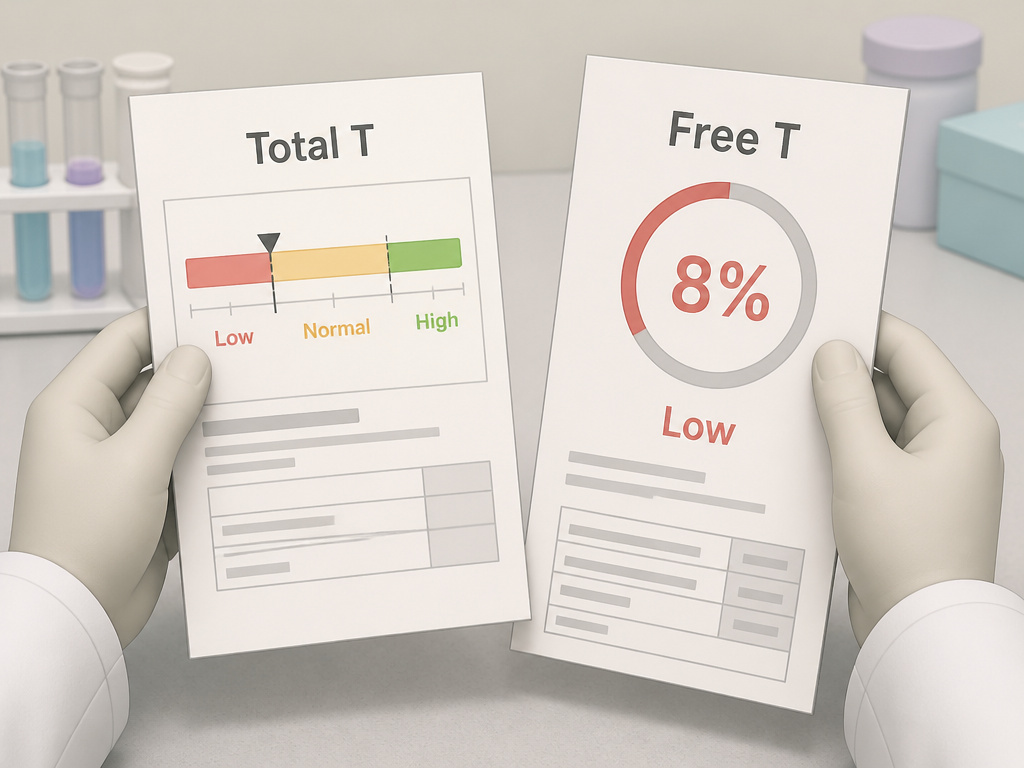
You don’t always need one. International guidelines are clear: start with total testosterone, especially when you compare a what percentage of testosterone should be free. Reserve the free test for specific, common situations.
- Your total testosterone is near the lower limit of normal. This is the most common reason. If your total T is in the “grey zone” (e.g., 250–350 ng/dL), the free T measurement decides whether you’re truly deficient. A performance of total testosterone measurement study found total T between 280 and 350 ng/dL is not sensitive enough to reliably exclude hypogonadism.
- You have a condition that affects SHBG. As listed above, if you have obesity, liver disease, or are on relevant medications, your total T is a poor indicator of androgen status.
- Your symptoms and total T disagree. You have classic low T symptoms (fatigue, low libido, depression) but your total testosterone is repeatedly mid-range or normal. This mismatch screams for a free T and SHBG check.
The Endocrine Society’s clinical practice guideline formalizes this approach, recommending free testosterone measurement in these exact scenarios. Not all professional societies agree universally, but this is the prevailing expert consensus.
How Free Testosterone is Measured (And Why It’s Tricky)
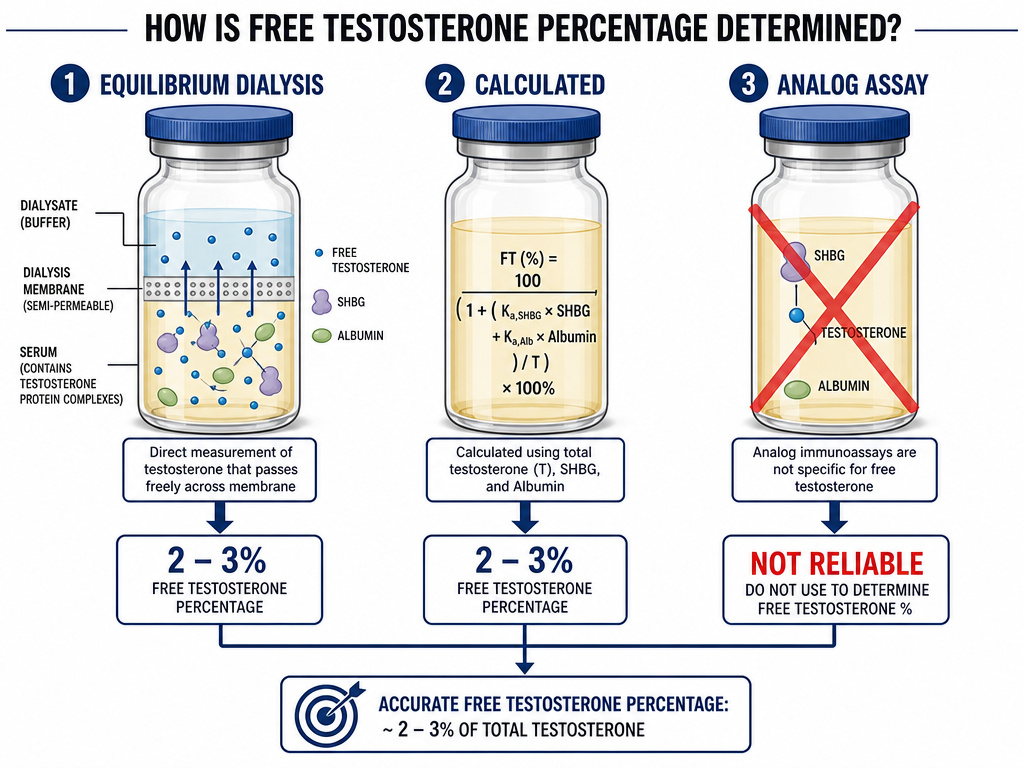
There’s a big gap between the best possible test and the test you’re likely to get. This gap explains why percentages and values can vary between labs.
- The Gold Standard: Equilibrium Dialysis (ED). This is the reference method. A serum sample is dialyzed against a protein-free buffer at 37°C until equilibrium. The free hormone crosses the membrane and is measured, typically with highly accurate mass spectrometry (LC-MS/MS). The CDC’s clinical standardization program uses this equilibrium dialysis free testosterone method. It’s technically demanding, slow, and expensive, so it’s mostly used in research and reference labs.
- The Common Clinical Method: Calculated Free Testosterone. This is what most people get. The lab measures your total T, SHBG, and albumin, then plugs the numbers into a formula (like the Vermeulen equation). It’s cheap, fast, and generally correlates well with ED. However, its accuracy depends on the quality of the underlying measurements and the formula’s assumptions about binding dynamics, which a testosterone binding reappraisal study notes can be oversimplified.
- Analog Immunoassay Direct Measurement. Some labs offer a “direct” free T test. These assays are notoriously inaccurate and are not recommended by major societies. They often overestimate free T levels.
Common mistake: Comparing a calculated free T from Labcorp to one from Quest and treating the difference as a real change. Always track your calculated free testosterone trend using the same lab and the same method. The trend is more valuable than any single number.
What to Do If Your Free Percentage Is Low
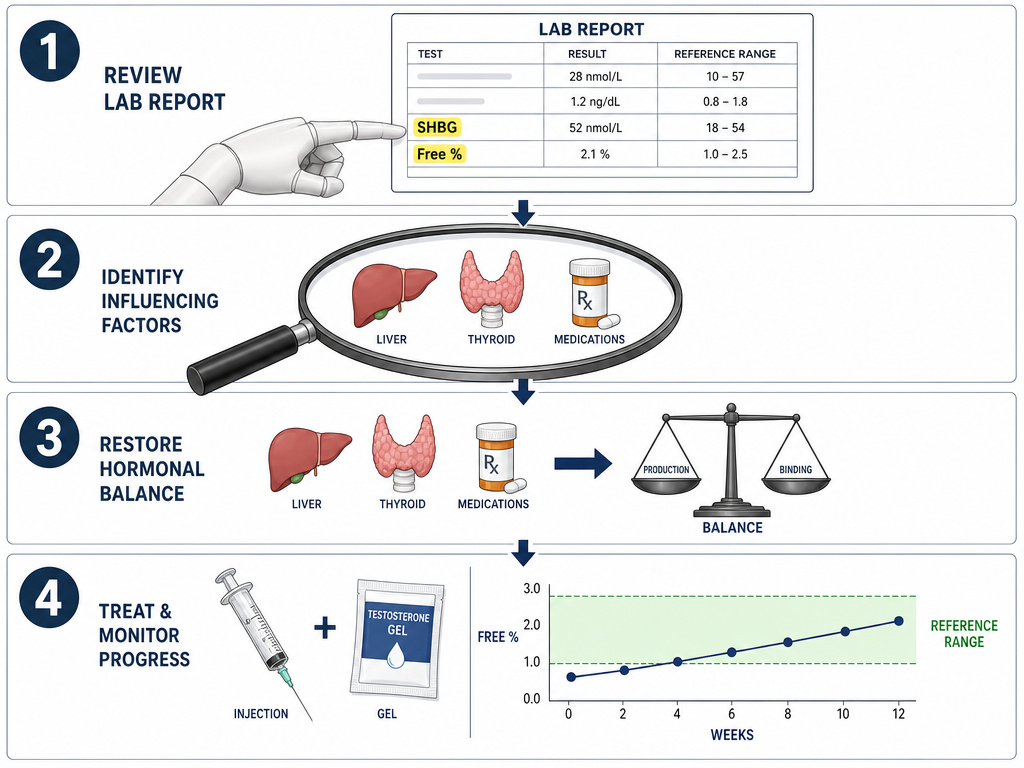
Found your free percentage sitting at 1.5%? Don’t just buy a “testosterone booster.” Follow a sequence.
First, verify the number. Was it a calculated value? Do you have the SHBG result to confirm the calculation makes sense? Low free percentage with normal total almost always points to high SHBG.
Second, investigate the cause of high SHBG. Work with your doctor to review:
- Medications list.
- Liver function tests (ALT, AST).
- Thyroid panel (TSH, Free T4).
- Inflammatory markers.
Third, address root causes before considering treatment. If your SHBG is high due to an underactive thyroid or liver inflammation, treating that condition may normalize your SHBG and free percentage without ever touching testosterone.
Fourth, if hypogonadism is confirmed, discuss treatment options. Testosterone therapy (gels, injections) will raise both total and free testosterone. The treatment target, per guidelines, is to get your levels into the reference range. For gels, aim for the mid-range; for injectables, aim for the low end at trough. Your doctor will check your hematocrit before and annually during therapy, and for men aged ≥40, will measure PSA at baseline, 3–6 months after starting, and annually thereafter.
Throughout this, remember that bioavailable testosterone, the free plus albumin-bound fraction, is what tissues actually see. It’s the most physiologically relevant metric, even if it’s less commonly discussed.
Difference in free testosterone between men and women
While the fact sheet does not provide specific comparative numbers for men and women, the underlying principle of what constitutes free testosterone applies to both sexes. Only a small percentage of the body’s total testosterone circulates in the unbound, or free, state. This free fraction is the portion that is biologically active and available for use by tissues. The key difference lies in the vastly different total testosterone levels between adult men and women, which naturally results in a corresponding difference in the absolute amount of free hormone. Conditions that alter sex-hormone binding globulin, such as obesity or thyroid disorders, can affect the free percentage in both men and women, potentially impacting hormone activity regardless of the total amount.
Frequently Asked Questions
What is a good percentage of free testosterone?
Good percentage falls within the 1–4% range of your total testosterone. More important than the percentage itself is where your absolute free testosterone level (in pg/mL) falls on your lab’s age-specific reference range and whether you have symptoms. A percentage of 2.5% with a level of 75 pg/mL and no symptoms is likely fine. The same percentage with a level of 40 pg/mL and crushing fatigue is not.
Is 290 total testosterone low?
It might be. At 290 ng/dL, your total testosterone is below the typical lower limit of normal (around 300 ng/dL for many labs). More critically, a study on predictive performance found that total testosterone must exceed 350 to 400 ng/dL to reliably predict normal free testosterone. A total of 290 ng/dL is near the lower limit of normal, a scenario where guidelines recommend assessing free testosterone.
What are the ideal testosterone levels for men?
There’s no single “ideal” level for all men. Healthy, young men often have total and free testosterone levels within the normal reference ranges for their age. However, a good testosterone level is one that alleviates symptoms of deficiency (if present) and sits within the normal range for your age. Optimal is having enough active hormone to feel vital and healthy without pushing into supraphysiological ranges, which carries risks.
Can you increase your free testosterone percentage?
You can influence it by managing your SHBG. Strategies that may lower high SHBG (thus raising your free percentage) include addressing underlying conditions (like thyroid disorders), reducing alcohol intake, and improving insulin sensitivity through diet and exercise. You cannot directly “supplement” your way to a higher percentage without changing the SHBG dynamic or raising your total testosterone.
The Bottom Line
The 1–4% rule is a useful anchor, but it’s not a diagnostic tool. Your free testosterone percentage is a consequence, not a cause. It’s the result of the interplay between your total testosterone production and your SHBG level.
Stop looking at your total testosterone in isolation. If your total testosterone is near the lower limit of normal (e.g., below 350-400 ng/dL) or you have symptoms with a mid-range total and suspected SHBG issues, your next step may be to get a panel that includes SHBG and free testosterone. That’s how you move from guessing to knowing.
Give the data a fair trial. Test it, don’t guess. Once you have the full picture, total T, SHBG, free T, you can have a productive conversation with your doctor about what, if anything, needs to change. Sometimes the fix is simple. Other times, it’s a clue to a different health issue altogether. Start with the basics, and let the evidence lead.
