
What Is the Testosterone to Epitestosterone Ratio?
This post contains affiliate links. As an Amazon Associate, we earn from qualifying purchases.
The testosterone to epitestosterone (T/E) ratio is a measurement used in anti-doping to detect the use of synthetic testosterone. It compares the amount of testosterone to its natural, inactive isomer, epitestosterone, in a urine sample. A key question in anti-doping is what is the testosterone to epitestosterone ratio that indicates doping. A ratio at or above the 4:1 threshold set by the World Anti-Doping Agency (WADA) triggers further investigation for a potential doping violation.
This ratio isn’t a general health marker. Its entire purpose is forensic. In a clean athlete, the concentrations of testosterone and epitestosterone in urine vary greatly, but the central question of what is the testosterone to epitestosterone ratio is used as an internal comparison. Introducing external testosterone skews this balance because the body’s own epitestosterone production doesn’t increase to match. That imbalance is what the test catches. The rest of this guide walks through the exact science of the test, the official rules that govern it, and what it means if you encounter this ratio outside of a sports context.
Key Takeaways
- The T/E ratio is a forensic anti-doping tool, not a routine health marker. It’s designed to catch exogenous testosterone use.
- WADA’s official threshold for further investigation is a ratio of 4:1, lowered from 6:1 in 2005 to improve detection sensitivity.
- Lab analysis follows a strict WADA technical protocol using gas chromatography/mass spectrometry (GC/MS) targeting the ion at m/z 432.
- A high ratio only indicates potential doping after triplicate confirmation and investigation into natural causes like low epitestosterone production.
- For health concerns, focus on standard testosterone testing panels (total, free, SHBG) rather than the T/E ratio.
The Biological Roles of Testosterone and Epitestosterone
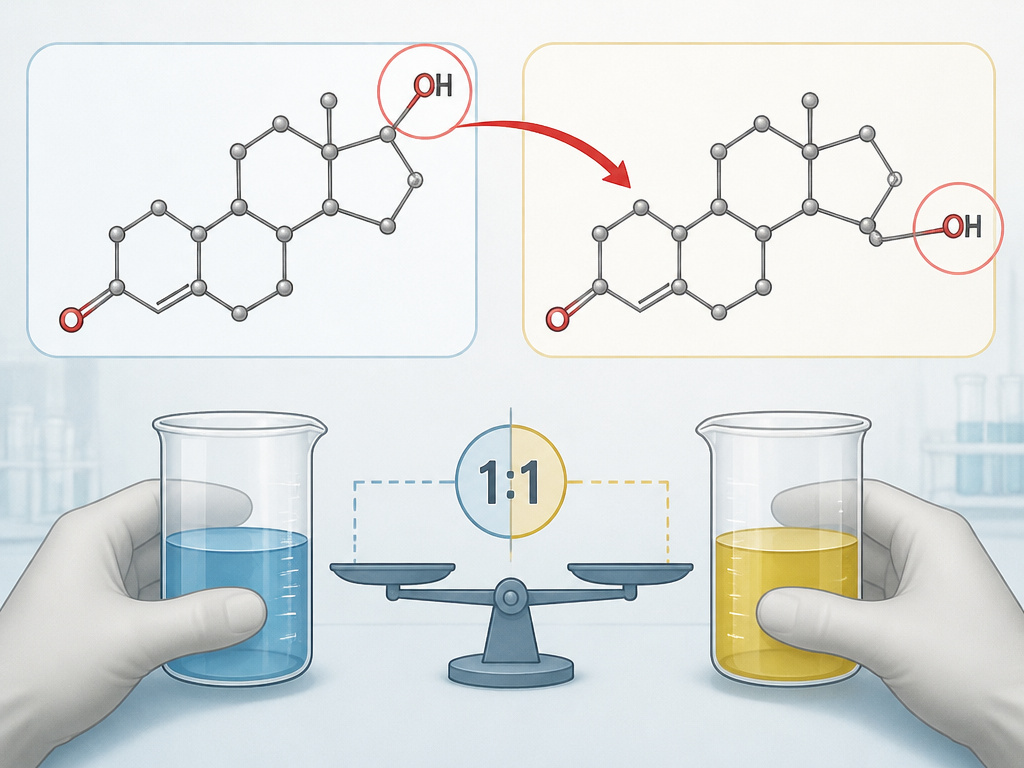
Testosterone needs little introduction. It’s the primary male sex hormone, driving muscle growth, bone density, libido, and overall vitality. Epitestosterone is its nearly identical twin. They share the same chemical formula but have a slight difference in the orientation of one hydroxyl group. This small change makes a world of difference in function.
While testosterone is potent androgenic activity, epitestosterone is biologically inert. Your body produces it naturally, but it doesn’t bind to androgen receptors or promote muscle growth. For decades, its only recognized role seemed to be as testosterone’s silent counterpart. In doping control, that’s precisely what makes it useful, it serves as an internal reference. Assuming natural production, the amounts of both should move in relative sync. Introducing a large external dose of testosterone breaks that sync.
The concentration of each hormone in urine varies massively between people. It depends on genetics, sex, age, and even the specific gravity of the urine sample. That’s why WADA’s official T/E ratio reporting standards mandate that all values be corrected to a standard specific gravity of 1.020 before any comparison is made. You can’t compare raw numbers between two different samples.
How the T/E Ratio Is Measured in a Lab
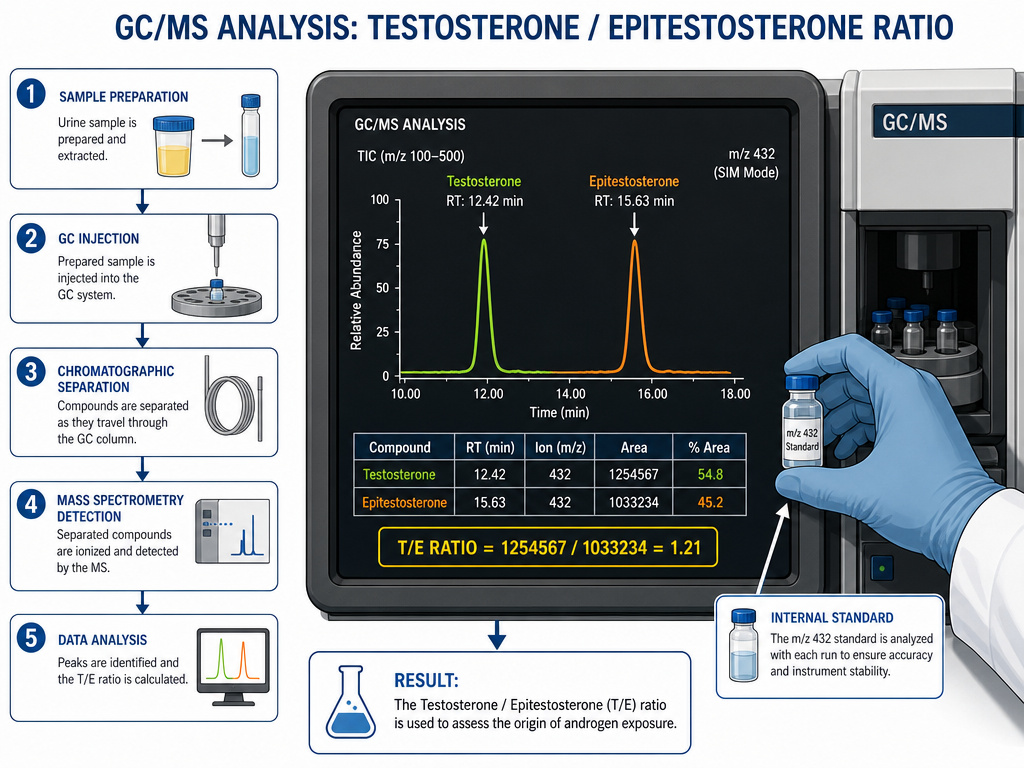
The process isn’t a simple dipstick test. It’s a precise forensic analysis defined down to the molecular fragment. Labs follow the WADA Technical Document TD2004EAAS, which spells out every step.
The primary method is gas chromatography coupled with mass spectrometry (GC/MS). The technician prepares the urine sample, often by breaking down the glucuronide conjugates of the hormones to measure the “free” forms. The sample is processed, and the T/E value is obtained by measuring the ion at m/z 432 by GC/MS analysis in Single Ion Monitoring mode (SIM) for testosterone and epitestosterone (equivalent to the glucuronide).
The T/E value is given by the peak area or peak height ratio of testosterone and epitestosterone (equivalent to the glucuronide) obtained by measuring the ion at m/z 432 by GC/MS analysis in a Single Ion Monitoring mode (SIM). The T/E value must be corrected using an appropriate standard.
That ion, m/z 432, is the fingerprint. The machine isn’t looking at the whole molecule; it’s counting fragments of a specific mass-to-charge ratio that both compounds produce. The ratio of the peak area for testosterone’s fragment to epitestosterone’s fragment gives the raw T/E number. That raw number is useless without calibration. Every batch of samples run must include a control sample where the T/E value, concentrations of testosterone and epitestosterone are known.
The accuracy of testosterone tests like this is paramount, which is why the method is so locked down. If the initial screen flags a high ratio, the confirmation test isn’t a repeat. It’s a triplicate analysis, the same test is run three times on three separate aliquots of the sample to rule out a lab error.
The 4:1 Threshold and Its Evolution
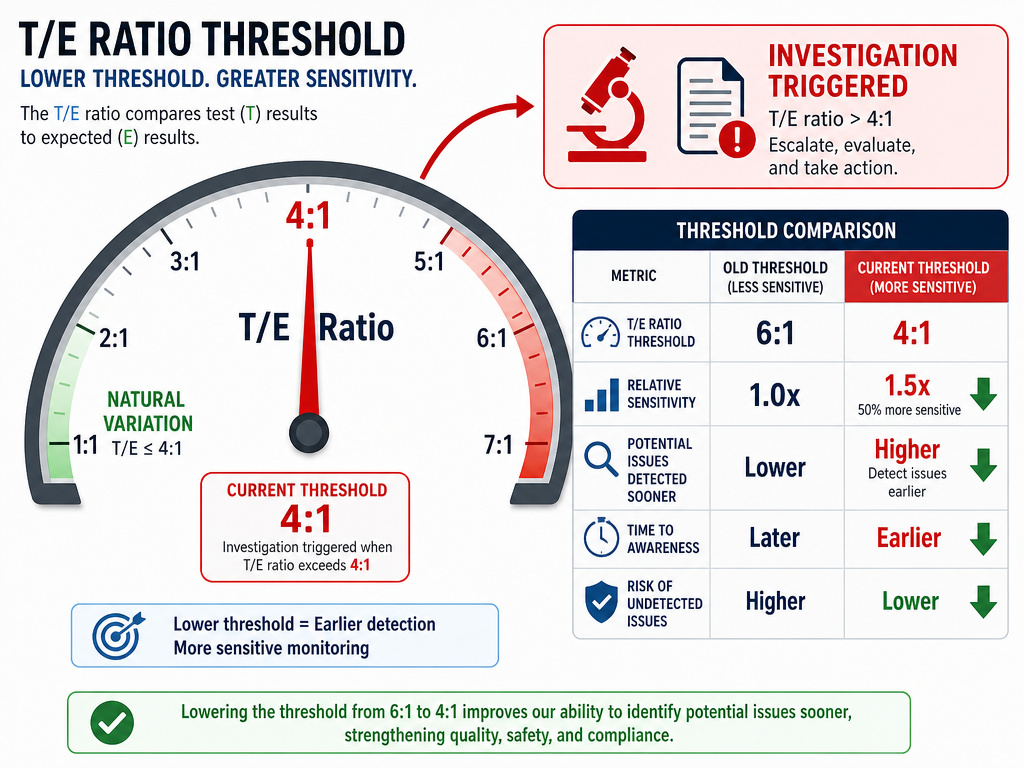
Where does the line get drawn? Since January 2005, the WADA Prohibited List has set the threshold at a T/E ratio of 4:1. A result at or above this level mandates further investigation. It’s not an automatic guilty verdict; it’s a trigger for the next phase of testing.
This threshold was lowered from 6:1. The change wasn’t arbitrary. Pushing the threshold down from 6:1 to 4:1 increased the sensitivity of the test, catching more potential dopers who might have been riding just under the old limit. It also made the technical demands on labs much stricter. Measuring a ratio of 4:1 with high precision is harder than measuring 6:1, especially when epitestosterone levels can be very low.
Where this goes sideways: Assuming any T/E ratio below 4 is “safe” for a dopers. The threshold is an administrative trigger, not a biological on/off switch. Investigators use a suite of markers, and consistently elevated ratios below 4 can still prompt scrutiny.
The 4:1 figure represents a statistical extreme. The 4:1 threshold is set outside the range of typical natural variation. The small fraction with ratios naturally above that, sometimes due to chronically low epitestosterone excretion, are why confirmation testing is so critical. Their samples get the full follow-up.
| T/E Ratio | Interpretation in Anti-Doping | Next Step |
|---|---|---|
| Below 4:1 | Within expected natural variation. | No further action. |
| At or Above 4:1 | Further investigation triggered. | Mandatory confirmation testing (in triplicate) and further investigation to determine if an Adverse Analytical Finding (AAF) should be reported. |
| Above 4:1 with Low Epitestosterone | Still an AAF. Epitestosterone concentration can be too low to measure precisely. | Confirm using testosterone concentration alone, corrected for specific gravity. |
What Triggers a High T/E Ratio?
Exogenous testosterone administration is the primary cause. This includes injections, gels, patches, and pellets. Exogenous testosterone administration, such as from topical applications, will increase the T/E ratio. The body doesn’t make more epitestosterone to match the incoming tidal wave of testosterone, so the ratio spikes.
But it’s not the only cause. The WADA document outlines specific scenarios labs must rule out before confirming a doping violation.
Microbial Degradation: Urine isn’t sterile. If a sample sits too long before analysis, bacteria can break down the glucuronide conjugates. The rule states that to report an adverse finding, the concentration of free (unconjugated) testosterone must not exceed 5% of the glucuronidated form. Elevated amounts of specific free steroids like 5α-androstanedione also signal microbial tampering.
Naturally Low Epitestosterone: A small percentage of people simply excrete very little epitestosterone. For them, even a normal testosterone output can produce a ratio above 4. This is where the isotope ratio mass spectrometry (IRMS) follow-up test comes in. IRMS measures the carbon isotope ratio (13C/12C) of the testosterone in the sample. Synthetic testosterone, derived from plant sterols like soy or yam, has a different isotopic “signature” than the testosterone your body naturally produces. A mismatch confirms an external source.
Other Endogenous Steroids: Taking precursors like DHEA, androstenedione, or even epitestosterone itself (as a masking agent) can alter the broader steroid profile and affect the T/E ratio. The full steroid profile, not just this one ratio, is always evaluated.
T/E Ratio vs. Other Doping and Health Markers
This ratio exists in a specific ecosystem of tests. It’s helpful to see what it does and doesn’t replace.
Compared to a Testosterone/Luteinizing Hormone (T/LH) Ratio: Other markers, such as the ratio of testosterone to luteinizing hormone, have been researched as potential alternatives, but WADA’s primary benchmark remains the T/E ratio. Despite this evidence, WADA’s primary benchmark remains the T/E ratio, likely due to the established, global infrastructure for urine steroid profiling.
Compared to Standard Health Panels: This is the critical distinction for readers of this site. Your annual physical or hormone clinic will not report your T/E ratio. They will measure your total testosterone, your free testosterone, and often your SHBG level. Those values define your optimal testosterone range for health and vitality. The T/E ratio is a forensic snapshot for a very specific question: “Was external testosterone introduced?” It doesn’t tell you if your levels are optimal, low, or high for your health.
For understanding your own hormonal health, learning about the difference between free and total testosterone is far more actionable. If you’re looking at lab results, knowing how to convert testosterone units from ng/dL to nmol/L is an essential skill. The T/E ratio answers a different, narrower question, specifically what is the testosterone to epitestosterone ratio.
The One Step Nobody Skips: Confirmation and Consequences
A single high reading is never enough. The WADA protocol is built to withstand legal challenge. The confirmation procedure is performed in triplicate. The instrumentation must be calibrated with an appropriate reference material. The identity of the steroid must be confirmed against a standard.
If the triplicate analysis confirms the initial finding, and IRMS testing confirms the testosterone is exogenous, the result is reported as an Adverse Analytical Finding (AAF). For the athlete, this means a potential sanction, a suspension from competition. The severity depends on the sport’s rules, the athlete’s history, and whether they can prove the substance entered their body without fault or negligence (a very high bar).
For the non-athlete, the consequences are different but worth understanding. If you are using testosterone under a doctor’s care for testosterone replacement therapy, your T/E ratio will be elevated. That’s expected. A legitimate TRT prescription is your defense in a doping context. This is one reason why the blurring of lines between supervised TRT and cosmetic steroid use is so problematic, both will spike your T/E ratio, but only one is typically done with medical oversight and documentation.
Anyone considering testosterone replacement therapy should weigh the pros and cons of TRT thoroughly, including the fact that it will alter your steroid profile in ways that could be flagged in a drug test.
Age and sex differences in epitestosterone levels
The concentration of urinary steroids such as epitestosterone varies greatly between individuals. This natural biological variation is a fundamental reason why the T/E ratio is used for anti-doping, as it compares these two hormones within the same person over time rather than against a single population-wide number. For a valid comparison, all measured values must be corrected for urine concentration to a specific gravity of 1.020. When an elevated T/E ratio triggers further investigation, the process includes measuring carbon isotope ratios to distinguish between natural endogenous production and external administration, as these isotopic signatures can differ based on an individual’s physiology and metabolism.
Frequently Asked Questions
What is a normal testosterone to epitestosterone ratio?
The natural T/E ratio in urine varies between individuals. The WADA threshold of 4:1 is intentionally set far outside this normal range to account for natural variation while catching doping.
Can a high T/E ratio occur naturally?
Yes, but it’s rare. A small segment of the population has a naturally low excretion of epitestosterone, which can result in a T/E ratio above 4 without any external testosterone use. In anti-doping, these cases are investigated with carbon isotope ratio (IRMS) testing to distinguish natural from synthetic testosterone.
Is the T/E ratio used in women’s sports testing?
Yes. The same WADA technical document and 4:1 threshold apply. However, the baseline concentrations of both hormones are much lower in women. The principle remains identical: exogenous testosterone administration will disproportionately increase testosterone relative to epitestosterone.
How long does testosterone affect the T/E ratio?
It depends on the dose and administration method. Studies show that even a single topical dose can elevate the ratio for over 24 hours. With sustained use, the ratio will remain elevated as long as exogenous testosterone is present in the system and for a period after cessation as the body clears it and restarts natural production.
Should I get my T/E ratio tested for health reasons?
No. The T/E ratio is not a diagnostic health marker. It does not indicate whether your testosterone levels are optimal, low, or high for your well-being. If you have health concerns, ask your doctor for a standard hormone panel that measures total testosterone, free testosterone, and SHBG. You can then see what percentage of free testosterone you have, which is a far more relevant health metric.
Before You Go
The T/E ratio is a precise, technical measurement built for one job. It’s the gold standard for catching testosterone doping because it exploits a fundamental biological truth: you can’t fake balance. If you’re looking at your own health, this number is a distraction. Focus on the basics first, sleep, nutrition, vitamin D, and zinc status, and use standard lab tests to track your progress.
If you are using testosterone, understand that this ratio is how a test will catch it. That’s true whether it’s a doctor-prescribed gel or a black-market vial. The test doesn’t measure intent, only chemistry. For any hormone-related decision, especially one involving testosterone therapy pros and cons, let clear diagnostics and professional guidance lead, not the desire to beat a test.
