
What Is Sperm Morphology? Explaining Shape and Fertility
This post contains affiliate links. As an Amazon Associate, we earn from qualifying purchases.
Sperm morphology is the assessment of the size and shape of sperm cells, measured as the percentage of sperm in a sample that appear “normal” under strict laboratory criteria. While historically seen as a key fertility marker, recent research finds its predictive value for natural conception or assisted reproduction like IVF is limited.
That definition from the WHO manual is precise for a reason, it aims to standardize a test notorious for variability between labs. The gap between the manual’s detailed specs and what the latest clinical reviews say about their usefulness is where most of the confusion lives for anyone reading a semen analysis report, which naturally leads to the question: what is sperm morphology?
What follows: a breakdown of what “normal” actually means by the numbers, why the 4% threshold exists, the ongoing debate about how much shape matters for getting pregnant, and a clear look at your options if your report shows a low result.
Key Takeaways
- The WHO 6th edition manual provides the global standard, defining a normal sperm head as 3–5 µm long and 2–3 µm wide with an acrosome covering 40–70% of its area.
- A result below the WHO 5th edition lower reference limit of 4% normal forms (using Kruger strict criteria) is often classified as teratozoospermia, but recent studies question its strong link to failed IVF or IUI cycles.
- For specific, uniform defects like globozoospermia (round-headed sperm), morphology assessment is critically diagnostic, as these are often tied to genetic conditions.
- The biggest practical limit is inter-laboratory variability; the same sample can get different scores at different labs, which complicates basing major treatment decisions solely on this number.
- If you have a low morphology result, the clinical consensus is to focus on the total motile sperm count and consider advanced treatments like ICSI, which bypasses many shape-related fertilization barriers.
What Does a “Normal” Sperm Look Like?
Forget the cartoon drawing. The World Health Organization’s 6th edition laboratory manual defines “normal” with micrometer-level specifications. It’s not a vague “oval shape”; it’s a checklist.
A morphologically normal sperm has three distinct regions, and each has its own set of rules.
The Technical Snippet: The WHO 6th edition defines a normal spermatozoon as having a smooth, oval head (length 3–5 µm, width 2–3 µm, length-to-width ratio 1.5–2) with an acrosomal region covering 40–70% of the head area and no vacuoles larger than one-fifth of the head. The midpiece is slender, approximately equal to the head length, and aligned axially. The tail is uniform in caliber, about ten times the head length, with no sharp angulations. Residual cytoplasm exceeding one-third of a normal head size is considered abnormal.
The head specifications are the most detailed because that’s where fertilization begins. The acrosome is a cap filled with enzymes that allow the sperm to penetrate the egg’s outer layer. If it’s too small, misshapen, or missing, a condition called globozoospermia, fertilization can’t happen naturally.
The midpiece is packed with mitochondria, the cell’s power plants. A bent, swollen, or irregular midpiece often means the sperm can’t generate the whip-like tail motion needed to swim the distance. And a tail that’s coiled, broken, or doubled simply can’t propel the cell forward.
When a lab tech scores your sample, they’re comparing hundreds of sperm against this exacting checklist under a high-powered microscope. Any single deviation from these criteria lands that sperm in the “abnormal” category.
The 4% Threshold: Where Did That Number Come From?
If you’ve read anything about sperm morphology, you’ve seen the 4% figure. It’s the lower reference limit from the WHO 5th edition (2010), based on the Kruger “strict” criteria. But that number has a history, and it’s been a moving target.
The WHO manual’s definition of a “normal” lower limit has dropped dramatically with each edition, reflecting a shift towards stricter and stricter scoring.
| WHO Edition (Year) | Lower Reference Limit for Normal Forms |
|---|---|
| 1st (1980) | 80.5% |
| 2nd (1987) | 50% |
| 3rd (1992) | 30% |
| 4th (1999) – Kruger Strict | 14% |
| 5th (2010) – Kruger Strict | 4% |
This evolution wasn’t because sperm worldwide were suddenly becoming more misshapen. It was because the criteria for calling a sperm “normal” became more restrictive, which is a core part of the what is sperm morphology discussion. The 1st edition used a “liberal” approach, while the 4th and 5th editions adopted the Kruger strict criteria, where even borderline-normal sperm are classified as abnormal.
The 4% figure is the lower reference limit for normal forms from the WHO 5th edition, based on the Kruger strict criteria. So, a result below 4% puts you in the bottom 5th percentile of that reference group. This is what gets labeled as teratozoospermia.
This statistical cutoff has a limitation. This statistical cutoff doesn’t automatically translate to a clinical fertility barrier for every individual. It’s a population-based reference point, not a definitive fertility switch that flips off at 3%.
Does Sperm Morphology Actually Affect Fertility?
This is where the conversation gets nuanced, and where simply reading a percentage off a report can lead you astray. The clinical relevance of sperm morphology, which gets to the heart of what is sperm morphology, is the most debated aspect of the standard semen analysis.
On one side, the WHO semen analysis laboratory manual exists to standardize testing to “contribute to global improvement in assessment of male reproductive function and treatment.” The implication is that measuring it matters for diagnosis.
On the other side, a 2024 review of contemporary research in PubMed Central concluded that most recent studies “fail to show an association between sperm morphology and natural or assisted fertility outcomes.” The authors of that clinical relevance of sperm morphology review note that using morphologically abnormal sperm often leads to similar IVF pregnancy rates.
We can examine what the research says for different conception paths.
Natural Conception
The data here is sparse but suggestive. The LIFE study, which followed couples trying to conceive naturally, found that a higher percentage of abnormal morphology was linked to a small but statistically significant increase in the time it took to get pregnant. It’s an association, not a guarantee of failure. Many men with very low morphology scores still father children naturally.
Intrauterine Insemination (IUI)
IUI places washed sperm directly into the uterus, bypassing the cervix but still requiring sperm to swim to and fertilize the egg. Earlier studies suggested morphology mattered for IUI success. However, the 2024 review points out that the most recent data, including a large meta-analysis, shows no correlation between teratozoospermia and pregnancy rates after IUI. Improvements in sperm preparation techniques and patient selection may have diminished the role of shape in this context.
In Vitro Fertilization (IVF) with or without ICSI
This is the clearest area of shifting consensus.
- Standard IVF: Here, sperm and egg are placed together in a dish. Historically, poor morphology was thought to hinder fertilization. The most recent studies, however, robustly show that using morphologically abnormal sperm leads to similar pregnancy outcomes.
- ICSI (Intracytoplasmic Sperm Injection): This changes everything. With ICSI, an embryologist selects a single sperm and injects it directly into the egg. This bypasses the need for the sperm to swim, penetrate the egg’s outer layers, or have a perfectly shaped head. ICSI effectively neutralizes the impact of poor sperm morphology on fertilization, making it the recommended treatment for severe teratozoospermia.
Where this goes sideways: Focusing solely on a low morphology percentage while ignoring total motile count. A man with 2% morphology but 50 million total motile sperm is in a very different situation than a man with 2% morphology and 2 million total motile sperm. The overall sperm health picture matters more than any single parameter.
The takeaway? Morphology alone is a weak predictor. As the review authors state, it “should not be used to predict fertilization, pregnancy, or live birth potential.” It’s one data point among several in a full semen analysis report.
What Causes Abnormal Sperm Morphology?
The causes are often split into two categories: lifestyle/environmental factors and genetic/medical conditions. For most men with mild to moderate teratozoospermia, a specific cause is never identified, it’s termed “idiopathic.”
Common Potential Contributors:
- Heat exposure: Frequent use of hot tubs, saunas, or tight underwear can increase scrotal temperature.
- Chemical exposures: Pesticides, heavy metals, industrial solvents, and certain painting materials.
- Smoking and recreational drugs: Tobacco smoke and anabolic steroids are particularly harmful.
- Varicocele: A swelling of the veins in the scrotum, which is a common reversible cause of poor semen parameters.
- Fever or acute illness: A high fever can disrupt sperm production, with effects seen in morphology about 2-3 months later.
- Genetic conditions: These are rarer but cause specific, uniform defects (e.g., globozoospermia).
Research on some factors is conflicting. For example, two small meta-analyses found a minimal, if any, impact of COVID-19 infection on sperm morphology. The evidence is often messy, which is why addressing general health is the first step.
How to Improve Your Sperm Morphology
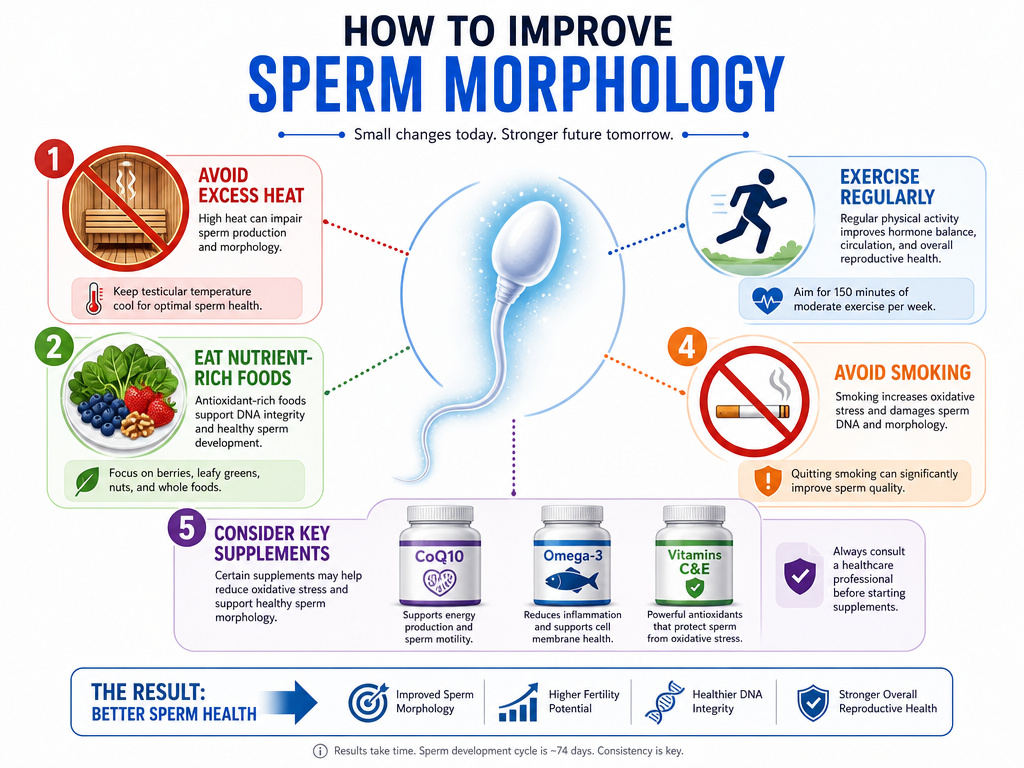
Improvement is possible, but it takes time, as a full spermatogenesis cycle is several months long. Any changes you make today will be reflected in a semen analysis roughly three months later.
Common mistake: Jumping straight to expensive “sperm-booster” supplements before addressing foundational lifestyle factors. The basics often yield the biggest return.
Start with these evidence-backed steps:
- Reduce Heat Exposure. Stop using hot tubs and saunas. Switch to loose-fitting boxers. Avoid prolonged laptop use on your lap.
- Clean Up Your Diet. Focus on a diet rich in antioxidants (berries, nuts, dark leafy greens) and healthy fats (olive oil, avocados). Oxidative stress is a key player in damaging sperm cells.
- Manage Weight and Exercise. Obesity is linked to poorer sperm quality. Aim for regular, moderate exercise, not excessive endurance training, which can have the opposite effect.
- Eliminate Toxins. Quit smoking. Limit alcohol. Review your workplace or hobby-related chemical exposures.
- Consider Targeted Supplements. After addressing lifestyle, some supplements have decent evidence. Think of them as support, not magic bullets.
- Coenzyme Q10: An antioxidant shown in some studies to improve morphology.
- Omega-3 Fatty Acids: Found in fish oil, crucial for sperm cell membrane fluidity.
- Vitamin C & E: Classic antioxidants that may protect sperm from oxidative damage.
You can explore a deeper list of sperm health supplements, but remember, they are adjuncts to a healthy lifestyle, not replacements for it. For concerns specifically about movement, our guide on improving sperm motility covers that related parameter.
Treatment Options for Low Morphology
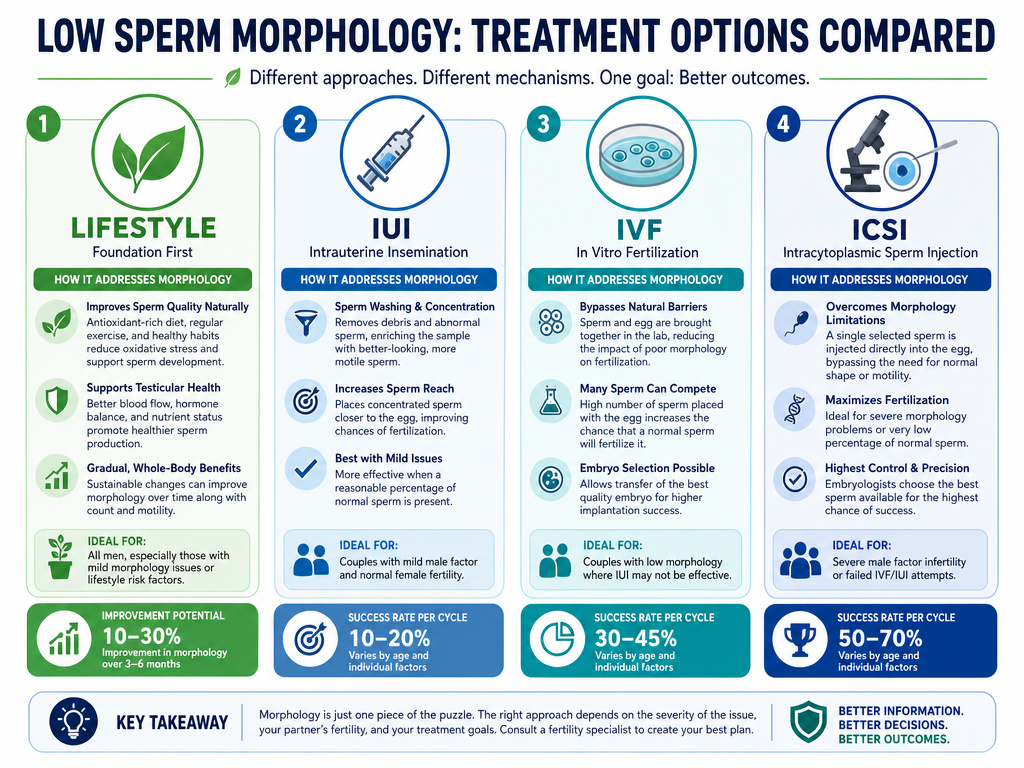
Your treatment path depends heavily on the severity, the presence of other sperm issues, and your partner’s fertility status. Here’s a comparative look at the main options.
| Treatment | How It Addresses Morphology | Best For | Limitations |
|---|---|---|---|
| Lifestyle Modifications | May improve overall sperm health and reduce oxidative damage. | Mild teratozoospermia with no other major factors; first step for everyone. | Takes 3+ months; improvement is not guaranteed. |
| Intrauterine Insemination (IUI) | Uses washed, concentrated sperm, bypassing some barriers but still requiring natural fertilization. | Mild morphology issues with good total motile count and no female factor infertility. | Success rates per cycle are modest; it is not effective for severe cases. |
| In Vitro Fertilization (IVF) | Eggs and sperm are combined in a dish, reducing the distance sperm must swim. | Moderate teratozoospermia, especially combined with other male or female factors. | Expensive and invasive; fertilization failure risk remains if sperm cannot penetrate egg. |
| ICSI (with IVF) | An embryologist selects and injects a single sperm directly into the egg, bypassing shape and motility issues. | Severe teratozoospermia, previous IVF fertilization failure, or very low sperm count. | The most expensive and invasive option; carries a small risk of passing on genetic abnormalities. |
For many couples, the conversation starts with a semen analysis to get the full picture, which includes count and motility alongside morphology. If male infertility is confirmed, a reproductive urologist can help identify any reversible causes like a varicocele.
Does abnormal sperm morphology pose a genetic risk to offspring?
For most men with a low morphology score, there is no specific evidence linking common sperm shape abnormalities to an increased genetic risk for children. The assessment is primarily a measure of physical structure and potential for fertilization. However, in specific and rare cases where a genetic defect causes 99-100% of sperm to have the same severe abnormality, morphology assessment can be diagnostically useful. In these instances, the abnormal shape is a visible sign of an underlying genetic condition that could be passed on. If you have a very high percentage of a specific, severe defect, a fertility specialist may recommend genetic counseling to discuss potential risks and testing options before proceeding with treatment.
Frequently Asked Questions
Is 4% sperm morphology bad?
It’s classified as abnormal (teratozoospermia) according to the WHO 5th edition reference limit. However, “bad” is a clinical overstatement. It places you in the lower 5th percentile of a fertile reference group, but many men with 4% or lower morphology conceive naturally or with assisted reproduction. The overall context of count, motility, and your partner’s fertility matters more than this single number.
Can you get pregnant with 1% or 2% morphology?
Yes, pregnancy is possible, but the likelihood of natural conception is lower. The most efficient path is often through Assisted Reproductive Technology (ART). In vitro fertilization with ICSI is specifically designed for such cases, as it manually overcomes the fertilization barriers posed by abnormal sperm shape. Many couples with severe teratozoospermia achieve pregnancy with ICSI.
Will sperm morphology improve?
It can, but not always. Improvement depends on the cause. If it’s due to a reversible lifestyle factor (like heat exposure, smoking, or a nutrient deficiency), you may see improvement in 3-6 months after making changes. If it’s due to a genetic condition (like globozoospermia), the defect is inherent and won’t improve, though healthy sperm may still be found for use with ICSI.
What’s the difference between morphology and motility?
Morphology is about shape (structure), and motility is about movement (function). They are related but independent parameters measured in a semen analysis. A sperm can be perfectly shaped but immotile (can’t swim), or it can be a poor swimmer with a normal shape. Both are important for natural conception, but ICSI can overcome issues with both.
Before You Go
The most important thing to understand about a sperm morphology result is that it’s not a standalone verdict on your fertility. It’s a single, somewhat fuzzy snapshot of one aspect of a complex process.
The measurement of sperm morphology has value in creating a standardized lab procedure, but its jump from lab value to clinical prophecy is where the evidence gets thin. If your report shows a low percentage, don’t let it become a source of undue stress. Instead, let it guide a conversation with a specialist about your complete fertility picture, sperm count, motility, your partner’s health, and your timeline.
Focus on what you can control: the lifestyle foundations that support overall sperm health. Then, work with a doctor to match the treatment, whether that’s timed intercourse, IUI, or IVF/ICSI, to the actual barriers you face. The technology available today, especially ICSI, means that sperm shape is far from the final word on building a family.
