
Does Low Testosterone Raise Cholesterol?
This post contains affiliate links. As an Amazon Associate, we earn from qualifying purchases.
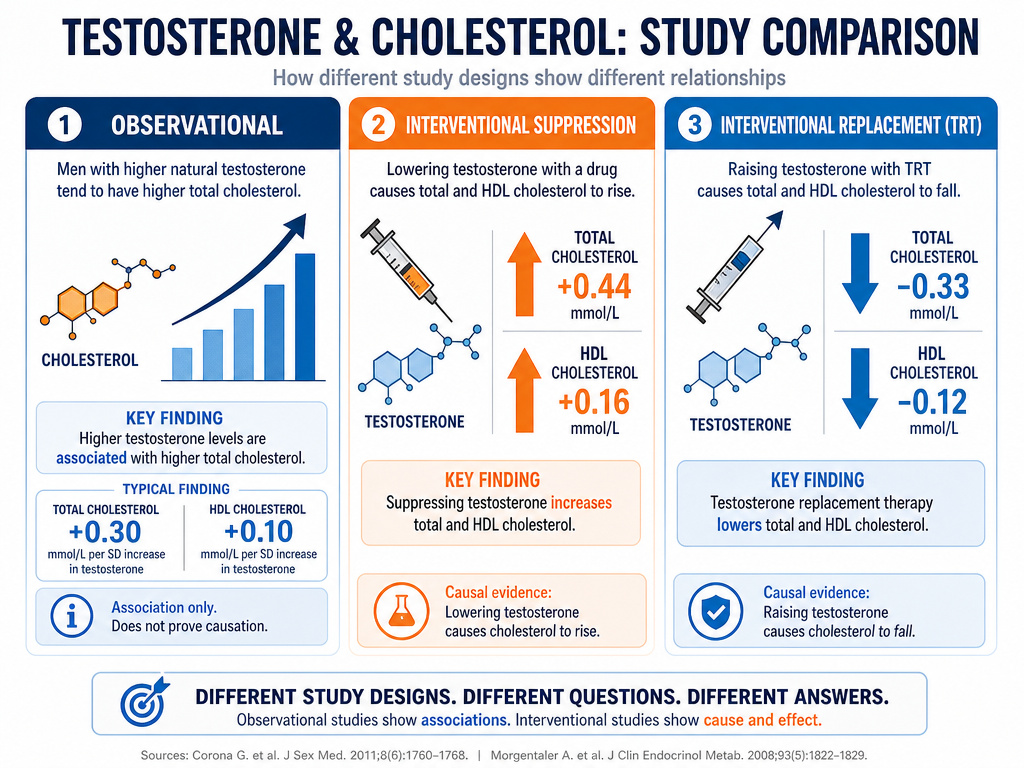
Low testosterone can raise total cholesterol and triglycerides, but its effect on “good” HDL cholesterol is complex and contradictory across studies. Observational data links low T to worse lipid profiles, while interventional studies show suppressing testosterone increases HDL, and replacing it in deficient men decreases HDL. The relationship isn’t a simple one-way street, it depends on whether you’re looking at natural hormone levels, artificial suppression, or therapeutic replacement.
That HDL puzzle is the part that most summaries gloss over. They’ll tell you low T is bad for lipids, or that TRT hurts your cholesterol, but the data from actual hormone manipulation trials paints a more nuanced picture. A key question is: does low testosterone raise cholesterol? The difference between observing a correlation in a population and actively changing a hormone in a controlled setting explains a lot of the confusion you see online.
What follows is a breakdown of the key studies, the numbers they actually found, and where they flat-out disagree. We’ll also cover what this means if you’re getting your levels checked or considering therapy, because the lab slip doesn’t interpret itself.
Key Takeaways
- Low testosterone is linked to higher total cholesterol and triglycerides in large observational studies, with the strongest link seen in younger men (aged 20-39).
- The effect on “good” HDL cholesterol is the biggest contradiction: suppressing testosterone in healthy men raises HDL, while giving testosterone to deficient men lowers it.
- Testosterone replacement therapy (TRT) in hypogonadal men typically lowers total cholesterol and LDL (“bad” cholesterol) by a small, consistent amount.
- The increase in a risky particle called Lipoprotein(a) after testosterone suppression can be dramatic, 40-60%, but only in people who already have elevated baseline levels.
- Managing cholesterol while on TRT isn’t just about the therapy; it hinges on baseline diet, body composition, and consistent monitoring.
The Observational Link: Low T, Higher Lipids
Start with the big picture. The Study of Health in Pomerania (SHIP) included 1,468 men aged 20-79. It found that those in the lowest quarter of testosterone had, on average, 0.23 mmol/L (about 8.9 mg/dL) higher total cholesterol and 0.73 mmol/L (about 64.6 mg/dL) higher triglycerides than men with higher levels. This is a cross-sectional snapshot, it shows an association, not proof that low T caused the change.
The more telling finding was prospective. When they looked at who developed dyslipidemia over time, the risk was strongest in younger men. For guys aged 20-39, low testosterone carried a relative risk of 1.51 for developing an adverse lipid profile. That means the connection between hormones and heart disease risk may be set early.
Common mistake: Treating a single cholesterol number in isolation. The SHIP data suggests the problem is the pattern over time, especially if low T symptoms are present, not a one-off high reading.
This association is a clue, not a verdict. It could be that low testosterone directly tweaks liver enzymes that manage cholesterol, which is central to the does low testosterone raise cholesterol question. It could also be that whatever is causing low T, like obesity or poor metabolic health, is also driving the cholesterol change. Teasing that apart requires intervention studies.
The HDL Cholesterol Puzzle: Why Studies Disagree
This is where the clean story falls apart. The core does low testosterone raise cholesterol question is especially tricky for HDL (“good”) cholesterol, and the best answer is: the studies don’t agree. You have to look at how the testosterone level was changed.
In one camp, you have studies that suppressed testosterone in healthy men. A 1992 study using a GnRH analog drove testosterone to very low levels. Result? HDL cholesterol increased by 10 mg/dL. A 1993 study using Cetrorelix found a 20% increase in HDL. When you remove testosterone, HDL goes up.
In the other camp, you look at giving testosterone to men who are deficient. A 2001 meta-analysis of TRT in hypogonadal men found it decreased HDL by 4 mg/dL. A 2002 study (Zgliczyński et al.) found that testosterone replacement specifically decreased the HDL2 cholesterol subclass and apolipoprotein A1.
So which is true? Both. The effect depends entirely on context. In a healthy system, testosterone exerts a mild suppressive effect on HDL production. Remove it, and HDL rises. In a system that’s already deficient, adding testosterone back doesn’t “raise” HDL to a normal level, it restores that mild suppression, resulting in a net decrease from the artificially high baseline the deficiency created.
This is critical for understanding how TRT affects cholesterol. In studies where testosterone was replaced in deficient men, HDL cholesterol decreased. That’s not necessarily a bad thing; it’s a normalization. The goal isn’t to maximize HDL at all costs, but to achieve a healthy overall lipid balance.
What Happens to LDL and Triglycerides?
The data for LDL (“bad”) cholesterol and triglycerides is more consistent, but still has wrinkles.
For LDL, some intervention studies point in one direction: the GnRH suppression study saw a rise in Apolipoprotein B by 28 mg/dL, while the TRT meta-analysis found LDL decreased by 5 mg/dL. However, observational studies like the SHIP cohort found no significant association between low testosterone and LDL cholesterol. The observational SHIP study found no significant association between low testosterone and LDL cholesterol in its models. This suggests that while active hormone manipulation affects LDL, the natural variation in testosterone might not be a primary driver for most men.
Triglycerides show a clearer signal. The SHIP cohort found a strong association between low T and high triglycerides (+0.73 mmol/L).
A fasting triglyceride level over 150 mg/dL is a louder signal for metabolic health than a borderline LDL number, and it’s one that responds directly to diet and exercise changes long before you consider medication.
The takeaway here is that LDL is worth watching, but triglycerides and the overall pattern often tell you more about the hormonal-metabolic link.
The Special Case of Lipoprotein(a)
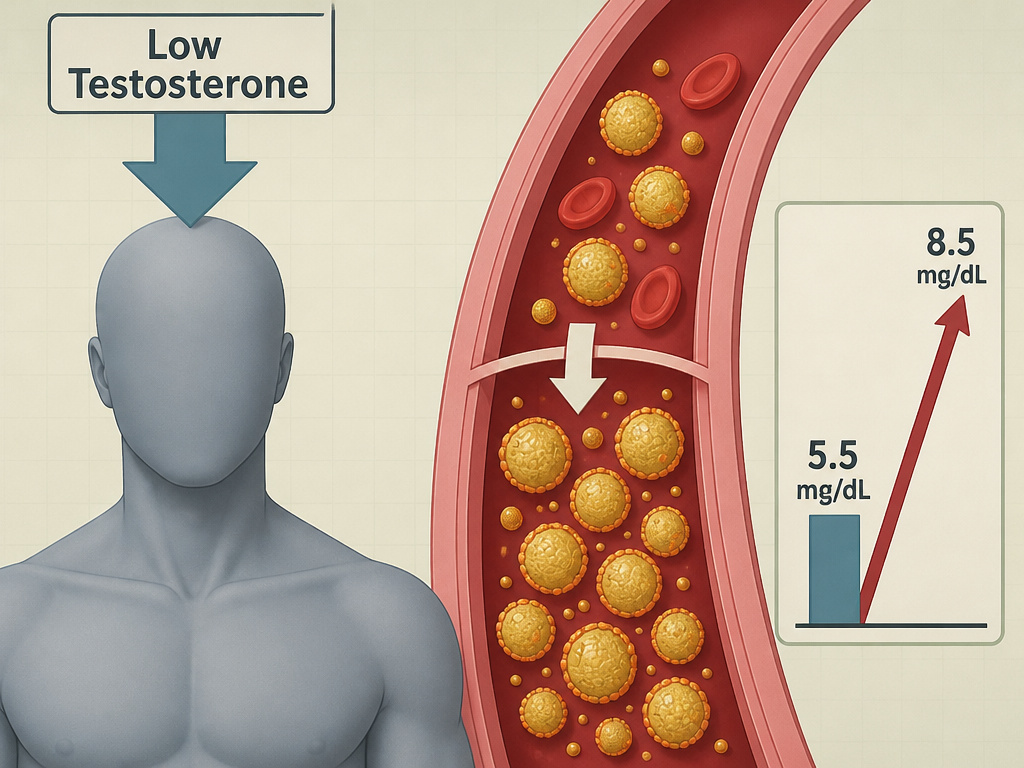
Lipoprotein(a), or Lp(a), is a genetically influenced, highly atherogenic particle. It’s not part of a standard lipid panel, but it might be the most sensitive to testosterone levels.
The Cetrorelix suppression study made a striking discovery. After three weeks of suppressed testosterone, the median Lp(a) level jumped from 5.5 to 8.5 mg/dL. The kicker? The increase was wildly dependent on baseline. Individuals who started with Lp(a) over 3 mg/dL saw their levels soar by 40-60%.
Where this goes sideways: Ignoring Lp(a) if you have a family history of early heart disease. If your dad had a heart attack at 50, this is one test to ask for, especially if you’re investigating hormonal issues.
The Cetrorelix suppression study found that testosterone suppression increased Lp(a) levels. For men with naturally high Lp(a), a significant cardiovascular health risk factor, low testosterone could unmask or exacerbate that genetic risk. This is a prime example of why the hormone-lipid relationship isn’t just about LDL and HDL.
Testosterone Replacement Therapy (TRT): Net Effect on Lipids
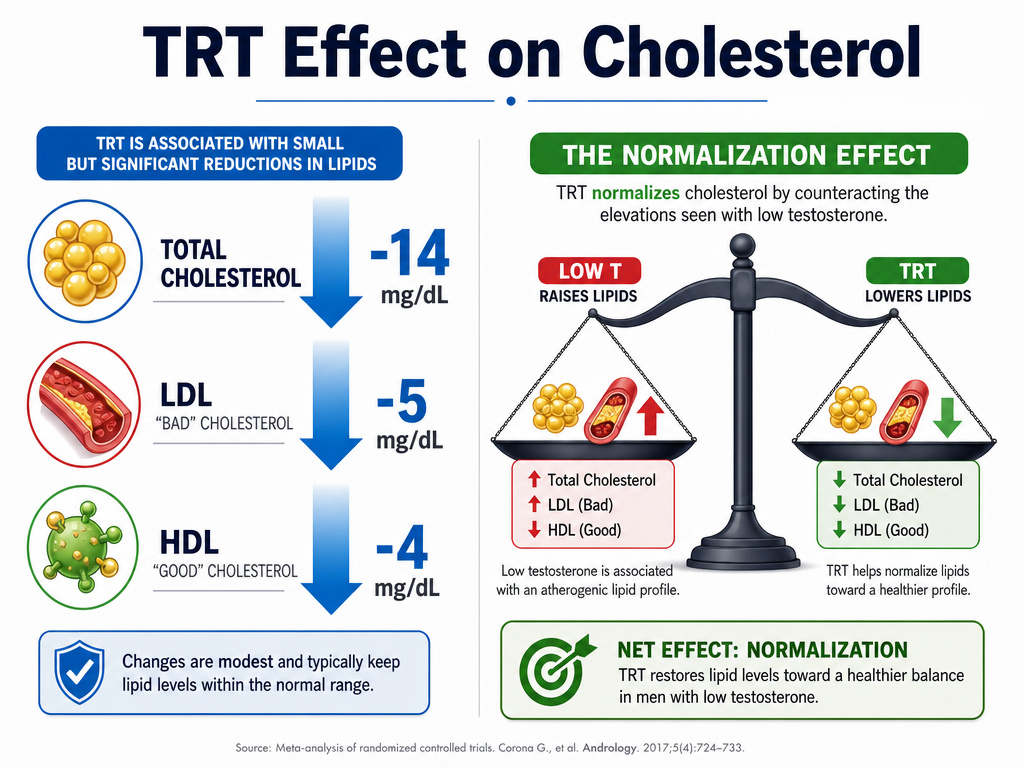
So, what does starting TRT do to your cholesterol panel? The Testosterone Ester Meta-Analysis (Whitsel, 2001) gives us a composite picture for hypogonadal men with mean baseline testosterone of 0.5 ng/mL. After about six months of treatment:
- Total Cholesterol: Decreased by 14 mg/dL
- LDL Cholesterol: Decreased by 5 mg/dL
- HDL Cholesterol: Decreased by 4 mg/dL
The net effect is a slight improvement in the total-to-HDL ratio, but a drop in the absolute HDL number. This is the normalization effect in action.
That’s why asking “does testosterone lower cholesterol?” is too vague. You must specify: does replacing testosterone in a deficient man lower cholesterol? The answer is yes, for total and LDL. Does removing testosterone from a healthy man lower cholesterol? No, it raises HDL and Lp(a).
This distinction is everything. It explains why forum anecdotes clash. One guy on TRT sees his HDL drop and panics. Another reads a study where low T raised HDL and gets confused. They’re describing two different sides of the same coin.
Why the Disagreement? Mechanisms and Modifiers
The conflicting data isn’t just noise. It points to underlying biological mechanisms.
It’s a system, not a single lever.
Second, age and baseline health are massive modifiers. The SHIP study found the low T-dyslipidemia link was strongest in young men. The SHIP study found the association between low testosterone and incident dyslipidemia was strongest in younger men (aged 20-39).
Finally, the method of testosterone change matters. Are we studying a natural, chronic state of deficiency often paired with weight gain and inflammation? Or a sharp, artificial suppression as in the interventional studies?
| Study Type | Testosterone Change | Effect on Total Cholesterol | Effect on HDL Cholesterol |
|---|---|---|---|
| Observational (SHIP) | Naturally Low | Increased (+8.9 mg/dL) | No significant association |
| Interventional Suppression | Artificially Lowered | Increased (+31 mg/dL) | Increased (+10 to +20%) |
| Interventional Replacement (TRT) | Artificially Raised in Deficiency | Decreased (-14 mg/dL) | Decreased (-4 mg/dL) |
Practical Takeaways: Testing and Management
We’ll keep this practical. If you’re concerned about testosterone and cholesterol, what should you actually do?
Get a full lipid panel and a hormonal panel, twice. A single snapshot is misleading. Hormones and lipids fluctuate. Baseline testing should include a full lipid panel (Total, LDL, HDL, Triglycerides) and a hormonal panel (Total T, Free T, SHBG, Estradiol) drawn in the morning. Do it twice, a few weeks apart, under consistent conditions (fasted, rested).
Interpret HDL in Context. If you start TRT and your HDL drops from 65 to 58 mg/dL, don’t panic. Look at the full picture: did your triglycerides plummet? Did your LDL drop?
Manage the System, Not the Number. It’s managing body composition, sleep, and dietary quality. This is foundational work that supports any subsequent therapy.
Monitor and Re-evaluate. If you begin TRT, expect a new lipid panel after 3-6 months. The goal is to see stability or improvement in the overall pattern, not to fixate on one moving part. If triglycerides rise or the ratio worsens, it’s a signal to scrutinize diet and cardio metabolic health, not necessarily to abandon therapy. Some men may need to discuss adding a dietary supplement like high-dose EPA fish oil or, in some cases, a medication like a statin, though that brings its own conversation about hormonal side effects.
Remember the Chicken and the Egg. Is low testosterone raising your cholesterol, or is the poor metabolic health that’s raising your cholesterol also lowering your testosterone? For many men, it’s the latter. Focusing on improving metabolic health through lifestyle often yields positive changes in both areas, making the direct hormone-cholesterol question less urgent.
How cholesterol is used to produce testosterone
Cholesterol is the direct building block for testosterone. Your body needs cholesterol to start the production process, as the hormone is synthesized from it through a series of chemical steps. This means having adequate cholesterol is a basic requirement for your body to make its own testosterone. However, this doesn’t mean higher cholesterol leads to higher testosterone; the relationship is about availability, not quantity. The process is tightly regulated by your endocrine system, and dysfunction in that system can disrupt the balance between cholesterol levels and hormone production.
Frequently Asked Questions
What is the biggest enemy of testosterone?
The biggest enemies are chronic lifestyle factors: sustained obesity (especially visceral fat), consistently poor sleep, chronic excessive alcohol intake, and prolonged, unmanaged stress. These disrupt the hypothalamic-pituitary-testicular axis and increase estrogen conversion and inflammation, all of which suppress production. A single bad night or week isn’t the enemy; the unbroken pattern is.
What are the symptoms of extremely low testosterone?
Extreme deficiency often shows up as a cluster: severe, persistent fatigue not relieved by sleep, complete loss of libido, inability to build or maintain muscle mass despite training, noticeable increase in body fat (particularly around the chest and abdomen), and mood changes like depression or irritability. It’s the combination and persistence that’s telling, not one off day.
What flushes cholesterol out of your body?
Your body doesn’t “flush” cholesterol. It processes and excretes it. The primary route is via the liver into bile, which is then eliminated through the intestines. Soluble fiber (from oats, beans, psyllium) binds to bile acids, forcing the liver to pull more cholesterol from the bloodstream to make new bile. This is the mechanism behind foods like oatmeal lowering LDL. Think of fiber as a shuttle, not a drain cleaner.
Can low testosterone cause bad cholesterol?
It can contribute to a worse overall lipid profile, which includes higher levels of atherogenic particles. Observational data links it to higher total cholesterol and triglycerides. The direct effect on LDL (“bad” cholesterol) is less clear from population studies, but interventional studies suggest low testosterone can create an environment that allows LDL to be more harmful, especially when paired with low HDL and high triglycerides.
Before You Go
The research shows a link, but it’s a conditional one. Low testosterone is more likely a partner in crime with poor cholesterol, not a sole perpetrator. The most actionable step isn’t obsessing over whether one causes the other; it’s breaking the cycle they both feed.
Get the two baseline tests, lipid panel and hormone panel, done properly. If both are off, address the foundational metabolic health first: clean up the diet, prioritize sleep, and start resistance training. For many, this improves both numbers enough to avoid more complex interventions.
If you move to TRT, understand that a drop in HDL is a probable, documented outcome of normalizing your hormones, not a automatic red flag. Watch the ratios, track your triglycerides, and keep the lifestyle pieces in place. The therapy manages the deficiency; you still have to manage the system it operates in.
The goal isn’t to have perfect individual numbers, but a resilient, healthy system where hormones and lipids are in balance. That takes more than a prescription; it takes consistent, boring, daily habits. The data just tells you where to point them.
