
Is Low Testosterone Linked to Aggressive Prostate Cancer?
This post contains affiliate links. As an Amazon Associate, we earn from qualifying purchases.
Yes, low testosterone is linked to a higher risk of aggressive prostate cancer, but the relationship is specific. It’s not total testosterone that matters most; it’s free or bioavailable testosterone. Men with low levels of these active hormones are more likely to have high-grade tumors (Gleason score ≥7) at surgery and see their cancer upgraded during active surveillance. The clinical cutoff for low total testosterone is consistently under 300 ng/dL.
The catch is age. This link appears strongest in younger men. For men over 60 or 65, the association is complex: Watts et al.’s blood-based analysis found an inverse association for older ages, while the Baltimore Longitudinal Study of Aging found higher free testosterone linked to increased risk in men over 65. That flip is why a single lab number without context is nearly useless. A key question is low testosterone linked to aggressive prostate cancer. You need the right test, taken at the right time, and interpreted alongside your age and symptoms.
What follows is a walk through the numbers from the largest studies, a breakdown of why free testosterone is the metric that counts, and a look at what this means for treatment decisions, including the evolving safety data on testosterone therapy after a cancer diagnosis.
Key Takeaways
- The link is strongest for free or bioavailable testosterone, not the standard total testosterone test many doctors order first.
- A total testosterone level below 300 ng/dL is the clinical threshold linked to a higher risk of tumor upgrading and aggressive disease.
- In a 2022 meta-analysis by Park et al., low serum total testosterone (<300 ng/dL) was associated with Gleason score upgrading after radical prostatectomy with an odds ratio of 2.3.
- Age reverses the risk: low free T is a concern for younger men, while higher levels may pose more risk for men over 65.
- While modern studies like the Veterans study by Wallis et al. Find testosterone replacement therapy (TRT) was not associated with an increased risk of aggressive prostate cancer, traditional prescribing guidelines and product labels still caution against testosterone therapy in men with prostate cancer.
The Core Evidence: Low Testosterone and High-Grade Disease
For years, the fear was that high testosterone fueled prostate cancer. The newer, more consistent finding points the other way.
A 2022 systematic review and meta-analysis by Park et al. Pooled data from multiple studies and patients. It found that a serum total testosterone level below 300 ng/dL was associated with Gleason score upgrading after radical prostatectomy. The odds ratio was 2.3. In plain terms, men with low T were more than twice as likely to have a more aggressive cancer discovered at surgery than their initial biopsy suggested.
This 2022 meta-analysis of over 1,300 patients established the <300 ng/dL threshold as a significant predictor of finding a more aggressive cancer at surgery than the initial biopsy showed.
This isn’t about causing cancer. It’s about predicting a worse version of it, which is why the is low testosterone linked to aggressive prostate cancer question is so important. The theory is that a low-androgen environment may select for cancer cells that are more aggressive and independent of hormonal signals, which is exactly what you see in high-grade disease.
Another pivotal study by Khera et al. In 2015 looked at a cohort of patients undergoing radical prostatectomy. It found that low bioavailable testosterone and low free testosterone were independent predictors of a pathological Gleason score of 7 or higher. Total testosterone didn’t show the same link. The study found low bioavailable testosterone and free testosterone were independent predictors of high-grade disease, with odds ratios of 1.76 and 1.39, respectively. This distinction is critical when you compare a is low testosterone linked to aggressive prostate cancer study, it’s the hormone available to your tissues that matters, not the total amount floating in your bloodstream bound up by SHBG (sex hormone-binding globulin).
Free Testosterone vs. Total Testosterone: Why the Type Matters
Multiple sources suggest free testosterone is the more relevant metric for prostate cancer risk compared to total testosterone, though clinical practice may vary. Here’s why.
Your body produces total testosterone. A large portion of it immediately binds to SHBG, creating a reservoir that isn’t biologically active. What’s left is free testosterone (a small percentage) and albumin-bound testosterone (termed bioavailable testosterone). These are the forms that can enter prostate cells and influence growth.
| Testosterone Type | What It Measures | Relevance to Prostate Cancer Risk |
|---|---|---|
| Total Testosterone | All testosterone in blood, bound and free. | Often shows weak or inverse association. Less useful for risk prediction. |
| Free Testosterone | Unbound, immediately active hormone. | Stronger, more consistent link to high-grade disease. The metric to track. |
| Bioavailable Testosterone | Free + albumin-bound hormone. | Also a strong independent predictor of aggressive cancer. |
| SHBG | Protein that binds testosterone. | High levels can cause low free T even with normal total T. A key confounder. |
The data from Khera et al. And others shows that total testosterone is a noisy signal. Two men can have an identical total T of 350 ng/dL. If one has high SHBG, his free T is low and his risk profile looks worse. If the other has low SHBG, his free T is normal and his risk is different. This is why I spent a year treating the lab’s printed range as a pass/fail line before it clicked. The number at the bottom of the range with crushing fatigue was a free T problem masked by a barely-okay total T.
The practical step is to ask for a free testosterone calculation or a direct measurement when you get your levels checked. A standard total testosterone test with normal results can be misleading if SHBG is high.
Does Age Change the Risk? The Data Says Yes.
Here is where the story gets complex. The relationship between testosterone and aggressive prostate cancer isn’t linear across a lifetime. It appears to bend with age.
A major 2022 Mendelian randomization study by Watts et al. Analyzed genetic data from nearly 200,000 men. It found that a 1 standard deviation (SD) increase in free testosterone corresponds to a 23% increased odds of aggressive prostate cancer (OR 1.23). But when the researchers looked at blood-based analyses from up to 25 studies, they found significant heterogeneity by age. Free testosterone had a positive association with aggressive cancer in men under 60 at the time of blood draw. For older men, the association was inverse.
Where this goes sideways: Assuming the risk is the same at 45 and 75. The Baltimore Longitudinal Study of Aging found higher free testosterone linked to increased risk in men over 65, while for younger men, lower levels often signal greater danger.
This flip makes biological sense. In younger men, a robust hormonal environment might help initiate or drive early aggressive disease. In older men, a lifetime of exposure coupled with age-related cellular changes might mean that maintaining higher androgen levels continues to stimulate existing, potentially indolent, cancer cells. The takeaway is that your age must be part of the conversation when interpreting your testosterone levels in the context of prostate health.
Testosterone Therapy (TRT) and Prostate Cancer: Outdated Fear?
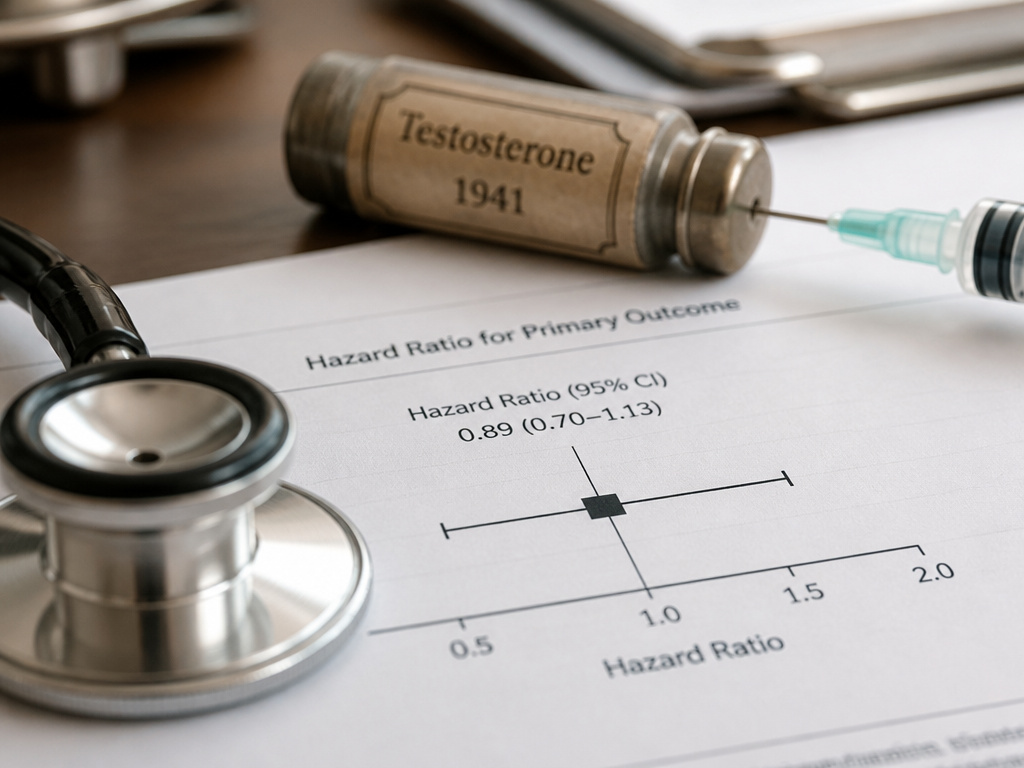
The historical dogma was absolute: testosterone therapy is contraindicated in men with prostate cancer. This was based on a 1941 case study and the theoretical “androgen hypothesis.” Modern evidence has largely overturned this.
The most compelling data comes from a 2018 retrospective cohort study by Wallis et al. Published in PLoS Medicine. It followed a large cohort of U.S. Veterans with low testosterone, including many who received testosterone treatment. The study found that TRT was not associated with an increased incidence of aggressive prostate cancer. The hazard ratio was 0.89, with a confidence interval that crossed 1.0 (0.70–1.13), indicating no significant link.
This real-world data suggests that restoring testosterone to normal levels in hypogonadal men does not ignite new aggressive cancers. It challenges the blanket warning still found in many prescribing guidelines and product labels that caution against testosterone therapy in men with prostate cancer.
However, caution is still the clinical standard. The NCCN Clinical Practice Guidelines for prostate cancer remain cautious, and most urologists will want a stable, cancer-free period, often years, after curative treatment before considering TRT. The decision is highly individual and must involve a specialist who can weigh the benefits of treating hypogonadal symptoms against any potential risks.
Practical Implications: From Screening to Active Surveillance
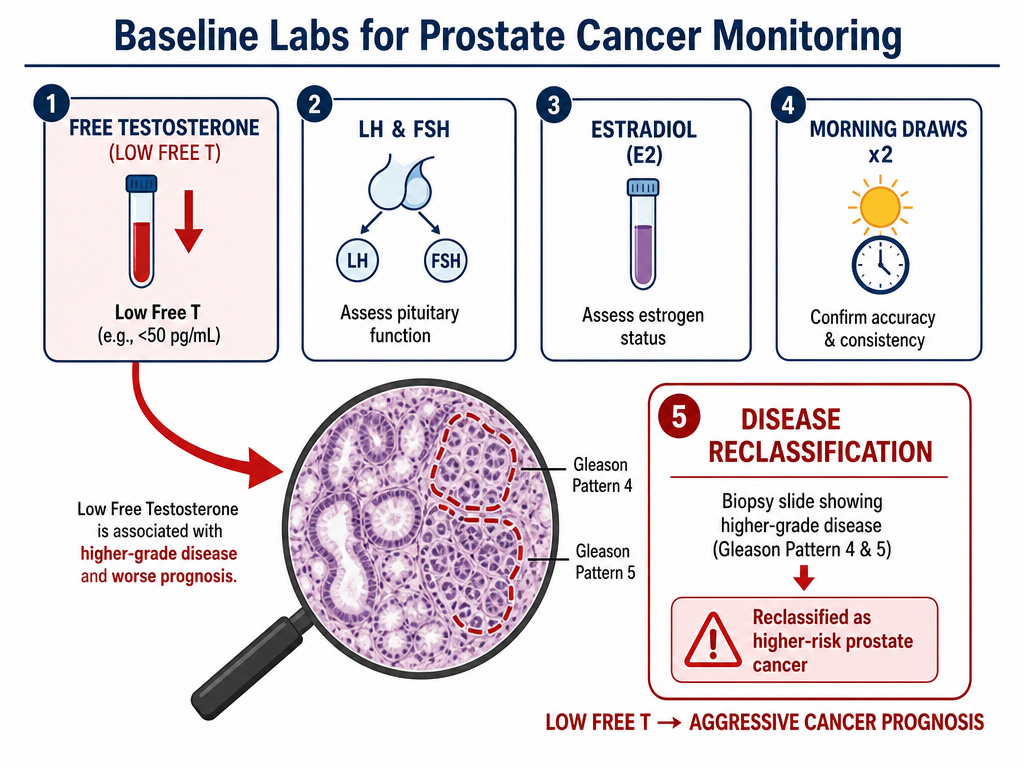
This research isn’t just academic. It changes how we approach monitoring and decisions.
For men on active surveillance for low-risk prostate cancer, a low free testosterone level might be a red flag. Studies, including one noted in a PMC systematic review, show that low baseline free T can predict disease reclassification, meaning the cancer looks worse on a future biopsy. It could be a factor in deciding between continued monitoring or moving toward treatment.
For any man getting a prostate biopsy, knowing your free testosterone level adds a piece to the prognostic puzzle. If you have low levels, this highlights the need for thorough sampling and possibly more frequent follow-up.
Before any discussion of supplements or TRT, baseline labs are essential. I learned this the hard way early on. You need more than a single snapshot of total testosterone. A proper baseline includes free testosterone, LH, FSH, and estradiol, drawn twice in the morning a few weeks apart. LH and FSH tell you if the problem is in the testes (high LH) or the brain’s pituitary gland (low/normal LH). That split changes everything.
Frequently Asked Questions
Does lowering testosterone help prostate cancer?
Yes, but only as a direct treatment for advanced disease, not as a prevention strategy. Androgen deprivation therapy (ADT) is a cornerstone treatment for metastatic prostate cancer. It works by drastically reducing testosterone to starve cancer cells. However, using drugs or supplements to lower testosterone in a healthy man or one with low-risk disease has no proven benefit and can cause significant side effects like fatigue, bone loss, and metabolic problems.
What causes aggressive prostate cancer?
Aggressive prostate cancer is caused by a combination of genetic mutations, cellular changes, and environmental factors. Age is the biggest risk factor. Family history, certain genetic mutations (like BRCA2), and race (higher incidence in Black men) also contribute. While hormones like testosterone play a role in growth, as detailed above, they are one part of a complex picture that includes inflammation, diet, and sheer random cellular replication errors.
How can I naturally increase my testosterone levels?
Focus on foundational health first, as exotic supplements rarely move the needle if basics are broken. Prioritize: 1) Sleep (7-9 hours nightly), 2) Strength training (compound lifts like squats and deadlifts), 3) Weight management (excess body fat increases estrogen conversion), 4) Vitamin D and Zinc sufficiency (get tested, supplement if deficient). Manage chronic stress, as high cortisol suppresses testosterone. These steps address the most common reversible causes of low T.
Can I live a normal life with low testosterone?
You can, but your quality of life may be significantly diminished. Untreated low testosterone is associated with chronic fatigue, low libido, depressed mood, loss of muscle mass, and increased body fat. It can affect work performance, relationships, and motivation. Effective treatment, whether through lifestyle intervention, clomiphene, or testosterone replacement therapy, aims to restore normal function and vitality. Many men treated for symptomatic hypogonadism report a dramatic return to their normal energy and drive.
The Bottom Line
The link between low testosterone and aggressive prostate cancer is real, specific, and clinically useful. The key is to move beyond the simplistic total testosterone number.
If you’re concerned about prostate health, especially if you’re under 60, ask your doctor to include free testosterone in your blood work. A level that is low, particularly alongside a total T under 300 ng/dL, is a data point that warrants closer monitoring. It should inform more frequent PSA testing and a thorough discussion with your urologist about biopsy results or active surveillance plans.
For men with diagnosed low testosterone, the old fear of TRT causing prostate cancer is fading in light of modern evidence. The decision to treat is now a balance of improving quality of life against a very low, and possibly neutral, risk, a conversation to have with a knowledgeable specialist after all the appropriate cancer screenings are complete.
Start with the right test. Let the evidence, not outdated dogma, guide the next step.
