
Does Testosterone Cause an Enlarged Prostate?
This post contains affiliate links. As an Amazon Associate, we earn from qualifying purchases.
Testosterone replacement therapy (TRT) can cause a measurable increase in prostate volume, by about 12% in one trial, but this anatomical change does not reliably worsen urinary symptoms or increase the risk of prostate cancer in monitored men. The driving mechanism appears to be testosterone’s conversion to estradiol, not testosterone itself.
That volume increase is the source of decades of concern. It’s why drug labels carry warnings and why urologists check PSA levels before writing a prescription. But the clinical reality, what men actually feel and what long-term studies track, is more nuanced. A bigger prostate on an ultrasound doesn’t automatically mean more bathroom trips at night. A common question is: does testosterone cause an enlarged prostate?
What follows is a breakdown of the numbers: the 12% volume change, the 0.16 ng/mL PSA bump from certain formulations, and the 18-year cancer trial that found no mortality difference. We’ll walk through what enlarges the gland, what that means for symptoms when you compare a does testosterone cause an enlarged prostate, and the one monitoring rule that catches problems early.
Key Takeaways
- Prostate volume can increase by roughly 12% on testosterone therapy, but lower urinary tract symptoms (LUTS) often do not worsen and may even improve.
- The PSA level is a critical monitoring tool; a rise greater than 1 ng/mL within 3-6 months of starting TRT warrants immediate medical review.
- Long-term data, including an 18-year follow-up from a major prevention trial, shows no difference in prostate cancer mortality between men on testosterone-modifying drugs and those on placebo.
- The route of administration (gel vs. Injection) matters; intramuscular shots are linked to a greater PSA increase than topical treatments.
- Baseline screening is essential. TRT is contraindicated for men with diagnosed prostate cancer or high-risk profiles.
The Short Answer on Prostate Volume and Symptoms
Testosterone can make the prostate gland grow. We have specific numbers from clinical trials. Testosterone supplementation has been shown to increase prostate size by 12%.
The clinical takeaway: However, a major review in Nature Reviews Urology concluded that circulating androgen levels are not strongly linked to BPH risk, and TRT may improve urinary symptoms.
Here’s where it gets counterintuitive. That physical enlargement doesn’t translate directly to worse symptoms for many men. In fact, some randomized trials report the opposite. One trial assigned 52 hypogonadal men to receive either testosterone enanthate (250 mg every 4 weeks) or a placebo. After one year, the men on testosterone reported significant improvements in their International Prostate Symptom Score (IPSS) and better urine flow rates. Not a single patient in that study needed extra medication or experienced urinary retention.
The disconnect between size and symptom is the core of the modern understanding of does testosterone cause an enlarged prostate. It suggests that while testosterone provides the fuel for growth, other factors, like estrogen conversion, inflammation, and nervous system tone, dictate whether that growth obstructs urine flow. This is why a man can have a moderately enlarged prostate and no symptoms, while another with a smaller gland struggles.
How Testosterone Actually Affects the Prostate Gland
The prostate is an androgen-dependent organ. It needs testosterone, or more precisely its potent derivative dihydrotestosterone (DHT), to develop and maintain itself. Without any androgens, as seen in historical eunuchs, the prostate remains underdeveloped. This established the long-held fear: more testosterone must equal more prostate growth.
But the relationship isn’t linear. The prostate’s androgen receptors can become saturated. Think of it like filling a glass of water. Once the glass is full, adding more water just overflows; it doesn’t make the glass itself bigger. Similarly, once prostate receptors are fully engaged by normal testosterone levels, adding more may not stimulate additional growth. This “saturation model” helps explain why raising low testosterone to a normal range often doesn’t cause runaway enlargement.
The more compelling mechanism involves a different hormone: estradiol. Testosterone is converted into estradiol in the body via an enzyme called aromatase. A pivotal randomized trial gave us a clear look at this process. Researchers compared three groups of older men with low testosterone: one got testosterone gel, one got an aromatase inhibitor (which blocks estrogen production), and one got a placebo. After 12 months, prostate volume increased significantly only in the group receiving testosterone gel, the group whose testosterone was being converted to estradiol.
The authors concluded the trophic effects of testosterone on the prostate are mediated via its aromatization to estradiol. This reframes the old model. It may not be testosterone, but the estrogen derived from it, that signals the prostate to grow.
This has practical implications. It suggests that monitoring and managing estrogen levels could be as important as watching testosterone levels for some men on TRT. It also partly explains why symptoms and size don’t always match, estrogen’s effects on prostate tissue are complex and involve stromal (supportive) cell proliferation, which affects gland firmness and pressure differently than epithelial (lining) cell growth.
BPH vs. Prostate Cancer: Untangling Two Different Risks
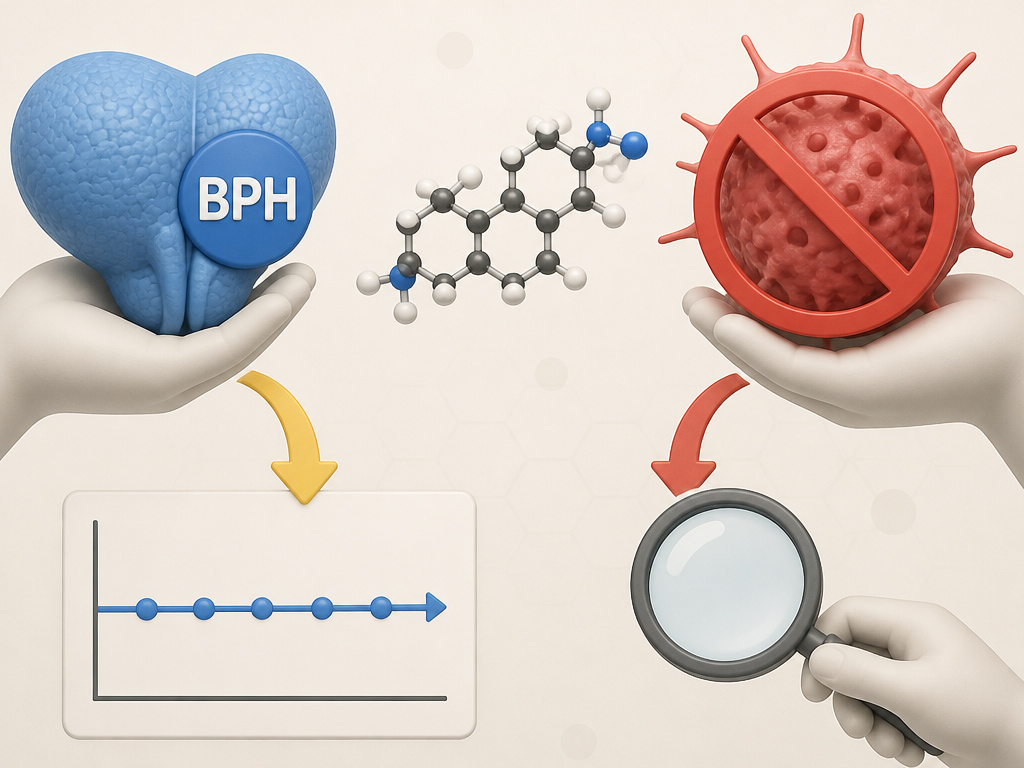
A swollen prostate blocking urine flow (BPH) and a malignant tumor (prostate cancer) are two distinct conditions. They often get conflated in discussions about testosterone, leading to unnecessary fear. The risks are different, and the evidence for each is separate.
For BPH and urinary symptoms, the data is relatively reassuring for men on TRT. As covered, symptoms often stay stable or improve. The prevalence of BPH increases from 30 to 40% in the 4th decade of life to 70–80% in those older than 80 years. A family history is a stronger risk factor than hormone levels; having a brother who had BPH surgery before age 64 increases your own risk by 4 to 6 times.
The cancer question carries more weight. The historical fear is etched in medical teaching: testosterone fuels prostate cancer. This stems from the 1940s discovery that castration (removing testosterone) could shrink metastatic tumors. Androgen deprivation therapy remains a cornerstone of advanced cancer treatment today.
| Concern | The Old Fear | What Large Studies Show |
|---|---|---|
| Does TRT cause prostate cancer? | Yes, it fuels growth. | A meta-analysis in the Indian Journal of Urology of 18 prospective studies with over 3500 men found no association between serum androgen levels and prostate cancer risk. Separately, a Nature Reviews Urology meta-analysis of 20 studies with nearly 20,000 men also concluded endogenous steroid levels were not associated with PC risk. |
| Does TRT make cancer more aggressive? | Likely. | Long-term follow-up (18 years) of the Prostate Cancer Prevention Trial found no difference in cancer-specific mortality between men taking finasteride (which lowers DHT) and placebo. |
| Who should absolutely avoid TRT? | All men with any prostate risk. | Contraindicated in men with diagnosed prostate cancer, and high-risk men (family history, African-American with PSA >3 ng/mL). |
The modern evidence from large-scale, long-term studies consistently challenges the direct cause-and-effect fear. A 2016 meta-analysis that combined data from 20 studies and nearly 20,000 men concluded that levels of endogenous (natural) steroids were not associated with prostate cancer risk. Also, drugs that drastically lower DHT (like finasteride or dutasteride) reduce the number of diagnosed cancer cases by about 23%, but they do not improve survival rates. This suggests they may be preventing low-grade cancers that would never have become lethal, rather than stopping dangerous ones.
The current, cautious consensus is that TRT does not appear to cause prostate cancer in men with healthy prostates, but it could potentially accelerate the growth of an existing, undiagnosed cancer. This is why rigorous screening is not just a recommendation, it’s a firewall.
What The Long-Term Studies Show About Cancer Risk
Short-term studies measure PSA and volume. Long-term studies measure lives. The most powerful data comes from trials that followed men for decades, not months.
The Prostate Cancer Prevention Trial (PCPT) is a landmark. The Prostate Cancer Prevention Trial (PCPT) reported that finasteride was associated with a reduction in diagnosed PC cases. This was hailed as proof that lowering androgens could prevent cancer. However, the 18-year follow-up data told a more nuanced story: there was no difference in overall or cancer-specific mortality rates between the finasteride and placebo groups. The drug prevented diagnoses, but it didn’t save more lives.
The REDUCE trial using dutasteride observed a 23% reduction in the rate of PC diagnosis after 4 years. Again, no mortality benefit has been established, which is why these drugs are not approved for cancer prevention.
What does this mean for testosterone? This shows that the relationship between androgens and prostate cancer is not straightforward. If drastically lowering a key androgen (DHT) doesn’t improve survival, then moderately raising its precursor (testosterone) may not be the universal danger it was once thought to be. The risk appears highly contextual, depending on the individual’s underlying genetics and existing cellular changes.
Where this goes sideways: Assuming “no diagnosis” equals “no cancer.” The finasteride trials likely prevented the detection of low-grade, non-lethal tumors. This creates a false sense of security and distracts from the need to detect the high-grade cancers that actually kill.
This is why blanket statements fail. For a 50-year-old with no family history, a normal PSA, and symptomatic low testosterone, the cancer risk from TRT appears very low in the context of long-term data. For a 65-year-old with a rising PSA and a brother who had prostate cancer, the risk calculus is entirely different. The studies provide population-level reassurance, but the decision is always personal and clinical.
Monitoring and Safety: The Non-Negotiable Protocol
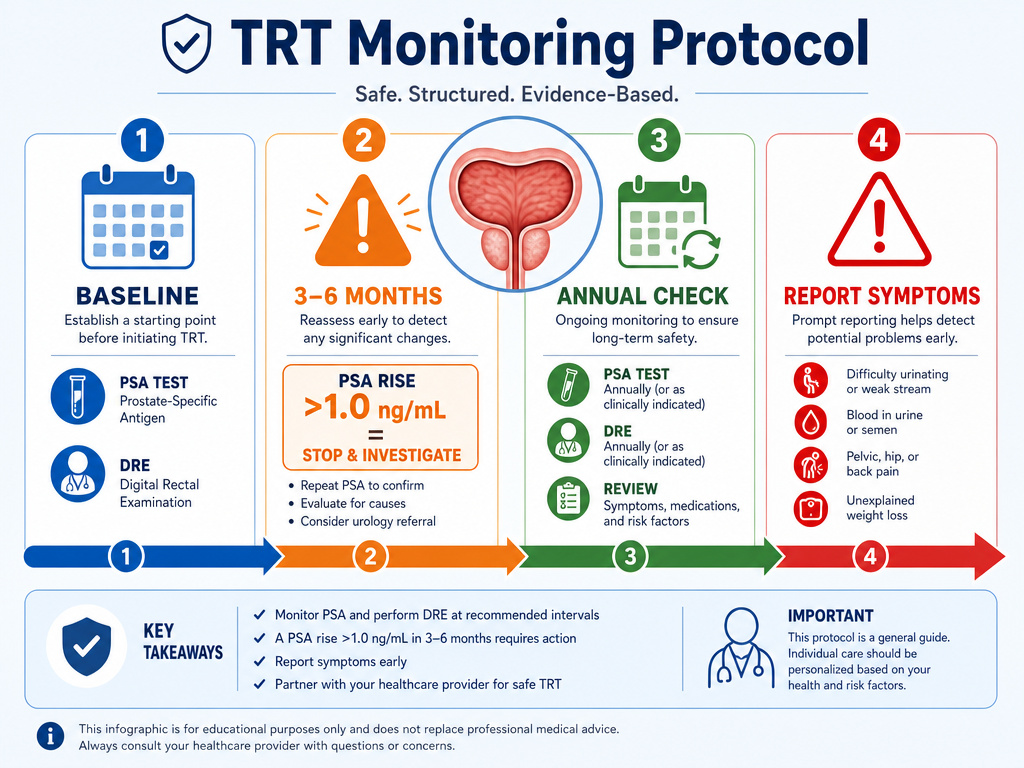
Starting testosterone therapy without a monitoring plan is like driving at night with your headlights off. You might be fine for a while, but you’re avoiding the very tool that shows you what’s ahead. The protocol isn’t complicated, but it’s strict.
First, a baseline must be established. This means a PSA test and a digital rectal exam (DRE) before the first dose. Current guidelines consider TRT contraindicated for men with a diagnosed prostate cancer or those at high risk, which includes men with a first-degree relative with prostate cancer and African-American men with a PSA above 3 ng/mL.
Once therapy begins, PSA monitoring is the guardrail. The critical rule from the Indian Journal of Urology is this: any major change in PSA (an increase greater than 1.0 ng/mL) within the first 3 to 6 months of therapy may reflect the presence of a pre-existing cancer and warrants cessation of therapy and further investigation. This isn’t about small, gradual climbs; it’s about a rapid jump that signals something other than simple gland growth.
| Monitoring Timeline | Action Required | Why It Matters |
|---|---|---|
| Before TRT (Baseline) | PSA test, DRE, symptom assessment (IPSS). | Rules out existing cancer and establishes a starting point. |
| 3-6 Months After Starting | Repeat PSA test. | Catches rapid PSA rises (>1.0 ng/mL) that suggest occult cancer. |
| Annually Thereafter | Repeat PSA test and symptom check. | Tracks long-term trends and catches slow-rising issues. |
| At Any Point | Report new urinary symptoms, pain, or blood. | Symptoms are as important as numbers. |
The formulation of testosterone matters for monitoring. Topical gels and creams did not show the same significant effect. This doesn’t make gels “safer,” but it means the expected PSA baseline on a gel might be more stable, making a concerning jump easier to spot.
How are metabolic syndrome, LUTS, and testosterone connected?
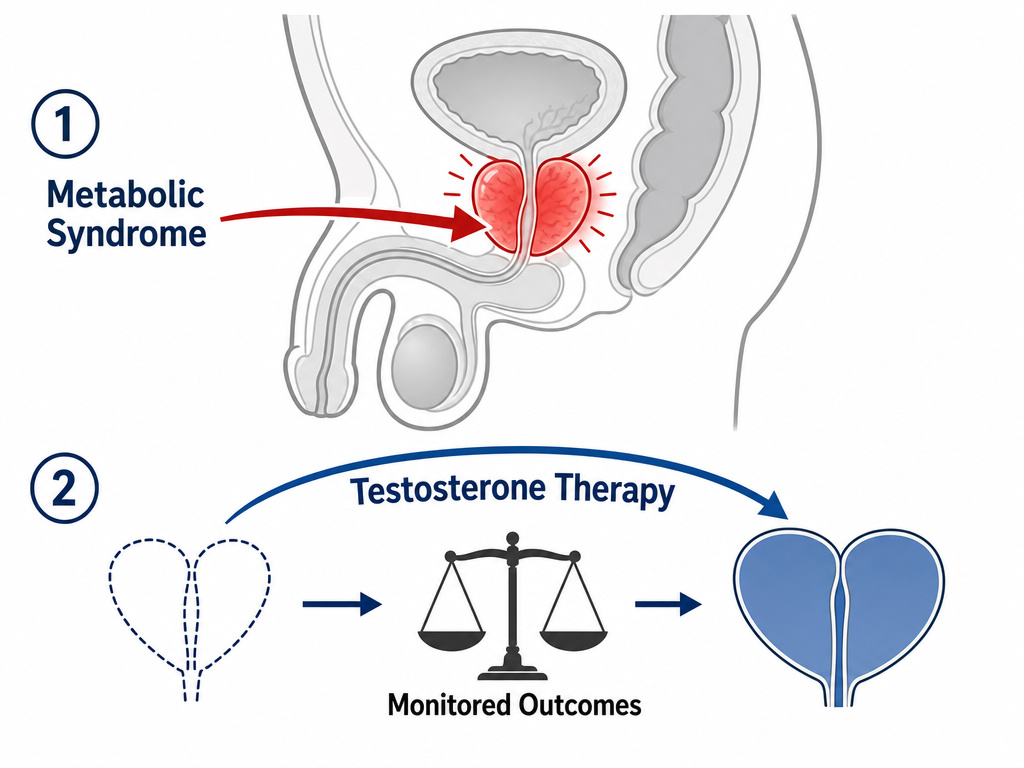
Metabolic syndrome, a cluster of conditions like high blood pressure and insulin resistance, is increasingly recognized as a factor in lower urinary tract symptoms (LUTS). While the fact sheet does not provide specific data on this connection, the relationship is understood to be indirect. Metabolic syndrome can promote inflammation and affect blood vessel health, which may contribute to prostate tissue changes and bladder dysfunction, worsening urinary symptoms. For men with low testosterone considering therapy, practical guidance is key. Since testosterone therapy can increase prostate size, a baseline assessment of metabolic health and urinary symptoms is recommended before starting. Men should be aware that while therapy may enlarge the prostate, clinical trials show LUTS often do not worsen, and in some cases, symptoms and flow rates can improve. Regular monitoring of symptoms and PSA levels remains the standard approach to manage any individual changes.
Frequently Asked Questions
Does testosterone replacement therapy (TRT) worsen BPH symptoms?
Not necessarily. While TRT can increase prostate volume, multiple clinical trials have found it does not reliably worsen lower urinary tract symptoms (LUTS). Some men even experience improvement in urinary flow and symptom scores, possibly due to improved overall energy and muscle tone.
How much does testosterone increase PSA levels?
The effect varies by method. A systematic review found that intramuscular testosterone injections can raise PSA by an average of 0.16 ng/mL. Topical gels and oral forms have a less pronounced effect. Any rapid rise of more than 1.0 ng/mL within the first 3-6 months, regardless of method, requires immediate medical evaluation.
Can I take testosterone if I have an enlarged prostate (BPH)?
It depends on the severity of your symptoms and your PSA level. If your BPH is stable and your PSA is normal, TRT may be an option under close urological supervision. However, if you have severe obstruction, recurrent urinary retention, or a very high PSA, TRT is generally not advised until those issues are managed.
What is the single biggest risk of TRT for the prostate?
The biggest recognized risk is accelerating the growth of a pre-existing, undiagnosed prostate cancer. This is why exhaustive screening before therapy and vigilant PSA monitoring in the first year are critical safety steps. The risk of actually causing new cancer appears low based on long-term population data.
Before You Go
The evidence shifts the conversation from a simple “testosterone is bad for the prostate” to a more precise set of questions. It asks about your baseline PSA, your family history, and the formula of testosterone you’re considering. It separates the concern over gland size (which can increase) from the experience of symptoms (which may not worsen).
The one action item that applies to every man over 40 considering any hormone-influencing supplement or therapy is to get a baseline PSA check and have a conversation with a doctor. It’s the cheapest and most effective risk mitigation strategy available. Guessing based on internet forums is expensive hoping.
Everything in the research hinges on that starting point. Without it, you’re interpreting the data blind. With it, you and your doctor can build a monitoring plan that addresses low testosterone symptoms while also watching prostate health. The goal isn’t to avoid a single hormone out of fear, but to manage the whole system with eyes wide open.
