
Can a Testicular Injury Cause Low Testosterone?
This post contains affiliate links. As an Amazon Associate, we earn from qualifying purchases.
Yes, a testicular injury can cause low testosterone, but the key detail most articles miss is the word “bilateral.” According to the Gülhane study, patients with unilateral G2 or G3 trauma had normal testosterone at one year, while a 2003 rat model of unilateral Grade I blunt trauma found significantly lower serum testosterone. The real risk for androgen deficiency comes from significant damage to both testicles, a scenario that data suggests affects fewer than 5 in 10,000 men who experience trauma.
The question concerns probability and mechanism as well as possibility. The body has a remarkable ability to compensate when one gland is impaired. The other testicle can ramp up production, and the pituitary gland signals harder by pumping out more luteinizing hormone (LH). This system works until both factories are damaged, which is why we ask: can a testicular injury cause low testosterone?
What follows is a breakdown of the specific injury grades that matter, the one-year hormonal data that shows who recovers, and the practical steps that separate a temporary bruise from a permanent endocrine shift.
Key Takeaways
- The lifetime risk of androgen deficiency from testicular trauma is likely below 5 in 10,000 men, stemming almost exclusively from severe bilateral injuries.
- Use the Gülhane Grading System (GGS): Grade 1 (bruise) is managed conservatively, Grade 2 (rupture) needs surgery, Grade 3 (crush/loss) requires removal.
- Unilateral injuries (one side) typically show good hormonal recovery at one year, even after surgical repair or removal, with the remaining testicle compensating.
- Prompt surgical exploration is critical for testicular rupture or large haematomas; delay raises the risk of infection, atrophy, and impaired sperm production.
- Ultrasonography (US) is the required imaging tool to check for a breach in the tunica albuginea, the white capsule whose integrity dictates the treatment path.
How Testicular Trauma Actually Affects Hormone Production
The testicle has two main jobs: make sperm (exocrine function) and make testosterone (endocrine function). Leydig cells scattered between the sperm-producing tubules are the tiny factories for testosterone. Trauma damages this architecture.
A direct blow or crush injury doesn’t just cause swelling. It shears tubules, ruptures blood vessels, and can destroy Leydig cells. The body’s immediate response is inflammation and a haematoma—a localized blood clot. If that pressure isn’t relieved or the structural damage isn’t repaired, the tissue can die, a process called necrosis.
Ultrasonography (US) is the recommended imaging modality for testicular trauma. Doppler studies show blood flow, and disruption of the fibrous tunica albuginea capsule on scan is a clear sign of testicular rupture, a surgical emergency.
This is where the clinical guidance from bodies like the British Association of Urological Surgeons (BAUS) is unambiguous. A large or expanding haematoma, or a clear rupture, needs prompt surgical exploration. The stated reason is to “preserve both endocrine and exocrine function.” Wait too long, and the window to save the hormone-producing tissue closes.
The Gülhane Grading System (GGS) and What It Reveals
In 2024, researchers introduced a practical, data-backed framework for grading these injuries. The Gülhane Grading System (GGS) doesn’t just categorize damage—it predicts the one-year hormonal and fertility outcome.
Here’s the breakdown:
| GGS Grade | Injury Description | Management | Key Hormonal Outcome at 1 Year (Unilateral Case) |
|---|---|---|---|
| Grade 1 (G1) | Contusion, small haematoma. Tunica albuginea is intact. | Conservative (rest, support, pain meds). | Normal FSH, LH, testosterone, and sperm parameters. |
| Grade 2 (G2) | Testicular rupture. Tunica albuginea is breached. | Surgical repair required. | Slightly elevated FSH/LH, but normal testosterone and sperm. |
| Grade 3 (G3) | Severe crush injury or shattered testis; non-viable. | Orchiectomy (surgical removal) required. | Slightly elevated FSH/LH, but normal testosterone and sperm. |
This table is the core of the modern answer. It shows that for a man with an injury to one testicle, even a severe one requiring removal (G3), the endocrine system often adapts fully. The remaining testicle increases its output, and the pituitary gland works harder (hence the slightly higher FSH and LH levels) to keep total testosterone in the normal range.
The 2024 Gülhane Grading System study followed a cohort of patients. Their finding was clear: “Patients with unilateral trauma experienced good recovery, regardless of trauma grade.” The body’s backup system is robust.
Where this goes sideways: Assuming no swelling means no problem. The BAUS notes the absence of scrotal swelling or haematoma does not preclude a significant testicular injury. Internal damage like a ruptured tunica albuginea won’t always show on the surface.
Unilateral vs. Bilateral Trauma: The Whole Story
The GGS data reveals the critical split. Unilateral injury is a manageable problem for the endocrine system. Bilateral injury is a completely different clinical scenario.
When both testicles are damaged, the compensatory mechanism has nowhere to go. The study’s data on patients with injuries on both sides tells a stark story:
- G3 + G1 Trauma: Significantly elevated FSH/LH to maintain normal testosterone, but sperm morphology suffered.
- G3 + G2 Trauma: Significantly elevated FSH/LH, normal testosterone, but all sperm counts dropped.
- G3 + G3 Trauma: Severely elevated FSH/LH, with all other hormonal and sperm parameters at zero.
The researchers concluded that “bilaterally affected patients were more likely to experience testosterone deficiency and poor spermiogram parameters.” This aligns with epidemiological data. A 2022 review in the PMC male hypogonadism epidemiology article calculated that the lifetime prevalence of androgen deficiency from testicular trauma is likely < 5 in 10,000, stemming almost exclusively from these bilateral cases.
My rule after reading this is simple: a single injury is a urological emergency to save that testicle, but it’s rarely a lifelong hormonal sentence. The conversation changes completely when the trauma involves both sides.
The Role of Surgical Timing
The BAUS guidelines stress speed for a reason. They state that prolonged or delayed management of a severe injury results in a higher risk of infection, testicular atrophy, and necrosis. More specifically, they note that “a delay in repair may result in impaired spermatogenesis and reduced endogenous testosterone.”
This isn’t theoretical. Surgery is indicated if there is no improvement after 72 hours of conservative treatment.
- 48-Hour Scan: For a small intra-testicular haematoma managed conservatively, a repeat ultrasound should be performed within 48 hours to check for progression.
The mechanism here is pressure and ischemia. A growing haematoma inside the tough tunica albuginea strangles the healthy tissue, killing the Leydig cells you’re trying to save. Going from a Grade 2 (repairable rupture) to a Grade 3 (needing removal) can happen in that window.
Diagnosis and Immediate Steps After an Injury
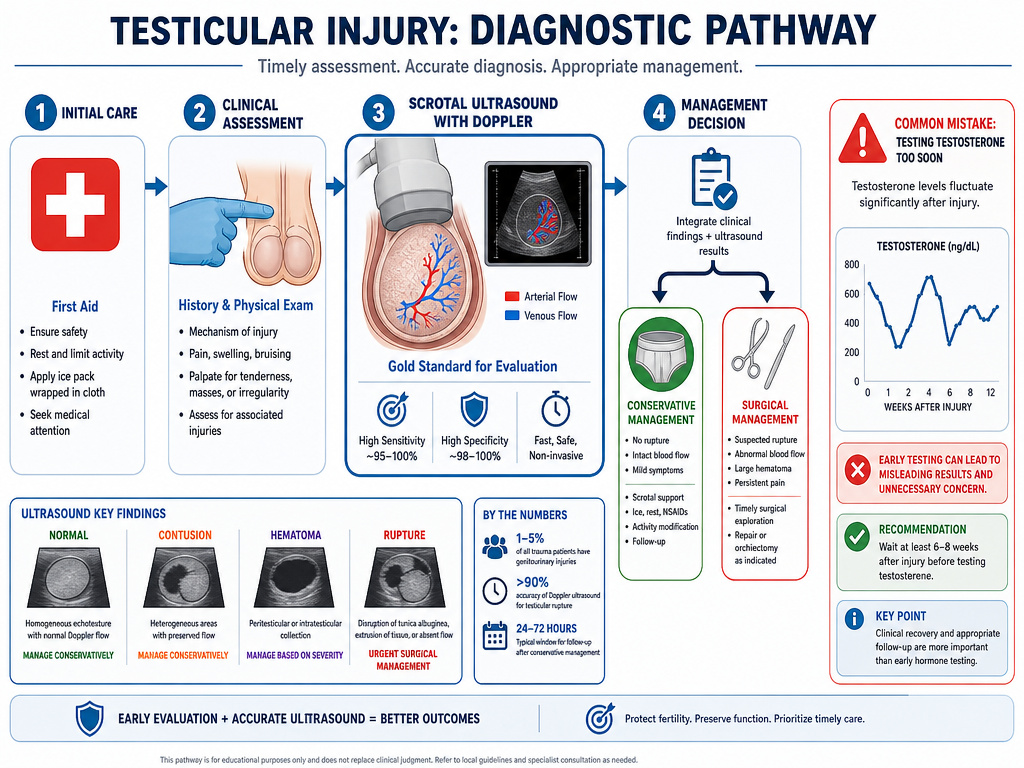
If you suffer a blunt or penetrating scrotal injury, the pathway follows a standard clinical protocol designed to triage based on objective findings.
- Stabilize and Assess: Rule out life-threatening injuries first. Get adequate pain relief.
- Clinical Examination: A doctor will check for swelling, bruising, and penetrating wounds. They know that a lack of visible swelling doesn’t rule out internal rupture.
- Urgent Imaging: This is the crucial step. A scrotal ultrasound with Doppler is essential. It will show:
- Integrity of the tunica albuginea.
- Size and location of any haematoma.
- Blood flow to the testicular tissue.
- The Decision Point: The ultrasound findings dictate the next move, as per BAUS guidance:
- Intact Tunica, Small Haematoma: Conservative therapy with scrotal support, analgesia, and anti-inflammatories.
- Disrupted Tunica or Large/Expanding Haematoma: Immediate surgical exploration and repair.
This protocol exists to make the decision objective. You’re not deciding based on pain tolerance; you’re deciding based on the integrity of the capsule visible on a screen.
Common mistake: Relying on a single, non-morning testosterone test after an injury. Testosterone has a diurnal rhythm and can be suppressed for months after any major physical trauma, not just genital injury. This “temporary post-traumatic hypogonadism” is systemic and distinct from direct testicular damage.
Long-Term Outlook and Recovery of Testosterone
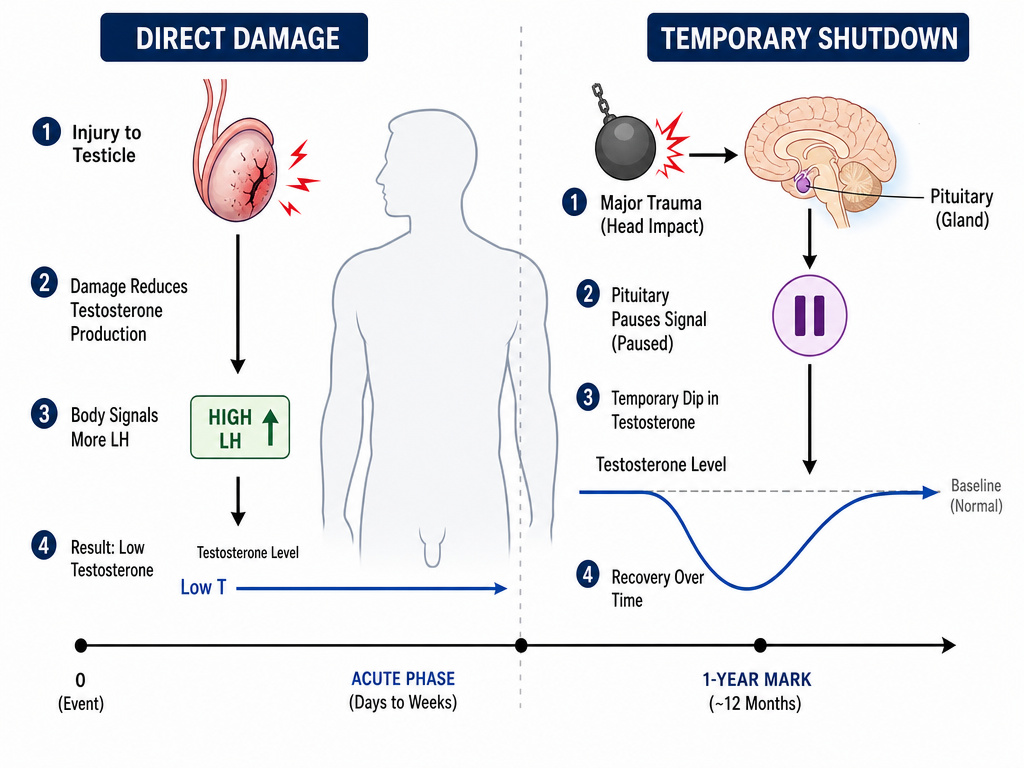
The long-term data is surprisingly reassuring for most men. We will separate the two potential causes of low T after trauma.
1. Direct Testicular Damage (Primary Hypogonadism):
This is what we’ve discussed. If enough Leydig cell mass is destroyed—typically requiring significant bilateral injury—the testicles cannot produce adequate testosterone even with strong signals from the pituitary (high LH). This is permanent and would require discussion about testosterone replacement therapy if symptomatic.
2. Temporary Post-Traumatic Hypogonadism:
This is an underrated point. Any major physical trauma, burn, or critical illness can temporarily shut down the hypothalamic-pituitary-testicular axis. The body prioritizes survival over reproduction. Any major physical trauma can temporarily suppress the hypothalamic-pituitary-testicular axis, leading to a transient drop in testosterone that often recovers over time.
This is why timing your lab work matters. Testing testosterone immediately after a major trauma will likely show a low number due to systemic stress and says little about long-term Leydig cell health.
Recovery Timelines and Monitoring
If you’ve had a testicular injury, here’s a practical monitoring framework:
-
Acute Phase (First 2-3 Months): Focus on surgical recovery or healing. Hormone tests here are largely irrelevant due to the temporary systemic shutdown. After the acute phase has passed, checking hormones like Total Testosterone, LH, and FSH can help assess testicular function.
-
1-Year Mark: This is the definitive point from the Gülhane study. Hormonal patterns are now stable. Good recovery is likely if you had a unilateral injury.
Persistent symptoms alongside lab-confirmed low testosterone and high LH may indicate impaired Leydig cell function. That’s the point to begin a detailed conversation with an endocrinologist or urologist about the pros and cons of replacement therapy, similar to discussions needed after testicular cancer treatment.
Other Related Causes of Testicular Damage
Trauma is a sudden, obvious cause. Other conditions can insidiously damage the same tissue, leading to similar hormonal outcomes. It’s useful to view them through the same lens of Leydig cell loss.
- Testicular Torsion: This is a surgical emergency where the testicle twists, cutting off its blood supply. Testicular torsion is a surgical emergency where delayed treatment can lead to testicular damage.
- Infection (Orchitis): Viral infections like mumps in post-pubertal males can directly inflame and destroy testicular tissue. Bacterial infections can have a similar effect.
- Medical Treatments: Certain chemotherapy drugs and radiation therapy targeting the pelvic region are toxic to Leydig cells, leading to iatrogenic (treatment-induced) hypogonadism.
- Varicocele: While primarily affecting sperm production through heat, a large, long-standing varicocele may also impair testosterone production in some men.
- Developmental Issues: A history of undescended testicles (cryptorchidism) that weren’t corrected early can lead to underdeveloped tissue and reduced Leydig cell mass in adulthood.
The common thread is the loss of functional Leydig cell mass, the core issue when asking can a testicular injury cause low testosterone. Whether it’s sheared, starved of blood, inflamed, or poisoned, the endpoint is the same: a reduced capacity to produce testosterone.
How can I prevent a testicular injury?
While the fact sheet does not list specific prevention tips, practical guidance focuses on seeking immediate medical attention for any trauma to protect long-term function. The key is proper assessment and management after an injury occurs. Since the absence of visible swelling does not rule out damage, any significant blunt force or penetrating injury warrants a medical evaluation. Ultrasound imaging is the recommended method to determine the severity. For severe injuries, prompt surgical exploration and repair is crucial to preserve testosterone production and prevent complications like infection, atrophy, or necrosis. Delayed management increases these risks.
Frequently Asked Questions
Can a minor testicular injury cause low testosterone?
Minor injury (Gülhane Grade 1), like a contusion with a small haematoma and an intact tunica albuginea, is extremely unlikely to cause any lasting change in testosterone levels. These are managed conservatively and full recovery of endocrine function is expected.
How long after a testicular injury would low testosterone appear?
If low testosterone is going to occur due to direct gland damage, it will be evident once the body recovers from the systemic stress of the trauma. Reliable testing is best done 3-6 months post-injury. A temporary drop immediately after the injury is common and not indicative of long-term damage.
Can testosterone levels recover after testicular injury?
Yes, in most cases. For unilateral injuries, the remaining testicle often compensates sufficiently to maintain normal testosterone levels, as shown in the Gülhane study. Even after removal of one testicle (orchiectomy), testosterone frequently remains in the normal range at the one-year mark.
What percentage of testicular injuries lead to low T?
The epidemiological data suggests the lifetime prevalence of androgen deficiency directly caused by testicular trauma is very rare, likely below 0.05% (5 in 10,000). The vast majority of cases involve severe, bilateral damage.
Should I get my testosterone checked after a testicular injury?
It is a reasonable part of long-term follow-up, but timing is critical. Wait at least 3-6 months post-injury for an accurate baseline. The test should include Total Testosterone, Free Testosterone, LH, and FSH to understand if any low T is due to testicular failure (high LH) or other factors.
The Bottom Line
A testicular injury can cause low testosterone, but the rule is more specific than the rumor: significant, bilateral damage is the primary driver. For the individual who takes a single blow to one side, the data is clear—good hormonal recovery is the expected outcome, especially with prompt, appropriate care. The body’s backup system is formidable.
The practical takeaway is about triage, not panic. Any significant scrotal trauma warrants an immediate ultrasound to rule out a ruptured tunica albuginea. That scan decides the path between watchful waiting and the operating room. If surgery is needed, getting it done quickly is the best action to preserve the testicle and the hormone factories inside it.
For long-term concerns, the one-year mark is your benchmark. If symptoms of low T persist that far out alongside confirmatory labs, the conversation shifts from injury recovery to managing a potential endocrine deficit. Until then, the odds are in your favor.
