
Can a Vasectomy Lower Testosterone? What the Studies Show
This post contains affiliate links. As an Amazon Associate, we earn from qualifying purchases.
A vasectomy does not lower testosterone. The procedure blocks the vas deferens to stop sperm transport, but it leaves the testicles’ hormone production untouched. Testosterone enters the bloodstream directly, independent of the tubes that carry sperm. Multiple studies tracking men for years after the procedure confirm no significant, long-term changes in testosterone, luteinizing hormone (LH), or follicle-stimulating hormone (FSH).
That’s the direct answer, and it’s backed by a stack of peer-reviewed papers. But if you’ve heard otherwise, you’re not imagining things, a few studies show conflicting numbers, and the noise online can be deafening. A common question in this noise is can a vasectomy lower testosterone.
This guide walks through the actual data, study by study. We’ll look at where the numbers agree, where they don’t, and what that means for the long-term picture of the can a vasectomy lower testosterone question. By the end, you’ll be able to read any headline about vasectomy and hormones and know exactly which questions to ask.
Key Takeaways
- Most medical sources state a vasectomy does not reduce testosterone production, though one 2018 study found total testosterone was significantly different between groups. Your testicles continue making hormones as before.
- Peer-reviewed studies, including a 2018 analysis of 485 vasectomized and 1,940 non-vasectomized men, found no long-term association between vasectomy and levels of key hormones like free testosterone and LH.
- If you feel low-T symptoms after a vasectomy, the timing is likely coincidental with age-related decline. A basic blood panel is the first step, not assuming the procedure caused it.
- Short-term hormonal dips in the first week are linked to surgical stress, not the vasectomy itself, and levels typically recover within two weeks.
- For true, permanent sterility, follow the post-vasectomy semen analysis protocol. Sperm can linger for months, and a lab test is the only confirmation.
How a Vasectomy Actually Works (And What It Doesn’t Touch)
A vasectomy is a mechanical interruption. It targets two specific tubes, the vas deferens, that carry sperm from the testicles to the urethra. The surgeon cuts, seals, or clips a small section of each tube. Sperm can no longer exit.
The testicles, however, have two jobs. Job one is making sperm. Job two is making testosterone. The hormone factory is a separate operation.
Testosterone is produced by Leydig cells inside the testicles. From there, it diffuses directly into the bloodstream. It doesn’t need the vas deferens. It doesn’t travel with sperm. Blocking the sperm highway does nothing to the hormone delivery trucks on a different route.
Think of it like a house with plumbing and electrical wiring. A vasectomy shuts off the water to one sink. The lights, the outlets, the entire electrical system, they’re on a separate circuit and keep working normally.
The part nobody mentions: The body reabsorbs the sperm that continue to be made after the procedure. They have nowhere to go, so they’re broken down and recycled locally. This is a normal, silent process that doesn’t trigger inflammation or hormonal feedback in the vast majority of cases.
This separation is why major health authorities are so consistent on the point. Hackensack Meridian Health states there is no indication a vasectomy harms testosterone production. The University of Utah Health is blunt: “Doing a vasectomy is not going to stop your testicles from making testosterone.”
The Short Answer: What the Bulk of the Data Shows
Most of the research lines up. If you look at hormone levels before a vasectomy and then track men for months or years afterward, the graphs are essentially flat.
A foundational 1982 study measured serum testosterone in 22 men before and up to 6 months after their procedures. The conclusion was straightforward: “Serum testosterone… Remained unchanged.” A 1984 study of 20 men found no significant alterations in LH, FSH, or dihydrotestosterone-sulfate over a two-year follow-up.
The most compelling recent data comes from a large 2018 study. Researchers compared 485 men who had a vasectomy for over 15 years to 1,940 non-vasectomized men. After adjusting for age, BMI, and other factors, they found vasectomy was not associated with levels of total testosterone, free testosterone, or LH.
That study concluded men with vasectomy for over 15 years will not have extended physiological problems, including sex hormones, though the question of total testosterone levels remains debated.
This is the heavyweight evidence. It’s a long-term, population-scale look that controls for confounding variables. The signal from most studies is clear: no long-term hormonal impact, though one study found total testosterone was significantly different.
When Studies Disagree: The One Notable Exception
One study often cited to suggest an effect is a 1989 analysis. It reported an increase in mean LH levels in the vasectomized group. However, the same study found no difference in testosterone levels between the groups when age was controlled for.
This is a critical detail. An isolated change in LH without a corresponding drop in testosterone is physiologically puzzling. LH signals the testicles to produce testosterone. If LH goes up but testosterone doesn’t, it suggests the testicles might be less responsive, but the 2018 study, which is larger and more recent, found no such link.
Furthermore, this 1989 finding on LH hasn’t been consistently replicated. The 1984, 2018, and 1976 studies reported no significant long-term change in LH, while the 1989 study reported an increase.
| Study (Year) | Key Hormone Measured | Finding in Vasectomized Men | Notes |
|---|---|---|---|
| 2018 (PMC) | Free Testosterone (FT), LH | No significant difference | Large sample (485 vs 1940), long-term follow-up (>15 yrs) |
| 1989 | Luteinizing Hormone (LH) | 16% mean increase | No corresponding testosterone drop found |
| 1982 | Serum Testosterone | Remained unchanged | Tracked for 6 months post-op |
| 1976 | Testosterone (T), FSH | No overall change | Noted short-term dip in week 1 (see below) |
The takeaway isn’t that the science is conflicted on can a vasectomy lower testosterone. It’s that one outlier metric in an older study gets amplified, while the consistent, null findings from multiple other studies don’t make for dramatic headlines.
The “Surgical Stress” Effect: Why Week One Is a Red Herring
Here’s where timing matters. One well-designed 1976 study did detect a hormonal shift, but it was transient and tied to the event of surgery, not the vasectomy itself.
Researchers measured hormones in 11 men from four weeks before to 40 weeks after the procedure. They found a significant fall in FSH and the Free Testosterone Index during the first week post-vasectomy. Levels recovered by week two. The study authors attributed this dip to the physiological stress of surgery.
Your body reacts to any surgical intervention. Cortisol spikes, inflammatory markers rise, and this can temporarily nudge other systems. This short-term dip is a stress response, not evidence that severing the vas deferens cripples testosterone production. A 1982 study found no significant change in testosterone one week after vasectomy, though it noted a non-significant tendency to decrease.
If you get blood work drawn the day after any surgery, the numbers might look off. That’s why studying hormones years later gives the true picture.
Long-Term Safety: What 10+ Years of Data Reveals
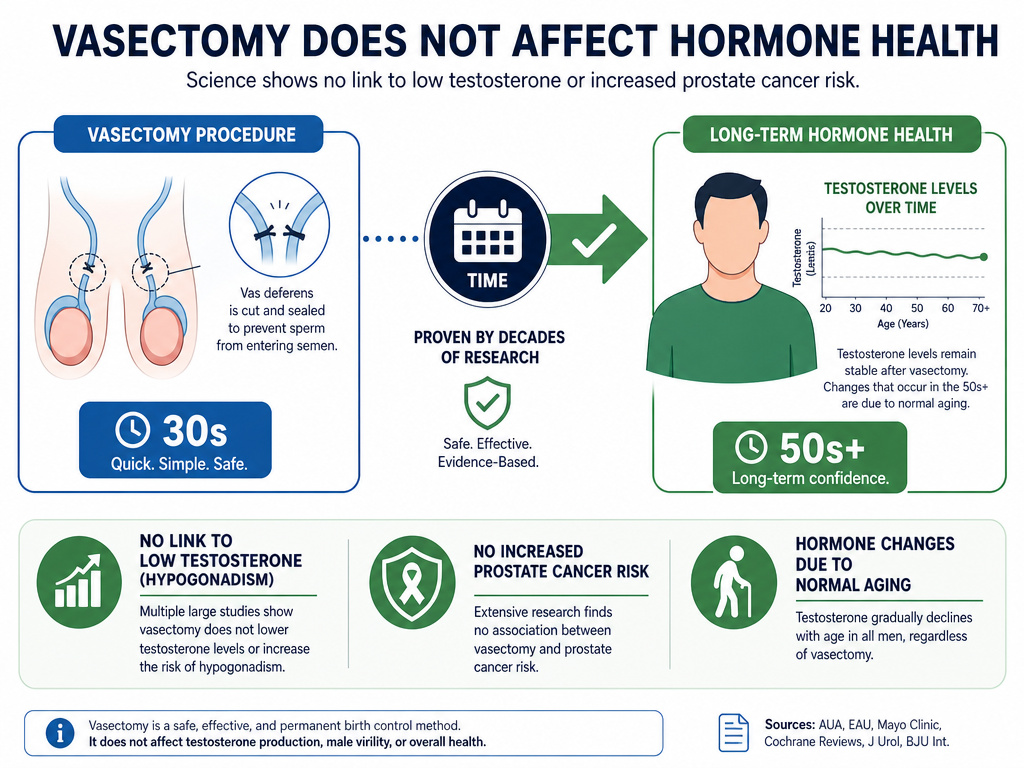
The big fear isn’t about next week. It’s about a slow, creeping decline over decades. Does a vasectomy set you up for low testosterone, prostate issues, or other problems ten or twenty years down the line?
The long-term data is reassuring. The 2018 study is the most direct evidence, explicitly stating that men with vasectomy for over 15 years will not have extended physiological problems, including sex hormones or cancer risk.
A 2021 review in PMC consolidated this view, stating plainly: “Vasectomy does not increase the risk of developing late-onset hypogonadism.” Hypogonadism is the clinical term for low testosterone.
Furthermore, major medical institutions have reviewed the link to other long-term concerns. The University of Utah Health notes there is no convincing evidence that vasectomy causes prostate cancer or is related to cardiovascular disease. Early studies suggesting a link had significant flaws and have not changed clinical practice.
Bottom line: The available long-term studies find no causal connection between vasectomy and age-related hormonal decline. If your testosterone drops in your 50s, it’s overwhelmingly likely due to the normal aging process, not a procedure you had in your 30s.
What If You Feel Different? A Practical Framework
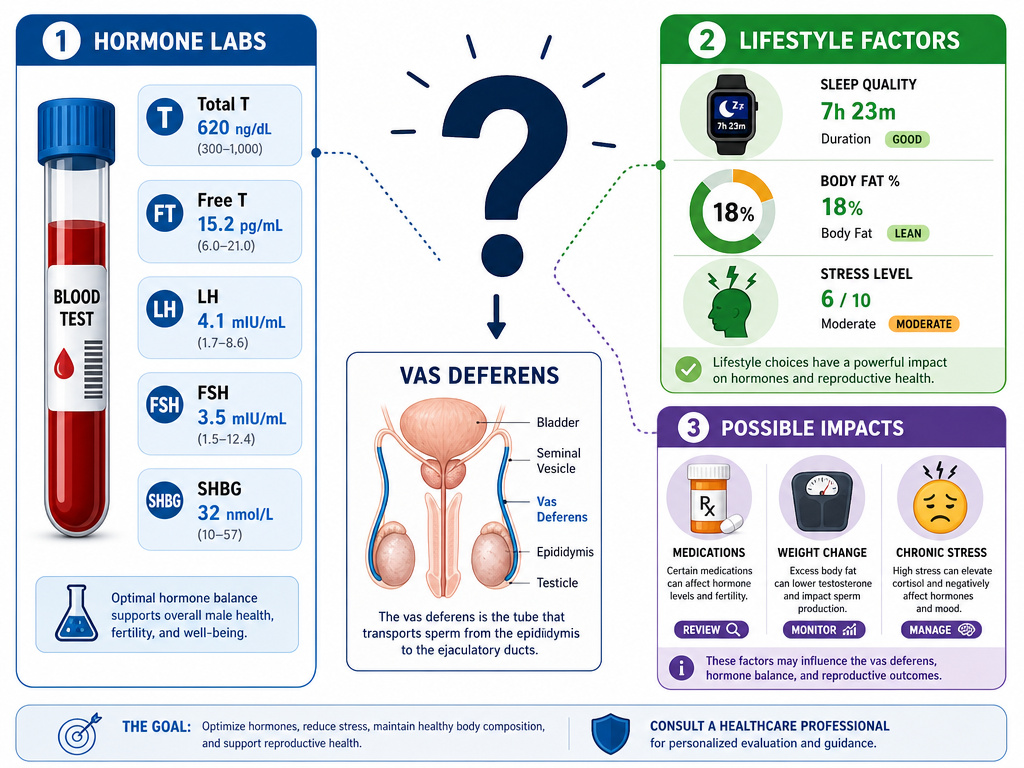
Imagine you had a vasectomy six months ago and now you’re tired, lack drive, and feel off. The studies say the procedure isn’t the cause. But your experience is real. What’s the next step?
First, separate correlation from causation. Testosterone naturally begins a gradual decline for most men starting in their late 30s. A vasectomy often coincides with this life stage. It’s easy to link the two events, but timing alone isn’t proof.
The only way to know is to test. Don’t guess.
- Get a Blood Panel. This should include Total Testosterone, Free Testosterone, LH, FSH, and SHBG (Sex Hormone Binding Globulin). A commercial lab service can facilitate this. The LH level is particularly telling. If your testosterone is low and LH is high, it points to a primary testicular issue. If both are low, it suggests a problem with the brain’s signaling (the pituitary). Neither pattern is caused by a vasectomy.
- Rule Out the Big, Reversible Drivers. Before you look at the vasectomy, look at the pillars of health that actually crash testosterone:
- Sleep: Undiagnosed sleep apnea is a massive, underrated suppressor of testosterone.
- Body Composition: Excess body fat, especially visceral fat, aromatizes testosterone into estrogen.
- Stress & Alcohol: Chronic stress elevates cortisol, which directly competes with testosterone production. Heavy alcohol use is toxic to Leydig cells.
- Review Other Life Changes. New medication? Significant weight gain? Major life stress? These are far more potent drivers of hormonal shifts than a vasectomy.
Common mistake: Blaming the vasectomy and spending hundreds on “testosterone booster” supplements before checking for a sleep apnea diagnosis or correcting a vitamin D deficiency. Fix the foundation first.
This is where the persona of a skeptical coach is vital. The evidence says the vasectomy is an unlikely culprit. The process says to investigate the likely culprits first. It’s less satisfying than a simple story, but it’s how you find the real answer.
Related Concerns: Libido, Erections, and “Sperm Buildup”
The testosterone myth fuels two other major fears: lost libido and erectile dysfunction. The logic goes, “No testosterone, no sex drive.” Since the premise is false, the conclusions are too.
Hackensack Meridian Health directly addresses this: “There’s no connection between a vasectomy and erectile dysfunction.” Erections are a vascular event, governed by blood flow and nerves, which the procedure doesn’t touch. Libido is complex, influenced by hormones, mood, relationship dynamics, and stress.
Then there’s the visceral fear of “sperm buildup.” The idea that sperm with no exit will cause pressure, pain, or some kind of internal explosion is common. It is a simple process. The body simply reabsorbs the sperm. It’s a routine cellular cleanup process. In a small percentage of men, a tender sperm granuloma can form at the surgical site 2–3 weeks after surgery, but this is an inflammatory nodule that usually resolves.
The Path to Confirmed Sterility
A vasectomy doesn’t make you sterile the moment you walk out of the clinic. Sperm remain in the piping downstream of the cut. You need to clear them.
The American Urological Association guideline (2012) recommends a post-vasectomy semen analysis (PVSA) between 8 and 16 weeks. A study noted that 33% of patients have no sperm when semen is tested 12 weeks after vasectomy. The key is the number of ejaculations, some protocols recommend at least 20.
Here’s the critical protocol:
- Use another birth control method until you get the all-clear from a lab.
- Provide a semen sample at the timeframe your doctor specifies (often around 12 weeks).
- The lab report must show zero motile sperm. The presence of motile sperm in semen at 3–6 months after surgery has a very low probability (about 0.36%) and is defined as early recanalization, which may require a repeat procedure.
This is the only step that confirms the procedure worked. Don’t skip it.
Frequently Asked Questions
What are the negative effects of a vasectomy on a male?
The primary effects are related to the surgery itself: short-term soreness, swelling, and bruising. Most evidence shows no negative long-term effects on testosterone, prostate cancer risk, or cardiovascular health, though one study found total testosterone was significantly different.
Do vasectomies mess up testosterone?
No. As outlined in multiple studies and stated by urological authorities, vasectomy does not affect testosterone production. The testicles continue to make and release testosterone into the bloodstream independently of the severed vas deferens.
What happens 10 years after a vasectomy?
Physiologically, nothing related to the vasectomy. The tubes remain blocked. Your testicles continue making hormones and reabsorbing sperm. Any health changes you experience a decade later are attributable to aging, lifestyle, or genetics, not the procedure. A long-term study of men with vasectomy for over 15 years showed no extended problems with hormone levels.
Does not ejaculating for 7 days increase testosterone?
There is a common belief that “saving up” sperm boosts testosterone. The evidence doesn’t support this. Testosterone production is a continuous, regulated process. Short-term abstinence may slightly increase sperm concentration in semen, but it does not cause a clinically meaningful rise in serum testosterone levels. Your hormone levels are regulated on a timescale of minutes and hours, not days.
Before You Go
The noise around vasectomy and testosterone is a case study in how a single, older data point can outshout a consensus. The bulk of the evidence, from the 1980s to a major 2018 study, finds no long-term hormonal impact, though one 2018 study reported a significant difference in total testosterone. The procedure blocks a physical tube; it doesn’t rewire your endocrine system.
If you’re considering a vasectomy, this hormonal concern shouldn’t be the deciding factor. The real considerations are permanence, the need for follow-up testing, and your certainty about future fertility.
If you’ve had one and now have low-T symptoms, the practical path is the same for any man: get a blood panel and scrutinize sleep, stress, body fat, and diet. The vasectomy is almost certainly a bystander. Chasing it as the cause will waste time and money. Test, don’t guess. The numbers will show you where to look next.
