
7 Best Enteral Feeding Products For Icu Protein Supplementation
This post contains affiliate links. As an Amazon Associate, we earn from qualifying purchases.
Our best overall enteral feeding product for ICU protein supplementation is the Nutren 2.0 Complete Nutrition Tube Feeding Formula, for its high protein and calorie density in a restricted fluid volume. The Kate Farms Organic Adult Peptide 1.5 Formula is our best plant-based hydrolyzed choice, while Medtrition NutriConnect ProSource TF20 Modular Protein excels for modular supplementation.
Choosing the right formula hinges on the patient’s digestive tolerance, protein requirements, and fluid restrictions. This guide was built by researching product specifications, manufacturer documentation, and clinical guidelines to help medical teams make informed, patient-specific decisions.
Top 7 Enteral Feeding Products For ICU Protein Supplementation in the Market


Certain content that appears on this site comes from Amazon. This content is provided "as is" and is subject to change or removal at any time.
The Best Enteral Feeding Products For ICU Protein Supplementation, Reviewed
Nutren 2.0 Complete Nutrition Tube Feeding Formula

What We Like
- High protein and calorie density supports critical needs
- Suitable for lactose-intolerant and gluten-free diets
- Calorie-dense at 2.0 kcal/mL
Trade-offs
- Not suitable for individuals with galactosemia
- Requires medical supervision for use
Nutren 2.0 packs 2.0 calories per milliliter, a dense concentration designed for situations where energy requirements are high but fluid volume must be restricted. Its complete nutritional profile means it can serve as a sole-source formula, eliminating the need to mix separate components. The formula is suitable for lactose-intolerant and gluten-free diets, addressing two common dietary restrictions, though it is not for individuals with galactosemia.
As a comprehensive nutrition formula, it provides a fixed blend of macronutrients and micronutrients. This means a patient’s entire nutritional regimen is tied to this single product. For cases where only protein supplementation is required, a modular product like the Medtrition NutriConnect ProSource TF20 would provide more targeted support.
Kate Farms Organic Adult Peptide 1.5 Formula

What We Like
- Hydrolyzed plant protein for impaired digestion
- Contains organic, allergen-free ingredients
- Provides a calorically dense sole-source formula
- Includes digestive aids like MCT oil
Trade-offs
- At 10.2 lb, the case is heavier than Nestle Peptamen Intense VHP
- The 15.0-inch case length requires more storage depth
A 1.5 cal/mL density delivers 500 calories and 24 grams of hydrolyzed protein in a single 325 mL carton, which is a substantial nutrient load for critical support. This makes it a strong candidate for ICU patients with compromised digestion who need a plant-based, allergen-conscious option. The inclusion of MCT oil and prebiotic fiber directly addresses the common enteral feeding challenge of gastrointestinal tolerance.
The trade-off is in the package weight and size, the 10.2-pound, 15-inch-long case is a notably larger footprint than something like the Nestle Peptamen Intense VHP. For a unit with restricted storage or a protocol requiring more frequent, smaller-volume supplements, the bulkier packaging could be a logistical hurdle. However, if the primary need is a high-calorie, hydrolyzed, plant-based sole-source nutrition, this formula’s specifications are designed precisely for that niche.
Product photos
Medtrition NutriConnect ProSource TF20 Modular Protein
What We Like
- 20g complete protein in a 60mL pouch
- Fast, no-mix administration for ICU settings
- Formulated to meet ASPEN protein guidelines
- No sweeteners or flavors to complicate formulas
Trade-offs
- Modular format requires a separate feeding base
- Not intended for oral consumption limits versatility
Delivering 20 grams of protein in a ready-to-use 60mL pouch, this product eliminates the need to mix powders, providing a precise tool for clinicians or caregivers to quickly boost a tube-fed patient’s intake. Its design supports critical care nutrition protocols where wound healing and metabolic stress are concerns, especially when the base formula is established and only protein requires augmentation. The absence of sweeteners or added flavors underscores its dedicated use for enteral administration.
This product is a specialist tool. You would not use it as a stand-alone meal replacement like Nutren 2.0, as it is purely a modular protein add-on. Its utility is also confined strictly to tube feeding, unlike an oral-ready option such as Medline ENT697. This narrow focus is its strength in an ICU setting, but it means you are buying a tool for one specific job.
Product photos
Nestle Peptamen Intense VHP Tube Feeding Formula

What We Like
- Peptide-based formula for easier absorption
- Protein ratio designed for high protein needs
- Supports maintenance of lean body mass
- Compact 5.0 x 8.0 x 5.8 inch case
Trade-offs
- Unflavored formulation is strictly for tube feeding
The decisive fact here is its peptide-based design, which means the protein is partially broken down for patients who might struggle with whole-protein formulas. This makes it a logical pick for an ICU setting where gut function is a concern and protein demands are critical. It suits a clinician aiming to support lean body mass with a formula engineered for high protein requirements per calorie, a specific need that not all broad-spectrum formulas address.
This product does not list a calorie density, so precisely calculating how it fits into a patient’s total energy needs requires extra work. That differs from a formula like Nutren 2.0, which clearly states its 2.0 kcal/mL specification. You are getting a specialized protein delivery system, but integrating it into a complete nutritional plan takes more planning. For a straightforward, calorie-dense base formula, you would look to other products.
Medline ENT697 Active Critical Care Liquid Protein
What We Like
- Ready-to-use liquid requires no mixing
- Dual-source protein from hydrolyzed collagen and whey
- Shelf-stable for convenient storage without refrigeration
Trade-offs
- 30 oz bottle is bulkier than modular protein pouches
- Not a sole source of nutrition, requires a base diet
Its ready-to-use liquid form defines this product, so it requires no mixing before oral sipping or tube feeding administration. The shelf-stable formula does not need refrigeration, allowing convenient storage in a supply cabinet. With 21 grams of protein from hydrolyzed collagen and whey, it is positioned as a supplement comparable to ProStat and ProSource Liquid protein, not a sole source of nutrition.
The trade-off for that convenience is a bulky container compared to a product like the Medtrition NutriConnect ProSource TF20, which comes in compact 60mL pouches designed for direct tube connection. The Medline bottle delivers 21 grams of protein, but it is not a complete formula, so it’s purely a modular supplement. For a patient requiring a sole-source, peptide-based nutrition like Nestle Peptamen Intense VHP, this wouldn’t be the appropriate product. It serves a specific, narrow role exceptionally well.
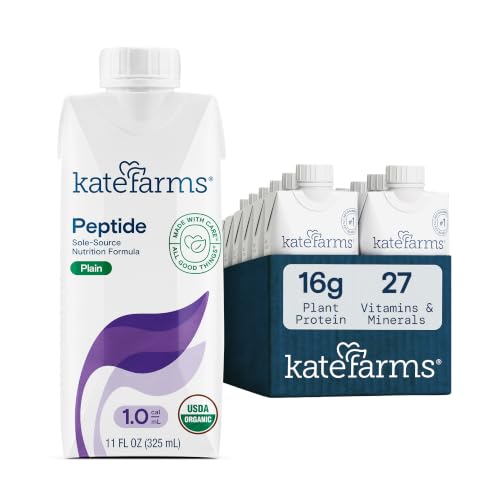
Kate Farms Peptide 1.0 Formula
What We Like
- Designed for fine-bore tubes without dilution
- Hydrolyzed protein and MCTs for easy digestion
- Includes prebiotic fiber for gut health support
- Certified organic and free from major allergens
Trade-offs
- Vanilla flavor may limit use in strictly unflavored protocols
Flowing smoothly through tubes as small as 6.5 Fr without needing dilution is its most decisive feature. That allows feeding directly from the carton for anyone using a very small-bore tube, which eliminates a preparation step and reduces clogging risk. Its hydrolyzed organic pea protein, MCTs, and prebiotic agave inulin are made for easy digestion. The formula is also certified USDA Organic, Non-GMO Project Verified, Kosher, and gluten free.
A trade-off comes from its formulation, which provides hydrolyzed protein, prebiotic fiber, and carbohydrates but not a higher calorie concentration. For a patient requiring dense calories in minimal fluid volume, a higher-volume feeding might be necessary. The vanilla flavor also means it is not a choice for strictly unflavored feeding protocols.
Product photos
Nestle Healthcare Nutrition Pauline CY Enteral Feeding Product
What We Like
- Sold in a convenient case of 24
- Sold in a case of 24
Trade-offs
- Categorized as baby formula, not adult medical nutrition
- Packaged solely in multi-unit case format
This makes it a straightforward choice for ICU protein supplementation when the sole goal is gastric delivery without any flavor elements that could complicate care or lead to refusal if used orally. It suits protocols where a hydrolyzed, elemental formula is indicated and where the nursing staff prefers the simplicity of a single, consistent product.
Compared to a modular protein like Medtrition NutriConnect ProSource TF20, this is a complete nutrition formula, not just a protein booster. You’d choose this when you need a sole-source nutrition, not a targeted protein add-on.
How We Evaluated Enteral Feeding Products
Our evaluation is based on a review of product specifications, manufacturer data, and clinical guidelines for enteral nutrition in critical care. We prioritized criteria proven to impact ICU patient management: protein density and source, formula digestibility for compromised GI tracts, and caloric concentration for fluid-restricted protocols. We also considered practical factors like case size and storage footprint for clinical settings. Our research synthesizes these factors from available documentation; we did not conduct clinical testing or monitor patient outcomes.
What To Look For In Enteral Feeding Products
Selecting an enteral formula requires matching the product’s characteristics to the patient’s clinical status and the care team’s logistical needs. Key considerations include the protein amount and type, the formula’s overall digestibility, and its caloric density.
Focus on protein density (grams per mL), protein source (intact, peptide, hydrolyzed), calorie concentration, and compatibility with fluid restrictions and tube size.
Protein Density and Source
Protein needs in the ICU can exceed 1.2 g/kg/day during rehabilitation. Products vary in how they deliver this protein. Complete formulas like Nutren 2.0 or Nestle Peptamen Intense VHP integrate protein into a balanced nutritional profile. Modular protein supplements, such as the Medtrition NutriConnect ProSource TF20, deliver concentrated, pure protein to boost an existing regimen. The protein source matters for absorption: peptide-based or hydrolyzed formulas, including the Kate Farms Peptide 1.0, are designed for patients with impaired digestion, as the proteins are pre-broken down.
Digestibility and Formula Type
Gastrointestinal intolerance is common in critically ill patients. Formulas with hydrolyzed proteins or medium-chain triglycerides (MCTs), like the Kate Farms Organic Adult Peptide 1.5, are easier to absorb. The presence of prebiotic fiber can also support gut health, a feature found in the Kate Farms Peptide 1.0. For patients with severe sensitivities, a peptide-based or elemental formula may be necessary. It’s crucial to distinguish between complete, sole-source nutrition formulas and supplemental products like Medline ENT697 Active Critical Care Liquid Protein, which are designed to augment a base diet.
Caloric and Fluid Density
Energy-dense formulas (e.g., 2.0 kcal/mL) are recommended for patients who cannot tolerate full fluid volumes or who require fluid restriction. This allows for the delivery of adequate calories and protein in a smaller volume. The Nestle Peptamen Intense VHP and Nutren 2.0 are examples of higher-calorie-density options. For fine-bore feeding tubes, a formula’s viscosity is critical; some, like the Kate Farms Peptide 1.0, are designed to flow without requiring dilution, which preserves calorie delivery.
- Check the kcal/mL rating against the patient’s fluid allowance.
- Verify the formula’s compatibility with your tube size (e.g., 6.5 Fr).
- Ensure any modular supplement is compatible with your base formula.
- Confirm the absence of allergens or contraindications (e.g., galactosemia).
- Consider the storage space required for larger cases.
Match the formula’s physical and nutritional properties precisely to the patient’s tube size, fluid limits, and digestive capacity.
Enteral Feeding Products For ICU Protein Supplementation Compared
The table below compares key specifications across our top picks to highlight their differences in protein delivery, calorie density, and primary use case.
| Product | Protein per Serving | Protein Source | Suitable Administration |
|---|---|---|---|
| Nutren 2.0 Complete Nutrition Tube Feeding Formula | 84 grams per 1000 mL | Casein and soy blend | Tube feeding |
| Kate Farms Organic Adult Peptide 1.5 Formula | 24 g | Hydrolyzed pea | Oral or tube feeding |
| Medtrition NutriConnect ProSource TF20 Modular Protein | 20 grams | N/A | Tube feeding |
| Nestle Peptamen Intense VHP Tube Feeding Formula | N/A | Peptide-based | Tube feeding |
| Medline ENT697 Active Critical Care Liquid Protein | 21 g | Hydrolyzed collagen & whey | Oral or tube feeding |
| Kate Farms Peptide 1.0 Formula | N/A | Hydrolyzed organic pea protein | Oral or tube feeding |
| Nestle Healthcare Nutrition Pauline CY Enteral Feeding Product | N/A | N/A | N/A |
Frequently Asked Questions
What is the best protein powder for enteral feeding?
The best option depends on the clinical goal. For a modular protein boost to an existing regimen, a pure protein supplement like Medtrition NutriConnect ProSource TF20 is designed for no-mix tube administration. For oral or tube-fed patients needing a liquid protein supplement, a product like Medline ENT697 Active Critical Care Liquid Protein may be suitable. Complete nutrition formulas already contain balanced protein.
What are the guidelines for enteral nutrition in the ICU?
Guidelines recommend initiating low-dose enteral nutrition within 48 hours of admission when feasible. Energy-dense formulas are used for fluid restriction or intolerance. Protein targets may start lower (max 0.8 g/kg/day) in early critical illness and increase to over 1.2 g/kg/day in the rehabilitation phase. The use of nutritional supplement beverages or specialized formulas should be tailored to individual tolerance and metabolic needs.
What tube feeding formula is high in protein?
Many formulas are high in protein, but they deliver it differently. Nutren 2.0 provides high protein within a calorie-dense, complete formula. Nestle Peptamen Intense VHP offers a high protein ratio in a peptide-based form for easier absorption. For the highest protein concentration per volume, a modular supplement like Medtrition NutriConnect ProSource TF20 provides 20g of protein in a 60mL pouch.
Can you put protein shakes in a feeding tube?
Only if the product is specifically formulated and labeled for tube feeding. Many oral nutritional supplements have viscosities or ingredients not suited for enteral tubes and could cause clogs or intolerance. Products designed for tube feeding, like those in this guide, are manufactured to appropriate standards for stability and flow.
When should you use a peptide-based formula?
Peptide-based formulas, such as Nestle Peptamen Intense VHP or Kate Farms Organic Adult Peptide 1.5, are indicated for patients with compromised digestion or absorption. The proteins are broken into smaller peptides, which may be easier for a stressed gastrointestinal system to process compared to intact proteins, supporting goals like wound healing.
The Bottom Line
For most ICU teams managing tube-fed patients with high energy and protein needs under fluid restriction, the Nutren 2.0 Complete Nutrition Tube Feeding Formula is the best overall choice due to its high calorie and protein density. Clinicians needing to supplement an existing regimen with pure protein should look to the modular Medtrition NutriConnect ProSource TF20. Those managing patients with sensitive digestion may prefer the hydrolyzed, plant-based Kate Farms Organic Adult Peptide 1.5 Formula. Ultimately, selecting the right product requires a precise match between the formula’s nutritional profile and the patient’s specific clinical requirements and tolerances.
