
Does Fish Oil Increase Testosterone? The One Clear Study
This post contains affiliate links. As an Amazon Associate, we earn from qualifying purchases.
Fish oil can increase testosterone, but the evidence is highly specific. A 2020 randomized trial found that 860 mg of DHA plus 120 mg of EPA daily for 12 weeks raised total testosterone in overweight and obese men. However, other large studies in different populations, like older men with heart disease, found no effect. Your body weight, the specific omega-3 fatty acid (DPA shows the strongest link), and whether you get it from food or supplements all change the outcome.
The 2020 trial’s result isn’t a universal rule. It’s a signal that in a specific metabolic context, overweight and obese men, targeted omega-3 supplementation can shift hormone levels. A common question in this area is: does fish oil increase testosterone? The rest of the research map shows where that signal vanishes and why.
What follows: a breakdown of the three key human studies, the surprising data on docosapentaenoic acid (DPA), the lean-versus-fatty fish puzzle, and what this means for your supplement bottle versus your dinner plate.
Key Takeaways
- A 2020 human trial demonstrated that 860 mg DHA + 120 mg EPA daily increased testosterone specifically in overweight and obese men.
- The 2025 NHANES analysis of 8,686 men found that only docosapentaenoic acid (DPA) intake had a consistent positive link to testosterone levels across all body weights.
- The large Alpha Omega Trial concluded n-3 fatty acid supplementation had no effect on testosterone in older men with a history of heart attack.
- For older men, the Hitachi Health Study linked higher lean fish intake to higher testosterone, but found no link for fatty fish.
- Animal studies are contradictory, with fish oil raising testosterone in mice but lowering it in rats, highlighting that mechanism alone isn’t a reliable guide.
The One Study That Shows a Clear Increase
The most direct evidence comes from a 2020 randomized controlled trial by Abbott and colleagues. Researchers gave overweight and obese men a daily dose of 860 mg of DHA and 120 mg of EPA for 12 weeks. The control group received corn oil.
After adjusting for baseline levels, age, and BMI, the fish oil group showed a statistically significant increase in total testosterone. This study is often cited as proof fish oil works. But the details are everything.
The dose matters. It was a DHA-rich formula, not a generic fish oil capsule. The population matters. The benefit was observed specifically in men carrying excess weight. This hints that the effect might be tied to correcting metabolic dysfunction, reducing inflammation or improving insulin sensitivity, rather than acting as a direct hormonal stimulant in already healthy men.
In the 2020 Abbott et al. Trial, the intervention group received 980 mg of total omega-3s (860 mg DHA + 120 mg EPA) daily for 12 weeks. The control received corn oil. After adjustment, the fish oil group showed a significant increase in serum total testosterone compared to control, but only within the cohort of overweight and obese participants.
Bottom line: This study provides a clear, positive answer for a specific group. If you’re overweight, a high-DHA supplement at that specific dosage is the protocol with the best human data.
The Conflicting Evidence: When It Shows No Effect

For every study that shows a benefit, there’s often one that doesn’t. The most notable null result is the 2012 Alpha Omega Trial. This was a large, long-term study involving 1,850 male post-heart attack patients aged 60–80.
Participants were split into groups receiving margarines with:
- 400 mg/day of EPA-DHA
- 2 grams/day of ALA (alpha-linolenic acid, from plants)
- A combination of both
- A placebo
At the end, the researchers concluded definitively: n-3 fatty acid supplementation did not affect serum total testosterone in these older men with cardiovascular disease. It also did not affect serum total testosterone, and 76 men in the trial developed incident testosterone deficiency (defined as <8.0 nmol/L).
This isn’t a failed study; it’s a boundary marker for the does fish oil increase testosterone inquiry. It tells us that in an older, sicker population, omega-3s don’t move the testosterone needle. The mechanisms that might help an obese 40-year-old may be irrelevant or overwhelmed in a 70-year-old with significant heart disease.
| Study | Population | Intervention | Duration | Effect on Testosterone |
|---|---|---|---|---|
| Abbott et al. 2020 | Overweight/Obese Men | 860 mg DHA + 120 mg EPA daily | 12 weeks | Increased |
| Alpha Omega Trial 2012 | Older Men (60-80) with Heart Attack History | 400 mg EPA-DHA and/or 2g ALA daily | 41 months | No Effect |
| Hitachi Study 2024 | Older Japanese Men (60-69) | Dietary Fish Intake (Observational) | N/A | Increased with Lean Fish Only |
The takeaway is you can’t extrapolate one result to all men. Your age and health history set the stage.
What Population Studies Reveal About Diet and Hormones
Randomized trials give us cause and effect in a controlled setting. Large observational studies like NHANES and the Hitachi Health Study show us patterns in the real world, hinting at what matters in a whole diet.
The 2025 NHANES analysis crunched data from 8,686 adult males. Its most striking finding was that when they looked at individual omega-3s, only docosapentaenoic acid (DPA) intake showed a significant positive linear association with serum testosterone across the entire cohort.
DPA is a lesser-known omega-3 fatty acid. This suggests the specific fatty acid profile, not just “omega-3s,” is critical when you compare a does fish oil increase testosterone study.
Where this goes sideways: Assuming all omega-3s are the same. The NHANES data points to DPA as the most consistent player, yet most supplements and dietary advice focus almost exclusively on EPA and DHA.
The study also revealed a BMI split:
- Normal-weight men (BMI<25): Total omega-3 and ALA intake were positively linked to testosterone.
- Obese men (BMI≥30): DHA, EPA, DPA, and SDA intake were positively linked.
This aligns with the 2020 trial’s finding in overweight and obese men. It seems the hormonal system in obese individuals responds to different omega-3 signals.
Then there’s the 2024 Hitachi Health Study II of 1,545 older Japanese men. It found that men who ate the most lean fish (like cod, tilapia, snapper) had an average testosterone level of 6.00 ng/mL, compared to 5.63 ng/mL in those who ate the least, a steady, significant increase. The kicker? Fatty fish intake (like salmon, mackerel) showed no significant association.
This turns the common assumption on its head. If EPA and DHA from fatty fish were the primary drivers, you’d expect the opposite result. The Hitachi study found a steady increase in serum testosterone with increasing lean fish intake but reported no significant association for fatty fish.
The Animal Data: A Tale of Two Species

When human data is mixed, we often look to animal studies for mechanistic clues. Here, the picture is just as divided.
A 2017 mouse study found that dietary fish oil administration over 10 weeks increased testosterone levels. The researchers identified a specific role for EPA-containing phosphatidylcholine in the testicular interstitium, suggesting a direct structural role in the cells that make testosterone.
The result? Omega-3 supplementation decreased serum testosterone and downregulated the mRNA expression of key steroidogenic genes needed to produce it.
One species shows an increase, another a decrease. This isn’t just academic. It tells us the effect is not a simple, conserved biological law. It can flip based on species, dose, and metabolic context. Relying on a rodent study to justify a human supplement is a shaky foundation.
Does Fish Oil Lower Testosterone? The Other Side of the Coin
With conflicting data, it’s fair to ask if there’s a scenario where fish oil could hurt your levels. The evidence is thin in humans but exists.
The 2021 rat study mentioned above is the main source. Furthermore, the Alpha Omega Trial paper cites older research:
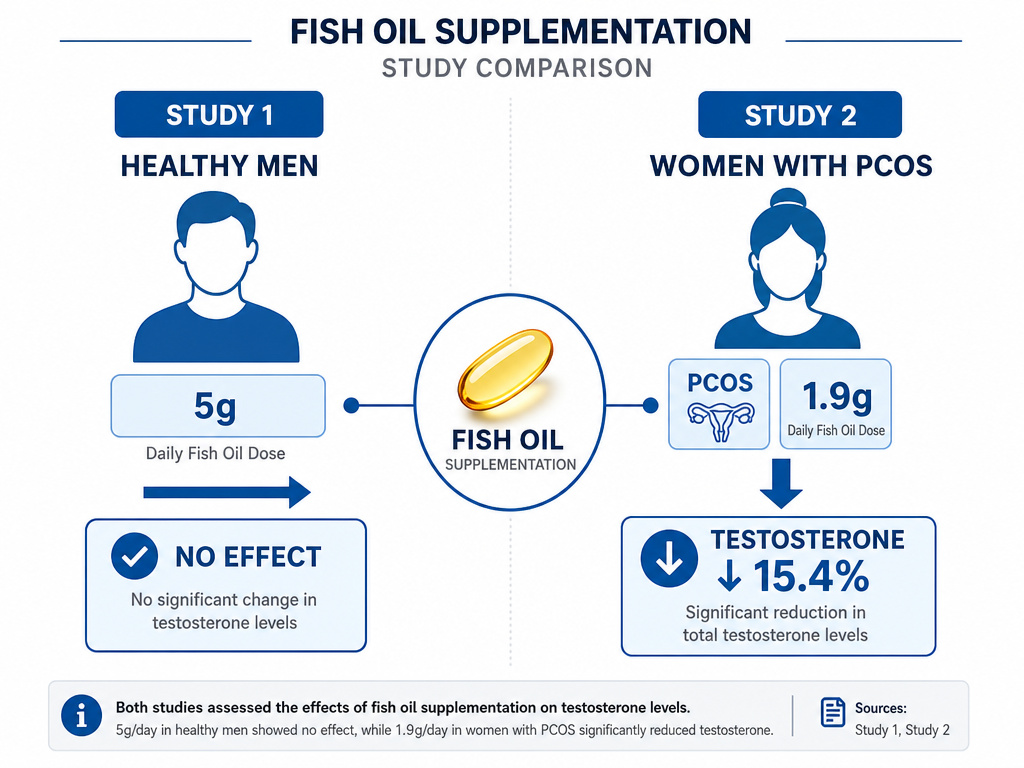
- A 1990 crossover trial gave 26 men a very high dose of 5 grams of EPA-DHA daily for 30 days and found no effect on testosterone.
- A 2011 trial in 22 women with PCOS used 1.9g of EPA and DHA daily for 6 weeks and found it reduced bioavailable testosterone levels.
Easy to miss: The evidence for fish oil lowering testosterone comes from a rat model and a study on women with a hormonal disorder. For healthy men, the risk appears minimal, but the data for a strong increase is also limited to specific groups.
The mechanism in the rat study involved downregulating mRNA expression levels of steroidogenic genes. Whether this translates to humans, especially at normal supplemental doses, is unknown.
This is where an evidence-based approach protects you. You’re not looking for a magic bullet. You’re looking for a signal that applies to you. For a high-dose therapeutic protocol, the picture is less clear.
Fish Oil vs. Other Testosterone Support Strategies
Putting fish oil in context is crucial. It’s one lever among many. How does it stack up?
First, the basics dwarf any supplement. Inadequate sleep, chronic stress, and excessive alcohol are proven testosterone killers. Fixing those will have a larger and more reliable effect than any bottle of pills.
For direct nutritional support, the evidence hierarchy looks something like this:
- Vitamin D Correction: Strong, consistent evidence that restoring deficient vitamin D levels raises testosterone. This is a first-line test and intervention.
- Zinc Sufficiency: Correcting a zinc deficiency has a clear positive effect. However, excess zinc can disrupt copper balance and stop being helpful.
- Magnesium: Supports sleep quality and metabolic function, indirectly supporting healthy hormone levels.
- Fish Oil / Omega-3s: The evidence is positive but conditional (dependent on weight, specific fatty acid, source).
- Herbal Adaptogens (e.g., Ashwagandha, Tongkat Ali): Good evidence for reducing stress and cortisol, which can secondarily support testosterone. Less direct evidence for raising T in already healthy men.
If you’re considering a testosterone supplements stack, the boring nutrients like vitamin D, magnesium, and zinc should be the foundation. Fish oil sits in the next tier, potentially useful, but not a cornerstone.
How to Use This Information: A Practical Framework
So, should you take fish oil for testosterone? Follow a decision tree.
Step 1: Check your context.
- Are you overweight or obese? The 2020 trial’s positive signal applies to you.
- Are you older with significant cardiovascular issues? The Alpha Omega Trial suggests don’t expect a hormonal benefit.
- Are you lean, young, and healthy? The data for a direct boost is weakest here.
Step 2: Prioritize food first.
Aim to include fatty and lean fish in your diet. The Hitachi study suggests there’s value in lean fish beyond just EPA and DHA. A varied seafood intake covers your bases for DPA, protein, selenium, and vitamin D.
Step 3: If supplementing, be specific.
If you fall into the “may benefit” category and choose to supplement:
- Look for a dose that matches the research. A supplement providing ~1,000 mg of omega-3s with a high DHA ratio (like the 860 mg DHA / 120 mg EPA used) is your target.
- Give it time. The studies showing effects ran for 12 weeks to 41 months. This isn’t an acute booster.
Step 4: Manage expectations.
The increases shown in the positive studies are modest, meaningful in a population, but not life-changing for an individual. It’s a support player, not the star. Your results are the real test.
How do I pick a good fish oil supplement?
Given the mixed research on fish oil and testosterone, selecting a supplement is about ensuring you get what the label promises. The 2020 trial that showed a benefit used a specific dose of DHA and EPA. A 2025 large analysis highlighted DPA’s association with testosterone levels.
Frequently Asked Questions
Is fish oil a proven testosterone booster?
For the general population, no. It is a conditional supporter. Proven increases are documented only in specific groups, primarily overweight and obese men using a high-DHA formula. For others, the evidence is mixed or shows no effect.
Which omega-3 is best for testosterone?
Current population data points to docosapentaenoic acid (DPA) as having the strongest consistent link to higher testosterone levels in men. However, the most positive clinical trial used a DHA-rich formula. Both EPA and DHA are important, but DPA from food may be an underrated player.
Can fish oil lower testosterone?
In healthy men at standard supplemental doses, there’s no strong evidence it lowers testosterone. One rat study and a study in women with PCOS showed decreases, but these findings haven’t been replicated in human male trials. The risk appears low.
How much fish oil should I take for testosterone?
The only dose shown to increase testosterone in a human trial is 860 mg of DHA plus 120 mg of EPA daily (total 980 mg omega-3s). Most generic 1,000 mg fish oil capsules contain only 300-500 mg of combined EPA/DHA, so check the label and dose accordingly.
Is eating fish better than taking supplements for testosterone?
The observational data suggests it might be. The Hitachi study found a link with lean fish intake, not supplements or even fatty fish. Whole fish provides a matrix of protein, vitamin D, selenium, and other nutrients that may work synergistically, which isolated omega-3 fatty acids in a capsule do not.
Before You Go
The research on fish oil and testosterone is a case study in nutritional nuance. It works for some, under specific conditions, with a specific type.
If you’re looking for a natural lever to pull, start with the basics: sleep, stress, vitamin D, and zinc status. If you’re carrying extra weight, a high-quality, high-DHA fish oil supplement is a rational experiment to run for 3-4 months, tracking how you feel.
But don’t expect a miracle from the bottle. The strongest signal in all this data is that foundational health, managing your weight, eating whole foods, is the most reliable path to robust hormone levels. Everything else is a fine-tune.
