
Does High Testosterone Cause Hair Loss? The DHT Connection
This post contains affiliate links. As an Amazon Associate, we earn from qualifying purchases.
High testosterone does not directly cause hair loss. The real culprit is dihydrotestosterone (DHT), a hormone converted from testosterone. Whether high testosterone leads to hair loss depends entirely on your genetics, specifically, how sensitive your hair follicles are to DHT. For most men with male pattern baldness, genetics are the primary driver, not circulating testosterone levels.
That genetic sensitivity is the whole game. It explains why two men with identical testosterone levels can have completely different hairlines. A common question is: does high testosterone cause hair loss? Your body’s internal instructions decide if a given amount of DHT will shrink a follicle over years or leave it untouched.
What follows is a breakdown of the DHT mechanism, what the latest population studies actually show about testosterone levels, and a practical guide for what to do next, whether you’re worried about natural levels, considering TRT, or already seeing thinning.
Key Takeaways
- Hair loss in male pattern baldness is driven by follicle sensitivity to DHT, not by high testosterone itself.
- A major population study in JAMA Dermatology found no significant link between serum testosterone levels and male hair loss in the general population.
- The vertex (crown) of the scalp shows a stronger link to hormone levels in some studies than the frontal hairline.
- Testosterone Replacement Therapy (TRT) carries a potential hair loss risk by increasing DHT substrate, but the effect varies widely by individual genetics.
- If you are losing hair and use performance-enhancing steroids, know that finasteride may not work against many synthetic androgens.
The DHT Connection: Why Testosterone Itself Isn’t the Villain
Think of testosterone as raw material and DHT as a specialized, more potent derivative. An enzyme called 5-alpha-reductase converts a small percentage of your testosterone into DHT. This happens locally in tissues like the scalp and prostate.
For hair follicles genetically programmed to be sensitive, DHT is a shrinking signal. It gradually miniaturizes the follicle over many growth cycles. The hair produced gets finer and shorter until, eventually, it stops growing visibly. This process is androgenetic alopecia, genetic, hormone-influenced hair loss.
This is the core mechanism: 5-alpha-reductase converts testosterone to DHT at the follicle. Genetically sensitive follicles react by shrinking. Without the enzyme or the sensitivity, high testosterone alone does not trigger this cascade.
The amount of conversion isn’t linear. You can have high testosterone but low 5-alpha-reductase activity, resulting in modest DHT. Conversely, someone with average testosterone but high conversion activity can have elevated local DHT levels. This is why focusing solely on a total testosterone number is misleading for hair loss concerns.
Your genetic sensitivity is inherited. It determines if your follicles see DHT as a threat. This sensitivity is why the pattern of loss is so predictable, it follows the follicles with the highest density of androgen receptors, typically at the temples and crown.
What the Population Studies Actually Say
The intuitive idea behind the does high testosterone cause hair loss question, more testosterone equals more hair loss, has been tested. The data is messy, which is itself an important finding.
A pivotal study published in JAMA Dermatology looked at men from the general population. It found no significant association between serum levels of total testosterone, free testosterone, or androstenedione and male pattern hair loss. The relative risk for total testosterone was 0.77. For free testosterone, it was 0.98. These numbers cluster around 1.0, indicating no meaningful link.
This JAMA Dermatology population study is a key reason experts now downplay circulating testosterone as a primary cause.
Other research complicates the picture. Another study in that review found DHT concentrations were significantly elevated in the hair loss group compared to control subjects (mean of 71.84 ng/ml vs. 1.41 ng/ml). Yet the same study found no significant difference in hormone levels between the frontal baldness and no-hair-loss groups.
This suggests the vertex (crown) might be more hormonally responsive than the frontal hairline. Another study in that review found dramatically higher DHT levels in a hair loss group versus controls (71.84 ng/ml vs. 1.41 ng/ml), but such extreme ranges often point to other factors, like the use of external androgens.
| Study Focus | Key Finding on Testosterone & Hair Loss | What It Suggests |
|---|---|---|
| General Population (2017) | No significant association between serum testosterone and hair loss. | For most men, natural testosterone levels aren’t the deciding factor. |
| Vertex Baldness (2024 Review) | Higher testosterone levels correlated with crown loss, but not frontal loss. | Hair loss pattern matters; the crown may be more hormone-sensitive. |
| Athletic Testosterone Use (2024 Review) | Elevated DHT is a common thread, but data is self-reported and mixed. | External testosterone use changes the risk equation significantly. |
The takeaway isn’t that science is confused. It’s that the relationship is non-linear and pattern-dependent. A single hormone level in your blood is a poor predictor of your scalp’s fate.
High Testosterone vs. Low Testosterone: A Hair Loss Paradox
This is where it gets counterintuitive. Low testosterone is also associated with hair loss, but for different reasons. Severe or prolonged low T can shift hair growth cycles, leading to a diffuse, overall thinning rather than the patterned recession of androgenetic alopecia. It’s more about the hair shedding from a lack of support than from miniaturization by DHT.
So, we have a spectrum:
- Very Low T: Can cause generalized thinning due to poor follicle health and support.
- Normal to High T: No direct causal link to patterned loss for most men; genetics and DHT sensitivity rule.
- Exogenously High T (TRT/Steroids): Increases DHT substrate, potentially accelerating genetic hair loss.
This creates a paradox for men on the border of the does high testosterone cause hair loss debate. If you have symptoms of low T and hair loss, treating the low T with replacement therapy might improve your overall well-being but could also accelerate pattern loss if you’re genetically prone. It’s a trade-off that requires a clear conversation with your doctor.
For a deeper look at this dynamic, our article on low testosterone and hair loss breaks down the mechanisms of thinning from deficiency.
What If You’re on TRT or Steroids?
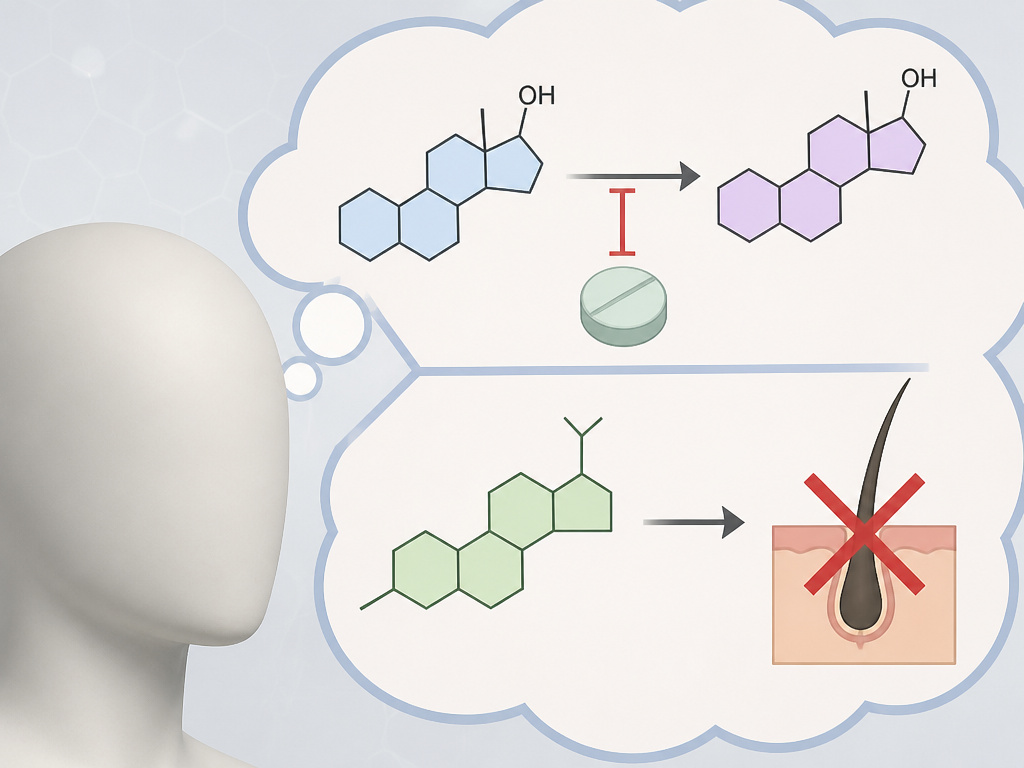
This changes the risk calculation. When you introduce external testosterone, you’re providing more raw material for 5-alpha-reductase to convert into DHT. If your follicles are sensitive, you are effectively pouring fuel on a smoldering fire.
The PMC narrative review on athletes notes that among anabolic-androgenic steroid users, alopecia is a potential risk. Another cited case involved a man developing noticeable pattern loss just one year after starting testosterone pellets.
Where this goes sideways: Assuming finasteride will fully protect you on steroid cycles. Studies are lacking on the efficacy of finasteride in preventing hair loss among anabolic-androgenic steroid users, especially those on high doses of testosterone.
If you are on legitimate testosterone replacement therapy under a doctor’s care, the approach is different. Here, the goal is to replace a deficiency, not to exceed natural limits. The hair loss risk exists but is manageable. Discussing a DHT blocker like finasteride with your prescribing doctor at the start of therapy is a common strategy to mitigate this side effect.
However, it’s crucial to understand the difference between testosterone and DHT before starting any blocker, as DHT plays important roles in libido, muscle, and brain function.
The Gender Exception: When High Testosterone Helps Hair
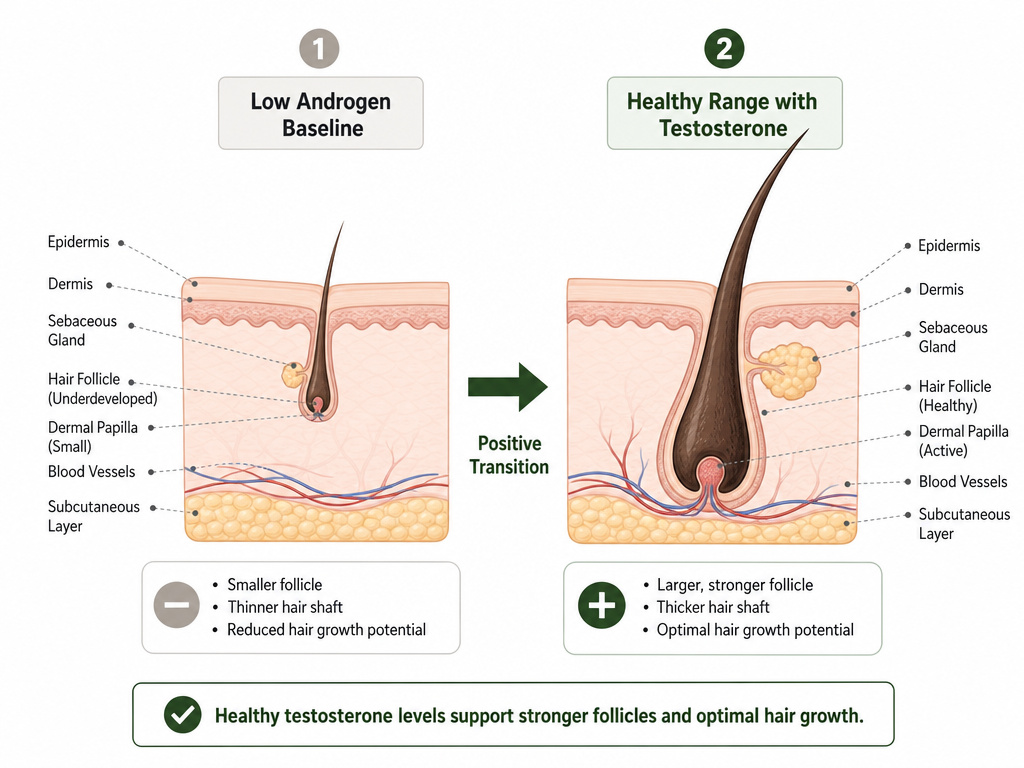
Here’s a critical edge case that proves the rule.
Why the opposite effect? In women with clinically low androgens, hair follicles can be under-stimulated. Providing testosterone brings them into a healthy functional range without triggering the aggressive miniaturization seen in genetically prone men. This starkly highlights that context, your starting hormonal baseline and your sex, dictates the outcome.
What You Should Do Next: A Practical Checklist
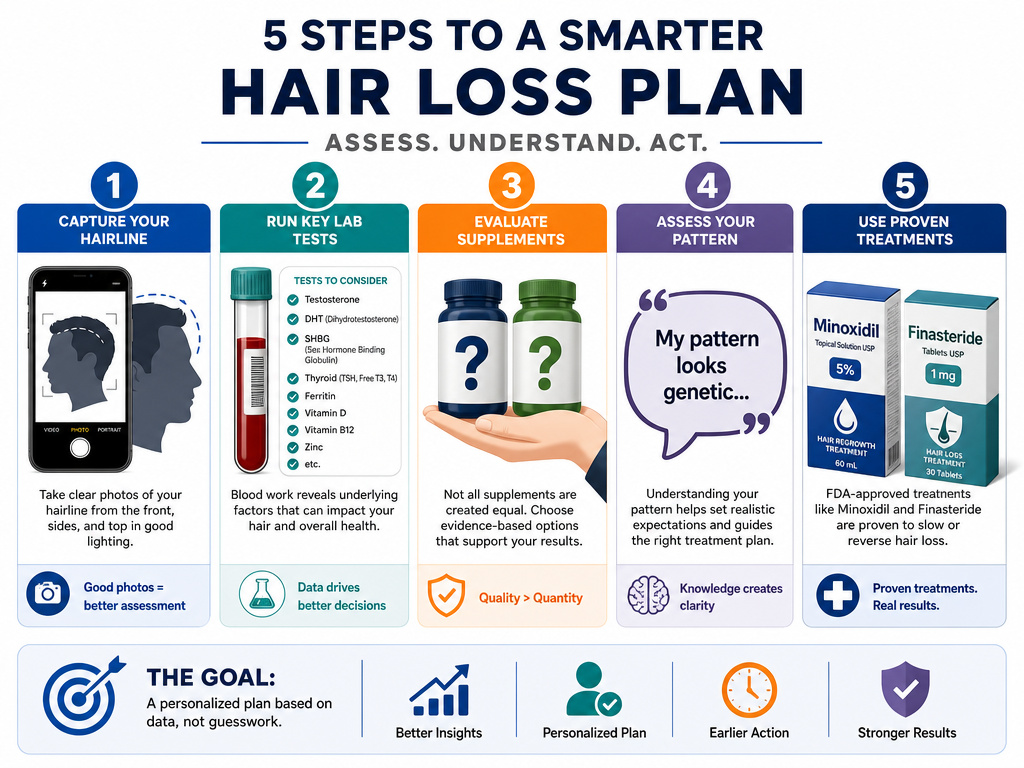
If you’re concerned about hair loss and testosterone, either naturally or due to medication, this sequence saves time and money.
- Map Your Pattern. Take clear, well-lit photos of your hairline and crown every 3-6 months. Patterned recession (temples, crown) points toward androgenetic alopecia. Diffuse thinning everywhere suggests other causes like thyroid issues, nutrient deficiencies, or stress.
- Ask your doctor for a blood panel that goes beyond total testosterone. Ask your doctor for a panel that goes beyond total testosterone. You need:
- Free Testosterone
- DHT (if available)
- SHBG (Sex Hormone Binding Globulin)
- Thyroid Panel (TSH, Free T3, Free T4)
- Ferritin (iron storage)
- Vitamin D This panel helps rule out other common causes of thinning. Low ferritin or thyroid dysfunction can mimic hormonal hair loss.
- Audit Your Supplements & Medications. Are you taking anything that could affect hormones? This includes over-the-counter DHT blocker supplements, performance supplements like creatine (which some suspect may influence DHT), or prescription steroids. Document everything for your doctor.
- Have a Specific Talk With Your Doctor. Go beyond “I’m losing hair.” Frame the conversation with your evidence: “My pattern looks genetic, and I’m on TRT. Can we discuss adding a topical DHT blocker or low-dose finasteride to mitigate acceleration?” or “My thinning is diffuse; could we check my ferritin and thyroid?”
- Consider Early Intervention. If it’s androgenetic alopecia, the most effective treatments are minoxidil (Rogaine) and finasteride (Propecia). Minoxidil works by prolonging the growth phase. Finasteride is a 5-alpha-reductase inhibitor that reduces DHT production. They work best to stabilize loss and regrow recent hair, not to resurrect long-dead follicles.
For those seeking non-pharmaceutical paths, research on how to lower DHT naturally explores diet and lifestyle factors, though their efficacy is modest compared to medication.
Frequently Asked Questions
Will testosterone increase hair loss?
If you are genetically prone to male pattern baldness, increasing your testosterone levels (via TRT or steroids) can accelerate hair loss by providing more substrate for DHT conversion. If you are not genetically prone, it likely won’t. Natural variations in testosterone are not a proven cause.
What are signs of high testosterone?
Signs can include increased muscle mass, aggressive or competitive drive, high libido, oily skin, and acne. However, these are non-specific and can have other causes. The only way to know is through blood testing. You can learn more about the signs of high testosterone for a fuller picture.
Why is Gen Z balding so fast?
Perceived faster balding in younger generations is likely due to a combination of increased awareness (social media, selfies), higher rates of stress and poor sleep, and the earlier use of performance-enhancing drugs or supplements that can affect hormones. The underlying genetics haven’t changed.
What are the big 3 for thinning hair?
In dermatology, the “Big 3” for treating androgenetic alopecia are:
- Minoxidil: A topical vasodilator that stimulates hair growth.
- Finasteride/Dutasteride: Oral 5-alpha-reductase inhibitors that reduce DHT.
- Low-Level Laser Therapy (LLLT): Devices like laser caps that may stimulate follicle activity. Consistent routine with these offers the best chance to halt progression and regrow hair.
Does creatine cause hair loss?
The link between creatine and hair loss is not proven. Some small, older studies suggested creatine might increase DHT, but the evidence is weak and hasn’t been replicated in larger, more robust trials. For most people, creatine is not a meaningful risk factor for baldness.
Before You Go
The fear that high testosterone equals a receding hairline is outdated. The evidence points to your genetic blueprint as the foreman, with DHT as its tool of choice. A high testosterone level without the genetic sensitivity is like having extra lumber but no blueprint to build a house, it just sits there.
If you’re considering TRT and are worried about hair, have the conversation upfront. The question for your doctor isn’t “Will I lose hair?” but “Given my family history and current hair state, what’s our plan to monitor and mitigate potential hair loss as part of this therapy?” That’s a proactive, evidence-based approach.
And if you’re using performance-enhancing steroids without a medical need, understand that you are deliberately stacking the deck against your hair follicles. In that scenario, over-the-counter solutions often can’t keep up.
Start with the photos and the blood work. Let the data, not the anxiety, guide your next step.
