
Does TRT Affect Kidney Function? A Data-Driven Look
This post contains affiliate links. As an Amazon Associate, we earn from qualifying purchases.
Testosterone replacement therapy (TRT) affects kidney function, but research presents conflicting conclusions. Some observational studies in hypogonadal men suggest long-term TRT may improve kidney markers like glomerular filtration rate (GFR). However, other studies, including case reports in patients with chronic kidney disease (CKD) and analyses of men with cardiovascular risks, indicate TRT may be harmful to kidney function and carries an increased risk of acute kidney injury (AKI).
That gap between potential benefit and proven harm is where the confusion lives. It is a matter of matching the therapy to a specific physiological starting point, not one of “good” or “bad”. A one-size-fits-all answer doesn’t exist here, and a key question for many is: does TRT affect kidney function?
What follows is a breakdown of the opposing data, the mechanisms at play, and the specific monitoring steps that separate a safe protocol from a dangerous one. We’ll walk through the studies that show improvement, the case reports that show acute failure, and the practical thresholds that should guide any decision.
Key Takeaways
- The evidence splits: an 8-year observational study found TRT improved average GFR from 87.0 to 98.0 mL/min/1.73 m², while a retrospective analysis linked TRT to an increased risk of acute kidney injury (AKI).
- Pre-existing kidney disease changes everything. A single 50mg testosterone injection caused a 14-year-old’s creatinine to spike from 140 to 473 μmol/l within a month.
- Cardiovascular risk is a kidney risk. Men with underlying heart disease or its risk factors face the highest AKI danger from TRT, per recent validation studies.
- Monitor three things before starting: a full metabolic panel, blood pressure, and a careful review of all medications, especially NSAIDs.
- Retest on a schedule. Get new kidney function labs at 8-12 weeks after initiation, not just at the one-year mark.
The Core Conflict in the Data
Open any three studies on testosterone and kidney function, and you’ll likely get three different conclusions. This reflects the study of vastly different patient populations, rather than being poor science. The central question isn’t “Does TRT affect the kidneys?” It’s “Whose kidneys are we talking about, and what shape were they in to begin with?” This is the core of the does trt affect kidney function debate.
One major observational cohort study on TRT followed nearly 500 hypogonadal men for up to eight years. The men received injections of testosterone undecanoate (TU) 1000 mg every 12 weeks after a loading phase. The result? Their average glomerular filtration rate (GFR), calculated by Mayo Clinic guidelines, improved significantly from 87.0 to 98.0 mL/min/1.73 m². Urea and uric acid levels dropped. The authors concluded long-term therapy could be renoprotective.
Now read the case report titled “Is Testosterone Detrimental to Renal Function?“. It details a 14-year-old with pre-existing CKD stage 3. Two weeks after a single, standard 50mg testosterone injection, his serum creatinine rose from 140 μmol/l to 206 μmol/l. One month post-injection, it peaked at 473 μmol/l. Advanced imaging showed a direct link to reduced renal cortical blood flow.
Where this goes sideways: Assuming your kidneys are in the same category as the study population you’re reading about. The 8-year improvement study looked at hypogonadal men without severe comorbid disease. The case report involved a patient with established CKD. Your starting point dictates which set of data applies to you.
The table below lays out this fundamental disagreement. It’s the first thing any doctor should review with a patient considering therapy.
| Study Focus | Patient Population | Key Finding on Kidney Function | Implied Risk |
|---|---|---|---|
| Long-Term TRT (8-year study) | Hypogonadal men, generally healthy | GFR improved (87.0 → 98.0 mL/min/1.73 m²); Urea/Uric Acid reduced | Appears Low |
| Acute Testosterone Exposure | Patient with pre-existing CKD (Stage 3) | Creatinine spiked 238% within one month; Cortical blood flow reduced | Very High |
| TRT & Cardiovascular Risk | Men with CV disease/risk factors | Associated with significantly increased risk of Acute Kidney Injury (AKI) | High |
| Transgender Hormone Therapy | Individuals starting masculinizing therapy | Suggests testosterone may be harmful to kidney function | Moderate |
How Could TRT Possibly Improve Kidney Function?
This is the counterintuitive part for many when you consider the does trt affect kidney function question. If testosterone can be harmful, how did that 8-year study show clear improvement? The mechanism isn’t direct; it’s through systemic improvements.
Low testosterone is often part of a metabolic syndrome picture, it’s linked to insulin resistance, poor vascular health, and chronic inflammation. All of these are hard on the kidneys. By correcting the hormonal deficiency, TRT can lead to better blood sugar control, reduced body fat, and improved endothelial function. These downstream effects can reduce the constant inflammatory and hemodynamic stress on the kidneys, potentially allowing measured function (like GFR) to improve.
Think of it like this: the kidneys were being stressed by the overall metabolic environment. Fixing testosterone was one part of fixing that environment. The kidney improvement was a side effect of better whole-body health, not a direct action of testosterone on nephrons.
The calculated GFR improvement from 87.0 to 98.0 mL/min/1.73 m² in the long-term study is meaningful. In clinical terms, that’s a shift from the low end of normal range to solidly mid-normal. It suggests a removal of some functional suppression.
This is why context is essential. If your low testosterone is part of a broader metabolic issue and your kidneys are otherwise healthy, therapy might help them. But if your kidneys are already damaged, they may not have the reserve to handle any change, let alone a potent hormone.
The Proven Mechanisms of Harm: AKI and Blood Flow
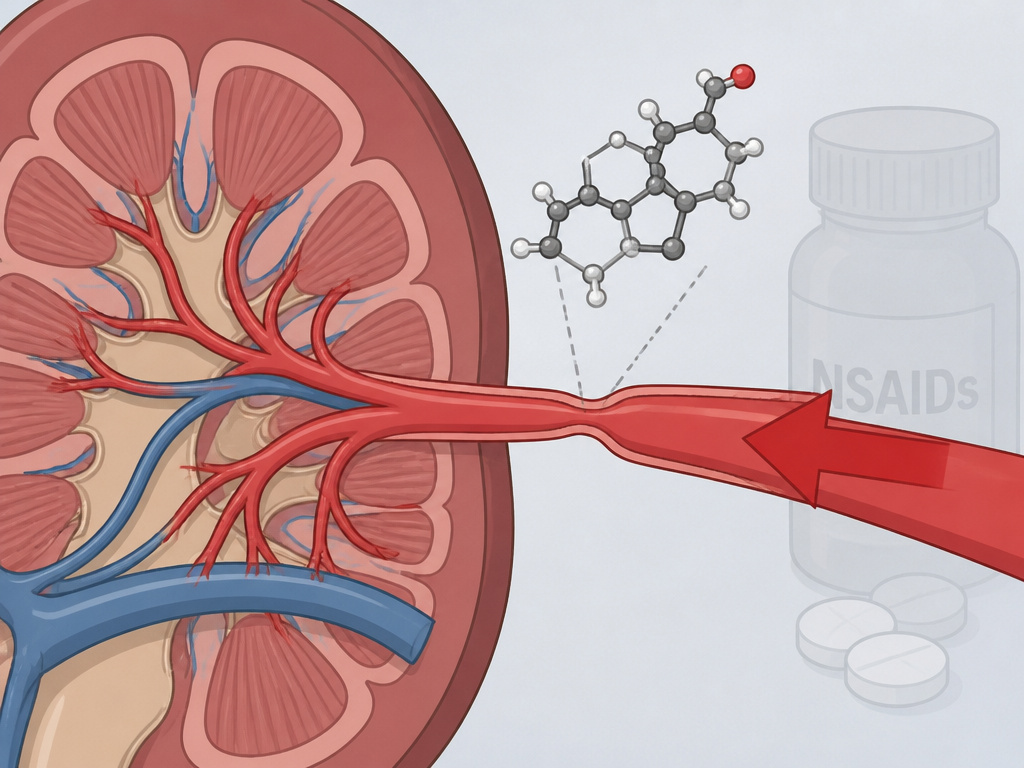
For patients with compromised kidneys or cardiovascular systems, the mechanisms of harm are more direct and dangerous. The primary risk is acute kidney injury (AKI), and the evidence here is becoming harder to ignore.
A 2024 retrospective validation study, published as a journal article on TRT complications, aimed to confirm findings from the large TRAVERSE trial. It found that hypogonadal men with underlying cardiovascular risk factors or pre-existing cardiovascular disease who receive TRT may be at increased risk of AKI.
The “how” is traced to hemodynamics, how blood flows through the kidneys. In the pediatric case report, the deterioration of renal function was linked to reduced renal cortical blood flow following testosterone exposure. In a kidney with already reduced blood flow, a further reduction can impair filtration.
Common mistake: Focusing only on testosterone and ignoring the other medications in the mix. Many men on TRT also take NSAIDs for pain or other medications that affect kidney perfusion. The combination creates a perfect storm for reduced renal blood flow.
This is where the link between chronic kidney disease and low testosterone becomes a critical chicken-or-egg dilemma. Does kidney disease cause low testosterone (very common), or does treating the low testosterone then worsen the kidney disease? For many patients, it’s the former. Starting TRT without thoroughly checking kidney status is how you end up with the second.
Monitoring Kidney Function on TRT: A Non-Negotiable Schedule
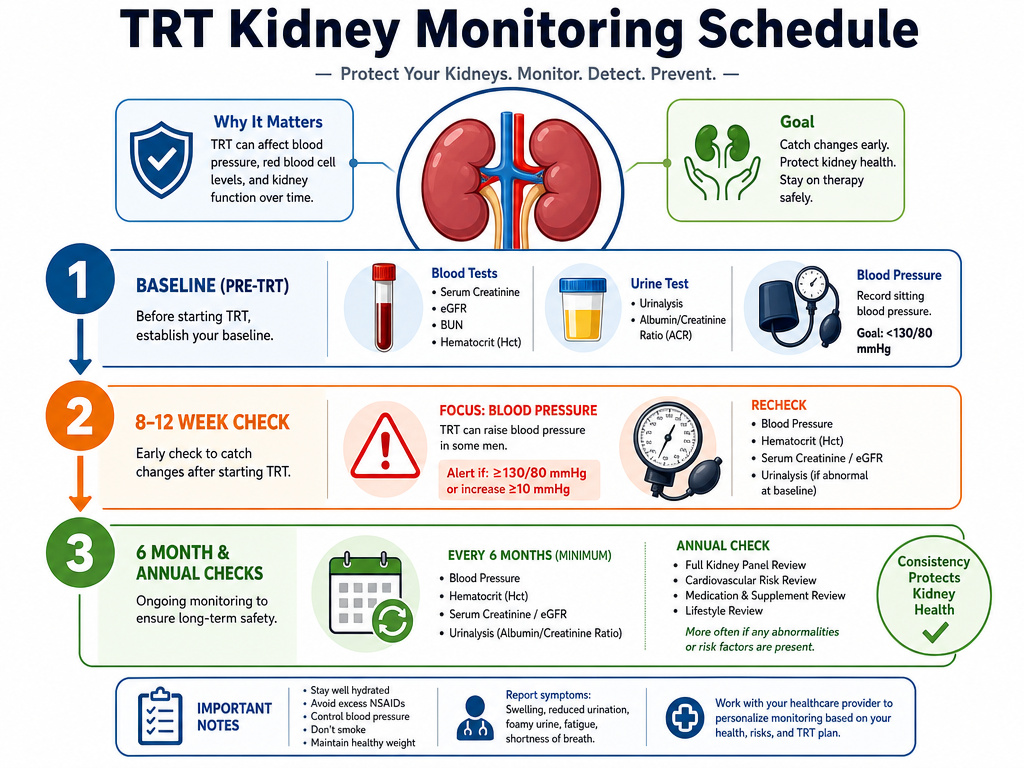
This is the practical takeaway. You cannot manage what you don’t measure, and with TRT, guessing about kidney function is a high-stakes gamble. The monitoring schedule isn’t just a formality; it’s your early-warning system.
Your baseline, before the first dose, is the most important set of labs you’ll get. It must include:
- Serum Creatinine & eGFR: The standard kidney function markers.
- Blood Urea Nitrogen (BUN) & Electrolytes: For a broader metabolic picture.
- Urinalysis: To check for protein or blood, which indicate kidney damage.
- Blood Pressure: Taken properly, seated and rested.
From there, the clock starts. Here is the retesting schedule that catches problems early:
- The 8-12 Week Check: This is your first safety stop. Kidney function and blood pressure must be reassessed. This is when early fluid retention or a subtle creatinine creep will show up.
- The 6-Month Follow-Up: If stable at 12 weeks, the next check is at 6 months. This consolidates the trend.
- Annual Monitoring Thereafter: Assuming stability, annual checks become the standard. Any change in health status, new medication, a surgery, a cardiac event, resets the clock and demands a new kidney panel.
This schedule integrates with the broader essential blood tests for TRT, which track hematocrit, lipids, and liver enzymes. Kidney health doesn’t exist in a vacuum.
I’ve seen lab results where a man’s eGFR dropped 15 points between his baseline and his 3-month check. The cause wasn’t the testosterone itself, but new-onset hypertension risk that hadn’t been managed. The TRT didn’t cause the kidney stress; the uncontrolled blood pressure did. But without the scheduled check, we wouldn’t have caught it for a year.
Special Considerations: CKD, Cardiovascular Risk, and Medications
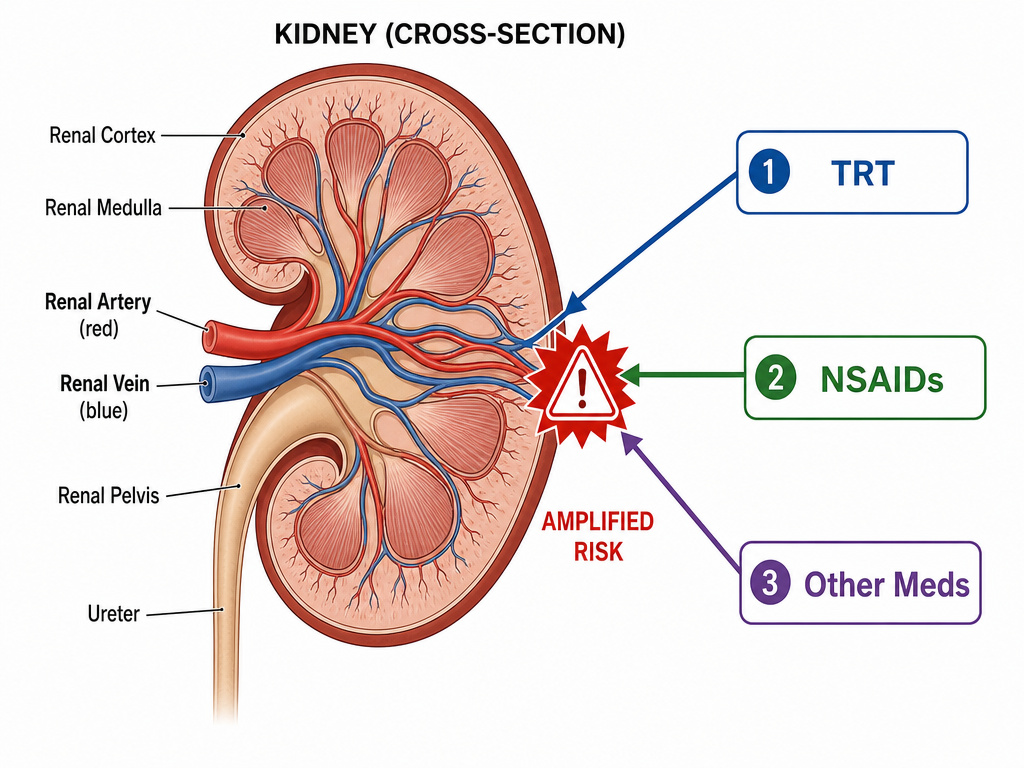
If you have a known condition, the standard rules don’t apply. Your protocol needs to be built on caution.
For Patients with Chronic Kidney Disease (CKD):
The pediatric case report is your cautionary tale. Any TRT in this population must be considered experimental and undertaken only with extreme caution under specialist care. Doses are typically much lower, and monitoring is weekly at the start. The goal is not to optimize testosterone levels but to cautiously alleviate symptoms without causing harm. The pros and cons calculation here is starkly different.
For Patients with Cardiovascular Disease:
The recent AKI risk data is specifically for you. This doesn’t mean TRT is automatically forbidden, but it means the justification must be stronger and the surveillance must be relentless. Your nephrologist and cardiologist need to be in the loop before you even consider a prescription.
Medication Interactions:
This is the silent amplifier. Testosterone’s potential impact on renal blood flow is bad enough. Combine it with NSAIDs (like ibuprofen or naproxen), which also reduce kidney perfusion, and you’re stacking risks. Certain antibiotics, ACE inhibitors, and diuretics also interact. A complete medication review is a mandatory part of the pre-TRT workup.
Can TRT improve kidney function?
Some long-term observational data suggests testosterone therapy may improve kidney function in men with low testosterone. One study followed hypogonadal men for up to eight years and found that treatment significantly improved their glomerular filtration rate, a key measure of kidney function. The same study reported significant reductions in urea and uric acid levels. This points to a potential renoprotective effect when TRT is administered long-term to this specific population. However, these findings are not universal and come from observational research, not controlled trials.
How does TRT indirectly affect the kidneys?
Testosterone therapy can influence kidney health through secondary effects on the body. It can increase red blood cell production, leading to higher hematocrit, which thickens the blood. This altered blood viscosity may affect blood flow and pressure within the kidneys. For individuals with cardiovascular risk factors, TRT may be associated with an increased risk of acute kidney injury (AKI). Managing these indirect effects is a critical part of a safe TRT protocol, as they can create conditions that may compromise renal function over time.
Is TRT safe with pre-existing kidney disease?
For men with pre-existing kidney disease, starting TRT requires extreme caution. Evidence is conflicting; some studies show improvement in hypogonadal men, while case reports document acute, significant deterioration in kidney function after a single testosterone dose in a patient with chronic kidney disease. This decline has been linked to reduced blood flow within the kidney cortex. A separate analysis suggests men with cardiovascular risk factors on TRT may face an increased risk of acute kidney injury. Therefore, initiating therapy demands a conservative approach with very close, frequent monitoring of kidney function markers.
Frequently Asked Questions
Can TRT increase creatinine levels?
Yes, it can. Creatinine is a byproduct of muscle metabolism. Since TRT can increase muscle mass, a slight, stable rise in creatinine (and a corresponding dip in calculated eGFR) is common and doesn’t necessarily indicate kidney damage. However, a rapid or large rise is a red flag for acute kidney injury and requires immediate investigation.
Does TRT cause water retention that hurts the kidneys?
Fluid retention on TRT is a common early side effect. For most, it’s mild and transient. However, significant edema can increase blood pressure and strain the kidneys. This is why monitoring blood pressure at every visit is critical. Managing this retention, through dose adjustment, diet, or medication, is key to renal safety.
I have stage 2 CKD. Is TRT completely off the table?
Not necessarily, but it enters a high-risk, high-caution category. The decision requires a detailed discussion with both a urologist/endocrinologist and a nephrologist. The potential benefits for quality of life must be weighed against the very real risk of accelerating kidney decline. If pursued, it would be with a lower-dose protocol and very frequent (likely monthly) kidney function monitoring.
How does TRT affect kidney stone risk?
This is an area with less direct data. Since calcium is a component of the most common kidney stones, there’s a theoretical risk increase. Staying well-hydrated is the best preventative measure. If you have a history of stones, discuss this with your doctor.
Before You Go
The kidney question with TRT is about applying the right data to the right person, not finding a universal truth. The 53% higher AKI risk in one group and the 11-point GFR improvement in another are both true, they just describe different roads.
Your single most important task is to know which road you’re on before you take the first step. That means full baseline labs, an honest assessment of your cardiovascular and kidney health, and a doctor willing to look at the full map, not just the destination. The therapy that may benefit one man’s health may pose risks to another’s. The difference is in the details you choose to measure first.
