
FSH and HCG Therapy for Male Infertility: Key Takeaways
This post contains affiliate links. As an Amazon Associate, we earn from qualifying purchases.
FSH and HCG therapy for male infertility is a targeted hormone replacement protocol for men with hypogonadotropic hypogonadism (HH), where the brain fails to signal the testes. HCG mimics luteinizing hormone (LH) to stimulate testosterone production inside the testicles, while FSH directly drives sperm cell development. A 2024 study found 78% produced sperm within a median of 5 months, but achieving pregnancy took a median of 27 months and depended heavily on the female partner’s fertility status.
The numbers from that study are the clearest picture we have of what to expect. They show a progression: first sperm appear, then counts climb, and finally pregnancy happens, but each step has its own timeline and its own set of variables. The female partner’s fertility status wasn’t just a footnote; it was the single biggest factor in whether a pregnancy occurred and how long it took.
What follows is a breakdown of the mechanics, the realistic timelines from the latest data, the critical role of female factor assessment, and the practical differences in fsh and hcg therapy for male infertility protocols. This is specialist territory, and the goal is to set clear expectations before you ever sit down with a reproductive endocrinologist.
Key Takeaways
- 78% of men with HH produce sperm within a median of 5 months of starting combined FSH and HCG therapy, but reaching higher sperm counts takes longer, 12 months for >2 million/mL.
- The female partner’s fertility status is the major determinant of pregnancy success. Without adverse female factors, 75% of treatment cycles achieved pregnancy (median 15 months); with them, only 35% did (median 43 months).
- hCG monotherapy (without FSH) is only an option for men with larger pretreatment testicular volume (>4 mL); men with very small testes ( 20 M/mL) | 24% | Not determined |
Where this goes sideways: Focusing only on the first appearance of sperm. That initial 5-month milestone is encouraging, but it’s not the finish line. The sperm concentration needed for a reasonable shot at natural conception is a bigger hurdle. If you stop monitoring after sperm appear, you’ll miss the plateau that often comes next.
What Determines Your Personal Timeline?
The study identified specific factors that sped up or slowed down the process of reaching these sperm thresholds.
Bilateral cryptorchidism (undescended testes in both sides) had a significant negative impact. Men with this history had a much slower time to the initial appearance of sperm. Pretreatment testicular volume also mattered for reaching the higher concentration goals. It makes mechanical sense, a larger testis has more potential sperm-producing tissue to recruit.
Conversely, subsequent treatment cycles were faster. If a couple tried, succeeded, and then later wanted another child, the second round of therapy often produced sperm more quickly. The body, it seems, remembers the pathway.
Common mistake: Comparing your month-3 sperm count to someone else’s online log. Your starting point, testicle size, history of cryptorchidism, exact diagnosis, sets your baseline. Their timeline is not your timeline.
How Do Female Fertility Factors Change the Outcome?
This is the part most discussions about male infertility treatments gloss over. The 2024 study made it unmistakably clear: the presence of adverse female fertility factors was the major determinant of successful pregnancy, with a hazard ratio of 0.20. In plain terms, it reduced the chance of pregnancy by 80% compared to cycles with no female factors.
The data splits into two starkly different realities:
| Scenario | Pregnancy Rate | Median Time to Pregnancy | Median Sperm Conc. At Pregnancy | IVF Required |
|---|---|---|---|---|
| No Adverse Female Factors | 75% of cycles | 15 months | 2.8 million/mL | 11% of pregnancies |
| Adverse Female Factors Present | 35% of cycles | 43 months | 35.4 million/mL | 46% of pregnancies |
The takeaway from the fsh and hcg therapy for male infertility data is counterintuitive but critical. When the female partner has no fertility issues, pregnancy often occurs with relatively low sperm counts, a median of 2.8 million/mL, which is still considered subfertile by World Health Organization standards. The couple’s overall fertility is good enough to make it work.
When female factors like tubal disease, endometriosis, or advanced age are present, the goalposts move. Much higher sperm concentrations are typically needed, and the couple is far more likely to require IVF. This turns the treatment into a dual-sided project.
The practical step this forces is early and thorough evaluation of the female partner. It’s not an afterthought. It should happen concurrently with the male workup. Knowing this landscape upfront prevents months of frustration and sets realistic expectations for whether the end goal will be natural conception or assisted reproduction.
FSH and HCG Protocols: What Do the Labels Say vs. What Works?
There are two main sources of protocol guidance: the official drug labels from regulators like the EMA, and clinical studies that test variations. They don’t always align perfectly.
The Standard Combined Protocol
The GONAL-f (EMA) product information specifies a continual combined regimen. The indication is clear: for stimulation of spermatogenesis in men with hypogonadotrophic hypogonadism with concomitant hCG therapy. It states treatment with GONAL-f (FSH) and hCG for at least 4 months induces spermatogenesis.
This is the classic, ongoing approach: start both hormones together and continue them. The FDA label for Follistim AQ outlines a similar continual protocol.
The Sequential Protocol and hCG-Only Option
Clinical practice and research sometimes diverge. Some clinical studies have used a sequential protocol, starting with hCG alone and adding FSH if needed. This mirrors real-world cost and step-wise thinking.
Furthermore, 13% of treatment cycles in the study succeeded with hCG alone. These were almost exclusively men with larger pretreatment testicular volume (>4 mL). This suggests a trial of hCG monotherapy can be reasonable for a subset of patients, a nuance not found in the official label. However, the EMA label for GONAL-f indicates it is for use with concomitant hCG therapy, implying FSH is required.
Bottom line: The “correct” protocol isn’t one-size-fits-all. It’s a discussion between patient and doctor that weighs testicular volume, cost, and the evidence behind sequential versus continual dosing.
Who Is. And Isn’t. A Candidate for This Therapy?
This treatment has a specific target. It replaces missing signals. If the signals are already present but the factory is broken, it won’t work.
You ARE a candidate if you have: A confirmed diagnosis of hypogonadotropic hypogonadism (HH). This means low testosterone alongside inappropriately low or normal LH and FSH levels. Causes can be congenital (like Kallmann syndrome), or acquired from a pituitary tumor, injury, or other infiltrative disease.
You are NOT a candidate if you have: Primary testicular failure. The EMA label for GONAL-f is explicit: “Elevated endogenous FSH levels are indicative of primary testicular failure. Such patients are unresponsive to GONAL-f/hCG therapy.” If your FSH is already high, your pituitary is shouting at testes that can’t listen. No amount of external FSH will fix that.
The gray area is idiopathic male infertility (low sperm count with normal hormones). The evidence here is mixed. A systematic review on HCG use concluded evidence is limited. However, This is not first-line treatment and is entirely different from treating true HH.
Commercial availability and drug shortages
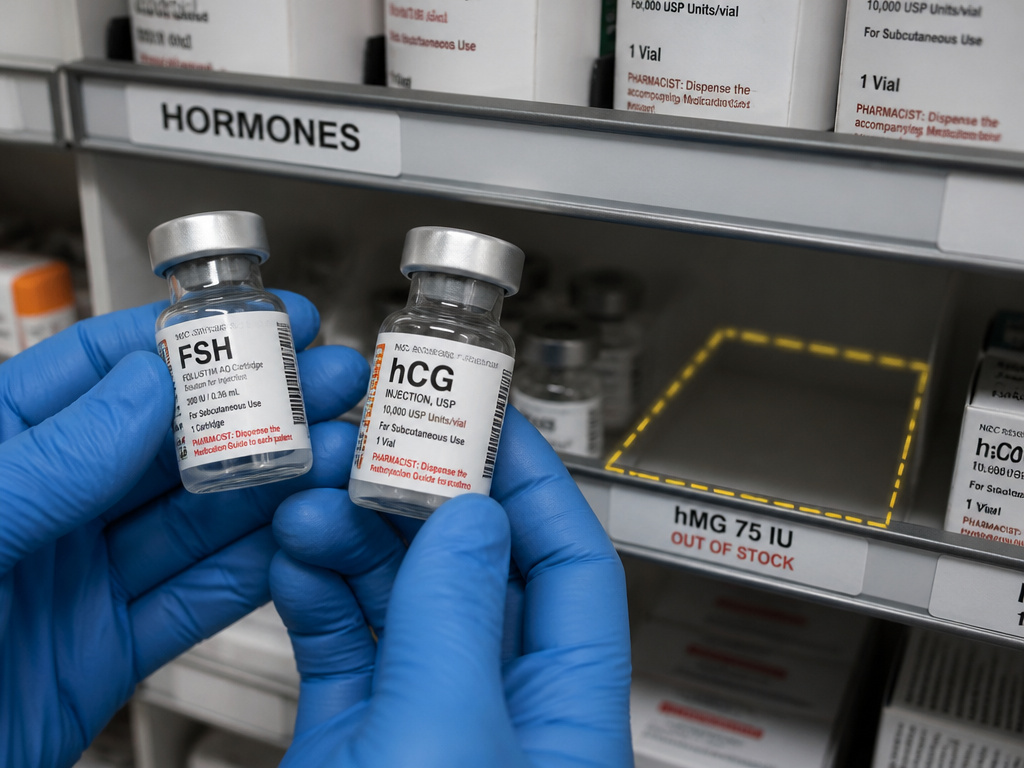
Medications containing FSH and hCG are prescription-only and manufactured by several pharmaceutical companies. These drugs are typically available through specialty pharmacies. However, supply chain issues can lead to periodic shortages, disrupting treatment schedules. Patients should be aware that their pharmacy may not always have their specific brand or formulation in stock. During a shortage, a doctor may need to prescribe an alternative product or adjust the treatment plan. It is practical to maintain open communication with both the prescribing physician and the pharmacy to manage any supply interruptions proactively.
Use for anabolic steroid recovery
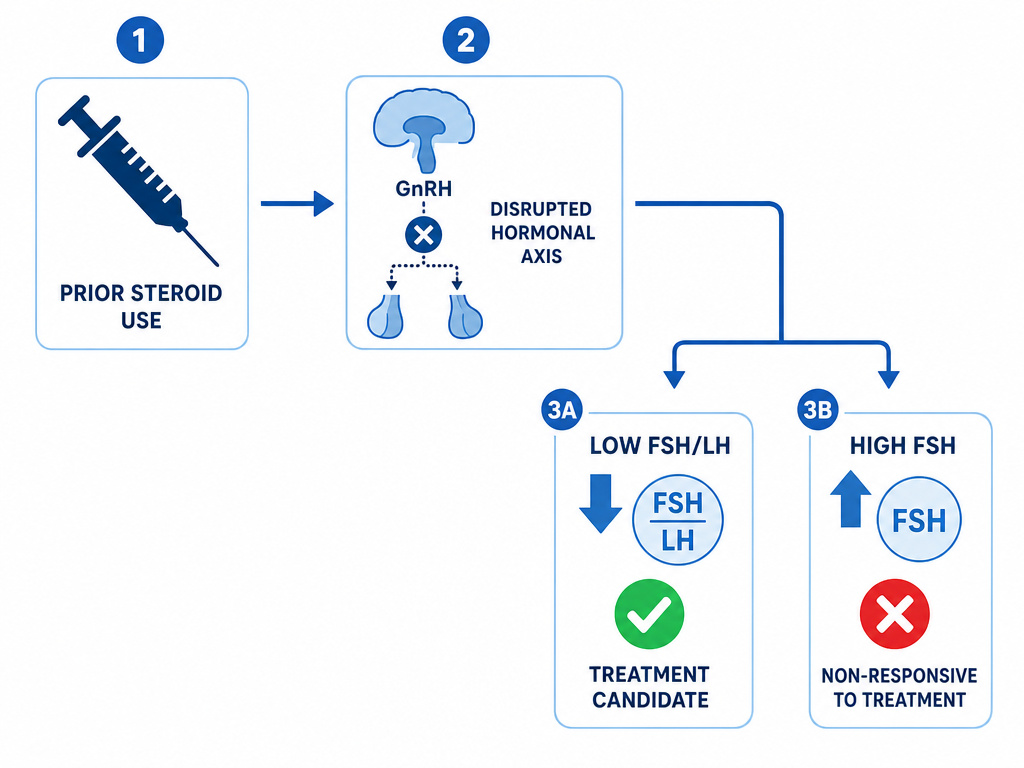
The use of FSH and hCG therapy for men recovering from anabolic steroid use is not an approved indication. The therapy is specifically indicated for men with congenital or acquired hypogonadotrophic hypogonadism. Men with elevated FSH levels, which can indicate primary testicular failure, are unresponsive to this treatment. For men whose infertility is related to prior steroid use, a thorough medical evaluation is necessary to determine the underlying cause of hormonal dysfunction. Treatment should only be pursued under the guidance of a specialist who can assess whether a therapeutic response can realistically be obtained.
Frequently Asked Questions
Can hCG and FSH be used to improve male fertility?
Yes, but only for a specific cause: hypogonadotropic hypogonadism (HH), where the brain doesn’t produce enough LH and FSH. For men with this diagnosis, hCG and FSH are replacement therapy that can successfully induce spermatogenesis. For other causes of infertility, like primary testicular failure or idiopathic issues, the evidence is weaker and it is not a standard treatment.
Is hCG better than TRT for fertility?
Yes, unequivocally. Testosterone replacement therapy (TRT) suppresses the hypothalamic-pituitary-gonadal HPG axis, shutting down LH, FSH, and your body’s own sperm production. HCG mimics LH, stimulating testosterone production within the testicles which supports, rather than suppresses, spermatogenesis. For men wishing to preserve or restore fertility, hCG is part of the solution; TRT is often the problem.
Will hCG bring back testicle size?
Often, yes. HCG stimulates Leydig cells in the testes to produce testosterone, which can increase testicular volume. This is why hCG is used to prevent testicular atrophy on TRT. However, the increase in size is primarily due to restored hormonal function, not necessarily a direct 1:1 correlation with mature sperm production, which requires FSH.
Which is better for men, Clomid or hCG?
They work differently and are used for different goals. Clomid (clomiphene) is a SERM that tricks the pituitary into producing more LH and FSH. It’s often used as a first-line oral therapy to boost natural hormone production. HCG is an injectable hormone that directly mimics LH. For severe HH, hCG (plus often FSH) is the direct replacement standard. Clomid might be tried in milder cases or for fertility recovery, but it is not as reliably effective as direct hormone replacement for established HH.
Before You Go
The most important number in this whole discussion isn’t a sperm count. It’s the result of your partner’s fertility workup. The 2024 data forces that conclusion: her status dictates the timeline, the likelihood of success, and whether you’ll need IVF. Get that evaluation early.
If you have true HH, the timelines are now well-documented. Expect about 5 months to see sperm, 12-14 months to reach counts that give you a real shot, and another several months on top of that to achieve pregnancy, with the entire journey stretching past two years if female factors are involved. This is a marathon, not a sprint, and it requires a specialist’s guidance for dosing and monitoring.
For men on TRT who are thinking about future fertility, the conversation needs to happen before you start. Once you suppress your LH and FSH, you’re starting from behind. Planning with fertility-preserving treatments or understanding the path to restore fertility after TRT is far simpler than scrambling to fix it later.
