
Gonadorelin vs HCG on TRT: Testicular Function & Fertility
This post contains affiliate links. As an Amazon Associate, we earn from qualifying purchases.
Gonadorelin and HCG are both used alongside testosterone replacement therapy to preserve testicular function, but they work differently. HCG acts directly on the testicular Leydig cells, mimicking LH with a 29-hour half-life, while gonadorelin stimulates the pituitary to release LH and FSH, but with a 10-40 minute half-life. For fertility preservation, HCG has robust evidence showing it maintains sperm parameters, while gonadorelin’s data in the TRT context is limited.
The difference in half-life is the whole ballgame. A hormone that clears in under an hour, injected twice a week, sends a whisper to a pituitary gland that your external testosterone is already shouting down. The direct approach of HCG bypasses that suppressed middleman entirely, a key distinction in the debate of gonadorelin vs hcg on trt.
What follows is a breakdown of the mechanisms, the hard numbers from clinical studies, the realistic timelines for seeing changes in testicular volume, and the practical trade-offs on cost and monitoring in the gonadorelin vs hcg on trt debate. By the end, you’ll know which option has the evidence for your specific goal—maintaining size, keeping fertility options open, or managing side effects like estradiol.
Key Takeaways
- HCG maintains normal sperm concentration in 78% of men on TRT per a 2024 study, versus 65% with gonadorelin.
- Gonadorelin’s 10-40 minute half-life means injections 2-3 times weekly create only brief hormonal pulses, which may be insufficient against TRT’s constant pituitary suppression.
- The 2020 FDA reclassification of HCG as a biologic caused supply issues, leading many clinics to offer gonadorelin as an available, not necessarily superior, alternative.
- For preserving testicular volume, HCG maintains normal size in 85% of men versus 70% with gonadorelin, with optimal results seen by 6-8 weeks.
- Adding either medication can affect estradiol levels; HCG is more likely to cause an increase due to direct testicular stimulation.
How They Work: HCG vs Gonadorelin on the HPG Axis
To understand the choice in the gonadorelin vs hcg on trt comparison, you need to see where each compound acts on the hormonal chain. Normally, your brain’s hypothalamus releases GnRH, which tells your pituitary to release LH and FSH. LH then travels to your testes, signaling the Leydig cells to produce testosterone. This is the HPG axis in men.
TRT breaks this chain. The constant high level of external testosterone tells your pituitary to stop producing LH. With no signal, the testes shrink and sperm production plummets. This is the root cause of testicular atrophy on TRT.
HCG is a direct LH mimic. It binds to LH receptors on the Leydig cells in the testes, bypassing the suppressed pituitary entirely to stimulate testosterone and sperm production. Gonadorelin is synthetic GnRH. It stimulates the pituitary gland to release its own LH and FSH, but it must do so against the suppressive signal of the TRT.
HCG has a half-life of about 29 hours. Gonadorelin’s half-life is 10 to 40 minutes. That 100-fold difference dictates the entire dosing strategy and potential efficacy. A long-acting direct stimulant versus a short-lived signal to a dormant gland.
The Evidence for Fertility Preservation
This is where the data diverges sharply. If maintaining fertility potential is a priority, the evidence strongly favors one path.
For HCG, the foundation includes key studies. The Coviello et al. (2005) study showed that in men on testosterone enanthate, concurrent HCG at 500 IU every other day maintained intratesticular testosterone at baseline, while a dose of 250 IU every other day limited suppression to 25%.
More recent data adds percentages. A 2024 study cited by FormBlends of 312 men on TRT found that 78% maintained normal sperm concentrations (above 15 million/mL) when using HCG 250 IU every other day.
For gonadorelin, the evidence in the TRT co-administration setting is thin. The same 2024 study reported only 65% of men maintained normal sperm concentrations with gonadorelin 100 mcg daily. Other clinical analyses state there is “almost no published data” for gonadorelin preserving sperm production in men on testosterone.
| Agent | Key Supporting Evidence | Sperm Concentration Maintenance (2024 Study) |
|---|---|---|
| HCG | Coviello (2005), Hsieh (2013) | 78% of men |
| Gonadorelin | Limited TRT-specific data | 65% of men |
Where this goes sideways: Assuming gonadorelin is a proven, equivalent substitute for HCG for fertility. The established medical use for gonadorelin is pulsatile administration via pump every 90 minutes for hypothalamic failure—a completely different protocol than twice-weekly injections alongside TRT.
The takeaway is clear for fertility preservation. If you are on TRT and want to keep conception as a viable option, hCG therapy is the documented, evidence-backed approach. Gonadorelin’s role here is not yet supported by comparable research.
Testicular Volume and “The Shrinkage”
Beyond fertility, many men want to prevent the physical shrinkage of the testes. It’s often the most noticeable side effect of LH suppression.
Both drugs can help, but not equally. Data from telehealth providers indicates HCG maintains normal testicular volume in about 85% of men, compared to 70% with gonadorelin.
The timeline matters. Gonadorelin works more slowly, requiring 6-8 weeks for an initial response and up to 10-12 weeks for maximum benefit.
I underestimated how quickly shrinkage could happen. Testicular atrophy is a known side effect of LH suppression on TRT. HCG is the tool that directly replaces that signal. The trade-off, which humbled me when I first looked at the bloodwork of men on these protocols, is that this direct testicular stimulation also produces more estradiol.
Dosing, Schedules, and the Half-Life Problem
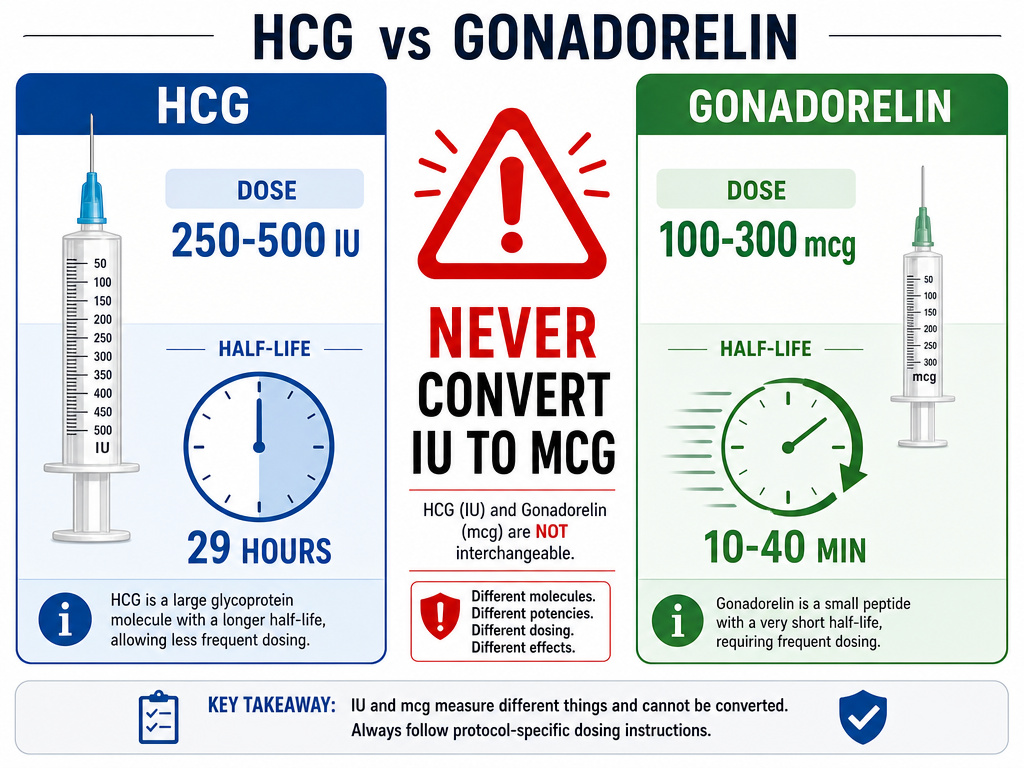
You can’t talk about dosing without circling back to half-lives. It dictates everything.
Typical HCG dosing on TRT is 250 to 500 International Units (IU), injected two to three times per week. The 29-hour half-life means this schedule keeps a consistent stimulus on the testes.
With a half-life of 10-40 minutes, a Monday-Thursday schedule creates two brief hormonal pulses. Is that enough to meaningfully activate a suppressed pituitary? The mechanistic doubt is why some experts are skeptical of low-frequency dosing.
| Consideration | HCG | Gonadorelin |
|---|---|---|
| Typical TRT Dose | 250-500 IU, 2-3x/week | 100-300 mcg, 2-3x/week (or daily) |
| Chemical Nature | Glycoprotein hormone (~36.7 kDa) | Synthetic decapeptide |
| Primary Challenge | Can increase estradiol; supply/regulatory issues | Very short half-life; weak evidence on TRT |
Common mistake: Converting IU to mcg or vice versa. They are different units measuring different things (biological activity vs. Mass). Never try to swap one for the other; follow the prescribed dose for the specific medication.
If your clinic switched you from HCG to gonadorelin, you might have been told to take it on the same schedule. That pharmacological mismatch is a core reason many men report it “doesn’t work as well.”
Side Effects, Cost, and Practical Realities
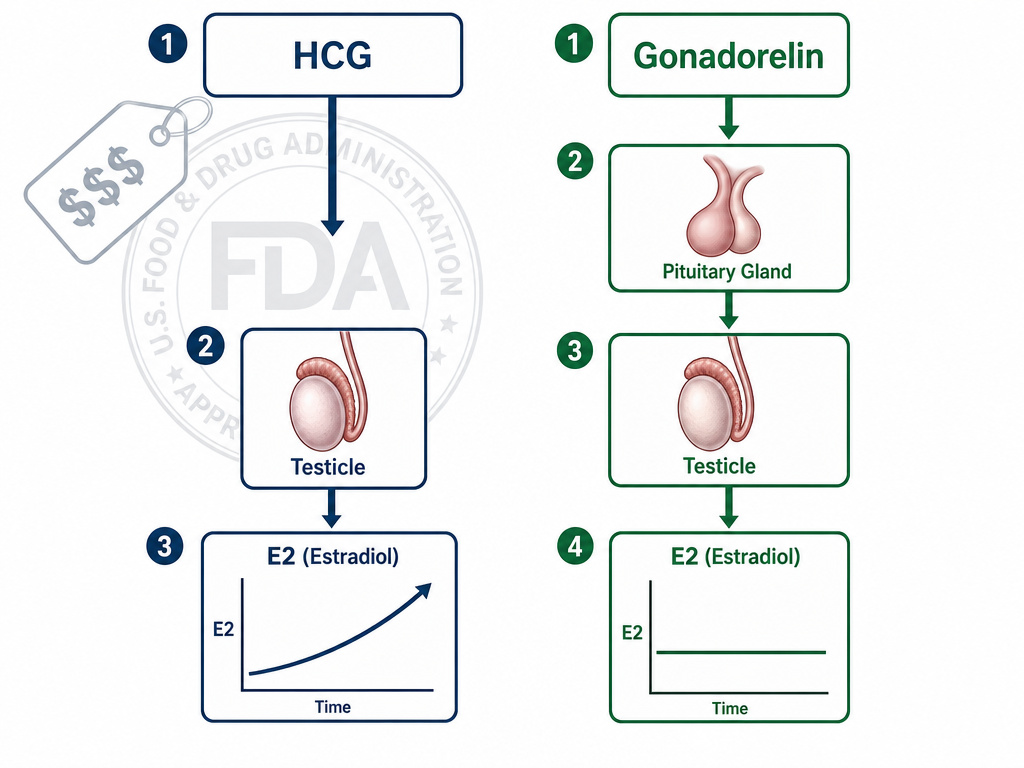
The direct action of HCG comes with a known side effect: it can raise estradiol. The Leydig cells produce testosterone, and some of that aromatizes into estrogen. This is manageable with monitoring and sometimes an aromatase inhibitor, but it’s a factor. Gonadorelin, working further up the chain, tends to have a minimal direct effect on estradiol.
Cost is a major differentiator. This is ironic, given that gonadorelin is often presented as the modern alternative.
Worth knowing before you start: The U.S. FDA reclassified HCG as a biologic in March 2020 under the Biologics Price Competition and Innovation Act (BPCIA). This made it illegal for compounding pharmacies to produce it, which triggered supply shortages. Many clinics switched to gonadorelin because it remained compoundable—a decision driven by availability, not superior evidence.
This regulatory shift is crucial context. It turned gonadorelin into the available option, not the better one. When you look at gray-market sources, the labeling is often vague and there’s zero clinical follow-up. For something that tinkers with your reproductive axis, that’s a hard pass. A reproductive endocrinologist with a semen analysis in hand beats any website.
The Bottom Line: Which One Should You Use?
The answer depends entirely on your primary goal. We will be blunt.
If your goal is preserving fertility and maximizing the chance of maintaining sperm production while on TRT, the choice is HCG. It has the decades of clinical use and the controlled study data, including the recent 78% success rate figure. This is the option for keeping the door open for fertility recovery.
If your goal is primarily preventing testicular shrinkage at a lower cost, and you are less concerned with robust fertility data, some sources (e.g., FullPotentialMen) present gonadorelin as a reasonable lower-cost option for maintaining size. Other sources (e.g., PeptideDeck) frame it more as a fallback when HCG is unavailable or causes estradiol issues, noting it is ‘not the upgrade the switch implied.’
For men struggling with high estradiol on HCG who still want testicular support, gonadorelin can be a fallback to discuss with your doctor. It is not a proven fertility-preserving upgrade, but it may help with volume with less estrogenic impact.
Start with the basics. Before adding either, get a baseline. That means understanding your own LH and FSH levels and, if fertility matters, a semen analysis. Exogenous testosterone can suppress sperm production. That’s a conversation worth having before the first injection, not after.
Does hCG cause desensitization compared to gonadorelin?
A key difference between hCG and gonadorelin is their potential to cause receptor desensitization. HCG is a direct agonist at the LH receptor on testicular Leydig cells. This means it mimics LH’s action directly. With its long half-life of about 29 hours, continuous stimulation from frequent hCG dosing may, in theory, lead to downregulation or desensitization of these receptors over time, potentially reducing its effectiveness. Gonadorelin, with its very short half-life of minutes, works upstream by stimulating the pituitary to release its own LH. This indirect, pulsatile signal more closely mimics the body’s natural rhythm and is not associated with direct receptor desensitization at the testicular level, as it relies on the body’s own regulatory feedback.
Can you use hCG or gonadorelin for PCT?
Post-cycle therapy aims to restart the body’s natural hormone production after it has been suppressed. In this context, hCG is sometimes used as a bridge because it can directly stimulate the testes to produce testosterone before endogenous LH production fully recovers. Its long half-life and direct action can help maintain testicular function during the transition. Gonadorelin’s role in PCT is less straightforward. Because it requires a functional pituitary gland to work, its effectiveness is limited if the pituitary is suppressed. Its established medical use for restoring fertility involves pulsatile administration via a pump, a protocol not typical for standard PCT. For practical PCT guidance, the choice often depends on the duration and depth of prior suppression.
Frequently Asked Questions
Does gonadorelin work as well as HCG on TRT?
No, based on the available evidence for the specific use of preserving testicular function and fertility alongside TRT. HCG has controlled studies showing it preserves intratesticular testosterone and sperm parameters. Gonadorelin has very limited data in this setting, and its extremely short half-life makes the standard dosing protocols pharmacologically questionable.
Is it good to take HCG while on TRT?
Yes, if your goals are to prevent testicular atrophy and/or preserve fertility potential. Clinical studies show it is effective for these purposes. The trade-off is the need to monitor estradiol levels, as HCG can cause an increase. It should always be done under physician supervision with appropriate lab monitoring.
Why would I take gonadorelin with TRT?
The main reasons are to help maintain testicular size at a lower cost than HCG, or as an alternative if you cannot tolerate the estradiol increase from HCG. Some clinics also promote it for its ability to stimulate both LH and FSH release, though the practical benefit of this on TRT is not well-established.
Can I take gonadorelin and HCG together?
There is no standard protocol or clinical evidence supporting the combined use of gonadorelin and HCG on TRT. Since both aim to achieve the same end result (stimulating testicular function), but through different mechanisms, using both would be redundant and increase cost and injection burden without a proven benefit. Therapy should be focused on one agent.
Before You Go
One rule most guides skip: if maintaining future fertility is a real concern for you, the conversation shouldn’t start with “HCG or gonadorelin?” It should start with a semen analysis and a discussion about TRT and fertility with a specialist. Banking sperm before starting TRT is a pragmatic option many men don’t consider until it’s too late.
For the majority of men whose primary aim is avoiding shrinkage, the choice is simpler. HCG is the proven, stronger agent with a faster timeline (6-8 weeks). Gonadorelin is the cost-saving alternative with weaker data and a slower, less certain response.
Your move depends on what you’re trying to protect. The evidence for each path is not equal, so match the tool to the job. And always, always verify the source of your medication and work with a clinician who checks your labs.
