
How Testosterone Levels Change With Age: What Studies Show
This post contains affiliate links. As an Amazon Associate, we earn from qualifying purchases.
Testosterone levels change with age, but not in the simple, linear way most people believe. In men, total testosterone often stays stable until about age 70, while the bioavailable fraction, the part your body can actually use, declines more steadily due to rising levels of a binding protein called SHBG. For many, lifestyle factors like obesity and inactivity explain more of the apparent decline than aging itself.
That stability finding is the part that flips the script. It comes from long-term studies like the Baltimore Longitudinal Study of Aging, which tracked men for decades to show how testosterone levels change with age. The data shows a gradual slope, not a cliff. The real story involves which number you measure, how you measure it, and what else is going on in your life.
What follows: a breakdown of the two types of testosterone, the data on when and how they shift, the surprising disagreement between major studies, and the practical steps you can take to understand your own levels.
Key Takeaways
- Total testosterone often stays flat until age 70, but bioavailable testosterone declines more steadily because SHBG increases with age.
- Lifestyle is a major driver, obesity, poor sleep, and chronic illness can accelerate decline more than the calendar.
- Test once, but trend twice. A single blood test is a snapshot with high variability; meaningful change requires tracking over time.
- Biochemical hypogonadism is rarer than you think, only about 2% of older men have persistent, very low levels with high LH.
- Older men respond differently to therapy, they see greater blood count increases and a clearer dose-response for libido at lower doses.
Does Testosterone Really Drop After 30?
A common but oversimplified view is of a 1-2% yearly decline starting in your 30s. That’s a commodity answer. The data is messier and more interesting.
The Baltimore Longitudinal Study of Aging (BLSA), one of the longest-running studies on the planet, found that total testosterone remained quite stable until the age of 70 years, providing key data on how testosterone levels change with age. After that, a progressive decline kicks in. But the bioavailable testosterone, measured via ammonium sulfate precipitation, showed a linear decline over the entire adult lifespan. The difference is SHBG, a binding protein that increases with age and locks up more of the total hormone.
This technical distinction is critical: a stable total testosterone level can mask a declining active fraction. Bioavailable testosterone is the portion not tightly bound to SHBG and is considered more reflective of androgen activity at the tissue level.
So the answer depends on what you’re measuring. If you only look at total T, you might miss the slow leak. This is why some men feel changes in energy or drive even when their main lab number sits in the “normal” range, their usable hormone pool is shrinking.
I learned this the hard way looking at my own eight years of lab draws. The total number bounced around a mid-range band, creating noise. But when I plotted the points, the gentle downward slope of the trend line told a clearer story than any single result. A single test is a weather report; a trend is the climate.
The Two Testosterones: Total, Free, and Why SHBG is the Gatekeeper
You have one testosterone molecule. But in your bloodstream, it exists in three states, and the balance shifts as you get older. This is the core mechanism that explains the aging pattern.
Total Testosterone (TT) is the full count, every molecule in a given volume of blood. Free Testosterone (FT) is the tiny, unbound fraction that can immediately enter cells. Bioavailable Testosterone (BT) is free testosterone plus the fraction loosely bound to albumin; it’s the “ready-to-use” pool. The gatekeeper is Sex Hormone-Binding Globulin (SHBG). It binds testosterone tightly, taking it out of circulation.
Here’s the shift: SHBG increases with age. According to the BLSA data, this rise is a key reason bioavailable testosterone declines more steeply than total testosterone. Your body might be making a similar amount, but more of it gets parked in storage.
| Testosterone Type | What It Measures | Age-Related Trend |
|---|---|---|
| Total (TT) | All testosterone in blood | Stable until ~70, then declines |
| Bioavailable (BT) | Free + albumin-bound (usable) | Linear decline across lifespan |
| Free (FT) | Unbound, active fraction | Declines due to rising SHBG |
| SHBG | Binding protein that locks up T | Increases with age |
This is why looking at normal testosterone levels gives an incomplete picture. You need to see the whole panel, total T, SHBG, and ideally calculated free or bioavailable T, to understand what’s available to your muscles, brain, and libido. You can see how this plays out specifically for the active fraction in our guide to free testosterone levels. The role of the binding protein is so central it warrants its own look at normal SHBG levels in men by age.
Where the Major Studies Disagree
If you read three different research papers, you might get three different stories about the timing and cause of the decline. This is evidence that the question is complex. Honest reporting has to show the conflict.
The biggest disagreement in the research on how testosterone levels change with age is about when total testosterone starts to drop. The BLSA data suggests stability until the eighth decade. However, other longitudinal studies, like the Massachusetts Male Aging Study (MMAS), reported a gradual but significant decline beginning in mid-adulthood (age 35-40). Meanwhile, the Endocrine Society Scientific Statement argues that apparent age-related reductions are explained by lifestyle confounders, and studies of Japanese and Chinese men show no age-related changes. A massive analysis of lab records suggested total T peaks at 20 and is stable until the 80s.
Where this goes sideways: Picking one study as the universal truth. The differences likely come from cohort health, measurement methods, and ethnic background.
Ethnicity appears to be a major variable. An Endocrine Society Scientific Statement highlights that while Western cohort studies show a decline, recent evidence shows no age-related changes in testosterone levels in Japanese or Chinese male cohorts. This stark contrast suggests genetic or powerful lifestyle confounders are at play.
Then there’s the driver debate. Is it aging itself, or is it the health problems that accumulate with age? The same Endocrine Society statement argues that lifestyle confounders like overweight/obesity, insulin resistance, smoking, and cardiovascular disease explain most or all apparent age-related reductions. A study of highly active male cyclists aged 55-79 found testosterone did not decline with age in that group.
The takeaway is that the average “1-2% per year” is a blurry average over a wildly variable population. Your trajectory depends heavily on which group you’re in. This complexity is why the question of aging vs lifestyle as the root cause is so critical.
How Common is True Age-Related Low T?

The term “low testosterone” gets thrown around, but persistent, biochemical primary hypogonadism, the kind driven by failing testes, is relatively rare, even in older men.
A longitudinal study of European men aged 40-79 found the baseline prevalence of biochemical primary hypogonadism was 1.35%. At the end of the follow-up period, it was 2%. The men with persistent, verifiable primary hypogonadism were typically over 70 years old at baseline and had very low serum total testosterone (mean <220 ng/dL) paired with high LH (about 20 IU/L).
About 20% of men with baseline biochemical primary hypogonadism had normal serum total testosterone at the end of the study. They were younger and had less severe initial deficits.
This points to an important reality: low T is often a temporary state. Acute illness, extreme stress, or a bad stretch of sleep can suppress levels. This is why retesting is essential before any major intervention. Jumping on therapy based on one low reading, especially if you’re under 70 and otherwise healthy, is often treating a lab glitch, not a lifelong condition.
The clinical definition matters. It’s not just a number below a line. It’s a persistently low number plus elevated pituitary hormones (LH/FSH) indicating the testes aren’t responding, plus consistent symptoms. This framework helps separate the 2% who have a primary gonadal issue from the larger group whose low levels are a symptom of something else, like obesity or sleep apnea. Understanding the difference between a standard and an ideal result is key, which we break down in optimal vs normal testosterone range.
Lifestyle vs. Aging: What Moves the Needle First?

You can’t change your birthday. But the data is clear: the lifestyle choices you make influence your hormonal trajectory more than the years themselves. Think of aging as the canvas and lifestyle as the paint.
The MMAS found that “apparent good health” added to androgen levels and flattened the age-related decline. What does “good health” mean in practice? It’s not perfection. It’s managing the big levers.
- Body Composition: Visceral fat is metabolically active and promotes the conversion of testosterone to estrogen. Dropping waist circumference is one of the most potent, natural levers. Tracking my waist at the navel, losing about two inches over three months did more for my follow-up labs than any supplement I’d tried previously.
- Sleep & Stress: Chronic sleep disruption and elevated cortisol directly suppress the hypothalamic-pituitary-testicular axis. Cutting alcohol to near zero for a month before a retest was a cheap experiment. My resting heart rate dropped, sleep scores climbed, and the retest showed a predictable bump.
- Chronic Disease: Conditions like type 2 diabetes, metabolic syndrome, and cardiovascular disease are strongly linked to lower testosterone. Managing these isn’t just about longevity; it’s about hormonal vitality.
The active cyclist study is the proof of concept. Their testosterone didn’t bow to age because their lifestyle protected the system. The decline is a default path that can be rerouted. This makes the frequency of testing a strategic choice, which we detail in how often to check testosterone levels.
Treatment Implications: Why Older Men Are Not Just Older Young Men
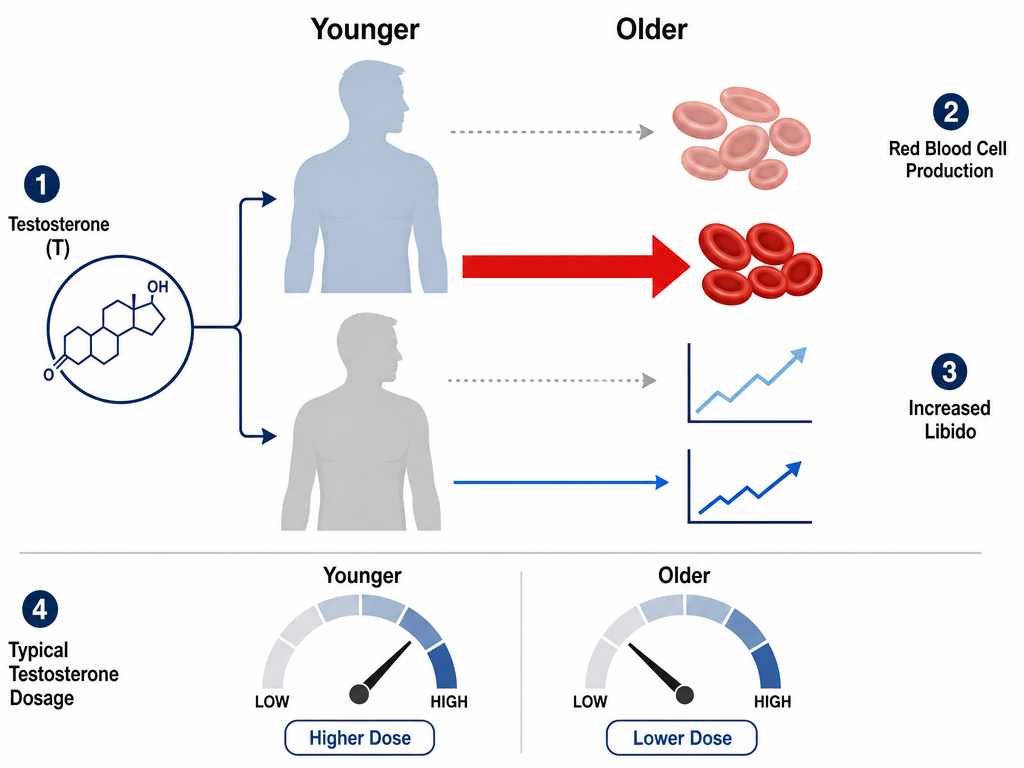
If testosterone therapy enters the conversation, the approach must be different for a 65-year-old than a 35-year-old. The physiology of aging changes how the body responds.
A revealing study compared the effects of different testosterone doses in younger (19-35) and older (60-75) men. The older group had significantly greater percentage increases in hematocrit and hemoglobin, a known risk of therapy. At very low, sub-physiologic replacement doses, the older men gained less fat mass than the younger men. Most notably, there was a clear dose-dependent effect on libido and erectile function in the older group, but not in the younger group.
The part nobody mentions: Older men are more sensitive to both the benefits and risks of testosterone. Their response is more precise, meaning lower doses can be effective, but side effects like elevated red blood cells are more pronounced.
This has direct clinical implications. A review in the journal Reproductive Biology and Endocrinology concluded that optimal, safe and effective testosterone replacement therapy dosages for older men might be 50–75% that of younger men. The “start low and go slow” mantra isn’t just caution; it’s pharmacodynamics.
This nuanced view of treatment is grounded in a deeper understanding of the aging and androgens physiology review. It also connects to the core research, like the Baltimore Longitudinal Study of Aging data, which established the baseline patterns we’re now trying to modify.
A Note on Testosterone and Women’s Aging
While the focus is often on men, testosterone levels change with age in women too, and the pattern is distinct. It’s a common related search, and most pages don’t cover it.
The conversation about “normal” is even more complex for women, as most lab ranges are not well-defined. For a detailed look at this pattern, see our guide to normal testosterone levels in women by age.
Symptoms of low testosterone
Common symptoms include a reduced interest in sex, persistent tiredness, and a decrease in muscle mass or strength. Other signs can be changes in mood, difficulty with concentration, and a loss of body hair. It’s crucial to understand that these symptoms are non-specific and can be caused by many other health conditions or lifestyle factors. Research shows that true, persistent biochemical hypogonadism is relatively uncommon in the general male population. If you’re experiencing a cluster of these symptoms, it’s a signal to have a conversation with a healthcare provider, who can help determine if hormone levels are a contributing factor.
Debunking ‘male menopause’ as a sudden drop vs. Gradual decline
The term ‘male menopause’ suggests a sudden, dramatic hormonal shift similar to female menopause, but this is misleading. Long-term studies like the Baltimore Longitudinal Study of Aging show a more gradual process. For total testosterone, levels often remain quite stable until around age 70, after which a decline may occur. Bioavailable testosterone, the fraction not bound to proteins, tends to decline more linearly over the adult lifespan. Evidence from studies of healthy, active older men and some ethnic cohorts also indicates that apparent age-related declines may be heavily influenced by lifestyle factors like obesity and chronic disease, not aging alone.
When to see a doctor / get tested
Consider consulting a doctor if you are experiencing multiple, persistent symptoms commonly associated with low testosterone, such as low libido, unexplained fatigue, or loss of muscle mass. Testing is typically warranted when symptoms are present, not as a routine screening. A review of European men found the prevalence of persistent primary hypogonadism to be low, and about 20% of men with initially low levels had normal results on follow-up, highlighting that a single test isn’t definitive. Be prepared to discuss your overall health, as factors like weight, activity level, and other medical conditions can significantly impact hormone levels and are important for an accurate assessment.
Frequently Asked Questions
What is the average testosterone level for a 70 year old?
There’s no single “average,” as ranges widen significantly with age. Based on large datasets like the BLSA, total testosterone levels for a healthy 70-year-old can vary widely. However, bioavailable testosterone will be lower than in a younger man with the same total T due to higher SHBG. The functional range matters more than the average.
Does ejaculating every day lower testosterone levels?
Short-term studies show a very minor, transient dip in testosterone immediately after ejaculation, with levels returning to baseline within hours or a day. There is no credible evidence that frequent ejaculation leads to a sustained, clinically significant lowering of overall testosterone levels. This is a myth that conflates short-term fluctuation with long-term status.
At what age is your testosterone highest?
Testosterone peaks in late adolescence or early adulthood, generally around age 20. This is when total testosterone reaches its maximum level. After this peak, the story shifts from growth and maturation to maintenance and gradual change, influenced by the factors discussed throughout this article.
How much does testosterone drop after 30?
The classic “1-2% per year” estimate is a broad average that masks huge variation. For total testosterone, some studies like the BLSA show very little drop until much later in life. The more consistent decline is in bioavailable testosterone, which may decrease more steadily due to rising SHBG. The better question is: what is your trend? You can explore the specifics of this early period in our article on the testosterone drop after 30.
The Bottom Line
Throw out the simple graph with a line pointing down from age 30. The real map of testosterone change with age has topographical features: plateaus, slow valleys, and cliffs that only some people approach.
The most actionable insight is that your lifestyle is the terrain. Before you audit the fundamentals, sleep quality, waist size, alcohol intake, and exercise habits for at least a month, look for a pharmaceutical or supplement solution. Track them. These levers move the needle first and most reliably.
If you test, understand what you’re measuring. A single total testosterone number is a blurry photo. You need the album: total T, SHBG, and a calculated free/bioavailable value, taken consistently (fasting, morning) over time to see a trend. Your body’s daily rhythm also affects this snapshot, which is covered in our look at daily testosterone fluctuations.
Finally, know that a low reading isn’t a life sentence. True, persistent primary hypogonadism is uncommon. For everyone else, the path is a slope you can influence, year by year, with the choices you make today.
