
How to Increase Testosterone Naturally After 40
This post contains affiliate links. As an Amazon Associate, we earn from qualifying purchases.
To increase testosterone naturally after 40, focus on three pillars: lose excess weight, do moderate aerobic and resistance exercise, and get consistent, high-quality sleep. Clinical guidelines show each 5 kg of weight loss can raise total testosterone by about 29 ng/dL, while chronic sleep restriction can lower it by 10-15%. This is a lifestyle overhaul, not a quick supplement fix.
The numbers from those guidelines are the part most articles skip. They tell you to lose weight, but not that the benefit is measurable and linear. They warn about sleep, but not that pulling a few all-nighters has a documented, percentage-based tax on your hormone levels.
What follows is a breakdown of those three pillars, the evidence behind them, and the practical, often boring, steps that actually move the needle for men seeking how to increase testosterone naturally after 40. We’ll also look at where supplements fit in (spoiler: last) and when the conversation might shift from natural optimization to medical therapy.
Key Takeaways
- Each 5 kg (11 lbs) of weight loss in overweight men is linked to a ~29 ng/dL increase in total testosterone, per the European Male Ageing Study.
- Persistent sleep deprivation lowers testosterone by 10–15%, according to the Canadian Urological Association guideline.
- A 20% reduction in BMI may be needed for a meaningful rise in free testosterone by lowering SHBG, a higher bar than the 5-kg rule suggests.
- Moderate aerobic exercise combined with weight loss is specifically cited by the EMAS as effective; standalone intense training without addressing body fat has weaker evidence.
- Testosterone Replacement Therapy (TRT) combined with weight loss was superior to weight loss alone for improving erectile dysfunction in obese hypogonadal men, per a 2023 EMAS statement.
The Weight Loss Math: 5 kg vs. 20% BMI
You know excess fat lowers testosterone. The real question is how much you need to lose to see a change, and the answer depends on which medical society you ask.
The 2023 position statement from the European Male Ageing Study (EMAS) provides a clear, linear equation: each 5 kg (about 11 pounds) of weight loss results in a 1 nmol/L increase in total testosterone. That converts to roughly a 29 ng/dL boost for every 5 kg shed. This is a powerful, actionable number. It means progress is incremental and measurable. Lose 10 kg, and the data suggests a potential 58 ng/dL rise.
Where this goes sideways: Believing any weight loss helps free testosterone. A meaningful increase in free testosterone, the active form, often requires a reduction in Sex Hormone-Binding Globulin (SHBG), which is more tightly linked to significant fat loss.
However, the 2023 British Society for Sexual Medicine (BSSM) guideline cites EMAS data to set a different, steeper bar, stating a 20% reduction in BMI is required for a “meaningful increase” in free testosterone due to SHBG changes. In contrast, the EMAS position statement indicates benefit from smaller, incremental loss, with each 5 kg of weight loss yielding a ~29 ng/dL increase in total testosterone. That’s a much bigger ask than the 5-kg rule implies.
| Guideline | Target | Reported Benefit | Key Limitation |
|---|---|---|---|
| EMAS (2023) | 5 kg weight loss | ~29 ng/dL increase in total testosterone | Doesn’t specifically address SHBG and free testosterone changes. |
| BSSM (2023) | 20% BMI reduction | Meaningful increase in free testosterone | A much larger initial commitment for obese men; the benefit may not be linear. |
This isn’t a contradiction; it’s a distinction between total and free testosterone. Small losses help total T. Reshaping your metabolism enough to lower SHBG and boost free T often requires a deeper transformation. The BSSM guideline itself references a study where 29 men with severe obesity saw total testosterone jump from 230 ng/dL to 388 ng/dL after bariatric surgery, a dramatic change following massive weight loss.
The takeaway? Start with the 5-kg goal. The boost in total testosterone is real and can improve symptoms. If you plateau, understand that further fat loss may be needed to reach the next level by managing SHBG. This is where tools like Cronometer for tracking and a consistent strength training routine become essential.
The Sleep Deprivation Tax: A 10-15% Penalty
If you’re trying to raise testosterone while chronically short on sleep, you’re filling a bucket with a hole in it. The 2023 Canadian Urological Association (CUA) guideline is blunt: persistent sleep deprivation or restriction lowers testosterone levels by approximately 10–15%.
Let’s translate that. If your baseline is 500 ng/dL, persistent sleep restriction can pull you down to 425–450 ng/dL. That’s enough to push someone from the middle of the normal range toward the borderline. And it’s not about one bad night; “persistent” is the key. Your body reads a pattern of shortened sleep as a chronic stressor.
The mechanism is straightforward. Sleep, especially deep sleep, is prime time for your body’s hormonal repair and release cycles. Disrupt that, and you disrupt the pituitary signals that tell your testes to produce testosterone. You also increase cortisol, which directly competes with testosterone production. It’s a double hit.
Common mistake: Prioritizing a 5 a.m. Workout over a full sleep cycle. The extra cortisol from the sleep debt might undo any potential hormonal benefit from the exercise.
Fixing this is simple in theory, hard in practice for many men over 40. It’s not just “get eight hours.” It’s about sleep quality and consistency.
- Consistency is king: Go to bed and wake up at the same time every day, even weekends. Your hormones thrive on rhythm.
- Address sleep apnea: Loud snoring, gasping, and daytime fatigue are major red flags. Sleep apnea fragments sleep and crushes testosterone. This is one of the most underrated fixes in the natural methods vs TRT conversation.
- Wind down: The hour before bed is for low light, no screens, and no intense work. This isn’t soft advice; it’s a signal to your nervous system that it’s safe to shift into restorative mode.
Improving your daily habits around sleep is arguably the highest-return, zero-cost intervention available. You cannot supplement your way out of a sleep debt.
Exercise: The Moderate Aerobic Rule
The third pillar is exercise, but the type matters. The 2023 EMAS position statement specifies that “moderate aerobic exercise, particularly when combined with weight loss,” increases testosterone.
This is a crucial nuance. It’s not “lift heavy and you’ll get huge T boosts.” The strongest evidence for a direct testosterone increase from exercise alone is mixed, especially in older men. The real synergy happens when exercise supports the primary goal of fat loss.
Here’s the practical breakdown:
- Aerobic Exercise for Fuel Burning: Walking, cycling, swimming. This burns calories directly, improves metabolic health, and, when done consistently at a moderate pace (where you can talk but not sing), supports the weight loss that drives the testosterone increase. Think of it as creating the caloric deficit that makes the 5-kg rule achievable.
- Resistance Training for Muscle and Metabolism: Lifting weights. This builds or preserves lean muscle mass. More muscle means a higher resting metabolic rate, making it easier to maintain weight loss. It also improves insulin sensitivity, which is tightly linked to better hormonal health. A workout program for this age should focus on compound movements, not exhaustion.
The old idea of “testosterone-boosting workouts” is mostly myth. The benefit is chronic and systemic: exercise makes your body more efficient at everything, including hormone regulation. It makes the weight loss from pillar one more effective and sustainable.
Where Supplements Actually Fit In

This is where my own experience has to chime in. I’ve spent years and a small fortune testing pills and powders. The honest ranking is: lifestyle first, deficiency correction second, “booster” supplements a distant third.
Your first supplement should be a blood test. Guessing is a waste of time and money. After that, the only supplements with a clear, direct rationale for testosterone support are those that correct a verified deficiency.
- Vitamin D: If you’re deficient in Vitamin D, supplementing to reach sufficiency can help. If you’re already sufficient, more does nothing. I learned this after taking 5,000 IU daily for months with no change in levels, my body just had what it needed.
- Zinc: Critical if you’re deficient, pointless and potentially harmful if you’re not. The oyster hype? Six medium oysters have over 30 mg of zinc. They “work” because they fix a deficiency, not through magic. Taking high-dose zinc long-term can cause nausea and copper deficiency.
- Magnesium: Supports sleep quality and hundreds of enzymatic reactions. A deficiency can impair sleep (see pillar two), but extra won’t boost T if you’re replete.
A quality multivitamin can act as a nutritional insurance policy, especially if your diet is inconsistent. Brands like Thorne are transparent about doses. Avoid “proprietary blends”, they hide the amounts of each ingredient, so you can’t tell if anything is at an effective dose.
As for the herbal “testosterone booster” aisle? The evidence is thin. Ingredients like ashwagandha are better understood as stress and sleep aids, which indirectly support hormones. Fenugreek and tongkat ali have mixed study results, often in deficient or stressed populations. Stacking five new supplements at once, a mistake I’ve made, is the fastest way to learn nothing about what works for you.
If you are considering testosterone supplements, manage your expectations. They are not a substitute for the three pillars. At best, they are minor supports on the margins.
When Natural Methods Meet Medical Therapy
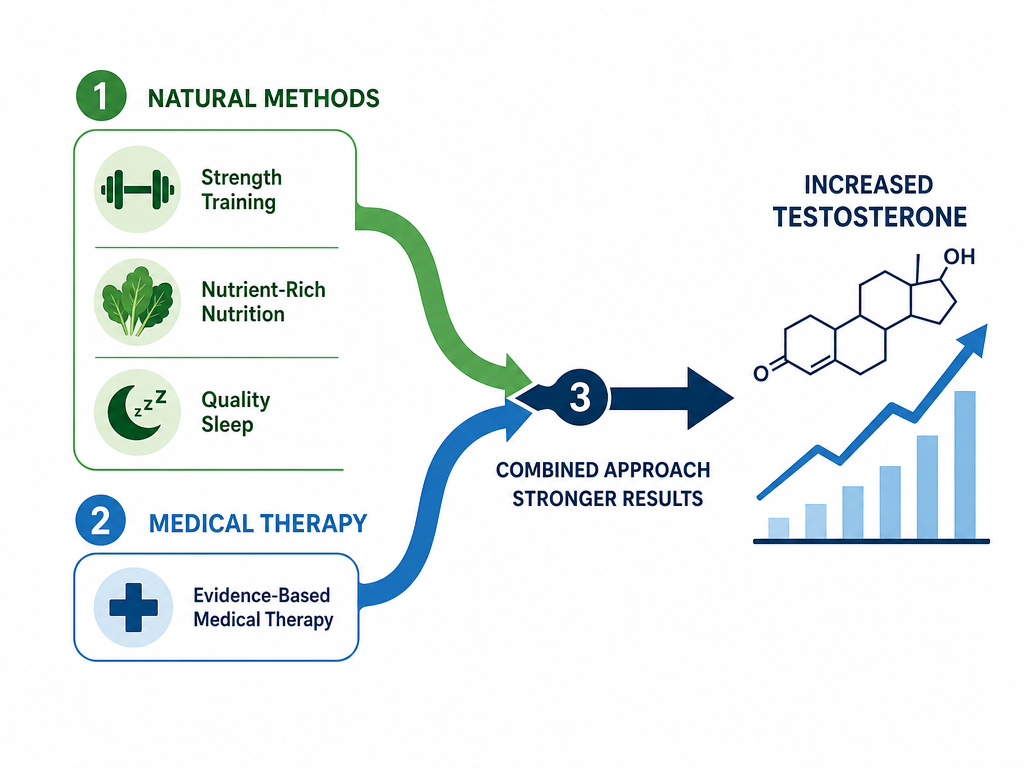
The line between natural optimization and medical treatment isn’t always clear. The clinical guidelines show an interesting overlap.
The EMAS position statement notes that in obese hypogonadal men with erectile dysfunction, TRT combined with weight loss was superior to weight loss alone for improving ED. This frames TRT not as a replacement for lifestyle, but as a potential augment for men who are already making changes but still have significant symptoms.
Conversely, the CUA guideline firmly positions lifestyle modification as a standalone first step, stating weight loss and exercise “have been shown to significantly increase serum testosterone levels.”
This is the critical conversation to have with a doctor if you’ve been diligent with the natural pillars for 6-12 months, a realistic timeline, and your levels are still clinically low with disruptive symptoms. It’s not “natural vs. TRT.” It’s about creating a complete plan. For some men, especially those with very high SHBG, lowering SHBG naturally through sustained weight loss may be the final key. For others with primary hypogonadism (a testicular issue), lifestyle helps general health but won’t fix the root cause.
The 40+ Specifics: Diet and Damage Control

After 40, your margin for error shrinks. Diet isn’t about “testosterone foods”; it’s about nutrient density and avoiding metabolic damage.
I tracked my diet in Cronometer for two weeks and found that beef and a weekly serving of liver closed more zinc, B12, and iron gaps than the three supplements I was taking. It was a humbling lesson in food first.
The other side is damage control:
- Alcohol: It’s a toxin. The liver prioritizes processing it over hormone regulation. Regular heavy use is a direct suppressant.
- Ultra-processed foods and sugar: They drive inflammation and insulin resistance, which impair Leydig cell function in the testes.
- Chronic stress: This keeps cortisol elevated, which blocks testosterone production. This is where tools like ashwagandha or meditation might have an indirect role, not as T-boosters but as stress buffers.
Your diet should support your weight loss goal (pillar one) for how to increase testosterone naturally after 40 and provide the building blocks for hormones (cholesterol, micronutrients) without adding metabolic burdens. It’s less about magic berries and more about consistent, high-quality protein, healthy fats, and fibrous vegetables.
Frequently Asked Questions
How can I naturally increase my testosterone levels if I’m over 40?
Focus on the three evidence-based pillars: lose excess body fat (target 5-10 kg initially), get 7-8 hours of quality sleep consistently, and engage in regular moderate aerobic and resistance exercise. Correct any verified nutrient deficiencies like vitamin D or zinc. This approach addresses the root causes of age-related decline, metabolic health, sleep quality, and body composition.
Does vitamin D increase testosterone?
Vitamin D supplementation can increase testosterone levels only if you have a pre-existing deficiency. Studies show that men with low vitamin D levels who supplement to reach sufficiency (40-60 ng/mL) often see a corresponding rise in testosterone. If your levels are already sufficient, taking more vitamin D will not boost testosterone further.
Do testosterone boosters really work?
Most over-the-counter “testosterone booster” supplements have weak or inconsistent evidence for significantly raising testosterone in healthy men. They often contain ingredients like fenugreek or D-aspartic acid, which may show small effects in specific, deficient populations. They are not a substitute for lifestyle changes and should be viewed with skepticism, especially proprietary blends that hide ingredient doses.
Can zinc increase testosterone?
Zinc can increase testosterone if you are zinc-deficient, which is not uncommon. Zinc is crucial for testosterone synthesis. However, if you have adequate zinc levels (which can be checked via blood test), supplementing with high doses (over 50 mg/day) provides no additional benefit and can cause side effects like nausea and copper deficiency. Dietary sources like oysters, beef, and pumpkin seeds are effective for maintenance.
Before You Go
The evidence gives you a clear map. The big levers are body fat, sleep, and exercise that supports metabolic health. The numbers from the EMAS, BSSM, and CUA guidelines aren’t vague suggestions, they’re quantified relationships.
Start with one pillar. Get your sleep locked in for a month. Then add a manageable calorie deficit to lose the first 5 kg. Track your progress not just by the scale, but by energy and how you feel. That’s the real metric.
If you’ve done the work for a solid year, truly dialed in the lifestyle, and still feel stuck with low symptoms, that’s the point for a deeper medical conversation. It’s not failure; it’s data. The goal isn’t to avoid therapy at all costs, but to build the healthiest foundation possible, whether you’re on it or not. The principles here for how to increase testosterone naturally after 40, especially the weight loss and sleep hygiene, improve every other aspect of your health anyway. They’re worth doing regardless of the final testosterone number.
