
Long Acting Testosterone Undecanoate Injections Explained
This post contains affiliate links. As an Amazon Associate, we earn from qualifying purchases.
Long-acting testosterone undecanoate injections are an oil-based depot formulation given by a healthcare professional every 10 to 14 weeks. The US version (AVEED) is a 750 mg/3 mL dose, with a fixed loading schedule of injections at day 1, 4 weeks, and then every 10 weeks. The EU/UK version is a 1000 mg/4 mL dose, where the first injection interval may be reduced to a minimum of 6 weeks compared to the 10-14 week maintenance range. Steady-state blood levels are reached after the third injection, around week 14, and patients must be observed in the healthcare setting for 30 minutes post-injection.
That 30-minute observation period is the first clue this isn’t a typical shot. It’s there because of the volume and the oil carrier, a specific risk that shapes the entire administration protocol. The difference between a smooth, sustained treatment and a serious reaction hinges on a handful of technical details most summaries gloss over, which is precisely what a guide to long acting testosterone undecanoate injections explained.
What follows breaks down the two major dosing protocols, the mechanics of the slow-release depot, the essential safety steps, and how this long-acting option stacks up against weekly injections in a long acting testosterone undecanoate injections explained. You’ll see where official guidelines diverge and what real-world data says about finding your optimal interval.
Key Takeaways
- The standard US dosing schedule is fixed: 750 mg at initiation, 4 weeks later, then every 10 weeks. The UK/EU protocol uses a 1000 mg dose and allows the first injection interval to be reduced to a minimum of 6 weeks.
- You achieve steady-state testosterone levels after the third injection, around week 14. Following an intramuscular injection of 750 mg, serum testosterone reaches maximum concentration after a median of 7 days (range 4 to 42 days).
- Following each injection, mandatory 30-minute observation is required in the healthcare setting to manage potential pulmonary oil microembolism (POME) or anaphylaxis.
- In real-world practice, the median optimized injection interval is 12 weeks, with 70% of patients settling between 10 and 14 weeks. Your interval is not set in stone.
- This is a Restricted (REMS) drug in the US. Only certified healthcare settings with emergency equipment on-site can order, dispense, and administer it.
How It Works: The Depot Effect
Forget daily gels or weekly shots for a moment. This injection uses testosterone undecanoate, an ester with a long fatty acid side chain, dissolved in castor oil. When it’s injected deeply into the gluteal muscle, it forms a small, localized depot. The oil isn’t absorbed quickly. Instead, it acts as a slow-release reservoir, the testosterone undecanoate gradually leaches out into the surrounding tissue, enters your lymphatic system, and then your bloodstream, where enzymes cleave off the undecanoate ester, leaving pure testosterone.
The result is a long, gradual rise and fall. According to the FDA prescribing information, a 750 mg injection reaches peak concentration in your blood after a median of 7 days. The range is wide, though, 4 to 42 days. That variability is why the loading phase exists. The first shot gets some hormone into your system, the second shot four weeks later builds on it, and by the third shot at week 14, you’ve hit a stable plateau. Your levels don’t spike and crash; they ride a gentle, sustained wave.
Following intramuscular injection of 750 mg, serum testosterone reaches maximum concentration after a median of 7 days (range 4 to 42 days). Steady-state serum testosterone concentration is achieved with the third injection of AVEED at 14 weeks. . FDA Prescribing Information for AVEED
This mechanism is what separates it from other forms of TRT in a long acting testosterone undecanoate injections explained. A testosterone cypionate injection might peak in 2-3 days and be largely cleared in 7-10. The undecanoate depot releases its payload over months.
How Often Do You Actually Need an Injection?
Here’s where the official US and UK/EU guidelines split, and where real-world data adds a third perspective. You need to know which protocol you’re on.
| Protocol | Dose & Volume | Loading Phase | Maintenance Interval |
|---|---|---|---|
| AVEED (US FDA) | 750 mg / 3 mL | Injection at Day 1 and Week 4 | Every 10 weeks |
| Testosterone Undecanoate (UK/EU) | 1000 mg / 4 mL | First interval may be reduced to 6 weeks | Every 10 to 14 weeks |
The US FDA label is strict: day 1, week 4, then every 10 weeks. No deviation. The thinking is that this rigid schedule reliably builds to steady state by week 14.
The UK Summary of Product Characteristics (SmPC) is more nuanced. It recommends a 1000 mg dose every 10 to 14 weeks for maintenance. But it explicitly says the first interval can be shortened to a minimum of 6 weeks to achieve sufficient steady-state levels more rapidly. This is a loading dose strategy your doctor might use if your symptoms are pronounced.
Then there’s what happens in clinics. A 2021 study of over 6,000 injections, cited in a PMC article on treatment intervals, found the median optimal injection interval after individualized titration was 12.0 weeks. The data showed 70% of patients landed between 10 and 14 weeks. Your body mass, metabolism, and target blood level ultimately determine your schedule. The “every 10 weeks” rule is a starting point, not a lifetime sentence.
The part nobody mentions: If you miss your 10-week mark by a week or two, don’t panic. You won’t crash to zero. The long tail of the depot means levels decline slowly. Call your clinic, reschedule, and get back on track. A pattern of missed doses, however, will keep you from ever reaching a stable plateau.
The In-Office Injection Protocol (Step-by-Step)

This isn’t a take-home vial. Administration is a specific, safety-critical procedure. Understanding it explains why you’re in the clinic for more than just a quick jab.
- Confirmation & Consent. Before any vial is opened, your diagnosis of hypogonadism must be confirmed with two separate morning blood tests showing low testosterone. Your doctor will also check your hematocrit and review contraindications like prostate cancer.
- Preparation. The vial is brought to room temperature, injecting cold, viscous oil is a bad idea. Using an appropriate drawing-up needle (for example, an 18G, 1.2mm x 50 mm needle per UK guidance for the 4 mL dose), the full dose is drawn into a syringe.
- Positioning & Site. You’ll likely lie prone. The only recommended site is the gluteus medius muscle in the upper outer quadrant of the buttock. This large muscle mass can absorb the volume safely, away from the sciatic nerve and major blood vessels. Guidance is clear: never the arm or thigh.
- The Slow Injection. This is the critical step. The clinician will use an appropriate needle (such as a 20G, 21G, or 22G needle per UK guidance) to administer a deep intramuscular injection. They must administer the dose slowly. The AVEED manufacturer recommends delivery over 60 to 90 seconds, while the UK SmPC states injections must be administered very slowly (over two minutes). This minimizes the risk of forcing the oily solution into a blood vessel.
- The 30-Minute Observation. You will not leave immediately. You must remain in the healthcare setting for 30 minutes after the injection. This is a black-box requirement to monitor for signs of pulmonary oil microembolism (POME), cough, chest tightness, dizziness, or anaphylaxis.
Before you start: This injection carries a risk of pulmonary oil microembolism (POME). Signs like sudden cough, shortness of breath, or chest pain can occur during or right after the injection. The mandatory 30-minute observation period is your safety net. Skipping it is not an option.
This protocol is why the injection methods for this drug are so specific. It’s also why the U.S. FDA requires the AVEED REMS program. The clinic itself must be certified and have emergency equipment and trained personnel on site. You can’t get this prescription filled at a regular pharmacy for home use.
Safety, Side Effects, and Required Monitoring
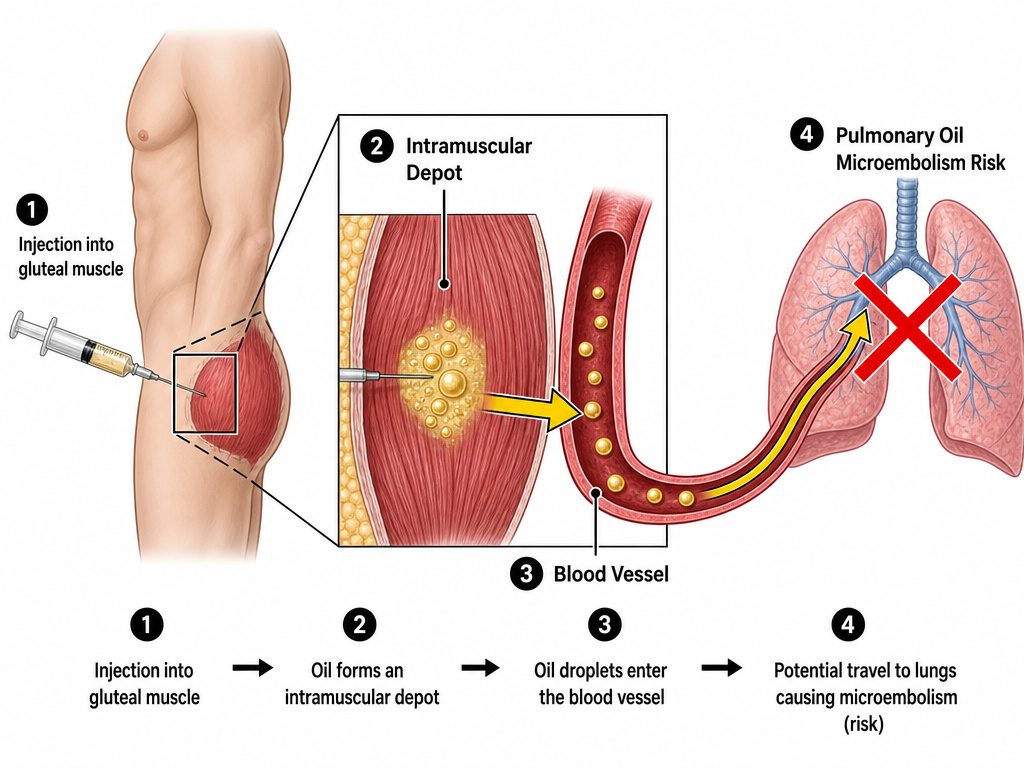
The long interval is convenient, but the high dose and oil carrier introduce unique risks. Monitoring isn’t a suggestion; it’s part of the treatment blueprint.
The most serious risk is pulmonary oil microembolism (POME). If even a small amount of the oil depot enters the bloodstream, it can travel to the lungs, causing coughing, chest pain, and shortness of breath. It’s why the injection must be slow and intramuscular. The 30-minute watch is for this. Another rare but serious risk is anaphylaxis, a severe allergic reaction to the drug or its components (like castor oil or benzyl benzoate).
Common side effects are what you might expect with any testosterone therapy, but their timing is tied to the pharmacokinetics. Acne, increased hematocrit (red blood cell count), mood swings, and injection site pain are reported. The pain isn’t always immediate; some report a deep ache that sets in a day later as the depot forms.
Your monitoring schedule is defined: * Before Starting: Confirm low T (two morning tests), check hematocrit and PSA. * 3-6 Months After Starting: Re-check hematocrit. * Annually: Check hematocrit, and monitor PSA, hemoglobin, and lipid concentrations periodically.
The rational use review article emphasizes that testosterone can raise blood pressure and is not recommended for men with uncontrolled hypertension. It also notes that in diabetic patients, testosterone may lower blood glucose, potentially requiring an adjustment in diabetes medication.
How It Compares to Other Testosterone Injections
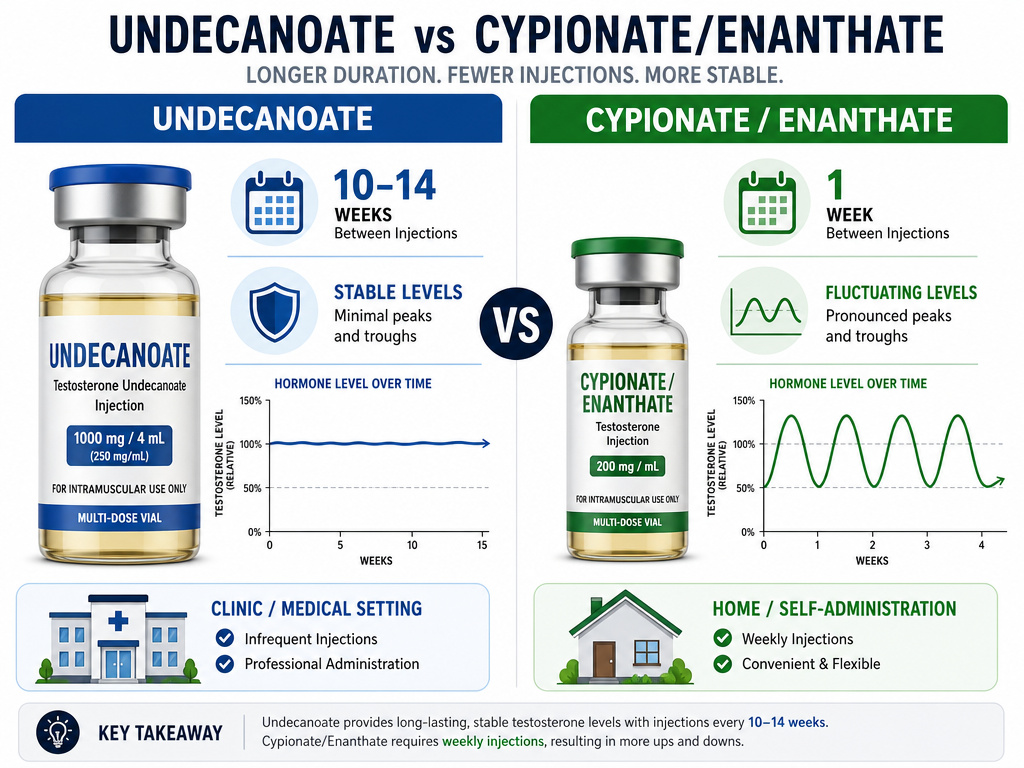
Is less frequent always better? It depends on what you value. This table lays out the key trade-offs.
| Factor | Testosterone Undecanoate | Testosterone Cypionate/Enanthate |
|---|---|---|
| Injection Frequency | Every 10-14 weeks | Every 1-2 weeks |
| Peak-to-Trough Swing | Very gentle, stable | More pronounced rise and fall |
| Administration | In-clinic only, with observation | Can be self-administered at home |
| Dose Flexibility | Very low; fixed large dose | Easy to tweak dose up or down |
| Major Risk Profile | POME, anaphylaxis (rare) | More frequent injection site issues, mood swings from peaks/valleys |
The biggest advantage is obvious: fewer injections. You’re looking at 4-5 shots a year versus 50-100. This eliminates the chore of weekly self-injection and the associated injection site rotation planning. The stable levels can also mean fewer emotional or energy rollercoasters compared to the sharper peaks and troughs of shorter esters.
The disadvantages are real. You lose flexibility. If your dose is too high or too low, you’re stuck with it for months. You can’t easily adjust. It also ties you to the clinic. Every injection is a scheduled appointment with a mandatory wait time. For some, this is a deal-breaker. The upfront cost is often higher, though it may balance out over time.
It’s a different tool, not a universally better one. For someone who travels frequently or hates needles, the convenience is significant. For someone who needs fine-tuned control, a shorter-acting ester you administer yourself might be preferable.
Who Is It For (And Who Should Avoid It)?
This injection is approved for adult men with classic hypogonadism, confirmed by lab tests. It’s not for “low T” due to aging alone, the FDA drug label for testosterone undecanoate states safety and efficacy for “age-related hypogonadism” have not been established.
You should avoid testosterone undecanoate if you have:
- Prostate or breast cancer.
- Past or present liver tumors (a contraindication per the UK SmPC, but not specified in the US FDA label for AVEED).
- Uncontrolled high blood pressure.
- A known allergy to testosterone undecanoate, castor oil, or benzyl benzoate.
- A high baseline hematocrit (thick blood).
There is limited experience on the safety and efficacy of testosterone undecanoate in patients over 65 years of age (UK SmPC), and the safety and efficacy of AVEED in men with ‘age-related hypogonadism’ have not been established (US FDA). It is not indicated for use in children and adolescents and has not been clinically evaluated in males under 18 years of age (UK SmPC). The safety and efficacy of AVEED in males less than 18 years old have not been established (US FDA).
For the right candidate, an otherwise healthy man with confirmed hypogonadism who values convenience and stable levels, it’s a powerful option. It sits alongside other long-acting TRT options like pellets, offering a different set of pros and cons.
Frequently Asked Questions
Is undecanoate better than cypionate?
It’s not “better,” it’s different. Undecanoate offers far fewer injections and more stable blood levels, which can smooth out mood and energy side effects. However, it offers less dosing flexibility, must be administered in a clinic, and carries the specific risk of POME. Cypionate allows for easy home administration and dose adjustment but requires weekly shots.
What happens if you miss an injection?
Don’t panic. The long half-life means your testosterone levels will drop gradually. Contact your clinic as soon as you realize you’ve missed the date to reschedule. They may advise getting the injection as soon as possible. Do not double the dose or change the interval yourself.
Can testosterone undecanoate be given subcutaneously?
No. The official labeling for both AVEED and the EU formulation mandates deep intramuscular injection into the gluteus medius. The volume and oil formulation are not approved for subcutaneous use. Research into subcutaneous administration is ongoing, but it is not current standard practice.
How long does it take to feel the effects?
You might notice some early changes after the first injection, but full, stable effects take time. Remember, steady-state levels aren’t reached until after the third injection, around week 14. Patience is key. Judging the therapy’s effectiveness before month 4 is premature.
Why is there a REMS program for AVEED?
The Risk Evaluation and Mitigation Strategy (REMS) is a U.S. FDA requirement due to the risks of POME and anaphylaxis. It ensures that only healthcare settings with certified staff and on-site emergency equipment can prescribe and administer the drug. This adds a layer of safety but also limits where you can receive treatment.
Before You Go
The appeal of long-acting testosterone undecanoate is the freedom from a weekly ritual. It is a trade: that freedom for a strict, in-clinic procedure and a loss of fine control. The 10-14 week interval is a guideline, not a prophecy, real-world data shows the middle, 12 weeks, is often the sweet spot.
If you’re considering it, the first step isn’t asking for a prescription. It’s getting two separate morning blood tests to confirm the diagnosis. From there, the conversation with your doctor should weigh the convenience against the lack of flexibility and the need for clinic visits. For the right person, it makes a major difference. For another, the weekly control of a shorter ester is worth the hassle. The goal is the same: steady, healthy levels. This is just one path to get there.
