
Low Testosterone and Osteoporosis in Men
This post contains affiliate links. As an Amazon Associate, we earn from qualifying purchases.
Low testosterone in men contributes to osteoporosis by disrupting the bone remodeling cycle, leading to increased fracture risk. Diagnosis for treatment consideration requires both a low serum testosterone level (below 200 ng/dL on repeat tests) and symptoms of androgen deficiency or a related condition like organic hypogonadism. Treatment is not one-size-fits-all: while bisphosphonates like alendronate are first-line for fracture prevention, testosterone replacement therapy (TRT) may improve bone density in men with confirmed hypogonadism but does not conclusively lower fracture risk, according to recent major trials.
The connection hinges on a simple biological fact: testosterone gets converted into estradiol, a hormone that directly signals bone-building cells to slow down breakdown. When testosterone drops, that signal weakens. This process is a key factor in low testosterone and osteoporosis in men. Bone loss outpaces formation, and the skeleton becomes porous and fragile over years, not months.
What follows breaks down that process, the specific diagnostic thresholds that matter, and the evidence behind every major treatment option. You’ll see where the latest research agrees, where it flatly contradicts older guidelines, and the one hormone combination that triples fracture risk even when total testosterone looks normal.
Key Takeaways
- The Endocrine Society guideline defines biochemical hypogonadism as a serum testosterone level below 200 ng/dL on more than one test, but treatment requires symptoms or a related condition like osteoporosis.
- A T-score of -2.5 or lower at the hip or spine on a DXA scan is the diagnostic threshold for osteoporosis in men, triggering a discussion of pharmacological treatment.
- Bisphosphonates like alendronate are the first-line drug class for reducing fracture risk, with studies showing alendronate monotherapy improves lumbar spine BMD with a mean difference of 5.2%.
- The 2024 TRAVERSE trial found testosterone therapy was associated with a 43% higher hazard for clinical fracture compared to placebo, challenging the idea that TRT is a reliable bone-protective treatment.
- Men with a combination of low bioavailable testosterone, low estradiol, and high SHBG face the highest fracture risk, a scenario often missed by standard lab panels.
The Diagnosis: More Than Just a Lab Number
You don’t diagnose this with a guess. It requires two separate pieces of hard evidence: a confirmed hormone deficiency and proof of compromised bone strength. Getting only one half of the picture leads to overtreatment or, worse, missed prevention.
The biochemical part starts with a morning blood draw, repeated at least once. The Endocrine Society guideline sets the bar at a serum testosterone level below 200 ng/dL (6.9 nmol/L) for treatment consideration. I spent a year treating the lab’s printed range like a pass/fail line. Then I saw two cases with nearly identical total testosterone results, one man was barely functioning with crushing fatigue, the other felt fine. The difference wasn’t the cutoff number; it was the presence of real symptoms and a sky-high SHBG level that locked up his available hormone. A number at the bottom of the range with no symptoms usually gets a recheck, not a prescription.
The 2012 Endocrine Society Clinical Practice Guideline states that pharmacological treatment for osteoporosis is recommended for men with T-scores of −2.5 or below at the hip or spine. This diagnosis should be confirmed by central DXA (dual-energy X-ray absorptiometry) scanning.
The bone strength part comes from a DXA scan. This painless, low-radiation test gives you a T-score, which compares your bone mineral density to that of a healthy 30-year-old man. A score between -1.0 and -2.5 indicates osteopenia (low bone mass). At -2.5 or lower, the diagnosis is osteoporosis. This isn’t a suggestion, it’s the threshold where fracture risk climbs sharply and most clinical guidelines say drug therapy should be on the table.
Where this goes sideways: Relying on a single testosterone test. Levels fluctuate daily and with stress. A single low reading proves nothing. The guideline says “on more than one determination” for a reason. The same logic applies to bone density; a one-time scan is a snapshot, but rapid loss is the real emergency. The MrOS study defined rapid hip bone loss as ≥3% per year. That kind of drop is a five-alarm fire, regardless of the starting T-score.
How Low Testosterone Weakens Bone (The Why Layer)
Testosterone doesn’t directly order bones to grow. Its most important job for your skeleton is acting as fuel for estradiol. Through an enzyme called aromatase, testosterone converts into estradiol. In men, this estrogen derivative is the primary hormone that puts the brakes on bone-resorbing cells called osteoclasts.
When testosterone levels fall, estradiol production drops. Without that “stop” signal, osteoclasts become overactive. They dig pits in bone tissue faster than the bone-forming osteoblasts can fill them in. The result is a net loss of bone mineral density each remodeling cycle. The architecture of the bone also changes, becoming more porous and brittle, like shifting from sturdy hardwood to weak balsa wood.
This process explains why men with prostate cancer on androgen deprivation therapy (which crushes testosterone) experience such rapid and severe bone loss. It’s also why the fracture risk isn’t just about density. Testosterone and its byproducts contribute to bone geometry and muscle mass. Less muscle means poorer balance and more falls, which is the final step in the fracture equation for low testosterone and osteoporosis in men. This direct link is why any discussion of the role of muscle loss in low testosterone is central to understanding overall fracture risk.
The High-Risk Hormone Profile Most Men Miss
Standard lab work often checks total testosterone. That’s a start, but it can be a decoy. Two other factors, sex hormone binding globulin (SHBG) and estradiol, complete the picture, and missing them is how men get told “your labs are fine” while their bones are quietly crumbling.
SHBG is a transport protein that binds tightly to testosterone. The more SHBG you have, the less free, bioactive testosterone is available to your cells. A study in the Journal of Bone and Mineral Research found that men with low bioavailable testosterone (<163.5 ng/dL) combined with high SHBG (>59.1 nM) have a significantly higher fracture risk (HR 2.1) than either factor alone.
The highest danger zone is a triple deficit. The same study showed the highest fracture risk (HR 3.4) occurs in men with the combination of low bioavailable estradiol (<11.4 pg/mL), low bioavailable testosterone, and high SHBG. This profile creates a perfect storm for bone loss, yet it’s invisible on a standard total testosterone report. It’s a classic case of the right answer to the wrong question. Understanding the role of low estrogen in men and its symptoms is therefore not a side note; it’s critical to assessing true bone health risk.
Treatment Options: TRT vs. The Bone Drugs
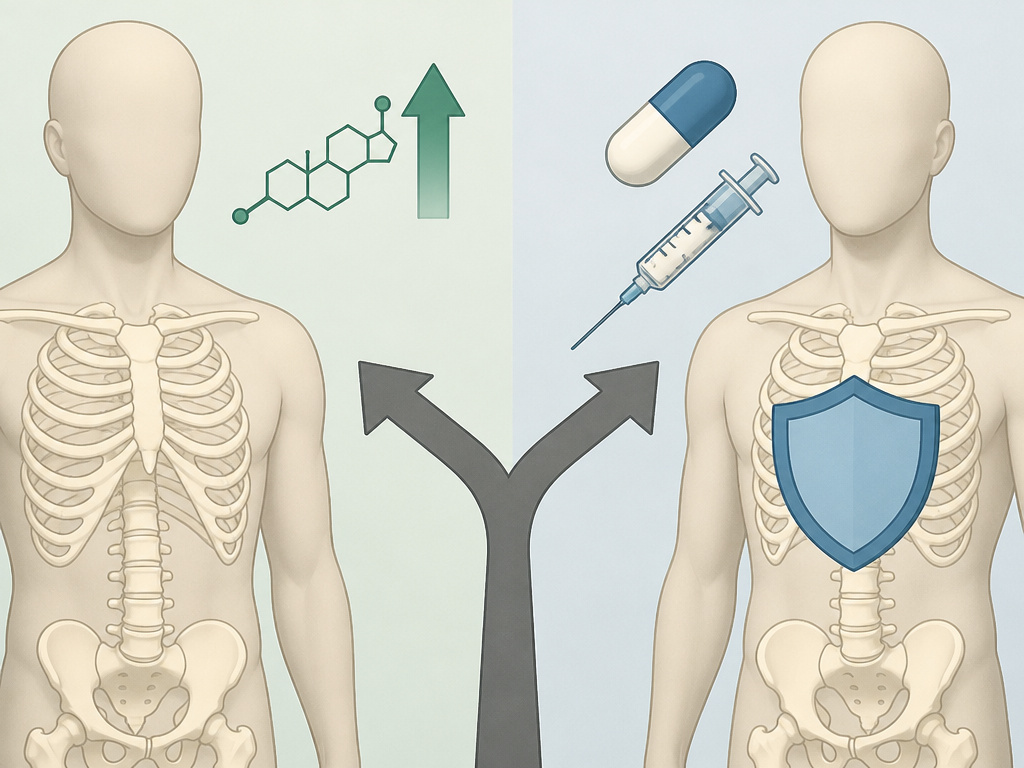
Here’s where the research gets messy and expert opinions diverge. You have two paths: treat the underlying hormone deficiency with testosterone replacement therapy (TRT), or treat the bone disease directly with anti-osteoporosis medications. They are not the same, and the evidence for each has evolved dramatically.
We begin with testosterone. A 2021 controlled clinical trial published in JAMA Internal Medicine found that one year of TRT in older men with low testosterone led to a mean 7.5% increase in spine trabecular volumetric bone density versus 0.8% with placebo. That’s a strong bone-building signal. Older guidelines, like the 2012 Endocrine Society guideline, even suggested testosterone could be used “in lieu of a ‘bone drug'” for certain high-risk men with confirmed hypogonadism.
Then came the TRAVERSE trial, published in the New England Journal of Medicine in 2024. This large, long-term study found a higher fracture risk with testosterone, which contrasts with earlier studies like a 2021 JAMA Internal Medicine trial that found testosterone improved bone density. After a median follow-up of 3.19 years, the fracture incidence was 3.50% in the testosterone group vs. 2.46% in the placebo group. The hazard ratio for clinical fracture was 1.43, meaning a 43% higher relative risk. This landmark NEJM testosterone treatment fracture study concluded that testosterone supplementation did not decrease fracture risk and may even increase it.
So what does a man do with conflicting data? The current, cautious consensus is this: TRT is not first-line therapy for osteoporosis. Its primary goal is to alleviate symptoms of hypogonadism like low libido and fatigue. If bone density improves as a side effect, that’s a benefit. But you cannot rely on it as a fracture-prevention strategy for low testosterone and osteoporosis in men. This aligns with a 2011 Osteoporosis International consensus statement that “osteoporosis is neither a sufficient nor a specific indication for testosterone treatment,” though the Endocrine Society guideline suggests it can be considered for high-risk men with low testosterone who have contraindications to standard bone drugs.
Common mistake: Pursuing testosterone therapy solely for bone protection. The 2024 TRAVERSE trial data shows it doesn’t reliably prevent fractures, and may slightly increase risk. It should be prescribed for classic hypogonadal symptoms, with bone density as a potential secondary benefit.
For directly reducing fracture risk, anti-resorptive medications are the proven choice. These drugs, primarily bisphosphonates and denosumab, work by inhibiting osteoclasts, the cells that break down bone.
| Medication Class | Example Drugs | Lumbar Spine BMD Improvement (Mean Difference) | Primary Benefit |
|---|---|---|---|
| Oral Bisphosphonates | Alendronate, Risedronate | 4.39% – 5.2% | First-line, proven fracture risk reduction |
| IV Bisphosphonate | Zoledronate | 6.10% | Yearly infusion, good for adherence |
| Monoclonal Antibody | Denosumab | 5.80% | Twice-yearly injection, potent effect |
The numbers in the table come from a 2023 meta-analysis cited in the Nature Reviews Rheumatology guideline. Alendronate, a common first choice, improves lumbar spine BMD by a mean difference of 5.2%. Zoledronate, given as an annual intravenous infusion, showed a 6.10% improvement. These drugs have decades of data showing they reduce vertebral and hip fracture rates.
The choice between them often comes down to adherence and convenience. A weekly pill (alendronate) is cheap but requires strict dosing rules (take on an empty stomach, remain upright). A yearly IV (zoledronate) guarantees the dose is delivered but requires a clinic visit. This is where working with a specialist who manages osteoporosis in men daily is invaluable; they can match the drug to your lifestyle and health profile, and may discuss targeted supplements for osteoporosis.
Building a Multi-Layer Defense Strategy
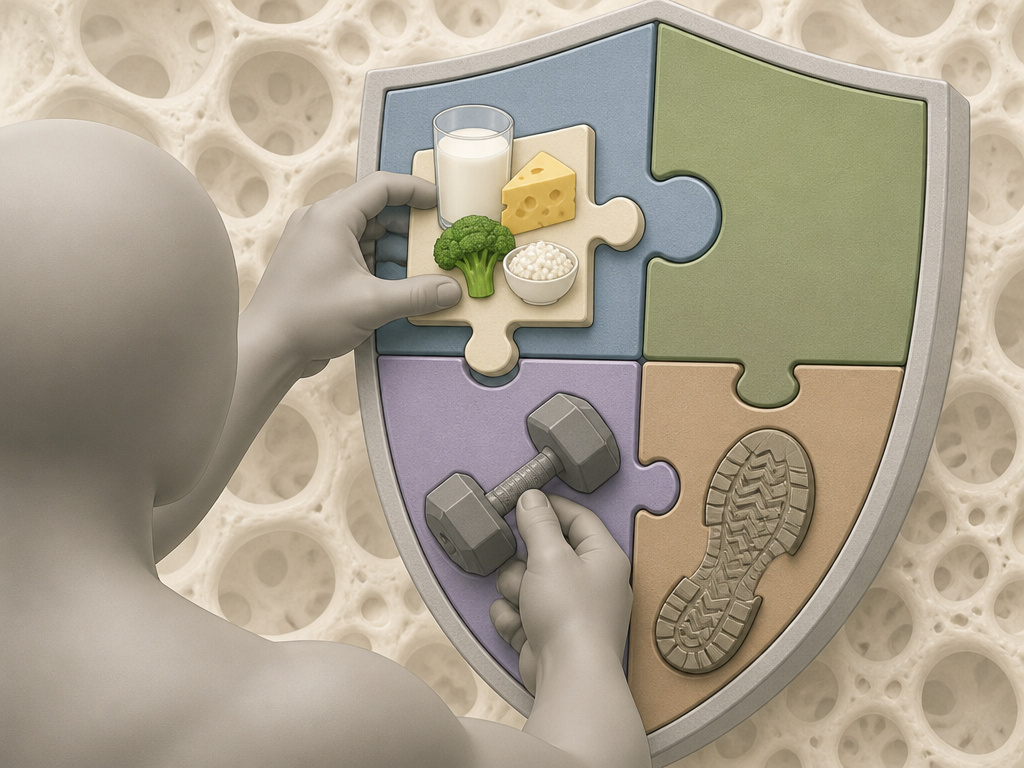
Medication is one pillar. A durable defense requires three others: nutrition, mechanical loading, and fall prevention. Ignoring these makes the drug’s job much harder.
Nutrition is about raw materials. Calcium and vitamin D are essential. Vitamin D enables calcium absorption, and without it, the calcium in your diet or supplements is largely wasted. While diet should come first, targeted vitamin supplementation for osteoporosis can fill critical gaps. The goal is consistent daily intake, not megadoses.
Mechanical loading is the signal that tells bone where to strengthen. Bones adapt to stress. Weight-bearing and resistance exercises are the most effective signals you can send. This doesn’t mean you need to become a powerlifter. Walking, stair climbing, and bodyweight exercises like squats and push-ups all count. Heavy lifting, enough protein, and avoiding extreme dieting did more for my own long-term bone picture than any pill I took early on. The muscle you build also improves balance, creating a positive feedback loop.
I learned this the hard way. Bone density never crossed my mind until my late 30s, when I realized I’d spent years obsessing over supplements for muscle and zero time thinking about my skeleton. Classic overkill with a blind spot.
Fall prevention is the final, critical layer. A strong bone is useless if you hit the ground with too much force. This makes managing joint pain from low testosterone and stability crucial. Simple strategies have a huge impact: wear supportive shoes with non-slip soles, keep walkways in your home clear of clutter and cords, install grab bars in the shower, and ensure your living space is well-lit. A review of medications with a pharmacist can also identify drugs that cause dizziness or orthostatic hypotension.
When to See a Specialist and What to Ask
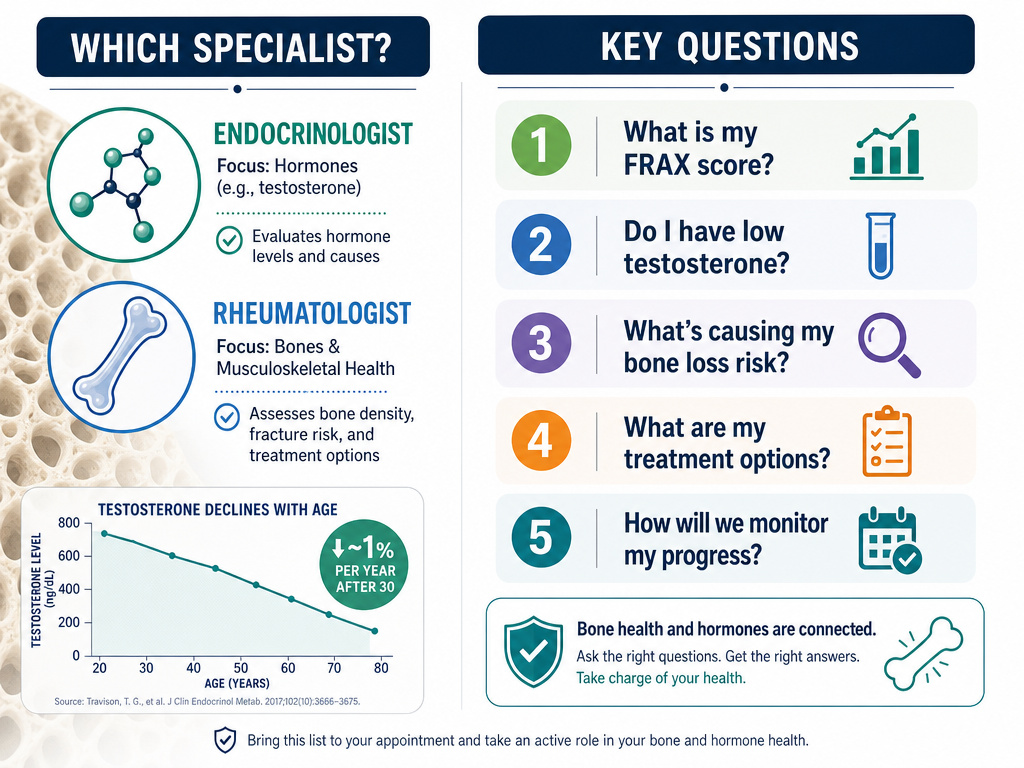
Navigating this alone is a recipe for fragmented care. Your primary care doctor can order initial labs and a DXA scan, but the interpretation and complex treatment plan benefit from a specialist’s lens.
You should seek a referral to an endocrinologist or a rheumatologist when:
- Your DXA scan shows a T-score of -2.5 or below (osteoporosis).
- You have osteopenia (T-score between -1.0 and -2.5) plus a major risk factor like a prior fracture, long-term steroid use, or confirmed hypogonadism.
- Your bone density is declining rapidly (≥3% per year at the hip).
- You have low testosterone and are considering TRT, especially if you have low bone mass.
Go to that appointment prepared. Here’s a short list of questions that cut to the chase:
- “Based on my DXA and labs, what is my absolute fracture risk over the next 10 years?” (Tools like FRAX can calculate this).
- “Do I need more specific hormone tests, like for SHBG, estradiol, or free testosterone?”
- “For my situation, what are the pros and cons of starting a bone drug like alendronate versus addressing my testosterone first?”
- “What is the monitoring plan? How often will we repeat the DXA scan?” (The guideline recommends every 1–2 years to assess treatment response).
- “If we start medication, what is the planned duration of therapy?” (Bisphosphonates are often prescribed for 3-5 years before a “drug holiday” is considered).
Having this conversation ensures you’re not a passive recipient of care, but a partner in the decision. It also helps clarify the often murky underlying causes of low testosterone in your specific case, whether it’s primary testicular failure or a secondary pituitary issue.
How common is osteoporosis in men?
Osteoporosis in men is often overlooked, but it’s a significant cause of fracture and disability. The condition can have a hormonal basis, with low testosterone being associated with increased fracture risk. This highlights that a simple total testosterone test can miss the full picture of bone health risk in men. Assessing these specific hormone levels provides information that complements standard bone density scans and fracture risk calculators.
Frequently Asked Questions
Should you take testosterone if you have osteoporosis?
Not for the osteoporosis alone. Testosterone replacement therapy (TRT) is indicated to treat symptoms of hypogonadism, like low libido, fatigue, and depressed mood, in men with consistently low levels. If you have both hypogonadism and osteoporosis, TRT may improve your bone density as a beneficial side effect. However, the 2024 TRAVERSE trial showed it does not reduce fracture risk and may slightly increase it. The first-line treatment for reducing fracture risk in osteoporosis remains anti-resorptive drugs like bisphosphonates.
Can osteoporosis be reversed?
You can’t completely “reverse” osteoporosis to the bone density of a 30-year-old, but you can significantly improve it and drastically lower fracture risk. Effective drug treatments can increase bone mineral density (BMD) by 5-10% at key sites like the spine over several years, which translates to a much larger reduction in fracture risk (often 40-70%). Combined with lifestyle changes, this allows men to live actively with the condition.
What foods should I eat if I have low bone density?
Focus on foods rich in calcium, vitamin D, and protein. Prioritize dairy (yogurt, cheese, milk), leafy green vegetables (kale, collard greens), canned fish with bones (sardines, salmon), and fortified foods. Protein from eggs, lean meat, and legumes is essential for maintaining muscle mass, which supports bones and balance. Limit excessive alcohol and salt, which can promote calcium loss.
Can a person live a long life with osteoporosis?
Absolutely. Osteoporosis is a chronic condition to be managed, not a death sentence. With modern diagnostics, effective medications, and lifestyle strategies, the primary goal, preventing debilitating fractures, is highly achievable. The key is proactive management: getting an accurate diagnosis, adhering to treatment, engaging in weight-bearing exercise, and implementing fall prevention at home. Many men live long, active lives by making their bone health a consistent priority.
The Bottom Line
The link between low testosterone and osteoporosis is real and mechanistically clear, but the treatment path is not straightforward. A total testosterone level below 200 ng/dL meets the biochemical threshold, but it’s the DXA scan T-score of -2.5 or lower that officially changes the game to osteoporosis.
Here is the pragmatic view the latest evidence supports: if your main concern is preventing a broken hip or spine, the first conversation should be about bisphosphonates like alendronate or risedronate. They have a long track record of reducing fractures. If you have symptomatic hypogonadism, the fatigue, low drive, and brain fog, then testosterone therapy is a valid option to discuss, with the understanding that its bone benefits are a positive side effect, not a guaranteed shield against breaks.
Don’t let the complexity paralyze you. The first step is always the same: get two morning testosterone checks and a baseline DXA scan. That means two morning testosterone checks and a baseline DXA scan. From that data, you and your doctor can build a layered plan that addresses both the hormone deficiency and the bone strength deficit. It’s how you move from risk to resilience.
