
SARMs vs Testosterone: Which Is More Dangerous?
This post contains affiliate links. As an Amazon Associate, we earn from qualifying purchases.
Testosterone is a full androgen-receptor agonist that binds system-wide, producing 4–7 kg of lean mass over 12–20 weeks in clinical trials. SARMs like Ligandrol are non-steroidal, tissue-selective compounds that produce 1–3 kg of lean mass in 8–12 weeks. Neither is FDA-approved for performance use, both suppress natural testosterone production, and both are banned by WADA. The key difference is potency and the depth of long-term safety data.
That difference in potency is stark. A clinical trial from 2001 showed testosterone plus exercise adding 7.6 kg of lean mass in 20 weeks. A 2013 trial on Ligandrol showed 1.21 kg in just 21 days. But the shorter trial and smaller gain mask a critical point: both compounds shut down your body’s own hormone production through the same biological axis.
What follows is a breakdown of the mechanisms, the numbers from the actual studies, the specific legal pitfalls, and the one lab test that shows what’s really happening in your body. The goal isn’t to recommend one. It’s to show why the sarms vs testosterone choice is a choice between two unregulated, suppressive compounds with incomplete safety pictures.
Key Takeaways
- Testosterone builds significantly more muscle than SARMs in clinical head-to-heads, but carries a more severe side-effect profile including estrogen conversion and potential cardiovascular strain. One analysis of clinical data suggests a 5-7x greater lean mass accrual with testosterone+training versus SARMs.
- Both suppress your HPG axis, lowering LH, FSH, and natural testosterone. Recovery can take weeks to months, and bloodwork is the only way to confirm it.
- 52% of SARM products contain the labeled ingredient per a 2017 JAMA study, with 39% containing unlisted contaminants — a massive unregulated product quality risk.
- Testosterone is a Schedule III controlled substance (prescription only) in the U.S., while SARMs are not approved for human use but are sold as “research chemicals.”
- The safer choice is context-dependent and sources disagree: medically supervised TRT has decades of data for hypogonadism, but some sources note supraphysiological testosterone use carries a ‘more severe side-effect profile,’ while others argue it’s safer due to more research. SARMs have almost no long-term human safety data for performance dosing and share similar risks like suppression and unregulated product quality.
How Do SARMs and Testosterone Actually Work?
They both target the androgen receptor, but the way they activate it changes everything.
Testosterone is a steroidal hormone and a full agonist. When it binds to the androgen receptor, it activates it fully in every tissue that has one: muscle, bone, prostate, skin, liver. It also converts into other hormones like dihydrotestosterone (DHT) and estradiol through natural enzymatic pathways. This system-wide activation is why it’s so potent for muscle growth and why it causes side effects like acne, hair loss, and gynecomastia.
Testosterone is a full androgen-receptor agonist that binds to androgen receptors system-wide. SARMs are non-steroidal compounds that bind to the androgen receptor with tissue-selective activity, designed to favor muscle and bone over prostate and skin cells.
SARMs like Ostarine (MK-2866) and Ligandrol (LGD-4033) are non-steroidal compounds. Their molecular shape is designed to bind the receptor in a way that preferentially signals muscle and bone cells to grow, while having a weaker effect on prostate or sebaceous gland cells. This is the “selective” promise. However, “selective” is not “side-effect-free.” The receptor in your brain and pituitary gland still gets the signal, which tells your body to slow or stop its own natural testosterone production.
The oral bioavailability is another practical difference. SARMs are taken as a pill. Testosterone, due to first-pass liver metabolism, is usually injected. That’s a major point for convenience, but it puts the liver directly in the firing line for any oral compound.
Muscle Gains: Clinical Data vs. Gym Bro Claims
The numbers from published studies tell a clear story, but they rarely match the hype you see online.
Consider the benchmarks. In a landmark study (Bhasin et al., 2001), healthy men taking 600 mg/week of Testosterone Enanthate alongside a structured weightlifting program gained +7.6 kg of lean mass over 20 weeks. That’s the gold standard for anabolic potency.
Contrast that with SARMs. In a clinical trial (Basaria et al., 2013), healthy men taking 1 mg/day of Ligandrol (LGD-4033) gained +1.21 kg of lean mass in just 21 days. Another trial on Ostarine showed +1.7 kg over 12 weeks in an elderly population. Clinical trials indicate SARMs produce roughly 1–3 kg of lean mass in 8–12 weeks at studied doses.
| Compound | Study Dose & Duration | Population | Lean Mass Gain | Source |
|---|---|---|---|---|
| Testosterone Enanthate | 600 mg/week for 20 weeks | Healthy men (19-40) | +7.6 kg | Bhasin et al. (2001) |
| Ligandrol (LGD-4033) | 1 mg/day for 21 days | Healthy men (21-50) | +1.21 kg | Basaria et al. (2013) |
| Ostarine (MK-2866) | 3 mg/day for 12 weeks | Elderly men & postmenopausal women | +1.7 kg | Dalton et al. (2011) |
Where do the claims of “gaining 15 pounds on one Ligandrol cycle” come from? Those are anecdotal reports from the bodybuilding community, not clinical data. The discrepancy is huge: 1.21 kg in a trial versus 6.8 kg (15 lbs) in a forum post. This gap is where marketing lives and where users get unrealistic expectations. The clinical data shows a starkly greater lean mass accrual with testosterone.
Side Effects and Suppression: The Unavoidable Trade-Off
You cannot separate the anabolic effect from the endocrine disruption in the sarms vs testosterone debate. Both of these compounds work by hijacking your hormone system.
Testosterone’s side effects are documented in clinical studies. They include:
- Estrogenic effects: Gynecomastia (breast tissue growth), water retention, and increased blood pressure from testosterone converting to estradiol.
- Androgenic effects: Acne, accelerated male-pattern baldness, and increased body hair from conversion to DHT.
- Cardiovascular risks: It can negatively affect cholesterol.
- Suppression: Exogenous testosterone shuts down your body’s production of luteinizing hormone (LH) and follicle-stimulating hormone (FSH), which in turn stops natural testosterone production in the testes.
SARMs suppress the exact same axis. The Basaria trial found that at the 1.0 mg dose of LGD-4033, follicle-stimulating hormone and free testosterone were significantly suppressed. Headache and dry mouth were the most common side effects in that trial. There is a documented risk of hepatotoxicity; a case report documented hepatocellular liver injury in a 24-year-old male one week after he stopped taking LGD-4033.
Common mistake: Thinking SARMs don’t require post-cycle therapy (PCT). Because they suppress LH and FSH, your natural testosterone production plummets. Coming off without a plan can mean months of low energy, libido, and mood while your axis struggles to restart.
Both compounds suppress the HPG axis. Your brain senses the androgen receptor is being activated (whether by testosterone or a SARM) and downregulates the signal to your testes. On bloodwork, this shows as low testosterone with LH and FSH switched off. The BPAC NZ clinical guidance lists SARMs right alongside anabolic steroids as axis-suppressing agents, noting effects can persist weeks to months after stopping.
Legal Status, Product Quality, and Real Access
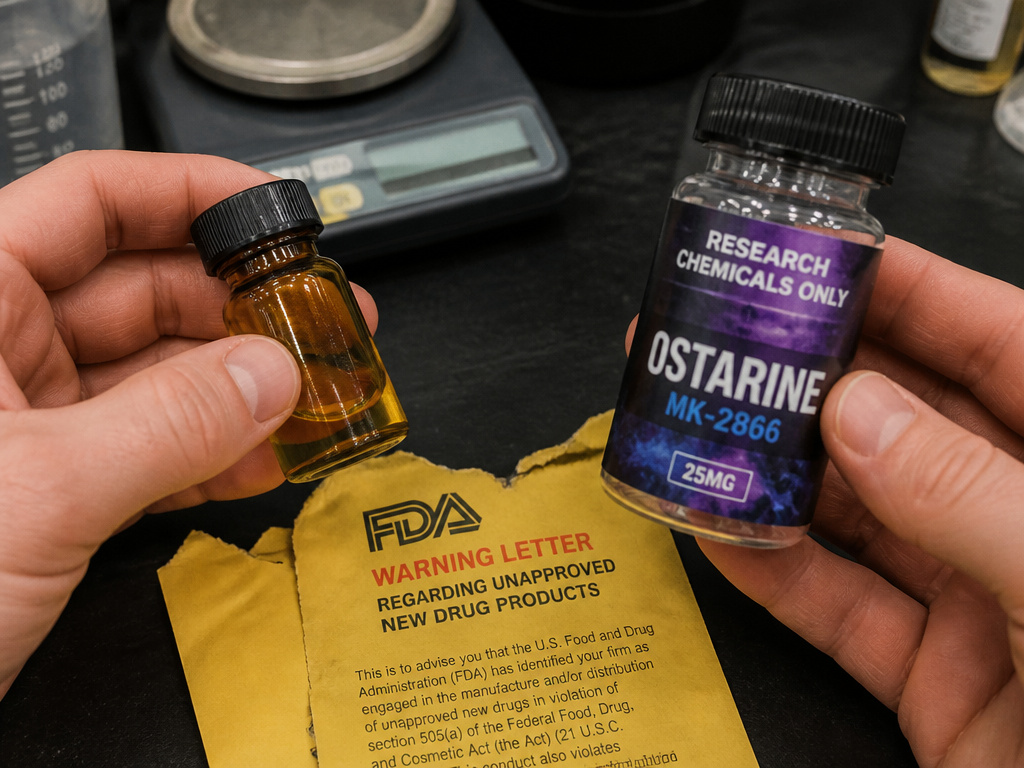
This is where theory meets a messy, often dangerous reality.
In the United States, testosterone is a Schedule III controlled substance. It is illegal to possess without a prescription. It is illegal to possess without a prescription.
SARMs occupy a gray area. The U.S. FDA states they are not approved for human use or as dietary supplements. The FDA has issued warning letters to companies marketing them as such. They are sold as “research chemicals” or “for lab study only.”
The product quality problem is severe. A 2017 JAMA study analyzed products sold as SARMs and found only 52% contained the labeled ingredient. 39% contained unlisted contaminants. Medsafe, New Zealand’s regulator, explicitly flags that unassessed SARM products carry risks of mislabelling and contamination. You are buying a product with high risk of mislabelling and contamination.
| Aspect | Testosterone (Non-Prescribed) | SARMs |
|---|---|---|
| U.S. Legal Status | Schedule III Controlled Substance (Prescription Only) | Not FDA-Approved; Sold as “Research Chemical” |
| Product Quality | Unregulated if sourced illicitly; pharmacy grade with prescription. | High risk of mislabeling & contamination (per JAMA, Medsafe). |
| Typical Cost | Clinic fees can be high; insurance may not cover. | $60-$100 per bottle, but quality is unknown. |
| Long-Term Human Data | Extensive for therapeutic use; limited for performance doses. | Minimal for performance use; long-term safety unknown. |
For athletes, the playing field is level: both SARMs and testosterone are banned by WADA under category S1. Detection windows for SARMs can extend several weeks.
The Essential Bloodwork: What to Test and When
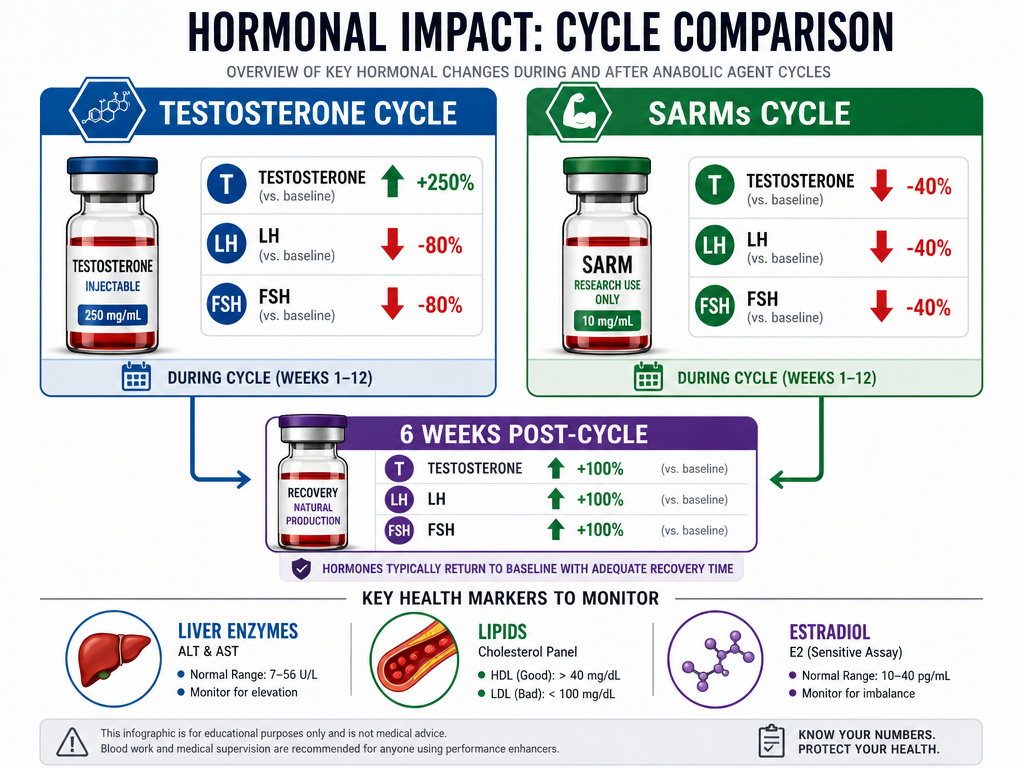
If you are considering or using either of these compounds, this is mandatory. Guessing about your hormone levels is a guaranteed way to cause long-term damage.
Before you start anything, get a baseline. This shows you where you naturally sit and provides a comparison point for recovery. The panel must be comprehensive:
- Hormone Panel: Total Testosterone, Free Testosterone, Luteinizing Hormone (LH), Follicle-Stimulating Hormone (FSH), Estradiol, SHBG.
- Liver & Lipids: ALT, AST, GGT (liver enzymes), HDL, LDL, Triglycerides.
- General Health: Full Blood Count (CBC), kidney markers, HbA1c.
On cycle, this panel tells different stories. On testosterone, your exogenous hormone will show high serum testosterone, but your LH and FSH will be suppressed. On SARMs, you’ll see the suppression directly: low testosterone with LH and FSH also near zero.
The critical test comes around 6 weeks after stopping. You need to see if your axis is recovering. Check testosterone, LH, and FSH again. Are they climbing back toward your baseline? Check testosterone, LH, and FSH to see if your axis is recovering. Effects can persist weeks to months after stopping.
Without these labs, you are flying blind. Bloodwork is essential to confirm recovery, which can be delayed. The only way to know is to measure.
SARMs vs Testosterone: Which Should You Actually Consider?
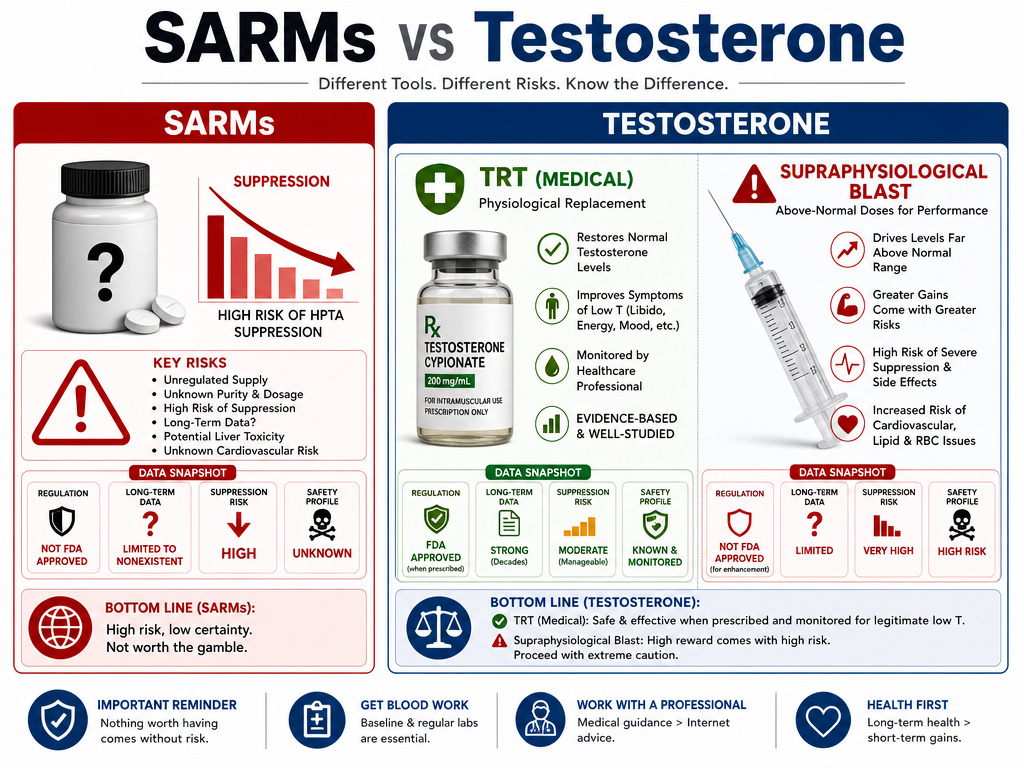
To be blunt. Neither of these should be a first, second, or third resort for a healthy individual with normal hormone levels looking to improve their physique.
If your natural testosterone is clinically low (<300 ng/dL with symptoms), see an endocrinologist. Discuss testosterone replacement therapy (TRT). This is a medical treatment for hypogonadism. This is entirely different from the supraphysiological “blast” doses used for bodybuilding.
If your levels are normal, the risk-benefit calculation for non-prescribed testosterone or SARMs is poor. The potential gains come with suppression, legal risks, and safety concerns.
SARMs are sometimes presented as a middle ground. Clinical data and regulatory warnings highlight their risks. They are less potent anabolics that still suppress your axis, come from an unregulated supply chain, and lack any long-term safety data.
Frequently Asked Questions
Do SARMs suppress testosterone?
Yes, significantly. Clinical trials show SARMs like Ligandrol suppress follicle-stimulating hormone and free testosterone in a dose-dependent manner. They activate the androgen receptor, which signals your brain to slow production of LH and FSH, the hormones that tell your testes to make testosterone.
What’s better for muscle growth, SARMs or testosterone?
Testosterone is vastly more potent. Clinical data shows testosterone with exercise can add over 7 kg of lean mass in 20 weeks, while studied SARMs typically add 1-3 kg in 8-12 weeks. Testosterone’s full systemic activation simply produces a stronger anabolic signal.
Can you pass a drug test if you take SARMs?
No. SARMs are banned by the World Anti-Doping Agency (WADA). Anti-doping labs test for them, and detection windows can extend for several weeks after your last dose. There is no guaranteed way to beat a professionally administered test.
Are SARMs safer than steroids?
The safety profiles are different, not necessarily better. SARMs may have fewer androgenic side effects like hair loss, but they still suppress natural testosterone and carry hepatotoxicity risks. Injectable testosterone esters avoid first-pass liver stress but introduce other risks. Neither has a safe profile for non-prescribed, performance-oriented use.
Do you need PCT after SARMs?
Yes. Post-cycle therapy (PCT) with compounds like SERMs (e.g., tamoxifen or clomiphene) may help restart your natural LH and FSH production after suppression from SARMs. However, PCT is not a guarantee of full or timely recovery, which is why pre- and post-cycle bloodwork is essential.
Before You Go
Your baseline testosterone level is a key factor. If it’s clinically low, that’s a medical conversation with an endocrinologist about TRT. If it’s normal, introducing any external androgen—testosterone or SARM—will suppress your system for a marginal physical return.
The concession here is about control. Medically supervised TRT offers a controlled dose, pharmacy-grade product, and ongoing monitoring. The non-prescribed use of either compound trades that control for a gamble on dosage, substance purity, and your body’s unique response to shutdown. The promised results from forums and marketers are not the results you see in controlled studies.
So here’s the surprising stance: for a healthy individual, the smarter investment isn’t in a bottle of research chemicals or a black-market vial. It’s in the full blood panel that tells you what you’re actually working with. Start there. The answer is almost never in the compound; it’s in the data you already have, but haven’t looked at yet.
