
Testosterone Gel Pros and Cons: The Evidence-Based Balance
This post contains affiliate links. As an Amazon Associate, we earn from qualifying purchases.
Testosterone gel delivers a steady, physiological dose of hormone through the skin, offering key advantages like stable mood and avoidance of injection peaks, but it requires strict daily adherence and carries a risk of accidental transfer to others. The starting dose for AndroGel 1.62% is 1.25 g (20.25 mg testosterone), while generic 1% gel often starts at 50 mg. Serum levels reach a steady state 48–72 hours after the first application.
That “steady state” is the whole point. It means your hormone levels don’t spike into the supraphysiologic range and then crash over the next two weeks, which is exactly what happens with short-acting intramuscular injections. You trade the inconvenience of a daily routine for the benefit of not riding a hormonal rollercoaster, a key consideration when weighing testosterone gel pros and cons.
What follows is a breakdown of that trade-off, central to the testosterone gel pros and cons. We’ll look at the documented benefits for sexual function, mood, and bone density, then match them against the real risks—from transference to cardiovascular events reported in the large TRAVERSE trial. We’ll also cover the practicalities: how to apply it correctly across different brands, what to monitor, and how it stacks up against other TRT options.
Key Takeaways
- Steady-state levels are reached in 2–3 days, avoiding the supraphysiologic peaks and troughs of weekly injections.
- The risk of accidental transfer is an essential daily safety routine; wash hands immediately and cover the site to protect others.
- Benefits appear on different timelines: mood and libido often improve in 3–6 weeks, while bone density changes require at least 6 months.
- Application sites are brand-specific; for example, AndroGel 1.62% is approved for shoulders and upper arms only, Fortesta 2% is for the thighs, while generic 1% gel can be applied to shoulders/upper arms and/or abdomen.
- Cardiovascular risk data is nuanced; the TRAVERSE trial found no increased risk of major heart attacks or strokes, but noted higher rates of atrial fibrillation and acute kidney injury.
The Core Trade-Off: Steady Levels vs. Daily Commitment
The main argument for a gel, a core part of the testosterone gel pros and cons, isn’t about absorption—it’s about pharmacokinetics, the shape of the hormone curve in your blood over time. A systematic review in 2022 put it plainly: among available treatments, only transdermal gel delivery and long-acting injectable testosterone undecanoate provide pharmacokinetic behaviour that gives a steady state level within a physiological range. Short-acting injections, by contrast, cause serum testosterone to rise into the supraphysiologic range within 24–48 hours and then gradually decline into the low-normal range over two weeks.
That peak-and-trough cycle can manifest as noticeable shifts in energy, mood, and libido. The gel smooths that out. Your levels sit in a target physiological range day after day. The catch is you have to apply it every single day, and you have to get the routine right to prevent exposing anyone else.
Where this goes sideways: Skipping the hand-washing step or not covering the application site. Cases of secondary exposure in children, resulting in virilization like penile or clitoral enlargement, are documented in postmarketing reports. These effects sometimes don’t fully reverse.
The daily habit becomes a discipline. You can’t just “catch up” with a double dose tomorrow. If you’re the type who forgets a daily vitamin, this format will test you. The convenience of a shot every few months is real, but so is the stability of a daily gel.
Documented Benefits: What the Research Says You Can Expect
Testosterone replacement aims to relieve specific hypogonadal symptoms: low libido, fatigue, depressed mood, and loss of muscle or bone mass. The gels have been studied for all of these. The key is that improvements don’t all happen at once.
Sexual function and mood tend to be the first responders. According to a systematic review, sexual desire and function improve 3–6 weeks after initiation of testosterone therapy. Effects on depression and mood can also be seen in that 3–6 week window, though they may take longer to fully stabilize. It can take 6 months until a clear effect is seen on erections and ejaculations.
Bone health is a slower, structural change. The same review notes effects on bone mineral density (BMD) have been shown in studies of 6 months duration and longer. One randomized controlled trial found that testosterone gel replacement in 227 men with hypogonadism during 6 months resulted in a decrease in osteoclastic activity and an early but transient stimulation of osteoblastic activity in the first 90 days. Observational studies show a gradual increase in BMD during treatment for up to three years.
For a broader look at the potential upsides, our overview of TRT pros and cons covers benefits common to all delivery methods.
| Expected Benefit | Typely Onset Timeline | Supporting Evidence |
|---|---|---|
| Improved libido & mood | 3–6 weeks | Systematic review of clinical data |
| Enhanced erectile function | ~6 months | Systematic review of clinical data |
| Increased bone mineral density | ≥6 months | RCT with 227 men over 6 months |
| Stable serum testosterone level | 48–72 hours | Pharmacokinetic study of 1% gel |
The “steady level” benefit is quantifiable. In the large TRAVERSE cardiovascular safety trial, the mean serum testosterone level in the gel group was 220.4 ng/dL at baseline and rose to a steady 440.5 ng/dL at 12 months. That’s the predictable elevation to a steady-state level the gels are designed for.
The Risk Profile: From Transference to Cardiovascular Events
The disadvantages aren’t just inconveniences; several are serious medical risks that require active management. These are clearly outlined in the official testosterone gel label from the FDA.
1. Secondary Exposure (Transference). This is the most distinctive risk. The gel can transfer from your skin to another person through direct contact, leading to unintended androgen exposure. Children are especially vulnerable, with cases reported of virilization. The mandate is simple: wash your hands with soap and water immediately after applying, and cover the application site with clothing after it dries. You must also wash the site thoroughly before any anticipated skin-to-skin contact.
Common mistake: Assuming the gel is “dry” and safe after a few minutes. The risk remains until it’s washed off. This non-negotiable routine is why we have a dedicated guide on how to prevent testosterone gel transfer.
2. Cardiovascular and Hematologic Risks. The TRAVERSE trial provides the best recent data. It found no increased risk of major adverse cardiovascular events (MACE) for gel versus placebo. However, it did report higher incidence rates for specific events:
- Nonfatal arrhythmias warranting intervention: 5.2% vs 3.3% (gel vs placebo)
- Atrial fibrillation: 3.5% vs 2.4%
- Acute kidney injury: 2.3% vs 1.5%
- Bone fracture: 3.5% vs 2.5%
The label also warns that testosterone can increase blood pressure and recommends periodic monitoring. It’s not recommended for men with uncontrolled hypertension. Venous thromboembolism (blood clots) has also been reported in patients using testosterone products.
3. Prostate and Urological Monitoring. AndroGel is contraindicated in men with breast or prostate cancer. Patients with benign prostatic hyperplasia (BPH) must be monitored for worsening symptoms. An increase in prostate-specific antigen (PSA) is the most common adverse reaction, with an incidence of ≥5%. The standard protocol is to monitor serum testosterone, PSA, hemoglobin, and hematocrit periodically.
4. Metabolic and Other Effects. Exogenous testosterone may cause azoospermia (absent sperm), impacting fertility. It can also lower blood glucose, potentially reducing insulin needs in diabetics. Edema and sleep apnea may occur in those with preexisting risk factors.
Application Rules: It’s Not Just Rub and Go
If you think you just squeeze some gel on your arm, you’re halfway to a problem. The specifics matter, and they change from product to product. Getting it wrong can affect absorption, dosing, and safety.
First, the universal steps:
- Apply to clean, dry, intact skin.
- Wash your hands immediately and thoroughly with soap and water.
- Let the site dry completely before putting on a shirt.
- Cover the site with clothing.
Where you apply it, however, is brand-specific. This isn’t a suggestion; it’s based on the absorption studies submitted for each product’s approval.
| Gel Product | Standard Starting Dose | Approved Application Site(s) | Key Site Restriction |
|---|---|---|---|
| AndroGel 1.62% | 1.25 g (20.25 mg testosterone) | Shoulders and upper arms only | Do not apply to abdomen, genitals, chest, armpits, or knees. |
| Generic 1% Gel | 50 mg testosterone | Shoulders, upper arms, and/or abdomen | More flexible than AndroGel 1.62%. |
| Fortesta 2% Gel | 40 mg testosterone | Front and inner thighs only | Specific thigh application for this formulation. |
This table highlights a critical point: you cannot freely substitute one gel for another without reviewing its official drug labeling. Applying AndroGel 1.62% to your abdomen, for instance, is off-label and its absorption profile there is unstudied. For a deeper dive on technique, see our guide on where to apply testosterone gel.
Dose titration is also standardized. For AndroGel 1.62%, the dose should be adjusted based on a pre-dose morning serum testosterone level checked at approximately 14 days and 28 days after starting or changing the dose. The goal is to find the lowest dose that maintains your level in the mid-normal range.
How Gel Stacks Up Against Other TRT Methods
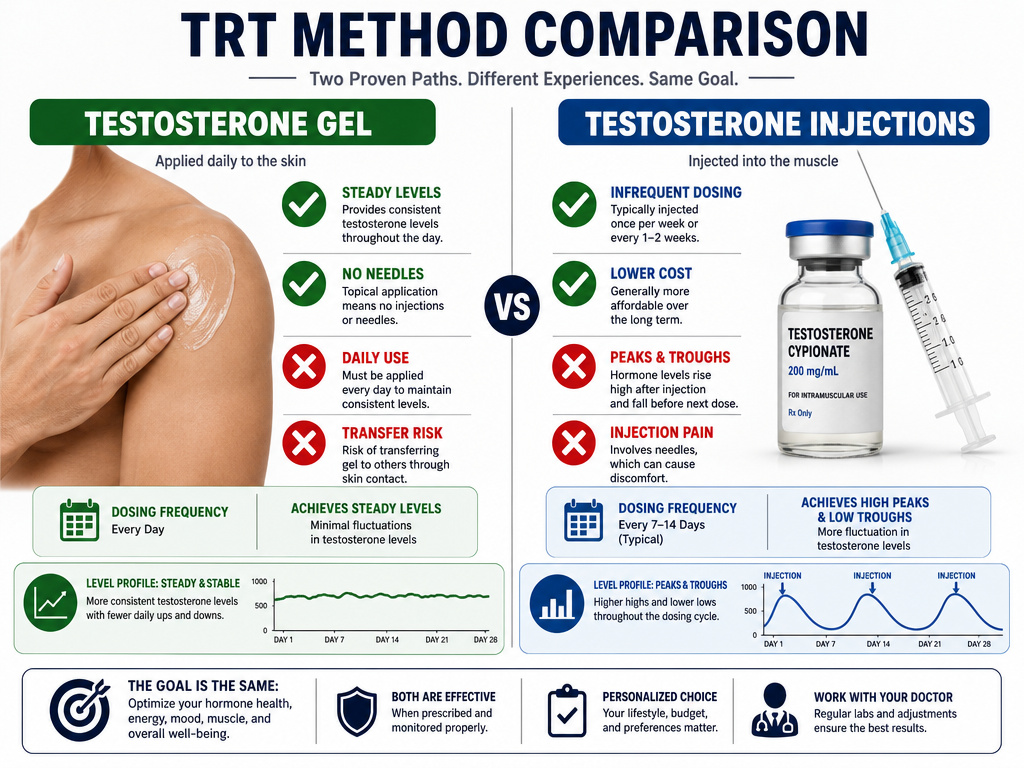
The choice is rarely just “gel or nothing.” It’s gel versus injections, patches, pellets, or newer forms like a nasal testosterone gel. Each has a different profile of pros and cons.
The most common comparison is between gel and testosterone injections. Here’s the head-to-head:
- Gel Pros: Steady physiological levels, no needles, no injection-site pain.
- Gel Cons: Daily application, transfer risk, potentially higher cost, skin irritation possible.
- Injection Pros: Infrequent dosing (weekly to every 3 months), no transfer risk, often lower cost.
- Injection Cons: Peaks and troughs (with short-acting esters), injection pain or anxiety, risk of supraphysiologic levels.
Patches and pellets are less common. Testosterone patches offer steady delivery but have a high rate of skin irritation. Pallets provide months of coverage but require a minor surgical procedure for insertion and carry a risk of extrusion or infection.
The “best” method depends entirely on your personal priorities: stability versus convenience, fear of needles versus fear of daily routine, and cost considerations your insurance dictates.
The Biochemical Fine Print: DHT and Bioavailability
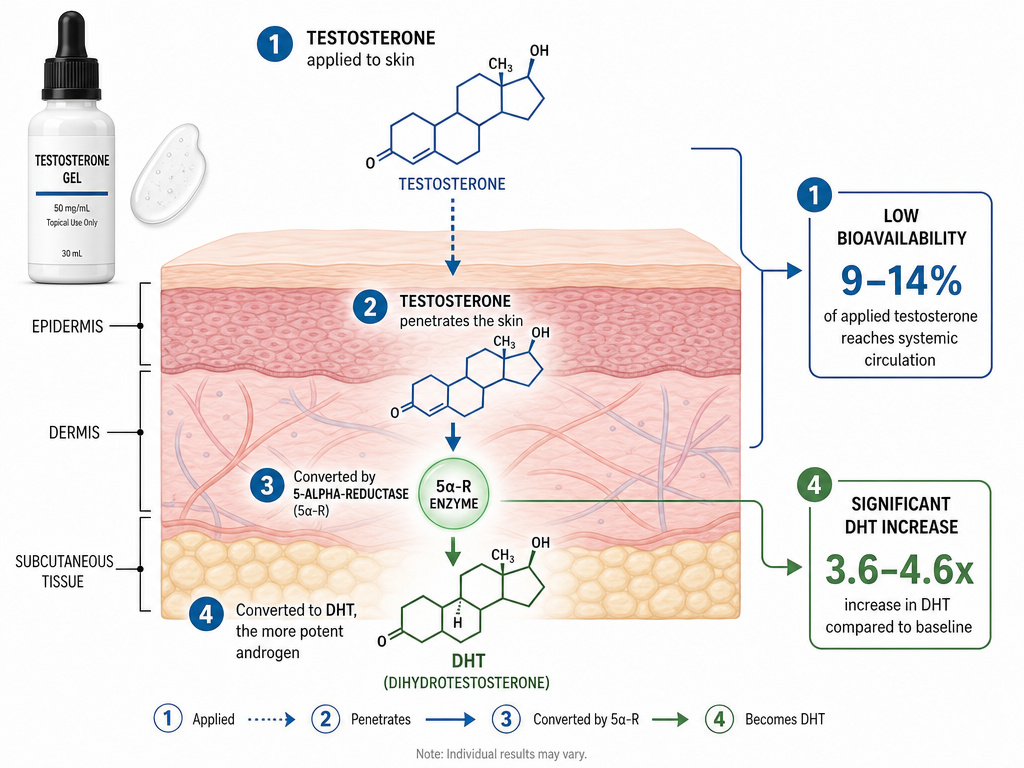
Beyond the broad pros and cons, there are specific metabolic effects that matter for some men. When testosterone is absorbed through the skin, a significant portion is converted locally to dihydrotestosterone (DHT) by the 5-alpha-reductase enzyme present in skin cells.
One long-term pharmacokinetic study found that a 1% testosterone gel increased serum DHT by 3.6- to 4.6-fold above baseline. This results in a significantly higher DHT-to-testosterone ratio compared to baseline or injectable routes. For most men, this is inconsequential. However, for those with androgenetic alopecia (male pattern baldness) or benign prostatic hyperplasia sensitive to DHT, it could theoretically accelerate hair loss or urinary symptoms. It’s a nuanced, often overlooked con.
On the absorption side, only a fraction of the topical dose gets into your system. Research indicates approximately 9-14% of the testosterone applied in a 1% hydroalcoholic gel is bioavailable. The rest remains on the skin surface or is metabolized locally. This is why dose adjustments must be guided by blood work, not by the amount you physically apply.
What to do if you miss a dose
If you forget to apply your testosterone gel, apply the missed dose as soon as you remember on the same day. If you only remember the next day at your regular application time, skip the missed dose and apply your normal dose. Do not apply a double dose to make up for the missed one. The steady-state levels provided by the gel mean an occasional missed dose is unlikely to cause a major disruption. To maintain consistent levels, try to apply the gel at the same time each day, typically in the morning after washing. Always wash your hands with soap and water immediately after application.
Drug interactions
Testosterone gel can interact with other medications, requiring careful monitoring. Androgens may decrease blood glucose, which could lower insulin requirements for diabetic patients. Changes in anticoagulant activity have been observed, so more frequent monitoring of INR and prothrombin time is recommended if you are on blood thinners. Using testosterone with corticosteroids or adrenocorticotrophic hormone (ACTH) may increase the risk of fluid retention. Patients with conditions like benign prostatic hyperplasia should be monitored for a worsening of symptoms. Always inform your doctor about all medications and supplements you are taking.
Frequently Asked Questions
What are the negative side effects of testosterone gel?
For AndroGel 1.62%, the most common adverse reaction (incidence ≥ 5%) is an increase in prostate specific antigen (PSA). Serious risks include secondary exposure to others, increased blood pressure, polycythemia (high red blood cell count), and a potential increase in the risk of certain cardiac arrhythmias like atrial fibrillation. Venous blood clots and sleep apnea are also possible, especially in at-risk individuals.
How long does testosterone gel take to kick in?
Serum testosterone levels reach a steady state in your bloodstream 48–72 hours after the first application. You will not “feel” this. Noticeable improvements in symptoms like low libido and mood often begin within 3–6 weeks. Maximum effects on other parameters, like erectile function or bone density, can take 6 months or longer.
Do you gain weight on testosterone gel?
It can change body composition. Testosterone therapy typically increases lean muscle mass and may decrease fat mass, which could lead to weight gain from muscle. It is not typically associated with pure fat gain. Any significant weight change should be discussed with your doctor, as it could relate to fluid retention (edema), a known risk in those with cardiac, renal, or hepatic disease.
Who should not use testosterone gel?
It is contraindicated for men with breast cancer or known/suspected prostate cancer. It should not be used by women who are pregnant or breastfeeding due to risk of fetal harm. It is also not recommended for men with uncontrolled heart failure, severe sleep apnea, uncontrolled high blood pressure, or high hematocrit that hasn’t been managed.
Before You Go
The gel is a tool, not a magic solution. Its value hinges on matching its specific profile—steady levels, daily routine, transfer vigilance—to your life and your health priorities. The research supports its efficacy for core hypogonadal symptoms, but it also demands respect for its documented risks.
If you’re considering it, start with the practicalities. Can you follow a daily, required 2-minute routine involving hand-washing and site coverage? Are the people in your household, especially children and partners, able to understand and avoid contact? Your answers to those questions are as important as your lab numbers.
Finally, remember this is a medical treatment, not a supplement. All the pros and cons here are grounded in clinical studies and prescribing labels, like the FDA full prescribing information. Work with a doctor who will initiate therapy at the evidence-based starting dose, check your levels at the recommended 14- and 28-day marks, and monitor your blood pressure, hematocrit, and PSA regularly. That’s how you capture the steady benefit while managing the very real cons.
