
Vitamin D Dosage for Testosterone: What the Research Says
This post contains affiliate links. As an Amazon Associate, we earn from qualifying purchases.
Vitamin D dosage for testosterone is not a one-size-fits-all number. For a man with a clear deficiency (25(OH)D under 50 nmol/L), a daily dose of 1,500–2,000 IU of Vitamin D3 might offer a modest benefit, especially alongside other health improvements like weight loss. For men with normal or borderline levels, supplementation is unlikely to raise testosterone, according to the most recent high-quality trials. The 2024 meta-analysis concluded the overall effect is minimal, a statistically significant but clinically negligible increase of 0.38 nmol/L.
That gap between a potential benefit for the deficient and no effect for everyone else is where the whole conversation lives. The dosage that works in one specific, tightly controlled study becomes useless hype when applied to a general audience. This guide walks through the specific studies, their doses, and the critical factor that decides whether you’re in the group that might see a change.
What follows: a breakdown of the two landmark studies that define the debate, a table of every tested dosage, the official health guidelines that have nothing to do with testosterone, and a practical protocol for testing and supplementing based on your own numbers.
Key Takeaways
- One cited positive study (Pilz et al., 2011) used 3,332 IU daily for one year in overweight, deficient men who were also losing weight, though isolating the vitamin D effect is nearly impossible. More recent trials and meta-analyses have found no significant effect.
- More recent, rigorous trials like the 2019 Graz RCT found no significant effect from 20,000 IU weekly (2,857 IU/day) in men with both low testosterone and low vitamin D.
- Test your 25-hydroxyvitamin D [25(OH)D] level first. Aiming for a general health target of >75 nmol/L (30 ng/mL) is a better goal than chasing a testosterone boost.
- If you supplement, Vitamin D3 (cholecalciferol) is the preferred form over D2. Take it with a meal containing fat for better absorption.
- Long-term supplementation without re-testing can lead to unnecessarily high levels or persistent deficiency. Re-check your level after 8–12 weeks.
The Research: A Tale of Two Studies
The question isn’t whether vitamin D can increase testosterone. It’s which study you believe, and more importantly, which group of men you resemble.
The optimistic case rests almost entirely on a single 2011 randomized controlled trial by Pilz et al. It enrolled 54 overweight men with a clear vitamin D deficiency (25(OH)D <50 nmol/L) who were in a weight loss program. They received 3,332 IU of vitamin D3 daily for one year. The result was a significant increase in total testosterone, from 10.7 to 13.4 nmol/L.
That sounds compelling. But you have to read the footnote. The men were losing weight, which itself can boost testosterone. The study design makes it very hard to say how much of the rise was from the vitamin D versus the concurrent lifestyle change.
Where this goes sideways: Citing the Pilz study as proof that “vitamin D boosts testosterone” ignores its specific context: deficient, overweight men in active weight loss. Applying its 3,332 IU dose to a lean, non-deficient man is a recipe for disappointment.
The pessimistic, or perhaps more accurate, case comes from later, more targeted trials. The 2019 Graz RCT is a direct counterpoint. Researchers recruited 94 men with both low total testosterone (<10.4 nmol/L) and low vitamin D (<75 nmol/L). They gave them a high weekly dose of 20,000 IU (about 2,857 IU/day) for 12 weeks.
The result? No significant effect on serum total testosterone. None. This was a group primed for a benefit, with both hormones low, and still nothing.
A 2024 meta-analytic review tried to settle the argument by pooling data from multiple trials. It found a statistically significant increase of 0.38 nmol/L. The authors then called this effect “minimal” and “clinically negligible.” In other words, even when you force the data to show a win, the win is too small to matter in the real world.
The takeaway is messy, which is why the topic persists. One older, confounded study shows a benefit. Newer, cleaner studies show none. The overall signal is weak at best.
What Dosages Were Actually Tested?
Studies have thrown a wide range of vitamin D dosages at the vitamin d dosage for testosterone question. The results tell you more about study design than about an ideal dose.
| Daily Dosage (IU) | Study Context | Reported Effect on Testosterone |
|---|---|---|
| 600 | General health maintenance, various populations | No significant effect |
| 1,200 | Athletic performance, winter supplementation studies | No significant effect |
| 2,000 | Common maintenance dose per Endocrine Society | Mixed; no clear testosterone benefit in isolation |
| 2,857 (20k/wk) | Graz RCT (2019) in men with low T & low D | No significant effect |
| 3,332 | Pilz RCT (2011) in deficient, overweight men | Significant increase (with weight loss confounder) |
| 4,000 | Upper limit of many longer-term trials | No significant effect |
The table shows a disconnect. The dose that “worked” (3,332 IU) lived inside a very specific scenario. The doses that didn’t work range from low to quite high. This suggests the dosage is less important than the person’s starting point.
A 2023 systematic review in PMC echoed this, concluding the evidence is heterogeneous and there’s limited evidence for significant changes in total testosterone from supplementation. When you see a headline claiming “3,000 IU is the magic number,” it’s cherry-picking the one optimistic data point from a field of null results.
Official Health Guidelines vs. Testosterone Targets
Before you pour a high-dose vitamin D supplement into your morning routine, know what the actual health authorities recommend. Their goals have nothing to do with hormones.
The NIH Vitamin D fact sheet sets the Recommended Dietary Allowance (RDA) at 600 IU/day for adults 19-70 and 800 IU/day for those over 70. This is the intake deemed sufficient for bone health in most people.
The Endocrine Society’s clinical practice guideline suggests higher intakes are needed to maintain optimal blood levels, recommending 1,500–2,000 IU/day to maintain a 25(OH)D level above 75 nmol/L (30 ng/mL). This contrasts with the NIH RDA of 600-800 IU/day for general bone health.
For treatment of deficiency, the Endocrine Society suggests 50,000 IU weekly or 6,000 IU daily for 8 weeks, followed by a maintenance dose of 1,500-2,000 IU/day.
Notice that none of these guidelines mention testosterone. They are focused on preventing rickets, osteoporosis, and supporting immune function. The official nutrient recommendations are a public health floor, not a hormonal optimization strategy.
This creates the first major decision point. Are you supplementing to correct a deficiency and support baseline health, or are you trying to manipulate a hormone? The former has clear guidelines and a high likelihood of success. The latter has shaky evidence and no agreed-upon protocol.
The Critical First Step: Testing Your Level

Skipping a blood test is the single biggest mistake you can make. You are flying blind. I took a general maintenance dose for years before finally testing, only to find my level was still lingering in the low 60s nmol/L, better than deficient, but not at the optimal range I was aiming for.
A 25-hydroxyvitamin D test is the standard. Results are typically in nmol/L (Europe/Canada) or ng/mL (US). You can convert ng/mL to nmol/L by multiplying by 2.5.
- Deficiency: <50 nmol/L (<20 ng/mL)
- Insufficiency: 50-75 nmol/L (20-30 ng/mL)
- Sufficient: >75 nmol/L (>30 ng/mL)
The Graz RCT that found no testosterone benefit specifically enrolled men with levels under 75 nmol/L. The Pilz study that found a benefit enrolled men under 50 nmol/L. See the pattern? If you are not deficient, the already-weak case for a testosterone boost evaporates completely.
Your test result dictates everything. A result of 40 nmol/L calls for a different approach than a result of 90 nmol/L. This is why blanket dosage advice is often worthless.
How to Supplement: Form, Timing, and Synergy

If your test shows a need, here’s how to supplement effectively. This is about raising your vitamin D level, not directly boosting testosterone.
Choose D3 over D2. Vitamin D3 (cholecalciferol) is the form your skin makes from sunlight and is more effective at raising and sustaining blood levels than plant-derived D2 (ergocalcalciferol). For any decision about choosing D3 or D2, D3 is the default.
Take it with food. Vitamin D is fat-soluble. Taking your softgel or drops with a meal that contains fat can improve absorption. This turns a 2,000 IU dose into a more effective one.
Consistency beats megadosing. A daily dose of 2,000-4,000 IU is more effective at building a stable blood level than a single weekly megadose of 20,000 IU. Your body likes a steady supply.
Consider K2, but manage expectations. The theory is that vitamin D3 and K2 work together to direct calcium to bones and away from arteries. While important for long-term cardiovascular health, evidence that K2 amplifies vitamin D’s effect on testosterone is non-existent. It’s a partner for health, not a hormone hack.
Mind your magnesium. Magnesium is a cofactor for the enzymes that activate vitamin D in the body. A deficiency can make your vitamin D supplementation less effective. It’s another boring, foundational nutrient that matters.
The Long-Term Strategy: Re-Test and Adjust
Starting a supplement is step one. Knowing what to do next is step two, and most people never take it.
The goal is to hit and maintain a 25(OH)D level in the sufficient range (>75 nmol/L). The only way to know if your dosage is working is to re-test. The standard advice is to wait several weeks after starting a new dose before re-checking your blood level.
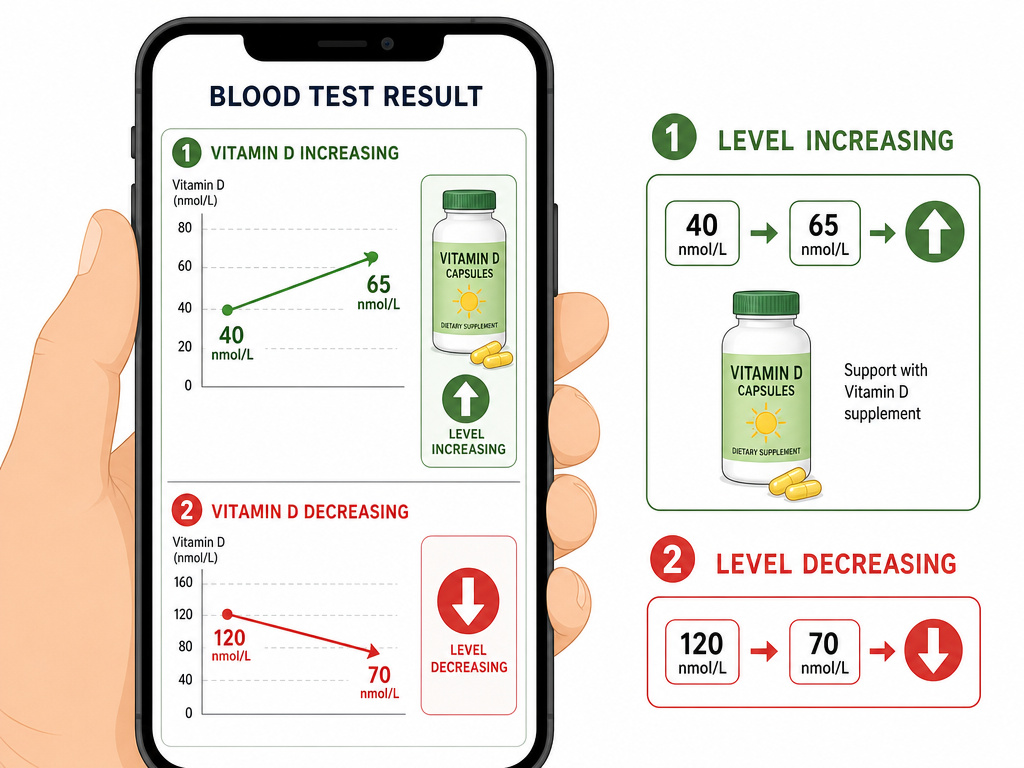
This is where you adjust. If you started at 40 nmol/L and took 2,000 IU/day for three months but only reached 65 nmol/L, you might need a slightly higher dose. If you shot up to 120 nmol/L, you can safely lower your dose. The NIH Vitamin D fact sheet notes the tolerable upper intake level is 4,000 IU/day for adults, but individual response varies widely.
This re-testing loop turns guessing into a data-driven process. It’s the difference between taking a supplement for five years with no idea if it’s working and owning your actual health numbers.
Other natural testosterone boosters (exercise, sleep, zinc)
If you’re looking to support healthy testosterone levels, focusing on broader lifestyle factors is more impactful than vitamin D alone. Regular exercise, particularly resistance training and high-intensity interval training, is a well-established stimulus for testosterone production. Prioritizing quality sleep is equally critical, as poor sleep patterns can significantly suppress hormone levels. Nutrition plays a key role; ensuring adequate intake of minerals like zinc, found in foods such as oysters, red meat, and pumpkin seeds, supports the enzymatic processes involved in testosterone synthesis. Managing stress to keep cortisol in check and maintaining a healthy body weight are also fundamental components of a natural approach to hormonal health.
Frequently Asked Questions
Does vitamin D increase testosterone immediately?
No. Hormonal changes from nutrient supplementation are slow. The studies showing any effect lasted between 12 weeks and one year. Don’t expect to feel a difference in days or even weeks.
What is the best time of day to take vitamin D for testosterone?
There is no proven best time for testosterone effects. For better absorption and to align with natural circadian rhythms, many take it with their largest meal, often breakfast or lunch. Avoid taking it right before bed, as it might interfere with sleep for some people.
Can I get enough vitamin D from the sun for testosterone?
Possibly, but it’s unreliable. Sun exposure depends on latitude, skin tone, season, and time outdoors. While it’s the natural method, most modern lifestyles don’t provide consistent, year-round exposure sufficient to maintain optimal levels (>75 nmol/L), making testing and supplementation necessary for many.
Are high-dose vitamin D supplements safe for long-term use?
Doses at or below 4,000 IU per day are generally considered safe for long-term use by most adults. However, vitamin D is fat-soluble and can accumulate. Extremely high doses (10,000+ IU daily for extended periods) without monitoring can lead to toxicity, causing hypercalcemia. This is why re-testing is part of a responsible protocol.
Should I take vitamin D if my testosterone is normal?
If your vitamin D level is sufficient (>75 nmol/L), taking extra vitamin D solely to raise normal testosterone is not supported by evidence and is unlikely to provide benefit. Focus on maintaining your sufficient level through diet, sensible sun, and a maintenance dose if needed.
Before You Go
The most honest answer to the vitamin D dosage for testosterone question is “it depends, but probably not much.” The robust effect promised by online articles shrinks to a tiny, maybe-not-real signal under the scrutiny of recent clinical trials.
Here is what doesn’t shrink: the importance of vitamin D for baseline health. Get tested. If you’re below 75 nmol/L, supplement with 1,500–2,000 IU of D3 daily with food. Re-test in three months. That protocol has a near-100% success rate for improving your vitamin D status. Whether it moves your testosterone a few points is almost beside the point, you’ll have fixed a far more important deficiency.
Focus your effort on the factors with the biggest, clear benefits: strength training, managing body fat, prioritizing sleep, and controlling stress. Vitamin D is a supporting actor in that play, not the star. Treat it like one.
