
What Is the Testosterone Saturation Model?
This post contains affiliate links. As an Amazon Associate, we earn from qualifying purchases.
The testosterone saturation model is a theory that prostate tissue, including cancer cells, has a limited number of androgen receptors. The model’s theoretical basis states maximal androgen-AR binding is achieved at serum testosterone concentrations ‘well below the physiologic range’. Above this saturation point, adding more testosterone does not proportionally increase prostate growth, challenging the old belief that testosterone always “feeds” prostate cancer.
That 250 ng/dL figure isn’t a guess. It comes from a 2011 clinical study in the Journal of Urology that tested the model’s predictions. The study used it as the operational threshold to see how men’s PSA levels responded to testosterone replacement therapy, which is a key application of what is the testosterone saturation model. The results split along that line.
What follows is a breakdown of the biochemistry behind the saturation point, the direct clinical data that supports it, and the ongoing debate about what this means for treating men with low testosterone, especially those with a history of prostate issues, which is central to the what is the testosterone saturation model question. We’ll also look at the practical monitoring guidelines that exist right now, because the theory is one thing, but your doctor’s protocol is another.
Key Takeaways
- The model proposes prostate androgen receptors are maximally activated at serum testosterone concentrations ‘well below the physiologic range’, making further testosterone increases above that level less impactful on growth.
- A key 2011 study found PSA increases in men on TRT were statistically significant only in those starting below 250 ng/dL, supporting the saturation concept.
- Major medical societies disagree on PSA monitoring for men on TRT; the American Urological Association (AUA) recommends a specific schedule, while the Society for Endocrinology advises following general population screening.
- The model is not a green light for TRT in all prostate cancer cases; it remains contraindicated in active, high-risk, or metastatic disease.
- Understanding the difference between free and bioavailable testosterone is crucial to grasping the model’s biochemical foundation.
The Core Idea: A Threshold, Not a Linear Scale
For decades, the shadow of Charles Huggins’ 1941 Nobel-winning work loomed large. He showed that reducing testosterone (via castration) shrank prostate cancer tumors, and adding it back made them grow. The conclusion seemed straightforward: testosterone fuels prostate cancer. More testosterone equals more growth. It was a linear, dose-dependent relationship that made TRT seem unthinkable for any man with a prostate cancer history.
The saturation model, formally introduced in a 2008 paper by Morgentaler and Traish, challenged that by looking at the mechanism. Prostate cells don’t respond to testosterone floating in the blood. They respond to testosterone that has entered the cell and bound to an androgen receptor (AR). Think of the AR as a lock, and testosterone as the key. The model posits there are a limited number of these locks.
The Saturation Model theory states that a critical serum testosterone concentration exists below which androgen becomes the rate-limiting factor for prostate growth. Maximal androgen-AR binding is achieved at concentrations “well below the physiologic range.”
Once all the receptors are occupied, saturated, additional testosterone keys have nowhere to go. The prostate’s growth signal hits a ceiling. This is why the relationship is a curve that plateaus, not a straight line that keeps climbing. The 2011 clinical study that tested this used a baseline total testosterone of 250 ng/dL as its operational threshold.
This reframes the entire conversation about testosterone and prostate cancer, which is the heart of what is the testosterone saturation model. The risk isn’t about high testosterone, but about pushing a system that is below saturation up toward it. This has direct implications for men considering testosterone replacement therapy (TRT) who have low levels.
The Biochemical Backbone: Testosterone Binding 101
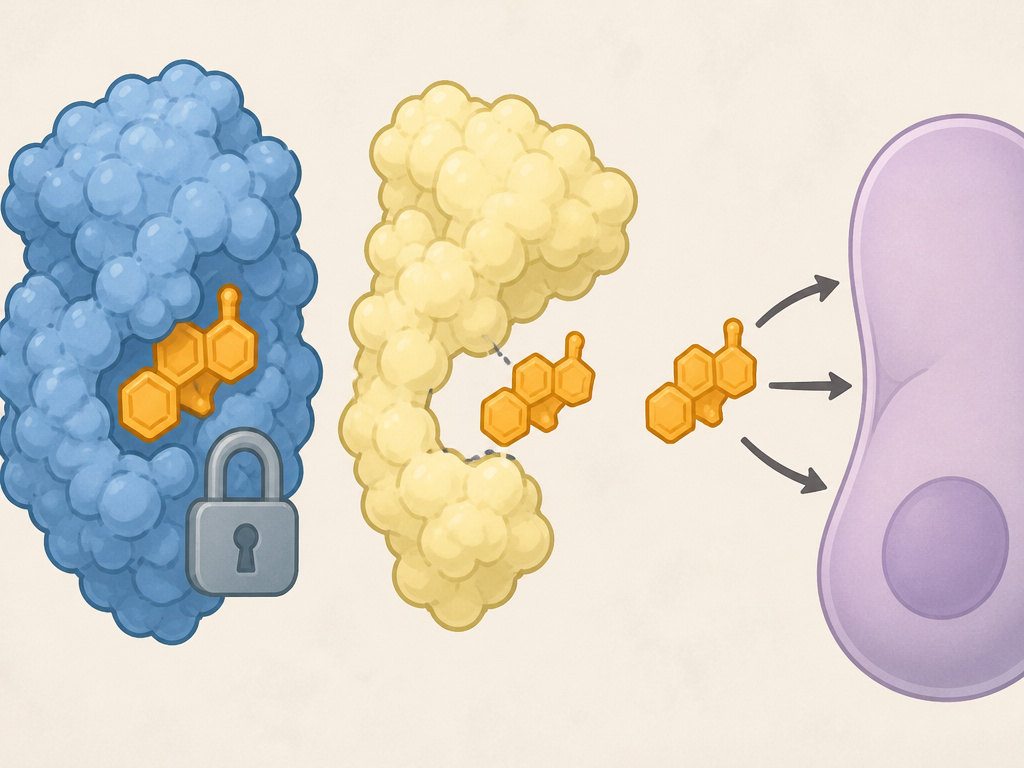
To understand saturation, you have to know what “serum testosterone” actually means. When a lab measures your total testosterone, it’s counting molecules that are mostly locked up. According to a detailed paper on testosterone binding, only 1% to 4% of circulating testosterone is unbound, or “free.” The rest is tightly bound to a protein called sex hormone-binding globulin (SHBG) or loosely bound to albumin.
The fraction that matters for tissue activity is called bioavailable testosterone. This includes the free testosterone plus the albumin-bound portion, which can easily detach and enter cells. SHBG-bound testosterone is essentially out of play. This is why your free vs total testosterone levels and your SHBG levels are critical, they determine how much testosterone is actually available to saturate those prostate receptors.
If your SHBG is high, your total testosterone might look normal, but your bioavailable fraction could be very low, potentially putting you below the saturation point. This nuance is often where the oversimplified “testosterone feeds cancer” argument falls apart. The model is deeply connected to your individual status regarding bioavailable testosterone.
What the Clinical Data Shows
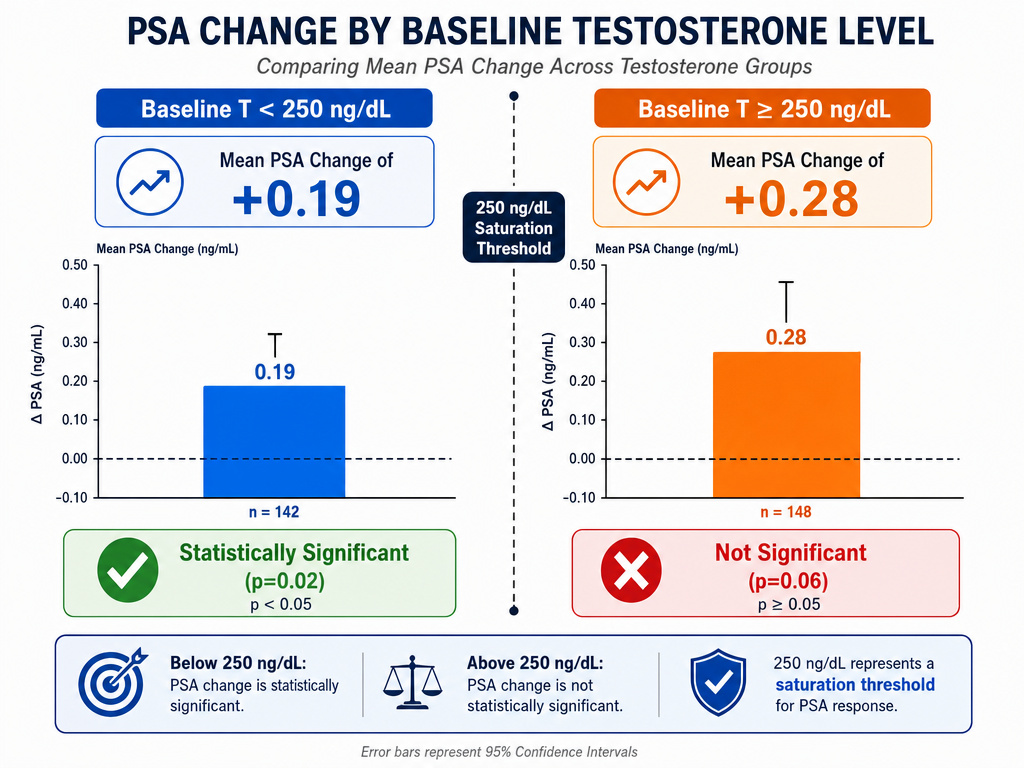
The theory needed clinical validation. It arrived in 2011 with a study published in the Journal of Urology. Researchers tracked PSA changes in hypogonadal men before and after 12 months of TRT. They split the men into two groups based on that 250 ng/dL baseline threshold.
The results were telling:
- In men with baseline testosterone <250 ng/dL, TRT led to a mean PSA increase of +0.19 ± 0.61 ng/ml. This change was statistically significant (p=0.02).
- In men with baseline testosterone ≥250 ng/dL, the mean PSA increase was +0.28 ± 1.18 ng/ml, which was not statistically significant (p=0.06).
| Baseline Testosterone | Mean PSA Change after 12mo TRT | Statistical Significance |
|---|---|---|
| < 250 ng/dL | +0.19 ± 0.61 ng/ml | Yes (p=0.02) |
| ≥ 250 ng/dL | +0.28 ± 1.18 ng/ml | No (p=0.06) |
This data supports the model. The men starting below saturation saw a measurable, significant PSA increase as TRT brought them up toward the plateau. The men already at or above saturation saw a smaller, non-significant blip, adding more keys to already-full locks didn’t move the needle much. It’s a crucial piece of evidence that moved the model from a biochemical concept to a clinically observable phenomenon.
You can find the details of this supportive research in the Journal of Urology clinical study report.
Where Experts Disagree: The Limits of the Evidence
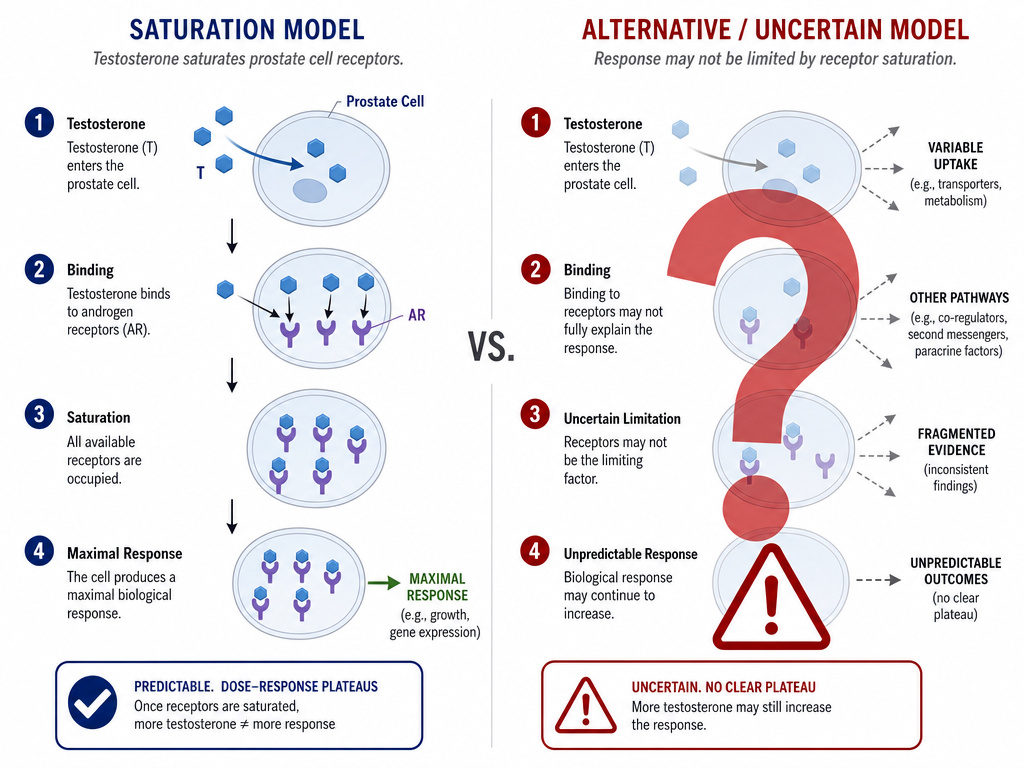
Not everyone in the urology community is convinced. The model has its articulate critics. A 2020 review published by the NIH directly questioned the evidence synthesis behind the original proposal. The authors argued that some references in the foundational 2008 paper were “troublingly taken out of context” and applied “in cases where it would be unwise to do so.”
Their conclusion was blunt: there is “insufficient evidence to support TRT in prostate cancer based on the Saturation Model alone.” This isn’t a minor squabble; it’s a fundamental disagreement about the quality of the evidence underpinning the entire idea. You can read this counterpoint in the PMC review questioning the Saturation Model.
This scholarly debate has real-world consequences. It creates a gap between advanced clinical practice (where some specialists use the model to guide TRT in select, low-risk patients) and conservative, guideline-driven practice. For a man researching his options, it means you might hear two completely different opinions from equally qualified doctors.
Where this goes sideways: Assuming the Saturation Model is settled science. It’s a compelling theory with supporting data, but it remains a topic of active debate and is not endorsed as a standard of care for all patients.
The model’s original proponents laid out their case in the ScienceDirect journal article on paradigm shift. Having both sides of the argument is how you make an informed decision.
Practical Implications: TRT, PSA, and Prostate Cancer
So, what does this mean if you’re a man with low testosterone, perhaps considering treatment? The model changes the risk calculus, but it doesn’t erase the chalkboard.
First, the clear boundaries: Modern clinical reviews state that TRT is contraindicated in men with metastatic or high-risk localized prostate cancer. The saturation model does not override this. However, cautious use may be considered in select individuals with previously treated, organ-confined disease and an undetectable PSA. This is a significant shift from the absolute prohibition of the past.
For men without prostate cancer, the model suggests that TRT is unlikely to stimulate new, harmful prostate growth if their levels are brought into a healthy, mid-normal range (likely above the saturation point). A 2025 review noted that TRT may cause a modest PSA increase, which typically stabilizes within the first year. A meta-analysis of seven randomized trials found no significant difference in prostate cancer diagnosis between TRT and placebo groups.
The biggest practical confusion lies in monitoring. Professional guidelines diverge sharply:
- The American Urological Association (AUA) advises a baseline PSA before TRT, a repeat at 3–6 months after starting, and annual monitoring thereafter, especially for men over 40 or with additional risk factors.
- The Society for Endocrinology recommends that men with hypogonadism simply follow the general population screening guidelines, without extra PSA tests solely because they are on testosterone therapy.
This isn’t a minor difference in timing. It’s a philosophical split on whether TRT itself constitutes an additional risk requiring surveillance. Your doctor will follow one of these paths, so it’s worth knowing which one.
Evidence from animal and cell line studies
The theoretical foundation for the Saturation Model draws from fundamental biochemistry. The model’s core principle, as stated in the 2008 paper by Morgentaler and Traish, is that androgen receptors in the prostate become maximally activated at serum testosterone concentrations ‘well below the physiologic range.’ This concept suggests a limit to androgen-dependent prostate growth. While the model was formally introduced in the peer-reviewed literature in 2008, its biochemical premise is based on the understanding that only a small fraction of circulating testosterone is biologically available to tissues. This saturation point implies that beyond a certain threshold, adding more testosterone may not proportionally increase prostate stimulation.
Link between low testosterone and prostate cancer risk
The Saturation Model challenges the old paradigm that higher testosterone inherently increases prostate cancer risk. Instead, it focuses on the effects of low testosterone. The model posits a critical serum concentration below which androgen becomes the rate-limiting factor for prostate growth. A key clinical study used a baseline total testosterone of 250 ng/dL as an operational threshold. In men starting below this level, testosterone replacement therapy led to a statistically significant, though modest, increase in PSA. In men starting above this threshold, the PSA change was not statistically significant. This supports the idea that the prostate’s response to added testosterone differs based on the starting saturation level.
Bipolar Androgen Therapy (BAT) for CRPC
Bipolar Androgen Therapy is a treatment approach for castration-resistant prostate cancer that conceptually extends ideas related to hormone saturation. While the Saturation Model itself primarily addresses the effects of testosterone replacement in androgen-deficient men, BAT explores the effects of rapidly cycling between very low and very high testosterone levels in a cancer that has adapted to a low-testosterone environment. The strategy is not a direct application of the Saturation Model for treating hypogonadism but rather an investigative therapy that challenges the traditional fear of high testosterone in prostate cancer. It represents a separate clinical exploration of how manipulating androgen levels far outside the normal range might affect advanced disease.
Frequently Asked Questions
Does the saturation model mean TRT is completely safe for the prostate?
No. It suggests the prostate cancer risk from TRT has been overstated for men whose levels are brought into a normal range. However, TRT is still contraindicated in active, high-risk, or metastatic prostate cancer. It may be an option for some men with a history of treated, low-risk cancer, but that requires careful, specialist management.
My testosterone is 350 ng/dL. Am I above the saturation point?
The 250 ng/dL threshold from the 2011 study is an operational benchmark, not a universal law for every man. The 2011 clinical study used a baseline of 250 ng/dL as an operational threshold. At 350 ng/dL, you are above that study’s threshold. However, individual variation exists.
Should I get my PSA checked more often if I start TRT?
This is where guidelines conflict. The AUA says yes, with a specific schedule. The Society for Endocrinology says no, follow standard screening. The best answer is to have a detailed conversation with your prescribing doctor about which protocol they follow and why. Your personal and family history will guide this decision.
Is the saturation model accepted by all doctors?
No. It is a well-known and influential theory, but it remains a topic of debate in urology and endocrinology. Some specialists use it to guide practice, while others believe the evidence is not yet strong enough to change traditional caution. This is why seeking a doctor experienced in hormonal health is crucial.
How does this model relate to natural testosterone optimization?
The core concept applies regardless of how you raise your levels. If you use diet, sleep, and natural testosterone optimization to raise your level from, say, 200 ng/dL to 400 ng/dL, the model suggests the prostate impact would be greatest as you move from 200 to 250 ng/dL, with less added effect as you go higher. The goal of natural optimization is often to reach a robust optimal testosterone level, which likely places you safely above the saturation point.
The Bottom Line
The testosterone saturation model is a pivotal concept that dismantles the old, linear “testosterone fuels cancer” dogma. It provides a mechanistic explanation for why bringing low testosterone levels up to a healthy range, often above 250 ng/dL, may not be the prostate danger it was once thought to be.
The catch is that this doesn’t translate to a simple, universal rule. The evidence is strong enough to change the conversation but not yet strong enough to erase all caution. Your next step isn’t to diagnose yourself. It’s to use this understanding to have a more informed talk with your doctor. Ask where they stand on the model, which PSA monitoring protocol they follow, and how your individual history fits into the current evidence. That’s how theory becomes practical, safe care.
