
How Long Does Tongkat Ali Take to Work?
This post contains affiliate links. As an Amazon Associate, we earn from qualifying purchases.
Tongkat Ali takes different amounts of time for different goals. Sources disagree on the onset of acute effects: aggregated user data (Biomogging) suggests they can appear within 3–7 days, while consumer survey data (Akarali white paper) identifies a minimum onset of two to four weeks. Improvements in stress markers and sleep quality show up in clinical studies at 4 weeks. Measurable shifts in serum testosterone take 2–4 weeks to appear on bloodwork and plateau around 8–12 weeks of consistent use. The timeline depends entirely on your goal, the extract quality, and your dosage.
That 3–7 day claim for libido comes from aggregated user data, but it directly conflicts with other consumer reports that peg the minimum onset at two to four weeks. This isn’t a mistake in the research, it’s a signal. The difference between feeling a boost in a week and waiting a month often comes down to the product in the bottle and what you’re actually measuring, which is why many people ask how long does tongkat ali take to work.
What follows: the three distinct timelines (acute, adaptive, and hormonal), the data behind each, and the four factors that determine which one you’ll experience. By the end, you’ll know exactly what to expect week by week and how to troubleshoot if nothing seems to be happening.
Key Takeaways
- Expect libido and mood shifts first, sources disagree on whether this happens in 3–7 days or requires 2–4 weeks, a gap that highlights the role of extract quality and individual response.
- Testosterone is a slower game. Serum levels begin shifting measurably after 2–4 weeks and typically plateau by 8–12 weeks of daily use.
- Your goal dictates the cycle length. Run it for 4–6 weeks for libido, 4–8 weeks for stress, and 8–12 weeks for natural testosterone optimization.
- Dose it in the morning. Late-day dosing is linked to insomnia and overstimulation, per consumer reports.
- Extract standardization is essential. Clinical trials primarily use 200 mg or 400 mg daily of water-soluble extracts; generic “200:1” products have shown drastically lower benefit rates.
The First Signs: Libido and Mood (3–7 Days vs. 2–4 Weeks)
You’ll feel this before you can measure it. The initial effects people report, a lift in mood, a noticeable uptick in libido, a general sense of well-being, operate on the fastest timeline. But here’s where the sources don’t agree, and that disagreement is useful.
Where this goes sideways: Assuming a libido boost means your testosterone has risen. These acute effects are likely driven by other mechanisms, like phosphodiesterase inhibition, which can work independently of your serum hormone levels.
One aggregated data source states acute effects on libido and well-being are noticeable within 3–7 days. Another white paper, drawing on a larger pool of consumer data, identifies a minimum onset of two to four weeks, with 30 days as a common threshold for noticing a meaningful change.
| Reported Onset | Source | Likely Drivers |
|---|---|---|
| 3–7 days | Aggregated user data (Biomogging) | Acute neurochemical/adaptogenic effects |
| 2–4 weeks | Consumer survey data (Akarali white paper) | Cumulative adaptogenic & hormonal modulation |
| 4 weeks | RCT on stress/sleep (Japanese adults) | Measured improvements in vigour, friendliness |
This isn’t an error. It’s evidence that the initial “feel” of Tongkat Ali is highly variable, which is precisely why many people ask how long does tongkat ali take to work. If you’re using a high-quality, standardized extract and you’re sensitive to its adaptogenic properties, you might notice something in the first week. If you’re using a generic powder or your baseline stress is high, it might take a full month to perceive a shift.
The four-week mark is where the clinical data gets concrete. A randomized controlled trial in healthy Japanese adults found that 4 weeks of supplementation led to measurable improvements in vigour and friendliness scores, alongside better sleep quality upon waking. That’s a real, study-backed timeline for the mood and stress-response benefits.
The short version: Don’t panic if you don’t feel anything in week one. Give it a full month on a consistent, morning dose before you judge its effect on your mood and daily drive.
The Testosterone Timeline: A Slower, Cumulative Shift
This is where Tongkat Ali earns its reputation as a testosterone booster, and the process is fundamentally different from the acute feel-good effects. Raising serum hormone levels is a cumulative, sensitizing action on your endocrine system. It’s not a switch; it’s a dial that turns slowly.
The key quassinoid, eurycomanone, has a short half-life of 1–2 hours and a low oral bioavailability of around 15%, which directly influences the how long does tongkat ali take to work timeline. This is why you take it daily, you’re maintaining a consistent, low-level signal to the systems that regulate hormone production.
Chronic dosing produces a cumulative shift in androgen output that takes 2–4 weeks to show up on bloodwork and plateaus by 8–12 weeks. The Physta®-standardized trials are the cleanest evidence base here.
You cannot shortcut this timeline. The aggregated data is clear: serum testosterone shifts are measurable at 2–4 weeks and plateau around week 8–12. This is why most sensible protocols for Tongkat Ali dosage for testosterone recommend a minimum 8-week cycle. Running it for two weeks and getting a blood test is a waste of money. The change hasn’t had time to establish itself.
The goal here is optimization, not replacement. The evidence shows conditional efficacy, primarily benefiting men with low-to-normal baseline levels. If your testosterone is already at the high end of the normal range, don’t expect a dramatic leap. This is a nudge, not a shove.
Test it, don’t guess. This slower timeline is the strongest argument for before-and-after blood work. Feeling more energetic could be from better sleep. Seeing a 50-point rise in free testosterone on a lab report after 10 weeks is data.
How Your Goal Changes the Schedule (and the Dose)
“Working” means different things. A bodybuilder looking for a slight edge in recovery, a stressed executive wanting better sleep, and a man with lagging libido are all asking the same question but expecting different answers. The timeline and the effective dose change with the goal.
This is the most practical way to use the data. You match your protocol to your desired outcome.
| Primary Goal | Suggested Cycle Length | Typical Daily Dose (Std. Extract) | When to Expect Noticeable Change |
|---|---|---|---|
| Libido / Acute Well-being | 4–6 weeks | 200–400 mg | 3–7 days to 4 weeks |
| Stress / Cortisol Management | 4–8 weeks | 200 mg | 4 weeks (per RCT) |
| Natural Testosterone Optimization | 8–12 weeks | 200–400 mg | 2–4 weeks (bloodwork), 8–12 to plateau |
| Post-Cycle Bridge (after PCT) | 8–12 weeks | 200–400 mg | Supports libido/mood during recovery |
| Ageing-Male Support (45+) | 12–24 weeks | 200 mg | Longer cycle for cumulative body comp benefits |
For example, if stress and sleep are your main targets, the 200 mg dose used in the 4-week Japanese RCT is your template. You’re not chasing a testosterone number; you’re chasing the vigour and sleepiness-on-rising scores that improved in that study. Your timeline is one month.
If you’re stacking it aggressively, like in the so-called “Huberman stack” with Fadogia Agrestis, the suggested cycle is 8–12 weeks on, followed by 2–4 weeks off. The logic here isn’t about suppression. Tongkat Ali is not suppressive, but about giving your system a break from the combined adaptogenic load.
Bottom line: Define “work” before you start. Picking the right timeline and dose from the beginning keeps you from quitting a 12-week testosterone protocol at day 10 because your libido didn’t double overnight.
The 4 Factors That Speed Up or Slow Down Results

The timelines above are maps. Your actual journey depends on these four variables. Ignore them, and you could be waiting months for a result that should have taken weeks.
- Extract Quality and Standardization. This is the biggest lever. A white paper analysis found that among users of quality standardized extracts, an estimated 72% reported at least one meaningful benefit. For generic, non-standardized “200:1” products, that reported benefit rate plummeted to about 31%. The difference is often the actual eurycomanone content. Clinical trials use 200 mg or 400 mg daily of specific water-soluble extracts for a reason. If your bottle doesn’t specify a standardized extract like Physta®, you’re not following the clinical protocol. Your timeline is guesswork.
- Your Baseline Physiology. The data shows Tongkat Ali is not a one-size-fits-all hormone bomb. Its testosterone-augmenting effects show conditional efficacy, primarily benefiting men with low-to-normal baseline levels. The evidence for testosterone augmentation shows conditional efficacy, primarily benefiting men with low-to-normal baseline levels. If you’re starting from a robust hormonal position, the visible “shift” will be smaller and might take longer to perceive. This is a key reason why the evidence for Tongkat Ali’s effects on testosterone levels is so population-dependent.
- Dosage and Timing. More isn’t always faster, but too little can be ineffective. The white paper notes a user-reported case of negligible effects at 200 mg/day but significant improvement at 400 mg/day. Find the minimum effective dose for your goal. Then, take it in the morning. Late-day dosing is consistently linked in consumer reports to insomnia and overstimulation. You’re giving your body a stimulating, adaptogenic signal; sending that signal at 8 PM is a good way to ruin your sleep, which undermines every benefit you’re seeking.
- Formulation and Bioavailability. This is a nerdy but critical point. A pharmacokinetic study in rats showed that a phospholipid complex formulation (TAF2-PC) increased the relative bioavailability of the extract to 209.20% compared to the standard extract. It also changed the peak plasma time. While this is animal data, it shows that how the extract is processed can change how fast and how much gets into your system. Most consumer products don’t use these advanced complexes, so stick with the proven, standardized water extracts.
Do You Need to Cycle Tongkat Ali?

Since it’s not suppressive and doesn’t require post-cycle therapy (PCT), the cycling question is about effectiveness and side-effect management, not hormonal recovery.
The consensus from long-term user data is that effects plateau. For testosterone optimization, that plateau hits around 8–12 weeks. Running the same dose beyond that point likely yields diminishing returns. The sensible approach is to run a cycle matched to your goal (see the table above), then take a break equal to at least half the cycle length.
A sensible approach is to run a cycle matched to your goal, then take a break. This reset period may help if you’ve experienced minor side effects like restlessness or if you suspect your response has attenuated. This approach to cycling adaptogens like testosterone supplements is a standard practice.
There’s no hard rule here, just the principle of giving your body a break from any consistent external modulator. Listen to your body. If sleep starts to suffer or you feel overly “wired” after a few months, that’s your sign to take a pause.
What to Do If It’s Not Working
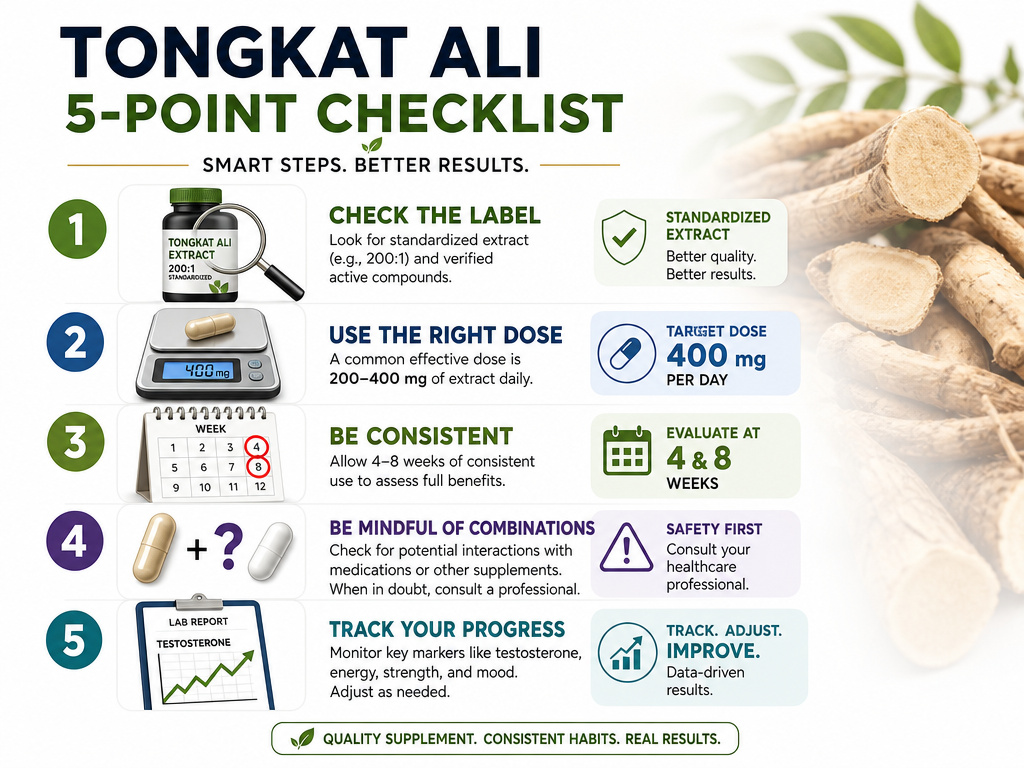
You’ve hit the 4-week mark. You’re taking a standardized extract at 400 mg every morning. Nothing. No lift, no extra drive, no change in the gym. Before you trash the bottle, run through this checklist.
- Verify the Product. Does the label specify a standardized water extract (e.g., “Physta®” or “standardized for eurycomanone”)? Or does it just say “Tongkat Ali root powder” or a vague “200:1 extract”? If it’s the latter, you might have one of the generic products with a reported benefit rate near 31%. Consider switching to a clinically-studied product from a list of high-quality Tongkat Ali supplements.
- Check Your Dose. Are you in the studied range? For most goals, that’s 200–400 mg. If you’re at 100 mg, you are in the low dose range. The anecdotal case in the white paper showed a clear difference between 200 mg and 400 mg.
- Manage Expectations. What is “working”? If your testosterone was already high-normal, the change may be smaller. That’s a positive result, even if you can’t feel it. Conversely, if you were expecting libido to skyrocket in 48 hours, your timeline was wrong. Revisit the goal-based schedules.
- Consider Your Stack. Are you taking anything that might conflict? High doses of zinc or other heavy metals? Stimulant-based pre-workouts that mask subtle energy changes? Sometimes, the supplement’s signal gets lost in the noise of everything else.
- Get a Blood Test. This is the only way to know for sure about the testosterone piece. A pre-cycle and 10-week post-cycle test will tell you if the dial moved, even if your perception didn’t change. Without this, you’re guessing.
If you’ve checked all these boxes and still have nothing after a full 8-week cycle on a standardized extract, it’s possible Tongkat Ali simply isn’t for you. Individual biochemistry varies. The data says a majority respond, but a minority do not. That’s okay. It’s more productive to know than to keep spending money and hope.
How do different Tongkat Ali brands and forms compare?
Not all Tongkat Ali supplements are created equal, and the form you choose can impact how quickly and effectively it works. The key difference lies in the extract’s bioavailability, which is how much of the active compound your body can actually use. Research indicates that a phospholipid complex formulation can significantly increase bioavailability compared to a standard extract. This means your body may absorb more of the active ingredients from each dose. Consumer data also shows a stark contrast in reported benefits. Users of quality, standardized extracts report meaningful benefits at a much higher rate than users of generic or non-standardized products. For consistent results, selecting a brand that uses a standardized extract is a practical first step.
Frequently Asked Questions
How quickly does tongkat ali increase testosterone?
Measurable increases in serum testosterone typically begin to appear on blood tests after 2–4 weeks of consistent daily use. These levels continue to rise and usually plateau around 8–12 weeks. This is a gradual, cumulative effect, not an overnight spike.
What are the signs that tongkat ali is working?
The first signs are often subjective: improved mood, a greater sense of well-being, and increased libido, which some notice within 3–7 days. More measurable signs include better sleep quality (feeling more refreshed on waking), improved stress resilience, and, over time, potential improvements in gym recovery and body composition. The only definitive sign for testosterone is a blood test.
What happens if I take tongkat ali every day?
Long-term daily use is generally considered safe for standardized extracts at clinical doses (200–600 mg/day). However, effects tend to plateau after 8–12 weeks for testosterone benefits. Minor side effects like insomnia or restlessness may become more likely with uninterrupted use. Most protocols suggest cycling, taking breaks, to maintain effectiveness and manage potential side effects.
How to take tongkat ali for best results?
Take a standardized water extract (like those used in clinical trials) at a dose of 200–400 mg, with your breakfast in the morning. Consistency is key, take it daily. Avoid late-day dosing to prevent sleep disruption. Pair it with a healthy lifestyle (adequate sleep, balanced nutrition, exercise) for synergistic effects.
Before You Go
The most frustrating answer is “it depends,” but with Tongkat Ali, that’s the honest one. It depends on whether you’re chasing a feeling or a lab number. It depends on whether the capsule contains a studied extract or root powder of unknown potency.
If you take one action from this, make it this: buy a single-ingredient, standardized extract from a brand. Skip the proprietary blends where Tongkat Ali is buried under five other underdosed ingredients. This isolates the variable. You’ll know whether this compound works for you.
Start with a clear goal and the matching timeline. Expect libido or mood shifts in the first month, but give testosterone a solid 8-week commitment before you judge it. And if you’re serious about the hormonal piece, budget for a blood test. The difference between hope and evidence is about $100 and one vial of blood.
Everything above assumes you’re using a standardized extract. If your bottle just says “Tongkat Ali 500mg” with no mention of standardization, all the timelines are void. You’re not experimenting with Tongkat Ali; you’re experimenting with a mystery powder. In that case, the only thing you can expect with certainty is a lighter wallet.
