
Does DHEA Increase Testosterone? What the Data Says
This post contains affiliate links. As an Amazon Associate, we earn from qualifying purchases.
DHEA (dehydroepiandrosterone) supplementation can increase testosterone levels, but the effect is not universal. It works reliably in postmenopausal women at doses of 50 mg/day or higher, raising testosterone by a weighted mean difference of about 24–30 ng/dL. It does not significantly increase testosterone in young, healthy men or in males with Addison’s disease, and its benefits for symptoms like low libido are not well-supported by evidence.
That 50 mg/day threshold isn’t a suggestion, it’s the line between a measurable hormonal change and statistical noise. The 2024 meta-analysis of postmenopausal women found that doses below that mark produced an increase so small it wasn’t statistically significant.
What follows is a breakdown of who responds, who doesn’t, the precise numbers from the latest meta-analyses, and the critical disagreements in the research that most overviews gloss over.
Key Takeaways
- DHEA supplementation at 50 mg/day or more significantly increases testosterone in postmenopausal women, with an average rise of 24–30 ng/dL.
- In young, healthy men undergoing resistance training, high-quality RCTs show no significant increase in testosterone from DHEA, contradicting some broader meta-analyses.
- Despite raising hormone levels, a major 2019 systematic review found low-confidence evidence that DHEA improves sexual function or libido in postmenopausal women.
- For individuals with adrenal insufficiency like Addison’s disease, DHEA can normalize low testosterone in women but not in men.
- The potential for androgenic side effects (acne, hair growth) increases with dose, especially in older women who may achieve supraphysiological hormone levels.
How DHEA Works (And When It Doesn’t)
DHEA is a prohormone, a building block your body can convert into both testosterone and estrogen. Think of it as raw lumber. Whether it becomes a table (testosterone) or a chair (estradiol) depends on the enzymes present in your tissues, and those enzymes are influenced by your age, sex, and overall hormonal environment.
This conversion process is why blanket statements fail. Giving a 25-year-old man and a 65-year-old woman the same 50 mg dose of DHEA is like giving the same lumber to two different carpenters with different blueprints. You get different end products.
The biochemical pathway from DHEA to active sex hormones involves enzymes like 3β-HSD and aromatase. In postmenopausal women, whose ovarian hormone production has ceased, this pathway becomes a primary source of androgens and estrogens, which is why they are the most consistent responders to supplementation.
The raw numbers from the 2024 meta-analysis of RCTs in postmenopausal women are clear for one group. In postmenopausal women, DHEA supplementation significantly increased estradiol levels (WMD: 7.86 pg/mL) and testosterone levels (WMD: 24.31 ng/dL). But that’s the average. Drill into the subgroups, and the story gets specific.
The 50 mg Threshold That Changes Everything
The dose makes the hormone. In that same 2024 meta-analysis, researchers split the data by dosage. The results weren’t subtle.
| Daily DHEA Dose | Testosterone Increase (WMD) | Statistical Significance |
|---|---|---|
| ≥ 50 mg | 29.65 ng/dL | Significant (P ≤ 0.001) |
| < 50 mg | 8.36 ng/dL | Not Significant (P = 0.111) |
WMD stands for weighted mean difference, the average change compared to a placebo group. The takeaway is blunt: if you’re considering DHEA for a hormonal effect, a 25 mg dose is likely a waste of money and expectation. The endocrine system seems to need that 50 mg trigger to shift gears meaningfully.
This has a practical consequence for choosing a supplement. Many products on the shelf are dosed at 25 mg. Based on this high-quality evidence, they are unlikely to produce a reliable testosterone increase. You want to look for a quality DHEA supplement that clearly offers a 50 mg serving, preferably in a micronized DHEA form for better absorption.
Common mistake: Taking a 25 mg DHEA supplement and expecting a testosterone boost. The clinical data shows the effect at that dose is negligible. You’re paying for a biochemical placebo.
Why does this threshold exist? It likely relates to saturation of metabolic pathways. The body efficiently converts and clears low doses of DHEA. At 50 mg and above, the conversion enzymes work at capacity, spilling over into pathways that produce measurable increases in downstream hormones like testosterone.
Who Actually Sees a Testosterone Boost?
This is where the research gets contentious. The population you belong to dictates the result. We will compare three distinct groups.
| Population | Does DHEA Increase Testosterone? | Key Evidence & Notes |
|---|---|---|
| Postmenopausal Women | Yes, reliably. | 2024 Meta-analysis: WMD of 24.31 ng/dL. Requires ≥50 mg/day. The increase in estradiol was significant only in women aged 60 and older (WMD: 8.92 pg/mL). |
| Young, Healthy Men | Evidence says no. | 1999 RCT: 50mg & 150mg/day showed no increase in men during resistance training. |
| Men with Addison’s Disease | No significant change. | 2008 RCT: 50 mg/day for 12 months caused no significant change in total testosterone. |
The starkest contradiction is between the young men and the meta-analyses, which brings us to the core does dhea increase testosterone question. A landmark 1999 study published in the Journal of Applied Physiology gave men 50 mg or 150 mg of DHEA daily during resistance training. It concluded, plainly, that oral DHEA supplementation “did not increase serum testosterone concentrations in young men.” The authors suggested it might only work in postmenopausal women.
Yet, a 2020 dose-response meta-analysis that included mixed populations reported an average testosterone increase in men. How do we reconcile this? Context. The meta-analysis included older men, men with health conditions, and studies of varying quality. The 1999 study was a tightly controlled RCT on a specific, healthy population. When you want to know if something works in healthy young men, the direct, high-quality RCT outweighs the blended average of a meta-analysis.
For DHEA for men specifically, this is the core dilemma when you compare a does dhea increase testosterone RCT to broader analyses. The cleanest human evidence from a 1999 RCT does not support a testosterone boost in young, healthy men.
The Libido Paradox: Hormones Up, Function Unchanged

Here’s a frustrating reality that anyone researching DHEA vs testosterone should know: raising a hormone level doesn’t guarantee you’ll feel any different.
A 2019 systematic review on DHEA benefits tackled this directly. After analyzing 23 randomized controlled trials in postmenopausal women, it found that DHEA use was not associated with a significant improvement in libido or sexual function. The evidence for this conclusion was graded as low confidence, meaning the studies were often inconsistent or imprecise, but the result is what we have.
Where this goes sideways: Assuming a higher testosterone number from DHEA will fix low libido. The 2019 systematic review found no significant improvement in sexual function, highlighting the gap between biomarkers and real-world experience.
This is a critical lesson in managing expectations. The body is not a simple machine where more testosterone automatically equals better drive. Libido is influenced by stress, relationship dynamics, sleep, and other hormones. DHEA might change your lab slip, but it may not change your life in the way you hope. This mirrors the broader question of testosterone booster efficacy, where ingredient mechanisms rarely translate into consistent user benefits.
Age and Duration: The Secondary Levers
If you are a responder, two other factors fine-tune the outcome: your age and how long you take it.
Age Matters for Estrogen. For postmenopausal women, the increase in estradiol (a form of estrogen) was significant only in those aged 60 and older (WMD: 8.92 pg/mL). In women under 60, the increase was a negligible 3.04 pg/mL. If you’re a younger postmenopausal woman looking for estrogenic benefits, DHEA may not be your best tool.
Duration Data Disagrees. How long should you take it? The sources conflict.
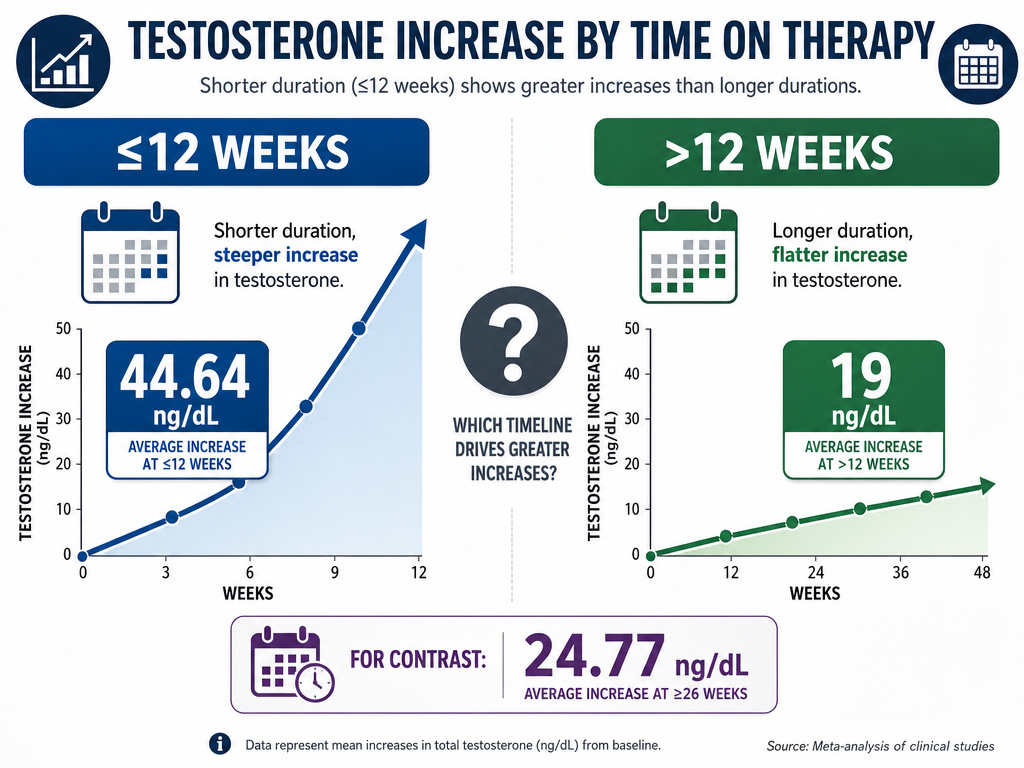
- A 2020 meta-analysis found a larger testosterone increase with durations of ≤12 weeks (44.64 ng/dL) compared to >12 weeks (19 ng/dL), suggesting effects might diminish over time.
- The 2024 meta-analysis found a (non-significantly) greater increase with durations of ≥26 weeks (WMD: 24.77 ng/dL) compared to <26 weeks (WMD: 19.04 ng/dL), while a 2020 meta-analysis found a larger increase with durations of ≤12 weeks (WMD: 44.64 ng/dl) compared to >12 weeks (WMD: 19 ng/dl).
What does this mean for you? The evidence doesn’t provide a clear, optimal timeline. It suggests that effects are measurable within 3 months, but whether they grow or shrink after 6 months is still an open question. This uncertainty is a reason to retest levels after 3-4 months if you and your doctor decide on a trial.
Safety, Side Effects, and Who Should Avoid It

DHEA is a hormone, not a vitamin. Its side effects are androgenic, think testosterone-related.
- Common side effects: Acne, oily skin, facial hair growth in women, hair loss (in those predisposed to male-pattern baldness), and mood changes.
- A specific risk: In the Addison’s disease trial, some older women on 50 mg/day achieved supraphysiological DHEAS levels and experienced mild androgenic side effects. This means the standard dose can be too high for some individuals.
- Drug interactions: DHEA can interact with hormone-sensitive conditions (like breast or prostate cancer), estrogen replacement therapy, and medications metabolized by the liver.
Before you start: DHEA can alter hormone-sensitive conditions and interact with medications. Have a conversation with your healthcare provider, especially if you have a history of cancer, are on HRT, or take antidepressants or mood stabilizers.
Who should avoid it? Men with normal testosterone levels, women who are pregnant or breastfeeding, and anyone with a hormone-sensitive cancer should steer clear. It’s also not for young men seeking a workout boost, the evidence for that just isn’t there.
Given the potential for side effects and the complexity of the difference between DHEA and testosterone, a blood test before starting is essential. You need to know your baseline testosterone, estradiol, and DHEA-S levels. Testing again after 3 months tells you if the supplement is working or if you’re just experiencing placebo effects (or side effects).
DHEA vs. Traditional Testosterone Replacement Therapy
DHEA is not a direct substitute for traditional testosterone replacement therapy (TRT). TRT involves administering bioidentical testosterone itself, providing a direct and predictable increase in hormone levels. In contrast, DHEA is a precursor hormone that your body must convert, and this conversion yields both testosterone and estrogen. The outcome is less predictable and highly dependent on individual factors like age, sex, and adrenal function. For instance, research shows DHEA can raise testosterone in postmenopausal women but may have no significant effect in young, healthy men. While TRT is a targeted medical treatment for clinically low testosterone, DHEA supplementation offers a more generalized hormonal nudge with variable results. The choice depends entirely on the underlying cause of low testosterone and individual health goals, making medical guidance essential.
Frequently Asked Questions
How long does it take DHEA to raise testosterone?
In a pharmacokinetic study, the testosterone peak occurred at 3.6 ± 2.2 hours post-ingestion of a 50 mg DHEA dose. For sustained, measurable increases, clinical trials assess outcomes over varying durations, with studies comparing effects at less than 26 weeks and at 26 weeks or more.
Is DHEA a good testosterone booster?
It depends entirely on who you are. For postmenopausal women, it is one of the more reliable supplement-based options for raising testosterone, provided the dose is 50 mg/day or higher. For young, healthy men, it is not an effective testosterone booster based on the highest-quality RCT evidence. Its role is specific, not universal.
What happens when a man takes DHEA?
Man with normal adrenal function may see little to no change in his testosterone levels, as shown in the 1999 study on young men. He may, however, experience side effects like acne or changes in mood due to the hormonal fluctuation. In men with adrenal insufficiency like Addison’s disease, a 2008 RCT found 50 mg/day DHEA caused no significant change in total testosterone.
Who should avoid taking DHEA?
Individuals with hormone-sensitive cancers (breast, prostate, ovarian), those with liver disease, women who are pregnant or breastfeeding, and men with normal testosterone levels should avoid DHEA supplementation. It’s also not recommended for young athletes based on the lack of efficacy data.
The Bottom Line
DHEA is not a universal testosterone booster. It’s a targeted hormonal intervention with a clear responder profile: postmenopausal women using at least 50 mg daily.
If you’re a man under 50 with normal adrenal function, the evidence from a 1999 RCT indicates DHEA is unlikely to raise your testosterone. If you’re a postmenopausal woman with low libido, understand that DHEA might change your hormone numbers without changing your symptoms, as the systematic review indicates.
The essential step is testing. Don’t guess your hormone levels. A simple blood panel for DHEA-S, total testosterone, and estradiol provides the map. Without it, using DHEA is a shot in the dark with real potential for androgenic side effects. Start with the data, not the hype.
