
Does Creatine Increase Testosterone? What the Data Shows
This post contains affiliate links. As an Amazon Associate, we earn from qualifying purchases.
Creatine does not reliably increase total testosterone levels in healthy men. The most recent systematic review of “testosterone booster” supplements, published in the International Journal of Impotence Research, concludes creatine is not effective for this purpose. The confusion stems from a few short-term studies showing increases in a related hormone, dihydrotestosterone (DHT), and from creatine’s well-documented ability to improve strength and muscle mass, benefits often misattributed to a hormonal change.
That DHT distinction is where the story gets interesting, and where most online explanations stop. The data isn’t just a simple “yes or no.” It’s a split between total testosterone, which stays flat, and a potent androgen that matters for muscle, hair follicles, and prostate tissue. Ignoring that split means misunderstanding both the potential benefit and the overstated risk.
What follows is a breakdown of every relevant study, the mechanisms at play, and what you can realistically expect from a creatine monohydrate supplement. This section details the safety profile endorsed by major sports nutrition bodies, explains how your diet affects your response, and separates reliable information from forum speculation.
Key Takeaways
- The bulk of evidence, including a 2023 systematic review, finds creatine supplementation does not effectively increase total testosterone, while two earlier trials reported short-term increases of 57 ng/dL and 150 ng/dL.
- A notable 2009 study on rugby players found creatine loading increased dihydrotestosterone (DHT) by 12 ng/dL while testosterone remained unchanged, highlighting a potential effect on hormone conversion, not production.
- You must use a loading protocol (e.g., 20g/day for 7–10 days) to see performance benefits without exercise; studies using only a maintenance dose (3-5g/day) without training show no effect.
- Vegetarians and older adults often see greater performance improvements from creatine due to lower baseline muscle creatine stores.
- Long-term safety is well-established; the International Society of Sports Nutrition states no compelling evidence of harm with doses up to 30g/day for 5 years in healthy individuals.
The Direct Effect on Testosterone: What the Data Actually Shows
Open any forum thread on this topic and you’ll find two camps. One cites a single 2009 rugby study as proof creatine spikes hormones. The other points to a dozen studies showing nothing. Both are partially right, and that’s the problem. The answer to does creatine increase testosterone depends entirely on which hormone you’re measuring and the timeframe you’re looking at.
Technical Snippet: A 2023 systematic review in the International Journal of Impotence Research, analyzing the efficacy of commercial “testosterone booster” supplements, concluded that creatine monohydrate does not effectively increase serum total testosterone levels. This meta-analysis represents the most current high-level synthesis of the available evidence.
The heavyweight evidence leans toward “no change.” The Examine.com research aggregation summarizes 10 clinical trials involving 218 participants. These studies used daily creatine doses from 3 to 25 grams for periods up to 12 weeks. None found a statistically significant effect on total testosterone levels in healthy, active young men. This is the consensus baseline.
But two earlier, smaller trials complicate the picture. They reported short-term testosterone increases of 57 ng/dL and 150 ng/dL after just one week of supplementation in active young men. These are the studies that fuel the “yes” argument for the does creatine increase testosterone question. The critical detail? These were acute, short-duration findings that longer, more robust research has failed to replicate consistently.
Here’s the part nobody mentions: No trials have ever investigated creatine’s effect on testosterone in men with clinically low testosterone (hypogonadism). All the data is from populations with normal baseline levels. Anyone claiming creatine will “fix” low T is extrapolating far beyond the science.
Dihydrotestosterone (DHT): The Source of the Controversy
This is where the conversation should live. If you’re worried about hair loss or are curious about the muscle-building mechanism, DHT is the hormone to watch, not total testosterone.
The infamous van der Merwe study (2009) is the root of this. Researchers gave college rugby players 25 grams/day of creatine monohydrate for one week (a loading phase), followed by 5 grams/day for two weeks. Total testosterone didn’t budge. But levels of dihydrotestosterone (DHT), a more potent androgen derived from testosterone, increased by 56%. The ratio of DHT to testosterone also rose significantly.
I learned this the hard way, chasing study abstracts without the full context. Seeing “56% increase” without the “DHT, not testosterone” qualifier sends you down a completely wrong path.
The researchers hypothesized that creatine might increase the activity of the 5-alpha reductase enzyme, which converts testosterone to DHT. This is a mechanistic theory, not a proven fact, but it’s a coherent explanation for the observed data. It also led the authors to cautiously note that “the long-term clinical safety cannot be guaranteed”, a line that gets ripped from its context to fuel fear.
| Hormone | Typical Effect of Creatine Supplementation | Key Study & Finding | Implications |
|---|---|---|---|
| Total Testosterone | No statistically significant increase in most studies. | 2023 Systematic Review: No effective increase. | Not a reliable testosterone booster. |
| Dihydrotestosterone (DHT) | May increase, particularly after a loading phase. | van der Merwe et al., 2009: 56% increase after 7-day load. | Potential link to hair loss concerns; possible anabolic mechanism. |
This DHT data directly conflicts with the long-term safety position of major institutions. The International Society of Sports Nutrition (ISSN), in its official position stand, states there is “no compelling scientific evidence” that creatine monohydrate has detrimental effects on otherwise healthy individuals. One short-term hormonal observation versus years of clinical safety data, the weight of evidence strongly favors the safety conclusion.
How Creatine Actually Works (It’s Not a Hormone)
Expecting creatine to work like a hormonal agent is misunderstanding its day job. Its primary mechanism is purely energetic, not endocrine.
Inside your muscle cells, creatine is stored as phosphocreatine (PCr). This molecule acts as a rapid-recharge battery for ATP, the universal energy currency. During short, explosive efforts like a heavy squat or a sprint, ATP gets depleted in seconds. Phosphocreatine donates a phosphate group to ADP, re-synthesizing ATP almost instantly. This powers a few more seconds of maximal effort.
Supplementing with creatine monohydrate saturates your muscle’s phosphocreatine stores by about 20-40%. That means a larger, readily available battery pack for high-intensity work. The practical outcomes? You might grind out one more rep on your last set, recover slightly faster between sprint intervals, or increase your training volume over time. This increased work capacity is the engine for muscle and strength gains, not a secret surge of testosterone.
Where this goes sideways: Taking a maintenance dose of 3-5 grams daily without a loading phase or consistent training. Studies that used this protocol without an exercise intervention saw no beneficial effects on performance or fatigue measures. The supplement boosts the work you can do; it doesn’t do the work for you.
Who Responds Best to Creatine? (It’s Not Just Young Meat-Eaters)
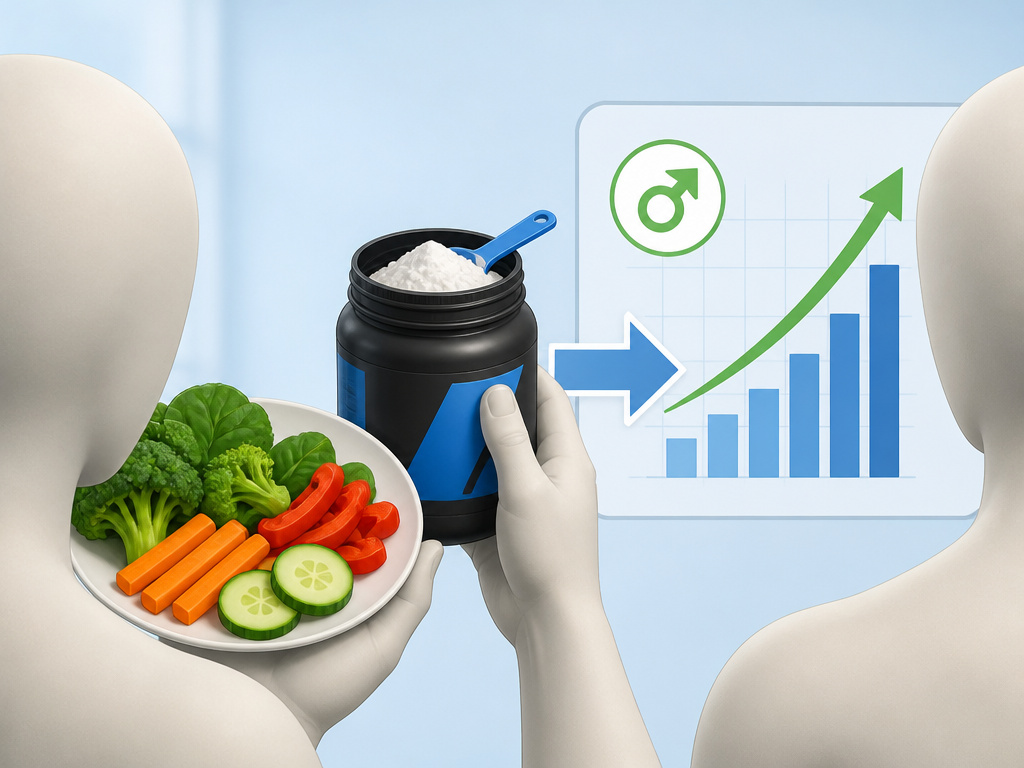
The “non-responder” myth persists, but it often just describes someone who started with full creatine stores. Research clearly identifies groups who get a more dramatic boost.
- Vegetarians and Vegans: A study by Watt et al. found that a creatine loading protocol (0.4 grams/kg/day or ~30g/day for 5 days) increased total muscle creatine content significantly more in vegetarians than in omnivores. If your diet contains little to no creatine (found only in animal products), your baseline is lower and the supplement’s saturation effect is greater.
- Older Adults (>65 years): Muscle creatine stores naturally decline with age. Research shows older populations can benefit markedly, even without exercise. Stout et al. reported that 14 days of creatine (20g/day for 7 days, then 10g/day for 7 days) with no training increased the Physical Working Capacity at Fatigue Threshold (PWCFT) by 15.6% and grip strength by 6.7% in men and women aged 64–86 years.
- Those Using a Loading Protocol of ~0.3 g/kg/day for 5–7 days: The ISSN notes the quickest method is ~0.3 g/kg/day for 5–7 days followed by 3–5 g/day maintenance. Skipping the load phase means a 3-4 week wait for full stores, delaying any performance effect.
I once tracked my diet meticulously and realized how few direct creatine sources I was eating. It was a humbling moment, given the money I’d spent on other supplements. For individuals with similar diets or in older age groups, creatine isn’t just an ergogenic aid, it’s a nutritional supplement filling a dietary gap.
Debunking Common Myths and Understanding Real Risks
Think of it with a mechanic’s logic. If your engine is low on oil (a basic deficiency), adding a premium performance fuel additive (a fancy supplement) is a waste. Fix the oil first. The same is true for supplement risks, often, the fear is aimed at the wrong part.
Myth 1: Creatine Causes Kidney Damage.
This is the most persistent scare story. The ISSN position stand is definitive: long-term studies (up to 5 years with doses up to 30g/day) show no adverse effects on renal function in healthy individuals. If you have pre-existing kidney disease, consult a doctor. For everyone else, it’s a non-issue backed by decades of research.
Myth 2: Creatine Leads to Hair Loss.
This myth stems entirely from the DHT hypothesis from the 2009 rugby study. There is no direct clinical evidence linking creatine supplementation to accelerated hair loss (androgenetic alopecia). DHT is one factor in male pattern baldness, but a short-term increase in one study does not establish a cause-and-effect relationship for hair follicles. Fear here is based on mechanism speculation, not outcome data.
Myth 3: You Must Cycle Creatine.
No physiological tolerance develops. Muscle creatine stores remain elevated as long as you take a maintenance dose. Cycling is unnecessary. The only reason to stop is if you choose to.
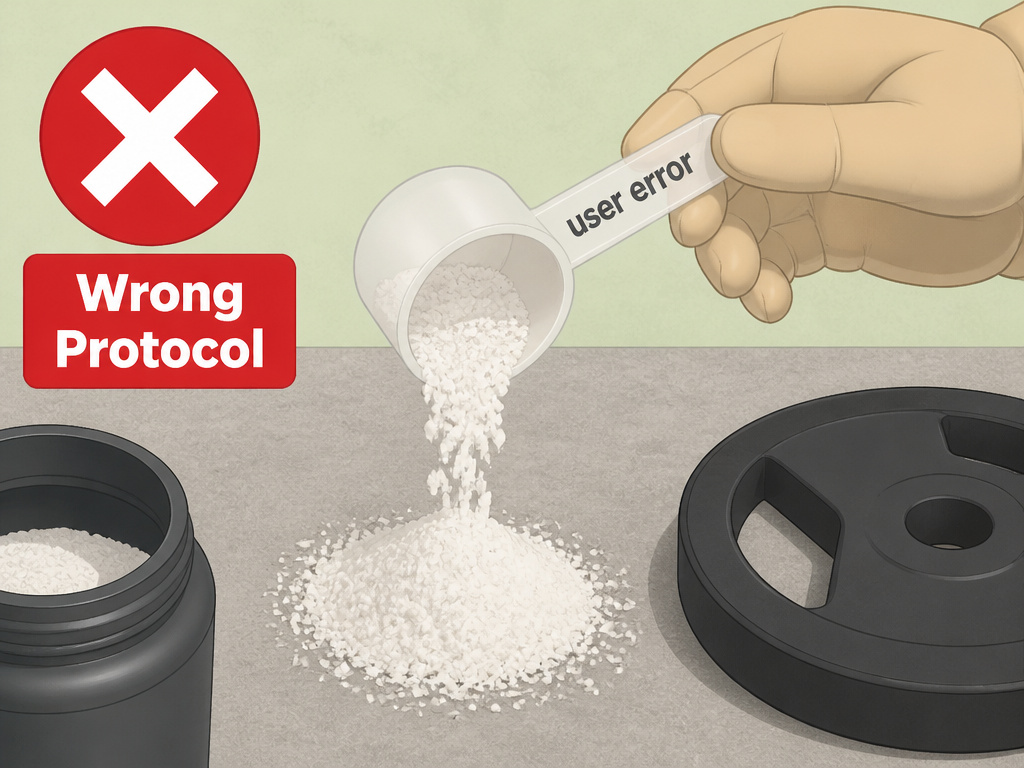
The Real “Risk”: Wasting Your Money on the Wrong Protocol.
The documented failure mode is using creatine incorrectly. As covered, studies using only a maintenance dose (3-5g/day) without a loading strategy and without exercise show zero benefit. You’re paying for a supplement that can’t do its job because you haven’t followed the basic instructions. This isn’t a side effect; it’s user error.
Caffeine and Creatine: A Counterproductive Mix?
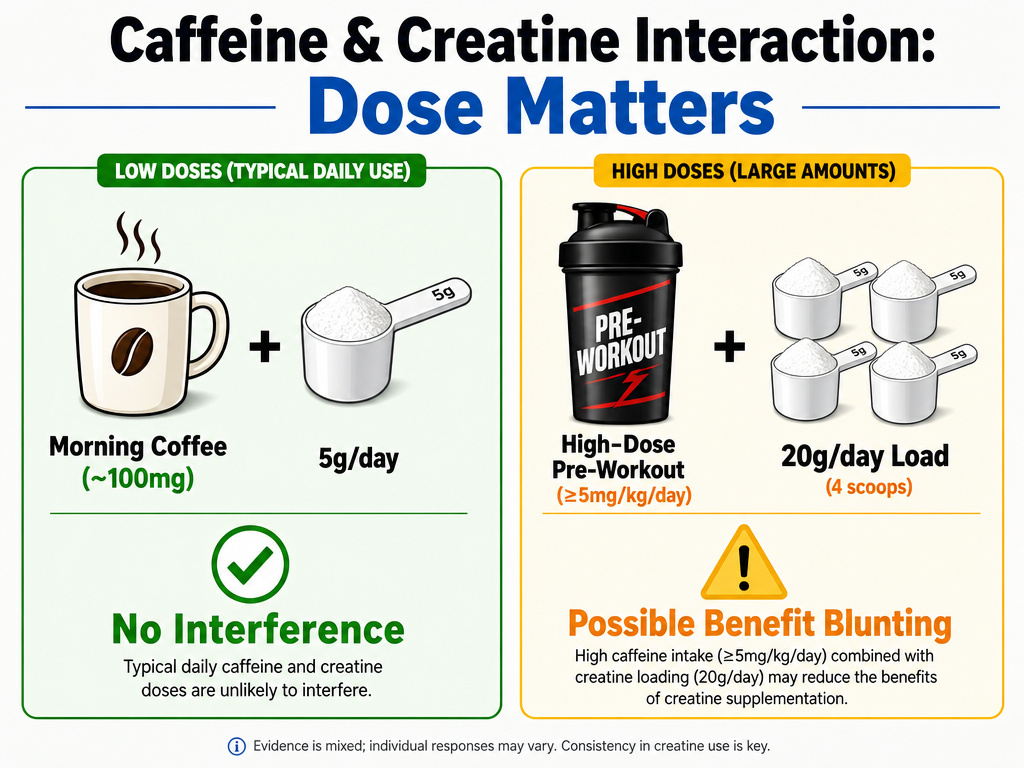
Your pre-workout coffee might be stepping on your creatine’s toes. The interaction isn’t about danger, but about interference.
Research indicates that combining a creatine loading phase (e.g., 20g/day) with chronic high-dose caffeine (≥5 mg/kg/day) can blunt creatine’s ergogenic effects. One study using a combined dosing strategy involving creatine monohydrate (20 grams/day for 4 days or 0.5 grams/kg/day for 1 day) and 5 mg/kg/day of caffeine resulted in interference between the two.
The mechanism isn’t fully clear, but caffeine’s diuretic effect might theoretically influence muscle cell hydration and creatine uptake. However, one study exploring combined ingestion of caffeine (6 mg/kg/day) and creatine monohydrate (3 grams/day) for 3 days demonstrated improved maximal knee extension torque compared to creatine alone.
Easy to miss: The negative interaction seems dose-dependent. Your morning cup of coffee isn’t the problem. The issue is stacking a high-dose caffeine pre-workout or fat-burner with a creatine loading phase.
| Scenario | Caffeine Dose | Creatine Dose | Typical Outcome |
|---|---|---|---|
| Morning Coffee + Maintenance | ~100mg (1 cup) | 5g/day | No expected interference. |
| High-Dose Pre-Workout + Loading | ≥5 mg/kg/day | 20g/day (load) | Possible blunting of creatine’s performance benefit. |
| Moderate Dose + Low Creatine | 6 mg/kg/day | 3g/day | One study showed a synergistic benefit. |
The practical takeaway? If you’re loading creatine, consider temporarily reducing or eliminating very high-dose caffeine supplements. Stick to your normal coffee habit and reintroduce other caffeine sources after the load phase.
Is Creatine Like a Steroid?
Creatine monohydrate is fundamentally different from anabolic steroids. Steroids are synthetic hormones that directly alter the body’s endocrine system, often leading to significant increases in muscle mass and strength but with a high risk of serious side effects. Creatine is a naturally occurring compound found in foods like red meat and seafood; supplementation simply increases the muscle’s stores of phosphocreatine to help regenerate ATP, the body’s primary energy currency. While some studies have noted transient changes in hormones like dihydrotestosterone in specific, short-term scenarios, the bulk of research, including a 2023 systematic review, concludes creatine does not effectively increase total testosterone. The International Society of Sports Nutrition states there is no compelling evidence that creatine monohydrate has detrimental effects on healthy individuals, a safety profile starkly different from that of controlled anabolic steroids.
Frequently Asked Questions
Does creatine increase testosterone in women?
The research is extremely limited. Most creatine-testosterone studies exclusively use male participants. Given that the effect in men with normal levels is inconsistent at best, there is no evidence to suggest creatine would increase testosterone in women. Women may still benefit from creatine’s performance and recovery effects, which are not hormonally mediated.
What happens after 1 week of creatine?
If you follow a loading protocol (e.g., 20g/day for 5-7 days), your muscle phosphocreatine stores will be nearly saturated by the end of the week. You may notice a slight increase in body weight due to increased water retention within muscle cells. Performance benefits in the gym, like an extra rep or two, can begin to appear. No significant, reliable change in testosterone occurs in this timeframe.
What are the negatives of creatine?
For the vast majority of healthy people, the negatives are minimal. Some experience mild gastrointestinal discomfort or bloating during the loading phase, which can be mitigated by splitting the dose (e.g., 5g four times daily) and taking it with food. The long-term safety profile is excellent, with no credible evidence linking it to kidney damage, hair loss, or other serious issues in healthy populations.
What actually boosts testosterone?
Evidence-based, natural levers for supporting healthy testosterone levels include: maintaining a healthy body weight, getting sufficient quality sleep (7-9 hours), managing chronic stress, engaging in regular resistance training, and ensuring adequate intake of key nutrients like Vitamin D, zinc, and magnesium. Supplements like Tongkat Ali and ashwagandha have some evidence for improving subjective feelings of vitality and reducing stress (which can lower cortisol and benefit hormone balance), but their direct effect on serum testosterone is modest and inconsistent. You can explore the best supplements for testosterone and muscle for a deeper look at this stack.
The Bottom Line
Creatine monohydrate is not a testosterone booster. Full stop. The 2023 systematic review conclusion should settle that question. The supplement’s real value lies in its proven, mechanism-driven ability to enhance high-intensity exercise capacity, support muscle growth through increased training volume, and aid specific populations like vegetarians and older adults.
The DHT data from a single, short-term study is an intriguing footnote, not a central thesis. It suggests a potential area for further research but is outweighed by the long-term safety data from the International Society of Sports Nutrition and others. Worrying about hair loss from creatine is like worrying about a rainstorm because you saw a single dark cloud, the forecast, backed by decades of observation, is clear.
If your goal is to get stronger, improve recovery, or offset age-related declines in muscle function, creatine monohydrate is one of the most effective and well-researched tools available. Start with a loading phase, stick to a 3-5 gram daily maintenance dose, and pair it with consistent training. For hormonal support, focus on the fundamentals: sleep, stress, nutrition, and weightlifting and testosterone. Use each tool for the job it was designed to do.
