
What Are Trough Testosterone Levels on TRT?
This post contains affiliate links. As an Amazon Associate, we earn from qualifying purchases.
Trough testosterone levels on TRT are the lowest concentration of hormone in your bloodstream, measured just before your next scheduled dose. This measurement, not your peak level, is the clinical standard for adjusting your therapy because it ensures you never dip below a therapeutic range. For the weekly subcutaneous injection XYOSTED, the FDA defines the target maintenance trough range as 350–650 ng/dL.
That target is specific to one drug’s pharmacokinetics. Other guidelines, like the AUA’s, suggest a different ideal range, and long-acting injections like AVEED have a completely different testing schedule. Getting the timing wrong, drawing blood a day after your shot instead of right before the next one, can make your therapy look perfect on paper while you still feel the symptoms of low testosterone. A key question for patients is what are trough testosterone levels on TRT.
What follows breaks down the mechanics: why the trough is the number that counts, how to time your blood test for any protocol, and what to do when your lab results land outside the target zone. By the end, you’ll be able to read your own lab report and have a clear, informed conversation with your prescriber.
Key Takeaways
- Trough levels are the clinical standard for dose adjustment because they guarantee your therapy’s floor, not its ceiling.
- Test timing is critical: for short-acting esters, draw blood just before your next dose; for long-acting testosterone undecanoate, test at the end of the dosing interval.
- The FDA label for XYOSTED sets a target trough of 350–650 ng/dL, while the AUA Guideline recommends a tighter 450–600 ng/dL “middle tertile” range.
- A single lab result is a snapshot; trends over 2-3 tests are more reliable than any one number, especially given natural assay variability.
- Hematocrit and hemoglobin must be monitored alongside testosterone, as TRT increases red blood cell counts, raising the risk of clots, strokes, and heart attacks.
What Is a Trough Testosterone Level?
Think of your testosterone therapy like a reservoir. You take a dose, and the level in your bloodstream rises to a peak. Then, as your body uses the hormone, the level gradually falls until the next dose tops it up again. The lowest point it reaches, the moment just before you refill the reservoir, is the trough.
This is a defined, measurable lab value. For the auto-injector XYOSTED (testosterone enanthate), the FDA label explicitly states that the trough concentration, called Ctrough, is the level measured 7 days after the most recent weekly subcutaneous dose, which directly answers what are trough testosterone levels on trt. That’s the protocol’s built-in checkpoint.
The trough level is the guaranteed minimum your body operates on between doses. If your trough is in range, you never functionally return to a hypogonadal state, regardless of how high the peak goes.
Why does this specific point matter so much? It eliminates guesswork. Peak levels vary wildly between individuals based on absorption, metabolism, and injection technique. But the trough is the therapy’s foundation. It tells your doctor whether the dose you’re on is sufficient to keep you above a therapeutic threshold for the entire dosing cycle. A trough of 400 ng/dL on a weekly protocol means you spent the week at or above that level. A peak of 1200 ng/dL tells you almost nothing about how you felt on day 6.
Why Trough Levels Matter More Than Peak
Chasing a high peak number is a common, and potentially risky, distraction. Online forums are full of men comparing their post-injection highs, but that’s like judging a battery by its voltage right after charging. The real test is how it performs when it’s nearly drained.
Your symptoms, energy, mood, libido, are far more closely tied to your sustained, trough-level exposure than to a brief hormonal spike. If your trough is too low, you’ll likely feel a return of low-T symptoms (fatigue, brain fog, low drive) in the days leading up to your next dose. This is the clearest sign your dose or frequency needs adjustment. Conversely, a sky-high peak, often from excessive dosing, is a primary driver of side effects like elevated estrogen conversion, water retention, and that jump in red blood cell count (hematocrit) that necessitates frequent blood donations.
The VA Clinical Recommendations emphasize that monitoring should be based on the “end of the dosing interval.” This focus on the trough is a safety mechanism, central to the what are trough testosterone levels on trt concept. It prevents a cycle of over-correction where you feel great for two days and awful for five, leading you to ask for a higher dose, which only amplifies the peak-to-trough rollercoaster and the associated risks.
How to Time Your Blood Test for an Accurate Trough
Getting this wrong invalidates the test. I learned this the hard way. Early on, I’d get my labs done a day or two after my injection. My numbers looked fantastic. But once I started drawing blood right before the next shot, my trough came in about a third lower, and that was the number that actually matched how I felt on the last day of the cycle.
The rule is simple: your blood draw must happen at the trough point. For most protocols, that means just before you administer your next dose.
- For weekly or bi-weekly injections (Cypionate, Enanthate): Schedule your lab appointment for the morning of your injection day, before you take your dose.
- For daily gels or creams: Apply your dose after the blood draw. Since these have a shorter half-life, the morning pre-application level is your daily trough.
- For long-acting testosterone undecanoate (AVEED): The Endocrine Society guideline recommends measuring serum testosterone at the end of the dosing interval prior to the next injection. For long-acting testosterone undecanoate (AVEED), test at the end of the dosing interval prior to the next injection.
Where this goes sideways: Getting your blood drawn at the wrong time. A test taken at peak (e.g., 24-48 hours post-injection) can show a robust level while your actual trough is much lower. You’ll leave thinking your protocol is dialed in while still experiencing hypogonadal symptoms for half the week.
Always note the time and date of your last dose on the lab requisition form. This single habit prevents more confusion than any other.
Target Trough Ranges: What Number Should You Aim For?
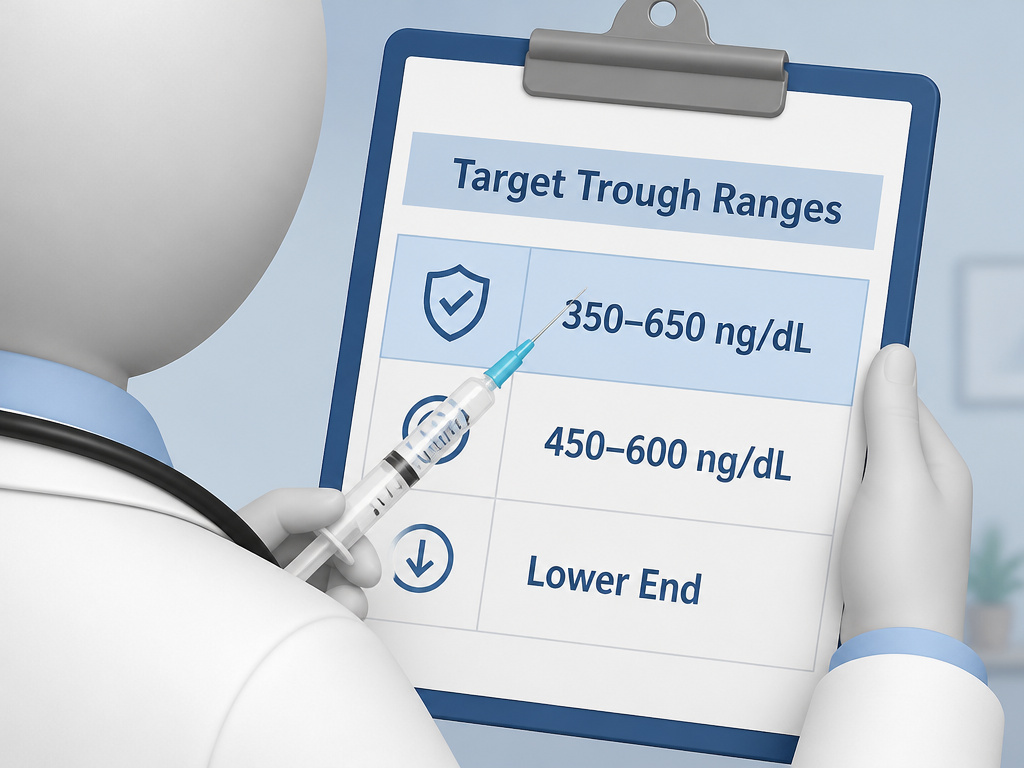
Here is where guidelines diverge, and there is no single universal “perfect” number. The target depends on the specific drug, the guiding medical society, and, most importantly, your symptom resolution.
| Source / Guideline | Recommended Trough Target | Key Context |
|---|---|---|
| FDA Label for XYOSTED | 350–650 ng/dL | This is the maintenance range specified for this specific weekly auto-injector after steady state is reached (by Week 6). |
| AUA Guideline (2018) | 450–600 ng/dL | Recommends targeting the “middle tertile” of the normal range for symptomatic men. |
| Society for Endocrinology (2021) | Lower end of normal range | Advises achieving a trough at the lower end of the assay’s reference range to minimize potential risks. |
The FDA’s 350–650 ng/dL range for XYOSTED is a useful anchor. It’s broad by design, acknowledging individual variation. The AUA Guideline suggests a tighter, higher target of 450–600 ng/dL, highlighting a disagreement among sources on the ideal range. This discrepancy highlighted in the PMC testosterone management article is why working with a knowledgeable prescriber is critical, they’ll help you navigate these different benchmarks.
Your personal optimal trough is the lowest number within a guideline range that fully resolves your hypogonadal symptoms. Starting at the lower end (e.g., ~400 ng/dL) and only increasing if symptoms persist is a safer, more refined approach than blasting straight to the top of the range.
The Critical Difference: Diagnostic Level vs. Treatment Trough
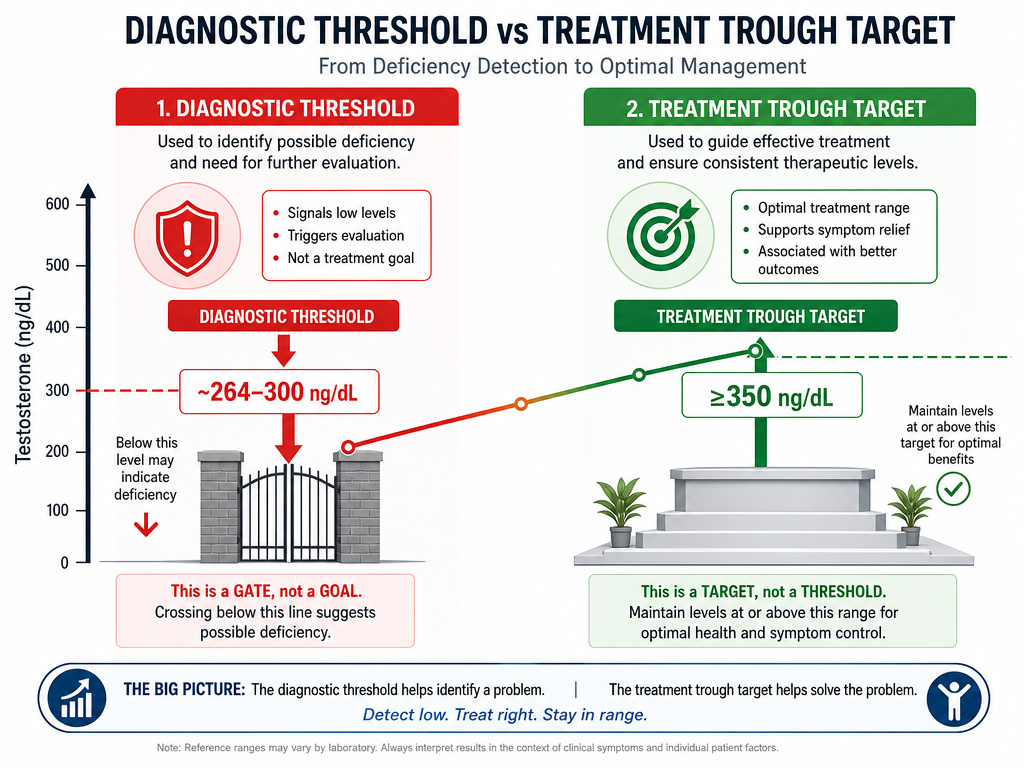
This is a fundamental point of confusion. The number used to diagnose hypogonadism is different from the number you target during treatment.
- Diagnostic Threshold: This is the cutoff used to confirm low testosterone. Sources disagree on the diagnostic threshold: the AUA Guideline uses 300 ng/dL, the EAU/ISSM guidelines use 264 ng/dL, and the VA TRT clinical recommendations state it should be based on the reference interval for the specific lab assay used. These are diagnostic gates, not treatment goals.
- Treatment Trough Target: This is the level you maintain with therapy. As the table above shows, this is typically 350 ng/dL or higher. The goal of TRT isn’t to barely cross the diagnostic threshold; it’s to restore levels to a point where physiology and symptoms normalize.
Mixing these up leads to bad decisions. If your diagnostic level was just below the threshold, achieving a treatment trough that is only marginally above it is likely inadequate. The therapy aims for a robust, sustained correction, not a marginal one.
How to Adjust Your TRT Dose Based on Trough Results
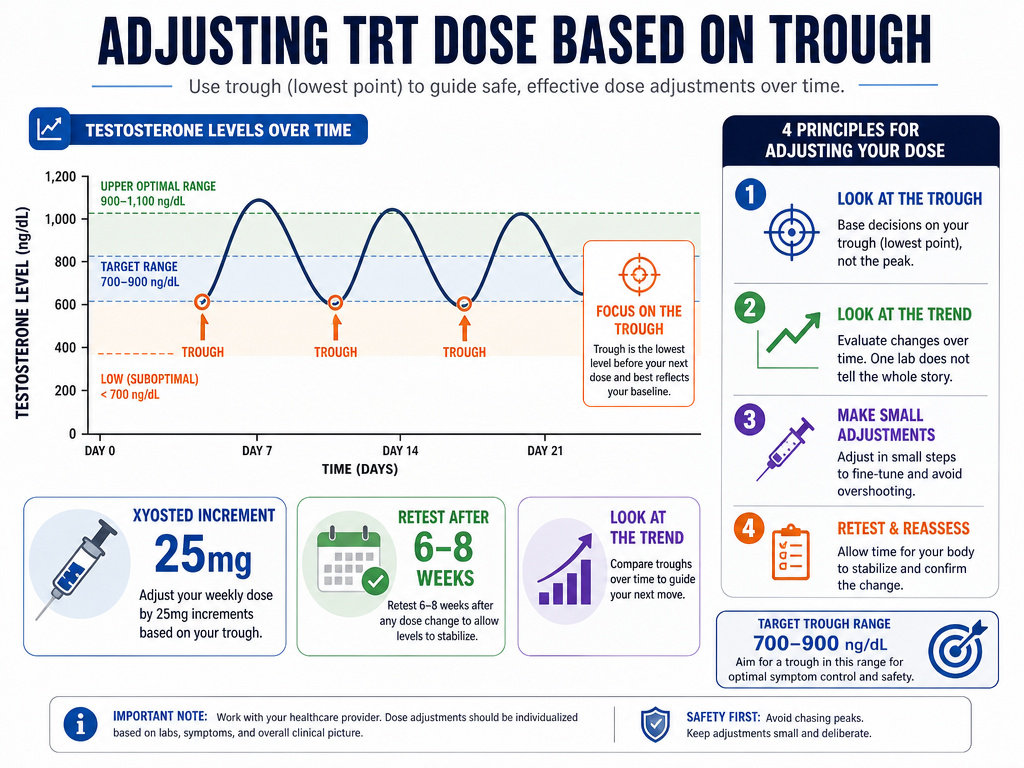
A lab result is just data. The action comes from interpreting it. Dose adjustment is a careful, incremental process, not a reaction to a single number.
For XYOSTED, the FDA label provides a clear roadmap: dose is adjusted in 25 mg increments based on the 7-day trough level. If your trough is below 350 ng/dL, an increase may be warranted. If it’s above 650 ng/dL or if your hematocrit is climbing too high, a decrease should be considered.
For other protocols, the principle is the same:
- Ensure Timing Was Correct: Before changing anything, verify the blood was drawn at the true trough.
- Look at the Trend: A single low or high result could be an outlier. Make decisions based on 2-3 consistent tests.
- Match the Change to the Gap: A small deviation might only need a slight frequency adjustment (e.g., moving from every 7 days to every 6 days). A large gap likely requires a dose change.
- Retest After 6-8 Weeks: After any change, allow enough time to reach a new steady state (at least 6 weeks for shorter esters) before retesting the trough. This patience prevents a frustrating and potentially dangerous yo-yo effect.
A study titrating intervals based on trough levels found the median optimal injection interval was 12.0 weeks (IQR 10.4-12.7 weeks). Doctors didn’t just pick a standard timeline; they used the trough value to personalize it for each patient.
Essential Safety Monitoring Beyond Testosterone
Focusing solely on your testosterone number is a major mistake. TRT affects several other systems, and monitoring them is essential for long-term safety.
Before you start: TRT increases red blood cell counts (hematocrit and hemoglobin) in many patients, which elevates the risk of blood clots, strokes, and heart attacks. Your provider must check these values regularly, and you may need to stop therapy or donate blood if they rise too high.
The FDA label for XYOSTED mandates this. It states clearly that “your healthcare provider should check your red blood cell count and hemoglobin while you use XYOSTED,” and that “you may need to stop XYOSTED if your red blood cell count increases.”
A comprehensive TRT blood work panel should always include:
- Hematocrit & Hemoglobin: The primary safety metrics.
- Estradiol (E2): Testosterone aromatizes into estrogen. High E2 can cause gynecomastia, water retention, and mood swings.
- PSA: For prostate health monitoring, especially in men over 40 or with a family history.
- Lipids and Metabolic Panel: To track the therapy’s broader impact on cardiovascular health.
Treating these markers is as important as hitting your testosterone target. An otherwise perfect protocol must be modified if it drives your hematocrit too high.
What do medical societies say about target trough levels?
Major medical societies provide guidance on where your trough level should be on TRT, but their recommendations differ. The AUA Guideline recommends targeting the middle tertile, which corresponds to a trough range of 450 to 600 ng/dL. In contrast, the Society for Endocrinology guidelines advise achieving a trough at the lower end of the normal reference range. The FDA label for a specific weekly testosterone injection sets a target maintenance trough range of 350 to 650 ng/dL. These varying targets highlight why your doctor’s approach will depend on the specific protocol, your symptoms, and the clinical guidelines they follow. Always discuss your target range with your prescriber.
Frequently Asked Questions
What should my trough level be on TRT?
There’s no single answer, but a common target is the mid-normal range of your lab’s reference interval, typically between 450–600 ng/dL. The official AUA testosterone deficiency guideline recommends this “middle tertile.” However, the correct target is the lowest level within a range like 350–650 ng/dL that resolves your symptoms without causing side effects.
Is 1500 testosterone too high on TRT?
For a trough level, yes, 1500 ng/dL is excessively high and outside any guideline’s target range. A peak may briefly reach this level after an injection, but a sustained trough this high significantly increases the risk of polycythemia (high red blood cell count), estrogen-related side effects, and other cardiovascular strains. It indicates a need for dose reduction.
Is 200 mg of testosterone a week a standard TRT dose?
200 mg per week is a common starting dose for testosterone cypionate or enanthate, but it is not a “standard” final dose for everyone. Many men achieve excellent trough levels in the target range on doses lower than a common starting point. The correct typical TRT dose is the smallest amount that achieves a therapeutic trough and symptom relief, which requires personalized titration based on your blood work timing.
Why do I still feel low if my trough is “normal”?
If your trough is technically within a lab range but you still have symptoms, consider three things. First, your personal optimal level may be at the higher end of that range. Second, your free testosterone might be low due to high SHBG. Third, non-hormonal factors like poor sleep, high stress, or nutrient deficiencies (e.g., vitamin D, zinc) can mimic low-T symptoms. A number on a page doesn’t override how you feel.
How often should I check my trough level on TRT?
Initially, after starting or changing a dose, check your trough 6-8 weeks later to allow levels to stabilize. Once you are on a stable, effective dose with no side effects, monitoring every 6-12 months is usually sufficient for long-term maintenance, alongside more frequent checks of hematocrit.
Before You Go
The most powerful insight is the principle that your trough level is the foundation of your entire TRT protocol. It’s the guarantee against returning to a hypogonadal state, and it’s the primary lever your doctor uses for adjustment.
Commit to this rhythm: same time of day, same point in your dosing cycle, every single lab draw. The consistency turns noisy data into a clear trend line. And remember, the goal is to find the lowest effective dose that gets your trough into a therapeutic range, this minimizes side effects and supports sustainable, long-term health. The numbers are a tool to achieve wellness, not a score to be maximized. Use them that way.
