
When to Get Blood Work on TRT: Timing Your Draw Correctly
This post contains affiliate links. As an Amazon Associate, we earn from qualifying purchases.
The correct time to get blood work on TRT depends entirely on your treatment method. For weekly testosterone cypionate injections, draw blood midway between injections, on day 3 or 4. For daily transdermal gels, test 2-8 hours after application once you’ve used it consistently for at least a week.
That formulation-specific timing is the difference between a useful result and a misleading number. A level drawn at the wrong point in your cycle tells you nothing about your average exposure or safety markers, which is why it’s critical to know when to get blood work on trt.
What follows is the monitoring schedule that actually works, broken down by method. We’ll cover the initial and follow-up labs, the critical hematocrit thresholds that trigger action, and the one preparation step that changes your testosterone reading by up to 30%.
Key Takeaways
- Draw blood for weekly testosterone cypionate on day 3 or 4 post-injection; for daily gels, test 2-8 hours after application.
- The primary safety marker is hematocrit; most guidelines recommend a dose review if it exceeds 51% and stopping therapy if it hits 54%.
- Always test under consistent conditions, fasting, same time of day, similar hydration, or you’re comparing noise, not signal.
The Core TRT Blood Work Schedule
Forget the generic “get tested regularly” advice. Your schedule has three phases: the initial check, the fine-tuning period, and maintenance.
The first lab draw should happen 4 to 6 weeks after you start therapy or after any dose change. This gives your body enough time to reach a steady state where the blood level reflects what you’ll experience long-term. Testing before this point is like checking the oven temperature one minute after you turn it on.
For injectable testosterone enanthate or cypionate dosed weekly, measure serum testosterone midway between injections. If dosing weekly, check on day 3-4. Target mid-interval levels are 350-600 ng/dL according to Endotext, while the VA recommends targeting the mid-normal range. Dose adjustment is indicated if levels are >600 ng/dL or <350 ng/dL according to Endotext, while the VA recommends dose adjustment if total testosterone exceeds 900 ng/dL.
After the initial test, you enter the fine-tuning phase.
I learned the importance of this schedule the hard way. My numbers looked perfect, so I assumed I was set. My hematocrit had slowly climbed during that time, a change I only caught because of a routine annual physical.
Timing Your Draw to Your Dose
This is the most common mistake in TRT monitoring. Drawing blood at a random time relative to your dose makes your testosterone level uninterpretable, highlighting the critical nature of knowing when to get blood work on trt. The protocol changes based on your medication.
| TRT Formulation | When to Draw Blood | Target Level | Why This Timing |
|---|---|---|---|
| Testosterone Cypionate/Enanthate (Weekly) | Midway between injections (Day 3-4) | 350-600 ng/dL (mid-interval) | Captures your average exposure, not the peak or trough. |
| Testosterone Undecanoate (Every 10+ weeks) | End of dosing interval, just before next injection | Low-mid normal range (trough) | Ensures your lowest level is still adequate. |
| Transdermal Gels (Daily) | 2-8 hours after application, after 1+ week of use | Mid-normal range | Measures peak absorption after steady-state is reached. |
| Oral Testosterone Undecanoate | 3-5 hours after ingestion with a fat-containing meal | Mid-normal range | Tracks the short absorption window this formulation requires. |
If you use a weekly injection, the day 3 or 4 rule is critical to answering when to get blood work on trt. Your testosterone peaks about 24-48 hours after the shot and then declines. Drawing at the midpoint shows if your dose provides a sufficient average over the full week. A level drawn the day after your shot will be falsely high; a level drawn the day before your next shot will be falsely low. Neither helps you set the correct dose.
For gels, consistency is everything. Apply the gel at the same time each day. After at least a week of consistent use, this is how long it takes to reach a steady state in your bloodstream, schedule your blood draw for 2 to 8 hours after that morning’s application. This captures your peak level, which is what guidelines use to gauge dosing adequacy.
The Essential Blood Markers (And Their Danger Zones)
A complete TRT blood panel looks beyond testosterone. It checks for efficacy, safety, and side effects. Missing a key marker is like flying a plane without checking the fuel gauge.
The complete blood count (CBC), specifically the hematocrit, is your top safety marker. Testosterone stimulates red blood cell production. For most men, this is a mild, managed increase. For some, it can push hematocrit too high, thickening the blood and increasing clotting risk.
Here’s where guidelines differ, and you need to know both numbers. The VA TRT clinical recommendations PDF suggests a dose review if hematocrit exceeds 51%. Multiple sources, including the AUA follow-up lab testing table, agree that therapy should be stopped if hematocrit exceeds 54%. That’s a small window between “monitor closely” and “stop treatment.”
Where this goes sideways: Ignoring a hematocrit of 52% because you feel fine. Blood viscosity increases exponentially past 50%, and the risk of stroke or heart attack isn’t something you feel until it happens.
Estradiol (E2) is the other critical monitor. A small percentage of testosterone converts to estrogen via aromatase. If your estradiol climbs too high, you might experience water retention, gynecomastia, or mood swings. If it crashes too low, you can feel joint pain and low libido. Not everyone needs to monitor it at every draw, but it’s essential at baseline and anytime you have symptoms of imbalance. The AUA recommends checking it in patients with baseline gynecomastia and optionally for others when checking total testosterone.
Your comprehensive metabolic panel (CMP) checks liver and kidney function. While modern TRT formulations are much easier on the liver than older oral steroids, it’s still a baseline check. Your lipid panel (cholesterol) should also be tracked, as testosterone can affect your HDL and LDL levels.
Prostate-Specific Antigen (PSA) monitoring involves shared decision-making with your doctor. If you have a baseline prostate concern or a strong family history, this will be part of your panel. General guidelines often recommend a urology consult if PSA increases by more than 1.4 ng/mL within a year or if it confirms above 4 ng/mL.
Pre-Test Prep: The Variables You Control

You can ruin a perfectly good lab result before the needle even touches your skin. Inconsistent preparation adds variability that looks like a change in your therapy.
The biggest variable is fasting. The T&F article states blood testing ‘should be performed in a fasting state’ because circulating T levels can be decreased by 14-30% in non-fasting conditions, while other guidelines focus on ‘early morning’ without explicitly mandating fasting. That’s not a minor fluctuation. If you test fed one time and fasted the next, a 30% drop could look like a failed protocol or a need for a dose increase.
Time of day matters because of testosterone’s diurnal rhythm. Levels are highest in the early morning and decline throughout the day. This is especially important for your diagnostic tests before starting TRT. Once you’re on therapy, the exogenous hormone mutes this rhythm, but consistency is still the best practice for comparable results.
Hydration directly impacts your hematocrit reading. Being dehydrated the day before your draw will concentrate your blood and give you a falsely high hematocrit. The goal isn’t to game the test by over-hydrating, but to be normally hydrated each time so you’re comparing the same thing.
Easy to miss: Acute illness. If you have a cold, the flu, or a flare-up of a chronic condition, reschedule your blood draw. Systemic illness can temporarily suppress testosterone, giving you a misleadingly low reading that doesn’t reflect your therapy.
What to Do With Your Results
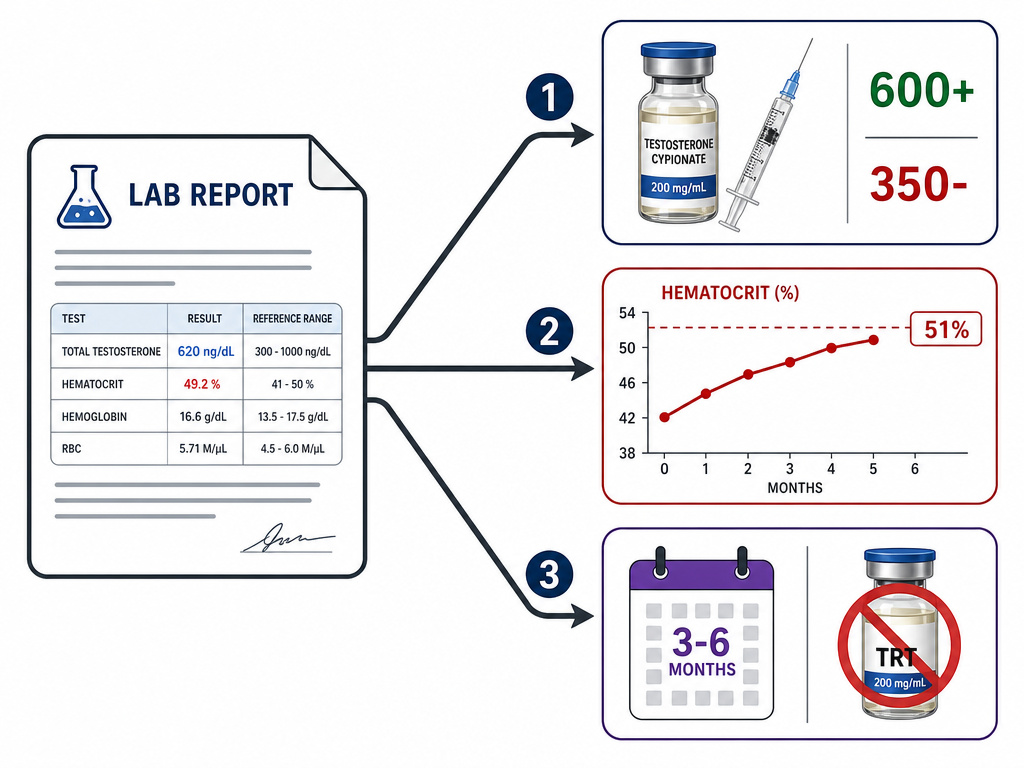
Getting the lab report is step one. Understanding what triggers an action is step two.
If your testosterone level is outside the target range, a dose adjustment is the next step. For weekly injections, the Endotext monitoring recommendations table indicates a change if you’re above 600 ng/dL or below 350 ng/dL at that mid-interval point.
A rising hematocrit is the most common reason for a protocol change. If you’re near 51%, your doctor might discuss four options: reducing your testosterone dose, increasing your injection frequency (which creates smaller, more frequent peaks), therapeutic phlebotomy (donating blood), or adding low-dose aspirin. Don’t try to self-manage this with supplements.
If your symptoms aren’t improving even with testosterone levels in range, the problem might not be the dose. The VA January 2026 TRT guide outlines a clear path: consider discontinuing TRT for 3-6 months, then retest to see if you are biochemically hypogonadal. If your symptoms were due to another issue like sleep apnea or depression, they’ll persist off therapy, and you’ve avoided lifelong unnecessary treatment.
Frequently Asked Questions
How long does it take to get TRT blood work results back?
Your clinic will contact you with results and any recommendations.
Can I get my blood work done at any time?
No. For accurate, comparable results, you must follow the timing rules for your specific TRT method. A random draw won’t show your true mid-interval or peak level, making dose adjustments guesswork. Always schedule your draw based on the schedule for your formulation.
What does “stable levels” actually mean?
Do I need to fast for all my TRT blood tests?
Yes, for the most consistent and accurate testosterone reading according to some sources, you should fast. The T&F article recommends fasting for 8-12 hours, while other guidelines focus on ‘early morning’ without explicitly mandating fasting. Non-fasting conditions can lower your measured testosterone significantly, making it impossible to compare results from one test to the next.
Before You Go
The single most important habit is consistency. Pick a schedule, mid-interval for injections, post-application for gels, and stick to it. Draw your labs fasted, in the morning, in a normally hydrated state. Record those conditions so you can replicate them every time.
This turns your blood work from a confusing report into a reliable tool. You’ll know if a change in a number is real or just noise from a different preparation. This clear information allows you and your doctor to manage your therapy safely for the long term, maintaining high benefits and controlled risks.
Start with the next test on your calendar. If you’ve been inconsistent, use it to establish your new baseline. From there, the path is straightforward.
