
What Time of Day to Test Testosterone?
This post contains affiliate links. As an Amazon Associate, we earn from qualifying purchases.
The best time of day to test testosterone is between 7:00 AM and 11:00 AM, after an overnight fast, when levels are at their daily peak. For an accurate baseline, you need a morning blood draw. Testing in the afternoon can drop your reading by up to 30% or more, which is enough to misclassify a normal level as low.
That 7–11 AM window is the consensus from clinical guidelines. The Province of British Columbia says before 10:00 AM. The NHS says before 11:00 AM. The International Society for the Study of the Aging Male (ISSAM) specifies between 07.00 and 11.00 hours. A key question is what time of day to test testosterone, and they all agree on the fasted part, too.
What follows is not just a restatement of that rule. It’s the mechanics behind it, the three specific situations where the rule bends or breaks, and the one mistake in test prep that costs more men an accurate reading than any other factor.
Key Takeaways
- Testosterone follows a circadian rhythm, peaking in the early morning and declining through the day. An afternoon draw can show a level 30% lower than your true peak.
- For diagnosis, draw blood between 7–11 AM after an overnight fast, when you are clinically well and on a stable sleep schedule. This is the standard across British Columbia testing protocol, NHS, and major medical societies.
- Biologic variation means two tests on the same untreated person can differ by up to 30%. Always confirm a low reading with a second morning fasted draw at least four weeks apart.
- If you are on stable testosterone therapy, timing shifts: test at the “trough” right before your next injection, or at least 4 hours after applying a gel, not strictly in the morning.
- Acute illness, poor sleep, or high stress suppress levels transiently. Testing during these states gives a falsely low snapshot that doesn’t reflect your baseline.
The Standard Rule: Morning, Fasted, and Stable
Get the blood draw between 7:00 AM and 11:00 AM. Do it after an overnight fast. Make sure you’re not sick, jet-lagged, or coming off a night shift.
This isn’t a suggestion. It’s the procedural guardrail that keeps a normal reading from being flagged as low. The reason is mechanical. Testosterone secretion is driven by a circadian rhythm, with pulses from the pituitary gland highest during sleep. The result is a reservoir that peaks shortly after you wake up and then declines steadily. Eating, especially a meal high in sugar or fat, can cause a further acute drop. So the morning fasted state captures your personal high tide.
Serum total testosterone must be collected in the morning, preferably before 10:00 AM, or within three hours of waking, and preferably in a fasting state. Testing should occur when the sleep-wake pattern is stable (e.g., not during shift changes or jetlag). Do not test during acute illness or hospitalization. – Province of British Columbia Guidelines
The numbers behind the rule are significant. One community-based study of men with an average age of 61 found total testosterone levels drawn from 8-11 AM were higher than levels drawn outside that window. That’s a difference big enough to cross a diagnostic threshold.
I learned this the expensive way. Years ago, I tested myself haphazardly, a late morning here, an early afternoon there. The swing between draws was bigger than I expected, sometimes 100 ng/dL or more. A single afternoon draw is a snapshot, not a verdict. Now I only compare fasted morning draws, ideally before 10 a.m., and I repeat any odd result before reacting.
Why Fasting Matters
Glucose intake can suppress the hypothalamic-pituitary-gonadal axis. In plain terms, a meal tells your body to shift priorities away from hormone production. An overnight fast standardizes this variable. It’s not about weight loss; it’s about eliminating a known suppressor to get a clean read.
Common mistake: Scheduling your test for 9 AM but having a coffee with cream and sugar on the drive to the lab. That breaks the fast. Water is fine. Check with your specific lab for their fasting requirements. When in doubt, drink water only.
How Testosterone Levels Change Through the Day
The decline isn’t linear or dramatic every hour. It’s a gradual slope. For a young man with a robust rhythm, the drop from morning to afternoon can be significant, which is central to the what time of day to test testosterone question. By evening, it can be substantially lower than the morning peak. This is the diurnal variation every lab accounts for when it publishes morning-specific reference ranges.
| Time of Day | Approximate Change from Peak | Clinical Implication |
|---|---|---|
| 7–9 AM | Peak (0% change) | Ideal testing window. |
| 10 AM–12 PM | -5% to -10% | Still acceptable for most guidelines. |
| 1 PM–4 PM | -15% to -25% | Risk of misclassifying a normal level as low. |
| 5 PM–8 PM | -25% to -35% | Results are not comparable to morning reference ranges. |
The slope flattens with age. Some studies in older men (mean age 60+) show a much blunted rhythm, with levels relatively stable from 6 AM to 2 PM. This is where sources genuinely disagree. The ISSAM notes one cross-sectional study where levels were “unchanged from 6 am to 2 pm” in older men. Yet another peer-reviewed timing research in a similar age group found levels from 2-5 PM were significantly lower than the 8-11 AM draws.
The safe takeaway: age may relax the rule, but it doesn’t erase it. If you’re under 50, you must test testosterone during the morning window. Over 50, a late morning draw is probably fine, but an afternoon draw still carries a risk of underestimation.
What to Do the Day Before Your Test
Your preparation is important. This isn’t about gaming the test; it’s about removing noise.
- Sleep normally. Get your normal sleep. A single night of poor or short sleep can suppress testosterone. Don’t test the morning after a red-eye flight or a night of terrible rest.
- Avoid strenuous exercise. Avoid strenuous exercise before the draw. Intense physical stress elevates cortisol, which can temporarily lower testosterone.
- Limit alcohol. Limit alcohol before your test. It affects liver function and hormone metabolism.
- Check your medications and supplements. Some prescriptions and over-the-counter products can interfere. Know what you’re taking and discuss it with your doctor. Don’t stop prescribed medication without guidance.
Where this goes sideways: Testing when you’re fighting a cold or just getting over one. Acute illness is a powerful temporary suppressor. Your immune system’ needs take priority, and hormone production dips. A test during this time will show a falsely low baseline. Wait until you are clinically well.
This level of preparation for a test turns a snapshot into a useful portrait. It controls the variables you can actually control.
When the Standard Rule Doesn’t Apply (The Edge Cases)
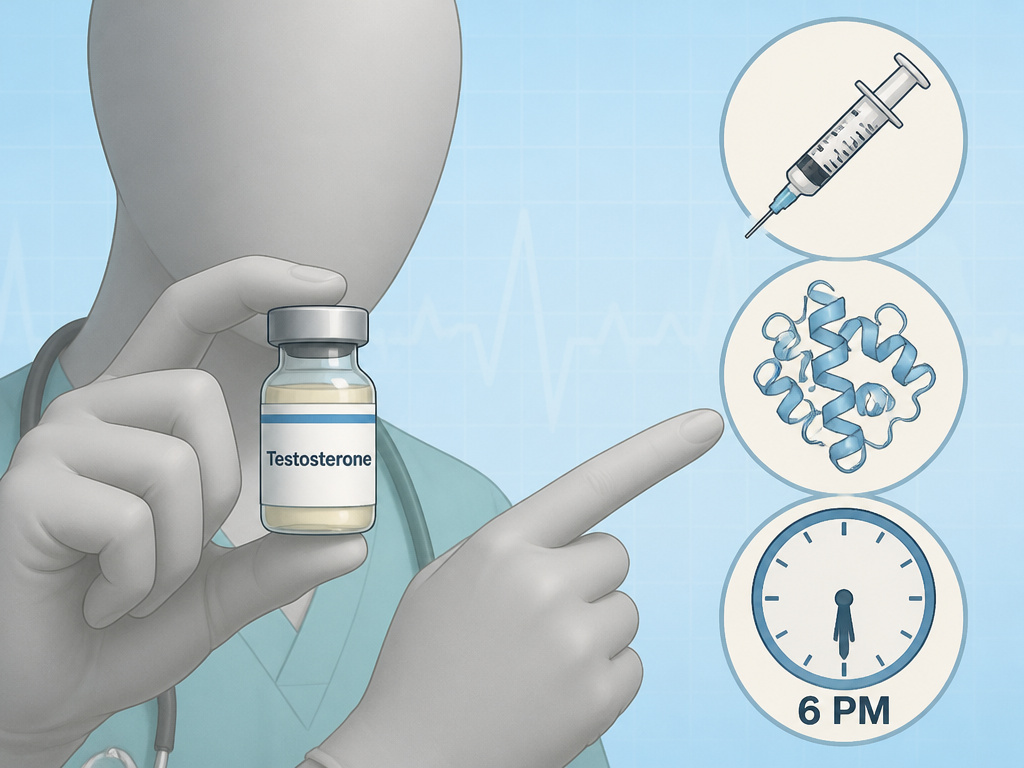
Three specific situations change the timing equation entirely. If you fall into one of these, the 7–11 AM fasted rule is the wrong guide.
1. You’re on Stable Testosterone Replacement Therapy (TRT).
When you’re treating low testosterone, the goal is to see if your dose is right, not to diagnose a deficiency. Timing is based on your treatment modality.
- Injections (e.g., Testosterone Cypionate): Test at the “trough.” Draw blood immediately before your next scheduled injection. This shows the lowest point in your cycle and confirms the dose lasts the full interval.
- Topical Gels (e.g., AndroGel, Testim): Test at least 4 hours after your last application. This allows absorption and shows a steady-state level. Morning application and a late morning draw is common.
- Oral Therapy: Follow your doctor’s specific protocol for timing.
The BC Guidelines specify annual monitoring for men on stable therapy, with timing based on the treatment modality, not strictly a morning fast.
2. You Have Abnormally High or Low SHBG.
Sex Hormone-Binding Globulin (SHBG) is the protein that carries testosterone in your blood. If SHBG is very high (common in older age, liver disease) or very low (common with obesity, insulin resistance), total testosterone becomes a misleading number.
In men with high or low SHBG levels, total testosterone may give a misleading measure of androgenicity, and estimating free testosterone via mass-action equation becomes worthwhile. – Peer-Reviewed Article, PMC
In this case, the “when” still matters, but the “what” matters more. You need a test that includes SHBG so your doctor can calculate free or bioavailable testosterone, the fraction that’s actually active. This is a classic example of why just getting a total testosterone number can send you down the wrong path.
3. You’re a Shift Worker or Have an Irregular Schedule.
If you work nights and sleep days, your circadian rhythm is flipped. The principle remains: test at the start of your “biological day,” within 3 hours of waking after your main sleep period, in a fasted state. For a night-shift worker who sleeps 9 AM to 5 PM, an ideal draw might be at 6 PM, after waking and before the first meal. The key is consistency, use the same timing for all follow-up tests.
Types of Tests and Why Method Matters
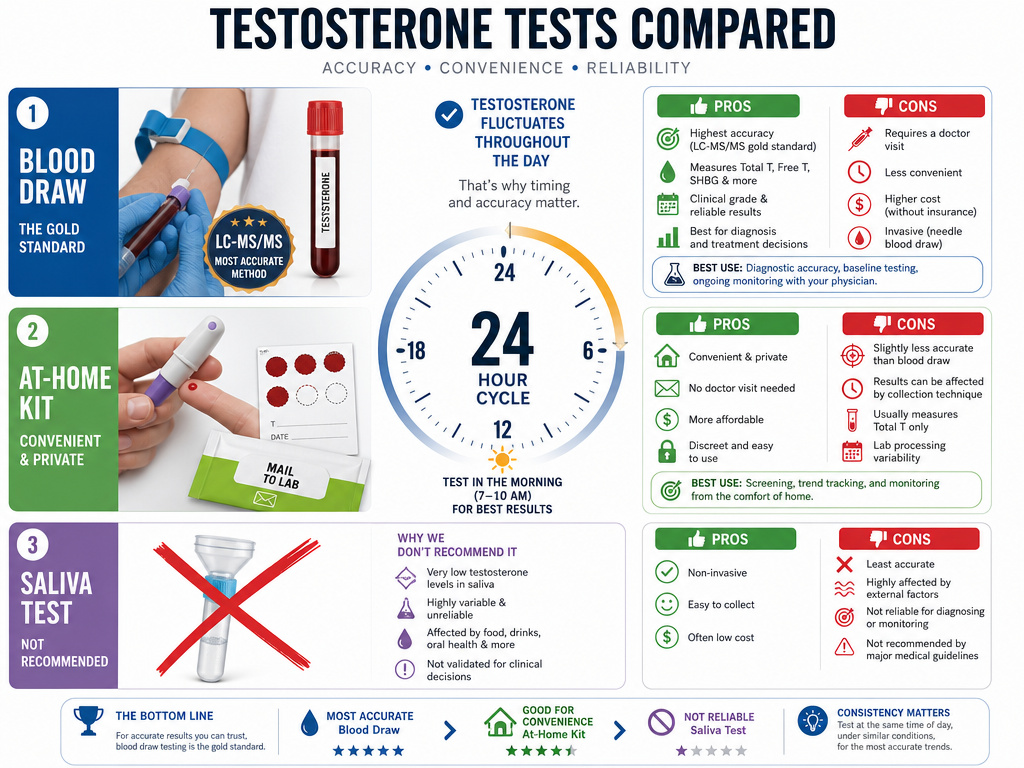
Not all testosterone tests are equal. The “when” is critical, but the “how” determines if the number is worth trusting.
Gold Standard: Blood Draw (Phlebotomy)
This is the clinical standard. A venous blood draw sent to a lab for analysis.
- Best Practice: Analysis via Liquid Chromatography Tandem Mass Spectrometry (LC-MS/MS). This method, recommended in the SEQC ML position statement, has high specificity and is the benchmark for accuracy.
- Pros: Highly accurate, measures total and free testosterone, allows for SHBG calculation.
- Cons: Requires a clinic visit, slower results.
Convenience Option: At-Home Blood Spot Kits
Companies like LetsGetChecked or Everlywell send a finger-prick kit. You mail a dried blood spot to their lab.
- Pros: Convenience, privacy.
- Cons: Generally less accurate than venous draws. The sample can degrade. Reference ranges may differ. I view these as decent for curiosity and trend-spotting, but I wouldn’t use a single result from one to make a treatment decision.
Not Recommended for Diagnosis: Saliva Tests
Saliva testing measures free testosterone. While convenient, the correlation with serum free testosterone is poor, and standardization between labs is virtually non-existent. Major clinical societies do not recommend saliva tests for diagnosing hypogonadism. The data isn’t reliable enough.
I’ve used both Quest Diagnostics and Labcorp. The key is to use the same lab for all follow-up tests because reference ranges and assay methods differ. Switching labs mid-stream makes tracking progress impossible.
How to Interpret Your Results (and What to Do Next)
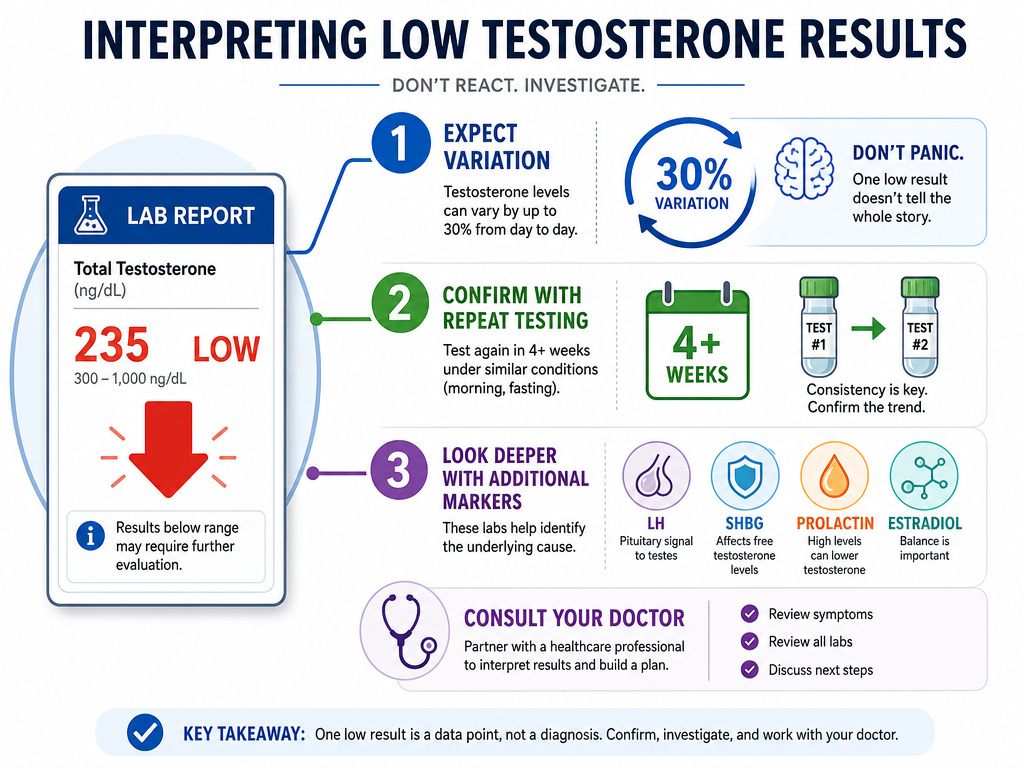
You get your report. The total testosterone number has a flag: LOW. Now what?
Step 1: Don’t panic.
Remember biologic variation. Two successive measurements on the same untreated person can differ by up to 30% due to normal fluctuations. One low reading is a signal to re-test, not a diagnosis.
Step 2: Confirm with a second test.
Guidelines are clear. The diagnosis of hypogonadism requires testosterone readings below the reference range on at least two different occasions, at least 4 weeks apart. Schedule a second morning fasted draw, following all the prep rules. This weeds out fluke lows.
Step 3: Look at the full picture.
A total testosterone number alone is incomplete. For a proper understanding results, you need a panel that includes:
- LH (Luteinizing Hormone): Distinguishes primary (testicular) from secondary (pituitary) failure.
- SHBG: Allows calculation of free testosterone, crucial if you have obesity or are older.
- Prolactin: Measured if total testosterone is very low (<5.2 nmol/L) to rule out a pituitary tumor.
- Estradiol (E2): Important for monitoring men on TRT.
If your second test is also low and you have symptoms, that’s the point to take the full panel and the results to a doctor. They can investigate the cause, which could be anything from sleep apnea to a pituitary issue, rather than just treating a number.
Before You Go
The rule is simple: test between 7 and 11 AM, fasted, when you’re well-rested and healthy. That single habit eliminates more testing error than anything else.
But if you must test outside that window, because of lab hours, work, or travel, understand the compromise. An afternoon level is not your baseline. It’s a depressed snapshot. Don’t let a single afternoon result taken during a stressful week dictate your next six months. Track it, then decide. Get the second morning draw.
And if you’re on treatment, forget the morning rule. Your schedule is now dictated by your dosing: trough for injections, 4+ hours after application for gels. That’s how you see if the protocol is working.
Does the time of day matter less for older men?
While the standard advice is for a morning blood draw, the natural daily variation in testosterone levels can lessen with age. Research indicates that the typical morning peak may be less pronounced in older men. One cross-sectional study of men with a mean age over 60 found serum testosterone levels remained relatively unchanged from the early morning through the early afternoon, showing only a modest decline later in the day. This suggests that for some older men, testing before the early afternoon may still provide a clinically useful measurement. However, because individual patterns vary, following the standard morning protocol when possible is still the most reliable approach to ensure consistent and comparable results.
What symptoms suggest you should get your testosterone checked?
Persistent symptoms like a noticeable drop in libido, unexplained fatigue, or erectile dysfunction can be clinical signs of low testosterone, known as hypogonadism. These symptoms often prompt a doctor to order testing. A diagnosis is not based on a single test, however. Consistent with clinical guidelines, low testosterone is typically confirmed by two separate blood tests showing levels below the reference range, taken at least four weeks apart. It is crucial to schedule these tests when you are clinically well, as acute illness can temporarily suppress hormone levels and skew the results. Testing should also be done when your sleep-wake pattern is stable, not during periods of shift work or jet lag.
Can medications or supplements affect testosterone test results?
Yes, various medications and supplements can influence your testosterone levels or the proteins that bind to it, potentially leading to misleading test results. For instance, conditions that alter sex-hormone binding globulin (SHBG) can make a total testosterone reading less reliable. If SHBG is very high or low, a doctor may need to calculate free testosterone for an accurate assessment. For men already on stable testosterone replacement therapy, the timing of the blood draw is based on the treatment method, not strictly a morning fast. Monitoring for those on injections is best done at the ‘trough,’ right before the next dose is due, while for gels, testing should occur several hours after the last application.
Frequently Asked Questions
Can I test testosterone in the afternoon?
You can, but you shouldn’t for diagnostic purposes. Testosterone follows a daily cycle, peaking in the morning and declining through the afternoon. An afternoon level can be 20-30% lower than your morning peak, which may falsely indicate a low level. Clinical guidelines and lab reference ranges are built around morning draws.
What if I’m a night shift worker?
Test at the beginning of your “biological day.” If you sleep from 9 AM to 5 PM, get your blood drawn in the early evening after waking, in a fasted state. The principle is to test at your personal peak, which is relative to your sleep cycle. Just be consistent and use the same timing for all follow-up tests.
Do I need to fast before a testosterone test?
Yes. An overnight fast of 8-12 hours is recommended. Eating, especially a meal with fat and sugar, can temporarily suppress testosterone levels. A fasted state standardizes this variable and gives the most accurate reflection of your baseline production. Drink water; avoid coffee with cream or sugar.
How long after starting TRT should I get tested?
Follow your doctor’s protocol, but Follow your doctor’s protocol for initial monitoring after starting therapy. The timing of the draw depends on your treatment method: at the “trough” right before your next injection, or at least 4 hours after applying a topical gel. This checks if your dose puts you in the target range.
Why did my testosterone levels drop from my last test?
Don’t assume a drop means a real decline. First, check the draw times. If one was at 8 AM and the next at 4 PM, that’s the likely culprit. Second, consider recent lifestyle: poor sleep, illness, increased stress, or changed exercise habits can cause temporary suppression. Always compare morning fasted draws taken under similar conditions, and remember that two tests can vary by up to 30% normally.
