
Testosterone Blood Test Results Explained
This post contains affiliate links. As an Amazon Associate, we earn from qualifying purchases.
Your testosterone blood test results come down to matching three things: your number, the lab’s reference range, and your specific symptoms. A result is not a verdict; it’s a snapshot that needs context. For men, total testosterone levels for ages 17-50 typically fall between 249–836 ng/dL (8.6–29.0 nmol/L), while for women 17-50, MedlinePlus gives a range of 8.4–48.1 ng/dL (0.3–1.7 nmol/L), while the British Columbia Ministry of Health states the upper limit of normal is approximately 2-3 nmol/L. The most important number is often the one you get between 7 and 10 a.m., because levels are highest in the morning and drop in the afternoon.
That morning number is your baseline, but it is not the whole story. Two men can have the same total testosterone level, and one feels fine while the other is dragging through the day. The difference often lives in the fine print, the SHBG level, the free testosterone calculation, and the timing of the draw relative to your last meal or workout. This guide walks through a real report line by line, shows you where the critical numbers hide, and explains why your doctor might order a second test before saying anything definitive. To help with this, the following section provides a clear breakdown of testosterone blood test results explained.
What follows: a breakdown of total, free, and bioavailable testosterone; how to read the ranges and units; the common reasons results vary; and the specific, informed questions to take back to your clinician.
Key Takeaways
- Testosterone levels peak in the morning. Draw blood between 7 a.m. And 10 a.m. for a valid baseline; an afternoon test can read lower and is not diagnostic.
- The reference range on your report is lab-specific. One lab’s “normal” low end might be 8.6 nmol/L (per MedlinePlus), while commercial immunoassay reference ranges can have lower limits as low as 4.9 nmol/L.
- Symptoms matter as much as the number. Per the American Urological Association guideline, a diagnosis of testosterone deficiency requires both a low level and associated symptoms like low libido or unexplained fatigue.
- For men on testosterone replacement therapy (TRT), timing your blood draw is critical. Test 2–8 hours after applying a gel, or for injectable testosterone enanthate or cypionate, measure testosterone either midway between injections or at trough, to see if your dose is correct.
- Always test total testosterone first. Reserve free or bioavailable testosterone tests for when your SHBG level is clearly abnormal, as they are often calculated, not directly measured.
The Anatomy of a Testosterone Lab Report
Pull out your own report or look at the sample one. A lab report is a collection of lines, each with a name, your result, a reference interval, and sometimes a flag. Your job is to know which lines carry the weight.
The first line is almost always Total Testosterone. This measures everything in your blood, hormone bound tightly to SHBG, loosely to albumin, and the tiny fraction that is truly free. For most initial screenings, this is the only number you need. The reference range next to it is specific to the lab that ran your test, the assay method they used, and your age and sex. A result of 350 ng/dL might be flagged “low” at Labcorp but sit in the “normal” range at a hospital using a different assay. That variability is not an error; it is the reality of hormone testing.
Total testosterone measurement is often adequate for initial patient evaluation. Conditions where SHBG levels might be altered may require measurement of free or bioavailable testosterone.
Below total testosterone, you might see Free Testosterone. This is the unbound, active hormone available to your cells. Crucially, most labs do not measure this directly. They calculate it using your total testosterone and your SHBG level. If your SHBG is normal, the free testosterone calculation adds little new information. If your SHBG is very high or very low, common in obesity, thyroid disorders, or with certain medications, then the calculated free testosterone can explain why you feel off despite a “normal” total. Some specialized labs use equilibrium dialysis, the gold-standard method, but it is rare and expensive. Assume yours was calculated unless stated otherwise.
Sex Hormone-Binding Globulin (SHBG) is the third key player. This liver-produced protein acts like a taxi service, carrying testosterone through your bloodstream. High SHBG binds more testosterone, leaving less free and bioavailable. Low SHBG does the opposite. It is a control variable, not a target itself. Your SHBG level helps your clinician interpret your total testosterone number. You can find a deeper dive on this relationship in our article about the difference between free and total testosterone.
| Lab Component | What It Measures | Why It Matters | Common Pitfall |
|---|---|---|---|
| Total Testosterone | All testosterone in blood (bound + free) | The primary screening number; establishes baseline. | Comparing results from different labs or assays. |
| Free Testosterone | Calculated unbound, active hormone | Explains symptoms when SHBG is abnormal. | Assuming it’s a direct measurement; it’s usually calculated. |
| SHBG | Binding protein that transports testosterone | Context for total T; high or low levels distort free T. | Treating SHBG as a problem to fix instead of an interpreter. |
Total, Free, and Bioavailable: Which Number Actually Matters?
Start with total testosterone. It is the most standardized, reliable number you have. The MedlinePlus medical encyclopedia entry provides the classic reference ranges: for men 17-50, 249–836 ng/dL (8.6–29.0 nmol/L); for men over 50, 193–740 ng/dL (6.7–25.7 nmol/L). For women 17-50, 8.4–48.1 ng/dL (0.3–1.7 nmol/L); for women over 50, 2.9–40.1 ng/dL (0.1–1.4 nmol/L). Those are the textbook frames.
But here is where it gets practical. Two major sources disagree on the diagnostic cut-off for low testosterone in men. The commonly cited threshold is 300 ng/dL (10.4 nmol/L), used in many U.S. Guidelines including the AUA testosterone deficiency guideline. A 2023 UK position statement sets a lower action limit of <8 nmol/L (about 230 ng/dL) for likely hypogonadism. Your doctor’s training and location will influence which number they use. This is not a contradiction, it is a gray zone. If your result is between 230 and 300 ng/dL, your symptoms become the deciding factor.
Free testosterone matters when SHBG is out of range. The British Columbia testing protocol PDF states that calculated bioavailable and free testosterone are “functionally and diagnostically equivalent (and therefore redundant).” The UK statement agrees it has no extra diagnostic value when SHBG is normal. So when should you look at it? If your total testosterone is middling but you have classic low-T symptoms, check your SHBG after you’ve had your testosterone blood test results explained. A sky-high SHBG could mean your free testosterone is actually low. A very low SHBG, often seen with obesity, can make your free testosterone look adequate even when your total is low. In those specific cases, the calculated free number has a job.
Bioavailable testosterone is simply the free testosterone plus the fraction loosely bound to albumin. It is another calculated value. For clinical purposes, it tells you the same story as free testosterone. Do not pay extra for it unless your clinician is following a specific protocol that requires it.
Decoding Reference Ranges and Units
Your lab report will show your result and a “reference range.” The reference range is the statistical range that captures the middle 95% of apparently healthy people the lab tested when they validated their assay. You can be at the very bottom of “normal” and feel terrible, or be at the top and feel fine. The range is a map, not a destination.
The units are critical. In the United States, testosterone is typically reported in nanograms per deciliter (ng/dL). In most other countries, including Canada and the UK, the standard is nanomoles per liter (nmol/L). You cannot compare a number in ng/dL to a reference range in nmol/L when you compare a testosterone blood test results explained. If your report shows both, the lab has done the conversion for you. If it only shows one, use an online converter, but know that the conversion factor is approximate (multiply nmol/L by 28.8 to get ng/dL; divide ng/dL by 28.8 to get nmol/L). We have a dedicated guide if you need help converting testosterone units.
Where this goes sideways: Comparing your result to a generic range you found online. A UK joint society position statement notes that commercial immunoassay reference ranges have lower limits ranging from 4.9 nmol/L to 11 nmol/L. Your lab’s printed range is the only one that applies to your result.
This variability is why serial testing at the same lab is so important. Tracking a trend, watching your number drop from 450 to 320 ng/dL over two years at Quest Diagnostics, is far more meaningful than comparing a 320 from Quest to a 350 from Labcorp. The NCBI Bookshelf laboratory assessment guide details the technical reasons for this assay variability, which is a known challenge in endocrinology.
Why Your Results Can Vary (It’s Not Just the Lab)

Before you panic over a single low number, understand the factors that can depress or inflate your result. Some are under your control; some are not.
The biggest factor is time of day. Testosterone follows a circadian rhythm, peaking in the early morning and hitting a trough in the late afternoon. The NIH testosterone test overview specifies the best time for a blood sample is between 7 a.m. And 10 a.m. An afternoon draw can show a level 30% lower than your true peak. This detail is the difference between a diagnosis and a retest. For more on this, see our article about the best time to test testosterone.
Acute illness is a major confounder. If you drew blood while fighting a flu, a cold, or even a significant injury, your testosterone will be temporarily suppressed. The UK clinical guideline is clear: measurements taken during acute illness “cannot be used to diagnose male hypogonadism.” Wait until you are fully recovered.
Other common influencers:
- Sleep: A single night of poor sleep can lower testosterone. Chronic sleep deprivation crushes it.
- Fasting vs. Fed State: A large glucose load can cause a sharp, temporary drop. For consistency, a fasted morning draw is best.
- Recent Exercise: A brutal weightlifting session the day before can lower levels temporarily.
- Medications & Supplements: Opioids, corticosteroids, and some antidepressants lower testosterone. High-dose biotin supplements can interfere with the assay itself, causing falsely high or low readings.
This is why a single abnormal test is not enough. The standard protocol, per MedlinePlus, is that a second sample is often needed to confirm a result that is lower than expected. Do not start any treatment based on one number. For a full list of factors, our guide about why testosterone test results vary breaks it down.
Symptoms vs. Numbers: The Diagnostic Gray Zone
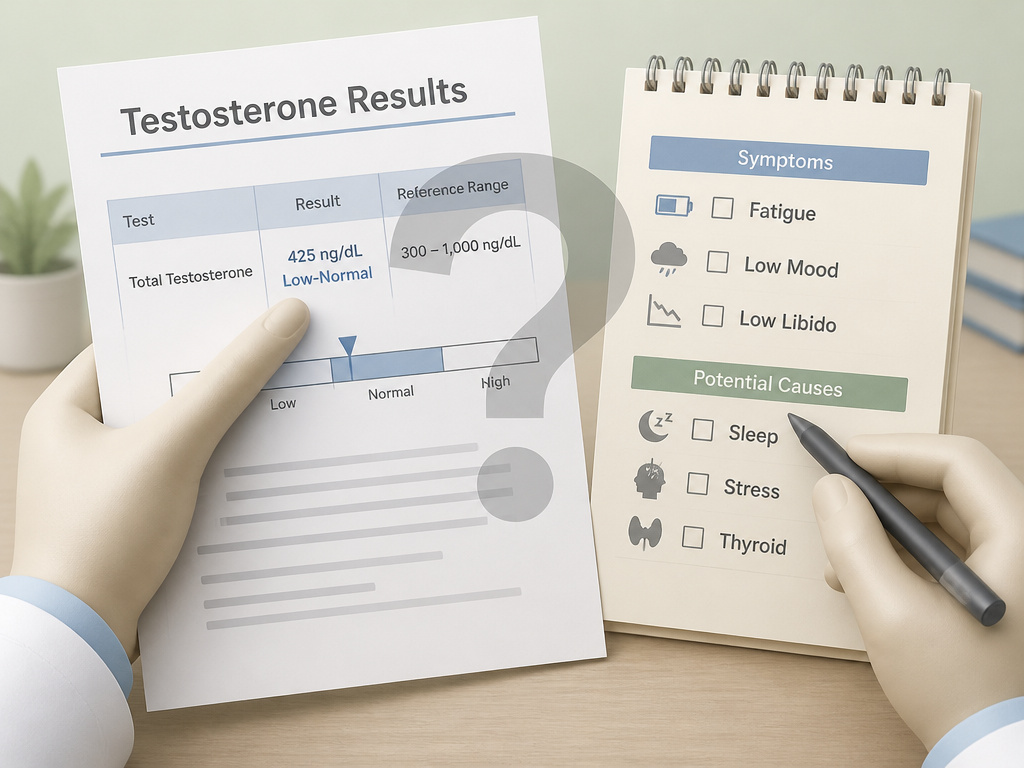
This is the most common frustration in clinic waiting rooms. Your result is “normal,” but you feel anything but. The official clinical practice guideline for testing from the American Urological Association resolves this: a diagnosis requires both a low level and associated symptoms. The number alone is not enough.
The symptoms themselves are notoriously non-specific. Low libido, erectile dysfunction, unexplained fatigue, depressed mood, loss of muscle mass, and increased body fat can all point to low testosterone. They can also point to sleep apnea, clinical depression, thyroid issues, or just chronic stress. This overlap is why a clinician will not look at your lab report in isolation.
Common mistake: Chasing a number without addressing lifestyle. A man sleeping five hours a night, eating poorly, and under constant stress will have low testosterone. Treating the number with medication without fixing the causes is a temporary patch on a leaking roof.
If your symptoms are classic and persistent but your total testosterone is in the low-normal range (say, 280–350 ng/dL), the next step is a deeper look. This is when checking SHBG and calculating free testosterone can reveal a mismatch. It is also when evaluating other hormones in a comprehensive hormone testing panel, like thyroid hormones, cortisol, and estradiol, can identify the real culprit. Sometimes the problem is not testosterone production but conversion to estradiol or a dysregulated stress axis.
Next Steps After Getting Your Results
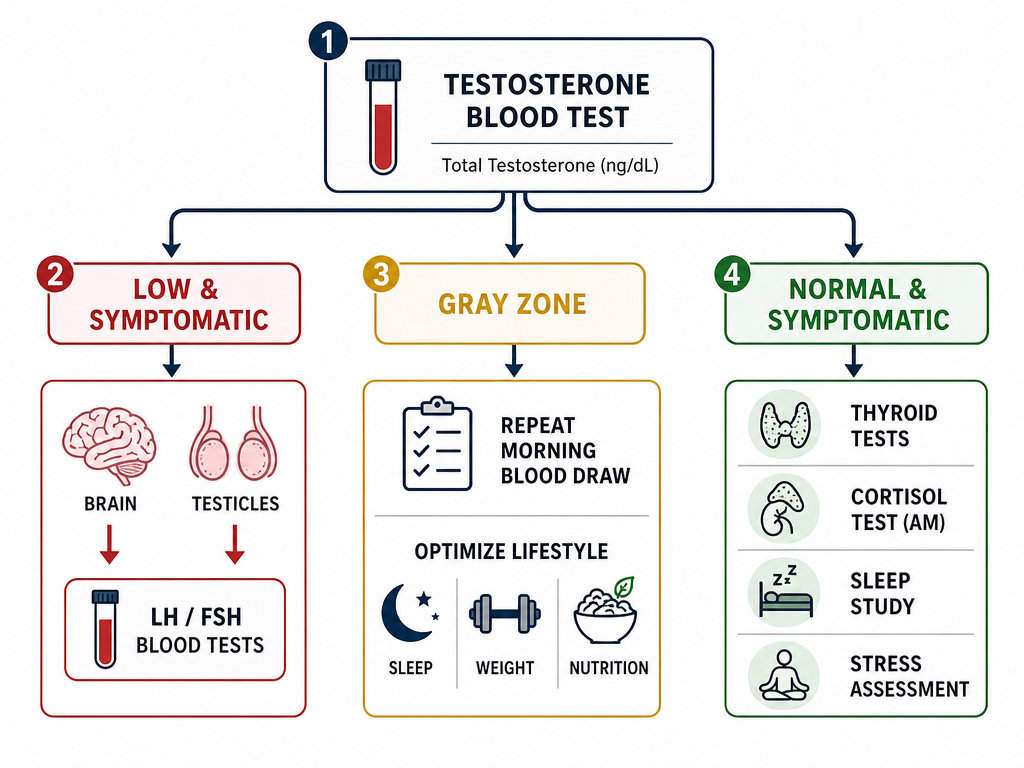
You have your report. You have read the ranges. Now what? Your action plan depends on where your numbers land and how you feel.
If your total testosterone is well below range (e.g., < 200 ng/dL) and you have symptoms:
This is the clearest case for further evaluation. Your doctor should investigate why. This involves checking LH and FSH to see if the problem is in the testicles (primary hypogonadism) or the brain’s pituitary gland (secondary hypogonadism). They will also look for underlying causes like pituitary tumors, iron overload, or genetic conditions. Treatment with testosterone replacement therapy (TRT) is a strong possibility here, but identifying the cause is step one.
If your total testosterone is in the “gray zone” (e.g., 230–350 ng/dL) with symptoms:
This is where the art of medicine comes in. The first step is often a repeat test following perfect protocol: a fasted, morning draw after a full night’s sleep, while you are healthy. If it comes back low again, you and your doctor discuss the risk-benefit of a trial of TRT versus aggressive lifestyle intervention. Many men in this zone see significant improvement by fixing sleep, losing weight, reducing alcohol, and correcting vitamin D or zinc deficiencies. Our guide about how to prepare for a testosterone test outlines the protocol.
If your total testosterone is normal but you still have symptoms:
Do not ignore this. It means your testosterone is likely not the primary issue. The next move is to expand the investigation. A full male hormone panel can check thyroid, cortisol, and estradiol. Screening for sleep apnea is crucial. So is an honest look at stress, diet, and exercise. A referral to an endocrinologist or urologist may be warranted to rule out other endocrine disorders.
For men already on TRT, monitoring is different. The British Columbia testing protocol PDF gives specific timing: test 2–8 hours after applying a gel, or midway between injections. The goal is to keep your trough level in the mid-normal range, not at the top. Annual checks of hematocrit and PSA are standard.
At-home testosterone testing options
At-home kits let you collect a blood or saliva sample yourself and mail it to a lab. The results come back to you directly. If you go this route, timing matters. Testosterone levels are highest in the morning, so the best time for a sample is between 7 a.m. And 10 a.m. A result that comes back lower than expected should not be taken as a final diagnosis. A second sample is often needed to confirm a low result. These direct-to-consumer tests can be a starting point, but you should always review the numbers with a healthcare provider who can consider your symptoms and medical history.
Why do reference ranges vary between labs?
Your testosterone result is judged against a lab’s specific reference range, and these ranges can differ. One lab might list a normal male range starting at 8.6 nmol/L, while another might start higher. This happens because labs use different equipment, testing methods, and study populations to establish their normal values. A result flagged as low at one lab could be considered normal at another. This is why clinicians often recommend repeating a test, sometimes at the same lab, before making a diagnosis. Always compare your result to the reference range printed on your specific report.
Frequently Asked Questions
What is the difference between ng/dL and nmol/L?
They are different units of measurement for the same hormone. Nanograms per deciliter (ng/dL) is standard in the U.S. Nanomoles per liter (nmol/L) is used in most other countries and in scientific literature. To convert ng/dL to nmol/L, divide by 28.8. To convert nmol/L to ng/dL, multiply by 28.8. Always compare your result to the reference range in the same units printed on your lab report.
Why did my doctor order a second testosterone test?
Testosterone levels fluctuate daily. A single low result, especially if it was drawn in the afternoon, during an illness, or after poor sleep, may not reflect your true baseline. Standard clinical guidance, including from MedlinePlus, recommends a second morning test to confirm a low result before making a diagnosis or starting treatment. It is a precaution against false positives.
My testosterone is low but my doctor won’t prescribe anything. Why?
There are two common reasons. First, your doctor may be following the guideline that requires both a low level and significant symptoms. If you are asymptomatic, treatment may not be indicated. Second, they may want to rule out or treat reversible causes first, such as obesity, excessive alcohol use, opioid medication, or untreated sleep apnea. Correcting these can often raise testosterone naturally.
Are at-home testosterone test kits accurate?
They are convenient but less reliable than a clinical blood draw. Most at-home kits use a finger-prick blood sample or saliva. Saliva testing for testosterone is not considered clinically reliable for diagnosis. Finger-prick blood tests can be affected by user error and still face the same assay variability issues as lab tests. Their reference ranges may also be less validated. They are useful for curiosity and tracking broad trends, but do not use them for self-diagnosis or to adjust medication.
The Bottom Line
A testosterone lab report is a tool, not an answer. The number needs its context: the time it was drawn, the lab that processed it, and the symptoms you brought with you. If your result sits in the gray zone between 230 and 350 ng/dL, your lifestyle choices over the next three months will tell you more than a second test would. Fix your sleep first. Get your weight down if needed. Re-test in the morning, fasted, and healthy. If it is still low and you are still symptomatic, you have a solid case for a deeper conversation with a specialist. The goal is not to chase a number on a page, but to use that number to get back to feeling like yourself.
