
Does Testosterone Affect Premature Ejaculation?
This post contains affiliate links. As an Amazon Associate, we earn from qualifying purchases.
Testosterone likely influences premature ejaculation, but the research is messy and points in opposite directions. Some studies link higher free testosterone levels to PE, while others find low testosterone in a specific subtype of the condition. The current clinical guideline notes it’s “logical to hypothesize” testosterone plays a role but only strongly recommends checking levels for delayed ejaculation, not premature.
That contradiction is the whole story. You can’t get a straight answer because the studies don’t agree, one group of men shows one pattern, another shows the opposite. The relationship isn’t simple cause-and-effect; it’s a modifiable background factor that interacts with everything from age to thyroid function. A key question in this research is: does testosterone affect premature ejaculation?
What follows is a breakdown of the competing evidence, the biological mechanisms that might explain the disconnect, and what a doctor following the latest guidelines would actually do. This discussion focuses on understanding why the question of whether testosterone affects premature ejaculation is so hard to answer.
Key Takeaways
- Studies directly conflict: A 2014 study in Urology Annals found men with PE had higher free testosterone (FT) levels, while a 2019 study in Andrologia linked low testosterone specifically to secondary PE.
- The AUA/SMSNA Guideline (2022) states no pharmacotherapy for PE is FDA-approved, making all drug use off-label, and only recommends checking testosterone for delayed ejaculation.
- Thyroid function may be a bigger clue: Research shows a significant correlation between TSH levels and ejaculation latency, making thyroid screening a more consistent check than testosterone.
- Age and PE subtype change everything. Younger men (25-40) with PE often have higher testosterone, while older men (55-70) with delayed ejaculation typically have lower levels.
- Treatment is not straightforward. If low testosterone is confirmed and treated, improvements in sexual function can take 12-24 weeks to become evident.
The High vs. Low Testosterone Debate
Open any two studies on the does testosterone affect premature ejaculation topic and you’ll find opposing conclusions. This is a fundamental split over whether the hormone facilitates the problem or its absence causes it.
The 2014 study by Kucukdurmaz et al. Compared men with lifelong PE to normal controls. It found the PE group had significantly higher serum free testosterone (FT) and follicle-stimulating hormone (FSH) levels. The authors suggested high FT might act as a facilitator of the ejaculatory reflex. A few years earlier, a review in Nature Reviews Urology citing Corona et al. (2008) noted a similar pattern: their youngest subjects (aged 25-40) with PE had higher total and free testosterone.
Then the picture flips. A 2019 study (as summarized in web research) focused on secondary PE found those patients had significantly lower testosterone concentrations compared to other PE subtypes, while other studies like Kucukdurmaz et al. (2014) found higher free testosterone in PE patients. In that group, testosterone replacement therapy improved ejaculatory latency. This reflects the disagreement among sources: studies like Kucukdurmaz et al. (2014) link higher free testosterone to PE, while other research (e.g., a 2019 study on secondary PE) links low testosterone to a specific subtype of the condition.
Where this goes sideways: Assuming all premature ejaculation has the same hormonal cause. The 2019 study isolated secondary PE as a unique subgroup where low testosterone was a factor, while lifelong PE showed no such link. Treating them the same way is a mistake.
How do you reconcile this? You look at the study populations. Hypogonadism is defined as having total testosterone (TT) levels below 350 ng/dl. It was designed to see if hormones were different in otherwise healthy men with PE. The second study specifically went looking for men with low T and secondary PE. They were asking different questions of different groups of men. Both answers are correct within their own frame, which is why the clinical advice is so cautious.
What the Guidelines Actually Recommend
When research conflicts, clinicians turn to consensus guidelines. The American Urological Association/Sexual Medicine Society of North America (AUA/SMSNA) Guideline on ejaculatory disorders, published in 2022, is the current standard. Its recommendations are measured, reflecting the uncertain evidence.
The guideline states it is “logical to hypothesize that the androgenic milieu has an influence on ejaculation.” That’s a careful, academic way of saying testosterone probably matters, but we can’t pin down exactly how. More concretely, the guideline supports checking testosterone in men with delayed ejaculation. For premature ejaculation, the recommendation to check testosterone is not as strong, implied by the overall hypothesis but not singled out as a primary action.
The AUA/SMSNA Guideline notes that none of the pharmacotherapy options for premature or delayed ejaculation have achieved FDA approval and their use is considered off-label.
This is a critical point for anyone considering medication. Drugs like certain SSRIs (e.g., paroxetine) are commonly prescribed “off-label” to delay ejaculation. Their use is based on clinical evidence and practice, not a formal indication approved by the FDA. This doesn’t mean they don’t work, but it shows that the treatment landscape is not settled. The guideline’s systematic review found a limited evidence base for such a common condition.
| Clinical Scenario | Guideline Stance on Testosterone Testing | Rationale |
|---|---|---|
| Delayed Ejaculation (DE) | Supported | Stronger observed link to hypogonadism; checking levels is part of a standard workup. |
| Premature Ejaculation (PE) | Hypothesized link | Evidence is contradictory; testing may be considered, especially if other symptoms of low T exist. |
| PE Refractory to Treatment | May be beneficial | If standard treatments fail, evaluating testosterone (and thyroid) becomes more relevant. |
The takeaway is that a doctor may check your testosterone if you have PE, but it is not the first or most important step. They are more likely to follow that thread if standard approaches do not help, or if you have other symptoms pointing to low testosterone, like low libido or persistent fatigue.
The Role of Other Hormones (It’s Not Just Testosterone)
Focusing solely on testosterone misses half the endocrine story. The ejaculatory reflex is a neurological event moderated by a cocktail of hormones. Two others have more consistent data in the context of timing.
First, thyroid-stimulating hormone (TSH). The Kucukdurmaz study noted a “significant correlation has been shown between serum TSH and mean intravaginal ejaculatory latency time (IELT) values.” Other research has demonstrated that treating hyperthyroidism can improve IELT. The thyroid gland essentially sets the body’s metabolic pace, and an overactive thyroid can accelerate ejaculation just as it accelerates heart rate. Checking TSH is often a more fruitful and consistent step than checking testosterone for unexplained PE.
Second, follicle-stimulating hormone (FSH). That same 2014 study found higher FSH levels in the PE group alongside higher free testosterone. FSH is involved in sperm production. Its elevation alongside high FT suggests a broader perturbation of the hypothalamic-pituitary-gonadal axis, not just a simple spike in one sex hormone. It’s a sign the system’s feedback loops are set differently in some men with PE.
The biological mechanism here is about modulation, not ignition. Testosterone doesn’t directly trigger ejaculation. It influences the sensitivity of neural circuits in the spinal cord and brain that control the reflex. Think of it as adjusting the gain on a microphone. Too much gain (high T) might make the system fire too easily with minimal stimulation. Too little gain (low T) might dampen sexual desire and arousal so much that control becomes irrelevant, but it might also dysregulate the system in a way that leads to poor control. This “facilitatory role” is why the effects can seem paradoxical.
Age, Subtype, and the Real-World Picture
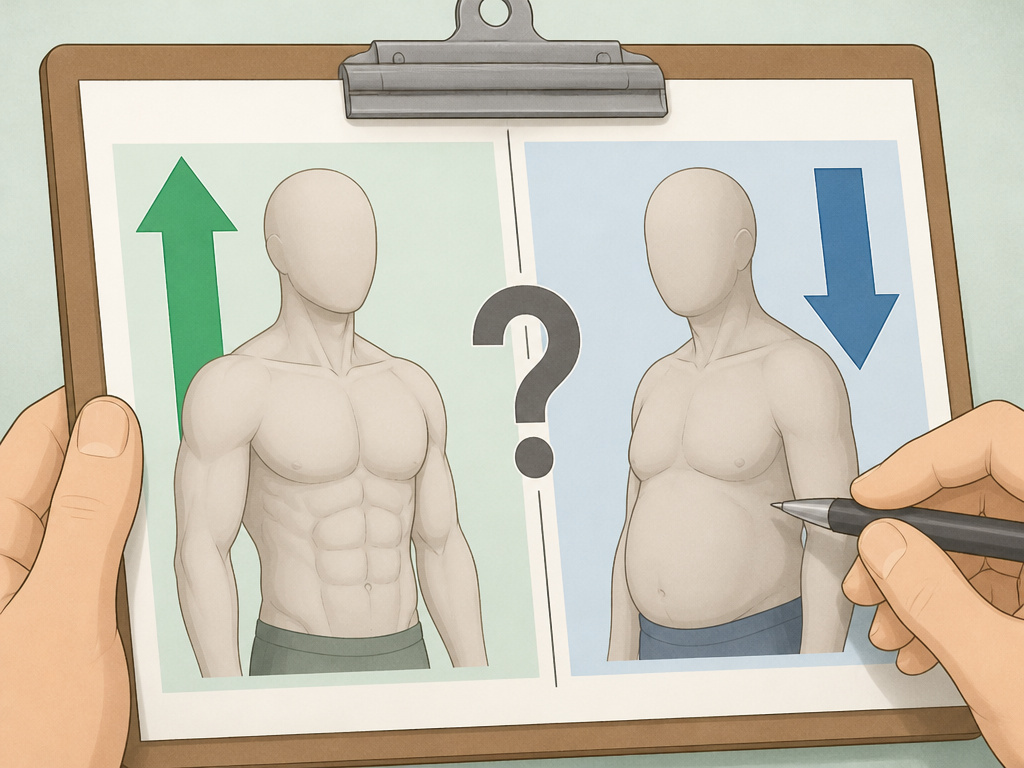
The conflicting research starts to make sense when you filter it by age and the type of PE a man has. The Corona et al. (2008) data, cited in the Nature Reviews Urology article, paints a clear spectrum: higher TT and FT levels in their youngest subjects (25-40 years) with PE, and lower TT and FT in the oldest group (55-70) with delayed ejaculation.
This aligns with the natural decline of testosterone with age. It also suggests testosterone’s role isn’t static. In a young man with a robust hormonal system, elevated free testosterone might contribute to heightened sexual arousability and a hair-trigger reflex. In an older man, declining testosterone is more often linked to a loss of desire and difficulty reaching climax.
The subtype of PE is the other critical filter. The 2019 study that found success with testosterone replacement therapy specifically enrolled men with secondary PE and testosterone deficiency. This is a key distinction from lifelong PE. Secondary PE is acquired, often later in life, and is more frequently associated with other health changes like declining hormones, the onset of erectile dysfunction, or psychological stress. In this context, low testosterone might be one piece of a larger puzzle causing new-onset ejaculatory trouble.
Bottom line: A 25-year-old with lifelong PE and a 55-year-old with newly developed PE likely have completely different hormonal profiles. The question “Does testosterone affect PE?” needs a follow-up: “Whose testosterone, and what kind of PE?”
What This Means for Testing and Treatment
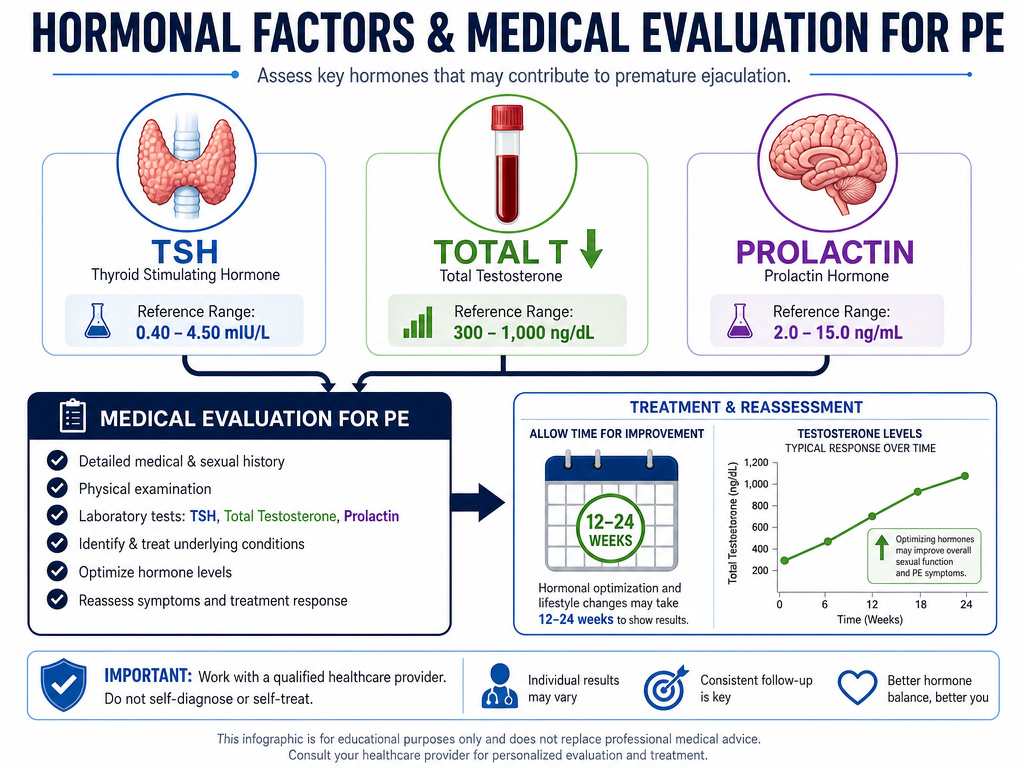
So you’re dealing with premature ejaculation. Should you get your testosterone checked? The answer is maybe, but not in isolation.
A rational approach starts with a medical evaluation to rule out clear causes like thyroid dysfunction, which has a stronger evidence base. A basic hormonal panel would include:
- TSH (for thyroid function)
- Total Testosterone (morning draw)
- Prolactin (to rule out a pituitary issue)
If your total testosterone comes back low (< 350 ng/dl), it’s worth a discussion with your doctor. It could be relevant, especially if you have secondary PE and other symptoms like low energy. The framework doctors use for this conversation is provided in the AUA/SMSNA Guideline on ejaculatory disorders.
If treatment for low testosterone is begun, patience is required. The Kucukdurmaz study notes that normalizing T values in hypogonadal men improves libido and erectile function, but it may take 12-24 weeks before the effects become evident. This isn’t a quick fix. Your body needs time to adjust to the new hormonal milieu.
It’s also crucial to understand the limits. Testosterone therapy is not an FDA-approved treatment for PE. Its potential use is off-label and targeted. A PubMed study on testosterone replacement therapy showed promise for the secondary PE/low T group, but that’s a specific subset. For the majority of men with PE, first-line treatments will be behavioral (like the start-stop technique) or pharmacological (like off-label SSRIs).
Furthermore, the decision to start TRT is significant. It commits you to ongoing therapy, requires monitoring, and has potential side effects. It should not be undertaken lightly or solely for the hope of fixing PE without clear evidence of deficiency and a full understanding of the benefits and risks of TRT.
Frequently Asked Questions
Can treating low testosterone cure premature ejaculation?
There is no guarantee. If a blood test confirms low testosterone, treatment may improve overall sexual desire and function, which could indirectly help with ejaculatory control. However, improvements can take several months to become noticeable. It is not considered a direct or FDA-approved cure for PE.
Should I ask my doctor for a testosterone test if I have PE?
Current medical guidelines do not strongly recommend routine testosterone testing specifically for premature ejaculation. A doctor is more likely to screen for other factors, such as thyroid function, first. They may check your levels if you have other symptoms suggestive of low testosterone or if initial treatments for PE are ineffective.
Why is there so much confusion about testosterone’s role?
The research shows conflicting results because premature ejaculation is not one single condition. Studies often examine different groups, such as younger men with lifelong PE versus older men with acquired PE, and find opposite hormonal patterns. This suggests testosterone is a background factor that interacts with age and other health issues, not a simple on/off switch.
If my testosterone is high, could that be causing my PE?
Some research has linked higher free testosterone levels to a more facilitated or rapid ejaculatory reflex. However, this is just one potential contributing factor among many, including psychological and neurological components. A high level alone is not a definitive diagnosis for PE and does not point to a standard hormonal treatment.
Before You Go
The link between testosterone and premature ejaculation is a classic example of a medical question that resists a simple yes or no. The evidence points in two directions because we’re likely looking at two different problems that share a name.
If you’re seeking answers, push your evaluation beyond a single hormone test. Insist on a check of your thyroid. Be clear about your history, is this lifelong or new? And manage expectations: even if low testosterone is a contributing factor and you choose to treat it, the timeline for seeing a change in sexual function is measured in months, not weeks.
The most practical step is to see a doctor who understands sexual medicine. They can navigate these contradictions, order the right tests, and discuss all your options, from behavioral strategies to off-label medications, within the context of your complete health picture. Your hormonal profile is one piece of data, not the diagnosis.
