
Can Low Testosterone Cause Infertility?
This post contains affiliate links. As an Amazon Associate, we earn from qualifying purchases.
Yes, low testosterone can cause infertility, but not always directly. The link is more about a broken system than a single number. Infertility happens when low testosterone signals a disruption in the brain’s hormonal command chain (the HPG axis), which starves the testes of the signals needed to make healthy sperm. A 2022 study in Fertility and Sterility found men with unexplained infertility and low total testosterone (<264 ng/dL) had poorer sperm morphology and lower live birth rates even when their sperm count was otherwise normal. Crucially, treating low testosterone with replacement therapy (TRT) almost always worsens fertility by shutting down this natural system entirely.
That gap between the lab value and the system’s health is where most confusion lives. A low number might be the symptom of a bigger problem, not the cause itself. A common question is can low testosterone cause infertility.
What follows: the specific hormone chain that breaks, why TRT is a fertility dead-end, the three medication paths that can work, and the real-world recovery timelines if you’ve already started testosterone.
Key Takeaways
- Low testosterone is often a symptom of a disrupted HPG axis, not the root cause of infertility. The brain’s signals (LH and FSH) are what actually drive sperm production.
- Testosterone Replacement Therapy (TRT) is contraceptive. Exogenous testosterone suppresses the HPG axis, crashing intratesticular testosterone and sperm production. A WHO Task Force study using 200 mg testosterone enanthate weekly led to azoospermia in 65% of men within about 120 days.
- Recovery is possible but not guaranteed. After stopping TRT, median time to recover sperm density >20 million/mL is 3.7 months, but a 2018 clinical study found 30% of men did not recover adequate sperm counts within a year, especially if older or on TRT longer.
- Fertility-friendly treatments exist. Medications like clomiphene (Clomid), hCG, and aromatase inhibitors can raise endogenous testosterone and sperm counts by stimulating the body’s own production system.
- Get a semen analysis first. You cannot guess sperm health from a testosterone level. A basic semen analysis and hormone panel (total/free T, LH, FSH) are the mandatory starting point before any treatment talk.
The Hormone Chain Reaction: How Low T Disrupts Sperm Production
The relationship isn’t a simple volume knob. Think of it as a three-part factory. Your hypothalamus (the CEO) sends GnRH to the pituitary (the manager), which then releases LH and FSH (the work orders) to the testes. LH tells Leydig cells to make testosterone, and FSH tells Sertoli cells to nurture developing sperm, which is central to the can low testosterone cause infertility question.
Low serum testosterone is often a downstream signal that this command chain is broken. The problem isn’t just the testosterone level at the end; it’s that the work orders (LH and FSH) have gone missing or are being ignored, which stalls the entire production line.
When the system is healthy, high intratesticular testosterone, which is much higher than blood levels, is what powers spermatogenesis. If the brain senses enough testosterone in the blood, it dials back LH and FSH to maintain balance. But if the testes themselves fail (primary hypogonadism), LH and FSH spike as the brain shouts louder to a broken factory. If the brain or pituitary fail (secondary hypogonadism), LH and FSH are low, and the factory sits idle with no orders.
This is why the LH and FSH numbers on your lab report matter more than your total T for figuring out the “why.” Low T with high LH points to testicular failure. Low T with low or normal LH points to a brain/pituitary issue, a key distinction when you compare a can low testosterone cause infertility scenario.
Why Testosterone Replacement Therapy (TRT) Is a Fertility Dead-End
This is the most critical misunderstanding. Taking exogenous testosterone, gels, injections, pellets, to fix low levels directly causes infertility. It’s not a side effect; it’s the mechanism.
Your brain is excellent at sensing testosterone. When you add it from the outside, the brain thinks the job is done. It shuts down production of GnRH, which in turn collapses LH and FSH output. With no LH signal, intratesticular testosterone plummets. A NIH PMC article on exogenous testosterone notes this can suppress intratesticular testosterone to <20 ng/mL, a level where sperm production grinds to a halt.
The WHO Task Force literally studied this for male contraception. Their data shows that 200 mg of testosterone enanthate weekly led to azoospermia (zero sperm) in 65% of men after about 120 days. Sperm concentration under 3 million/mL was their threshold for effective contraceptive action.
Common mistake: Using TRT while trying to conceive. A survey cited in the Canadian Urological Association guideline found roughly 25% of urologists would still prescribe it to infertile men. The CUA itself gives this a Grade A recommendation against it.
The takeaway is absolute. As stated in an NIH contraceptive testosterone warning, “Testosterone is a contraceptive and should not be used in men who desire fertility.” If a clinic offers you TRT for fertility, walk out.
Fertility-Friendly Treatment Options: Clomid, hCG, and Aromatase Inhibitors
If TRT shuts down the system, these medications work by stimulating it. They are the tools reproductive urologists and endocrinologists use to boost both testosterone and sperm counts simultaneously.
| Medication | How It Works | Best For | Key Consideration |
|---|---|---|---|
| Clomiphene (Clomid) | Blocks estrogen receptors in the brain, tricking it into releasing more GnRH → LH/FSH → T. | Men with secondary hypogonadism (low LH/FSH). Non-invasive, oral medication. | Can sometimes raise estrogen too much, requiring monitoring. Doesn’t work if the pituitary is damaged. |
| Human Chorionic Gonadotropin (hCG) | Mimics LH directly, stimulating Leydig cells to produce testosterone inside the testes. | Preserving fertility during TRT (as an add-on) or for standalone stimulation. Injects subcutaneously. | More expensive, requires injections. May not fully mimic FSH, so sperm maturation can be incomplete alone. |
| Aromatase Inhibitors (e.g., Anastrozole) | Blocks the conversion of testosterone to estrogen. Lower estrogen signals the brain to produce more LH/FSH. | Men with a high testosterone-to-estradiol ratio (symptoms of low T but normal/high total T). | Not a first-line monotherapy. Used off-label; requires careful monitoring to avoid crashing estrogen. |
My rule is to write down the start date for everything new. I learned this after trying a short course of an over-the-counter aromatase inhibitor from a supplement brand. My total T number went up on a follow-up test, but I felt worse, achy joints, low mood. I hadn’t tracked the start date or gotten an estradiol test first. Turns out I’d likely overshot and crashed my estrogen, which is just as bad for libido and well-being. Change one thing at a time, and always measure the right thing.
Clomid is often the first-line oral agent because it’s well-studied and kickstarts the body’s entire natural pathway. HCG is more direct but also more hands-on. The choice isn’t yours to make alone; it’s a discussion with a specialist who can interpret your full hormone panel. These are powerful fertility-preserving alternatives to TRT, but they are prescription medications, not supplements.
The Recovery Timeline: What If You’ve Already Taken Testosterone?
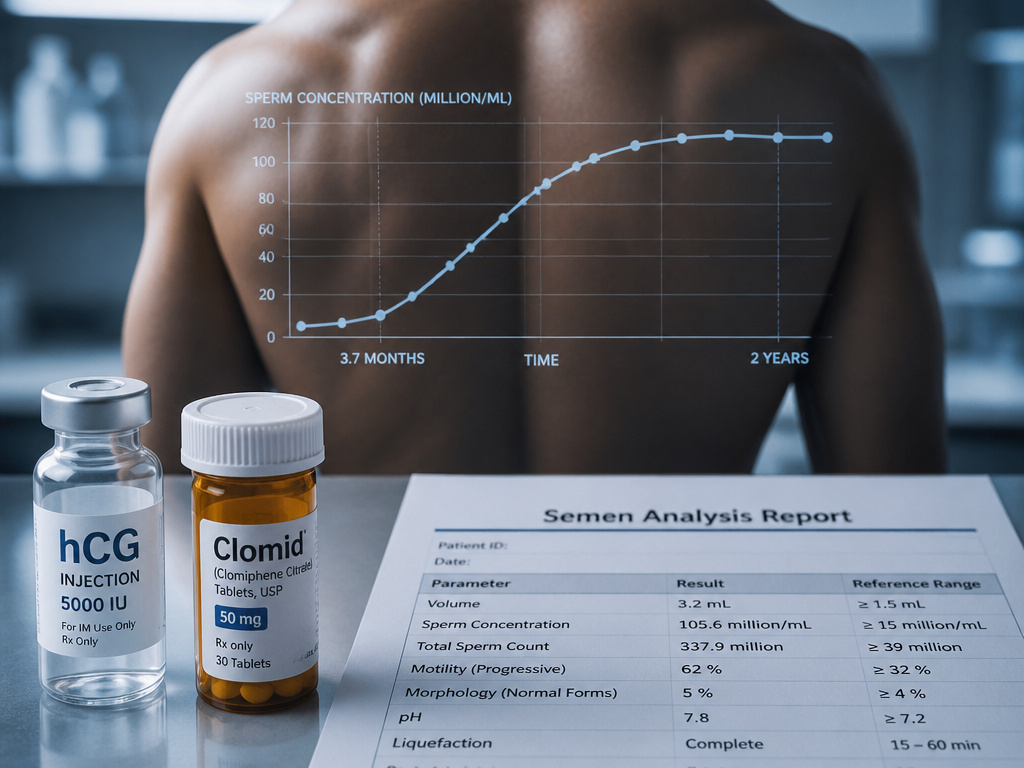
Stopping TRT is the necessary first step, but the path back is variable. The optimistic data comes from controlled trials. The sobering data comes from clinical practice.
The WHO studies show a median recovery time (sperm density >20 million/mL) of 3.7 months after stopping, with 84% of men reaching that threshold. They state that all men eventually recovered to baseline.
However, a 2018 clinical study (Kohn et al.) found that 30% of 66 men previously on testosterone therapy did not achieve a total motile sperm count >5 million after 12 months of recovery efforts with hCG/SERMs. Failure was linked to older age and longer duration of TRT.
Where this goes sideways: Assuming fertility will bounce right back. For some men, it takes 3-4 months. For others, it can take up to 2 years. This highlights a gap between controlled trial outcomes, such as those from WHO studies reporting high recovery rates, and real-world clinical practice, such as the Kohn et al. Study which found 30% did not recover adequately within a year.
The process to restore fertility after TRT typically involves stopping exogenous testosterone and often using the same stimulatory medications (Clomid, hCG) to jump-start the HPG axis. This isn’t a DIY project. It requires a specialist’s oversight, repeated semen analyses every 3 months, and patience.
Diagnosis First: What Tests You Actually Need
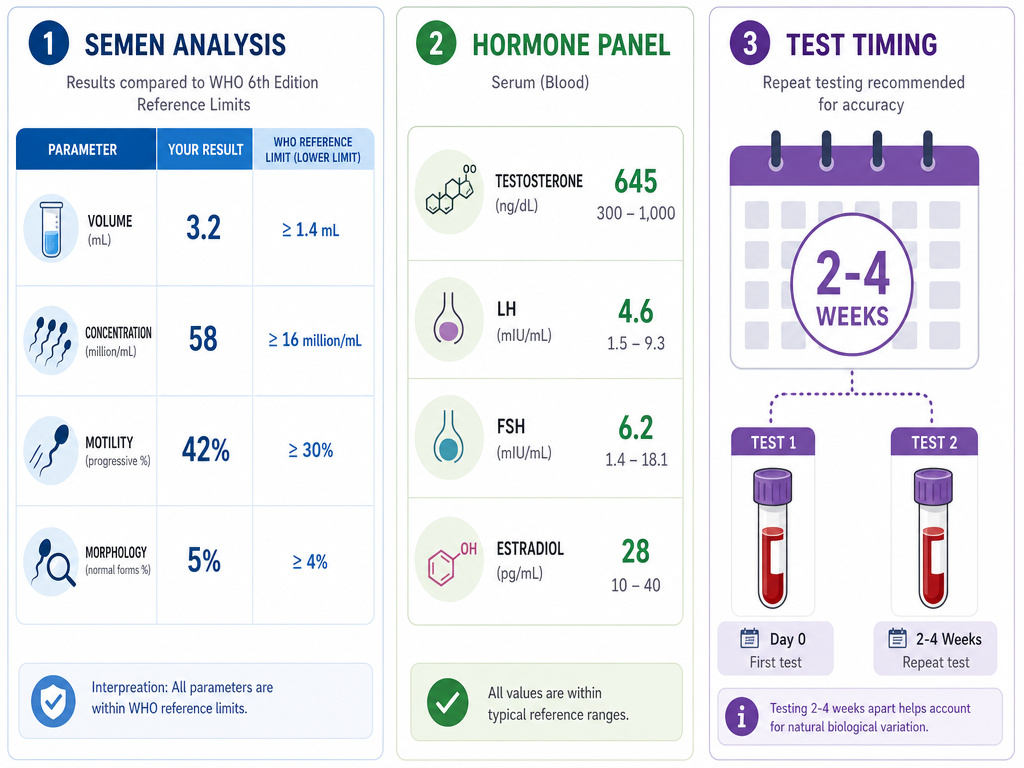
Before you consider any treatment, you need a map. Guessing based on symptoms or a single testosterone test is how men waste years.
- Semen Analysis: This test is essential. You cannot infer sperm health from a hormone level. This test measures volume, concentration, motility (movement), and morphology (shape). The WHO reference limits are: volume <1.5 mL, concentration <15 million/mL, motility <40%, and strict morphology <4%.
- Hormone Panel: Get this drawn in the morning, fasted. You need more than just total testosterone.
- Total & Free Testosterone: The raw amount and the biologically active portion.
- Luteinizing Hormone (LH) & Follicle-Stimulating Hormone (FSH): These tell you why testosterone is low.
- Estradiol (E2): Important for libido and bone health; needed if considering aromatase inhibitors.
- Prolactin & TSH: To rule out other pituitary or thyroid issues.
- Repeat the Test: Hormones fluctuate. A single low test should be confirmed with a second draw 2-4 weeks later before any diagnosis is set in stone.
This baseline is what separates a targeted plan from a shot in the dark. It reveals if you’re dealing with a cause of male infertility like a varicocele (which often shows a specific pattern) or a purely hormonal issue.
Navigating the Healthcare System: Who to See and When
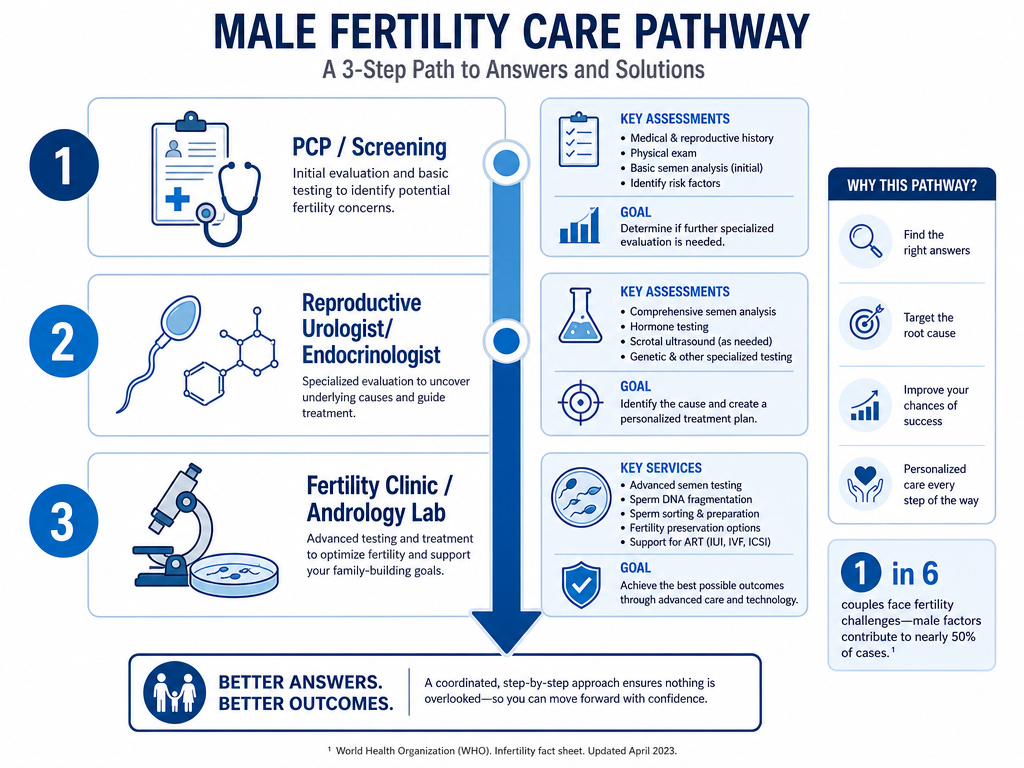
You have symptoms. You’re worried about fertility. Where do you start? The pathway matters because the wrong door can lead to the wrong solution.
- Primary Care Physician (PCP): A logical first step. They can order initial blood work (testosterone, LH, FSH) and a semen analysis referral. Their role is screening and referral. Many are not deeply versed in the nuances of TRT and infertility, so be prepared to advocate for a specialist referral if fertility is a priority.
- Reproductive Urologist or Endocrinologist: This is the gold-standard destination. A reproductive urologist is a surgeon who specializes in male fertility and hormone issues. An endocrinologist specializes in hormonal systems. Either can interpret complex hormone panels, manage stimulatory medications, and provide care aligned with the latest ASRM/AUA male infertility guideline.
- Fertility Clinic (Andrology Lab): For the semen analysis and advanced sperm function testing. They work closely with reproductive urologists.
If your PCP is hesitant to refer you, come prepared. Say, “I have low energy and low libido, and we’re trying to conceive. I’d like a full hormone panel and a semen analysis to rule out correctable causes before considering any treatment.” That frames it as a joint investigative mission.
Lifestyle and Foundational Health
Medications address the hormonal engine. Lifestyle protects the fuel and the machinery. No pill can fully overcome the damage of chronic poor health.
- Weight Management: Obesity increases estrogen conversion and can suppress LH. Significant weight loss can reverse obesity-related hypogonadism.
- Sleep Quality: Chronic sleep deprivation crushes testosterone. Aim for 7-8 hours of quality, uninterrupted sleep. Sleep apnea is a major and treatable cause of low T.
- Heat Exposure: The testes are outside the body for a reason, they need to be cooler. Avoid hot tubs, saunas, and tight underwear for prolonged periods, especially if sperm parameters are already borderline.
- Toxin & Medication Review: Discuss all medications with your doctor. Some, like opioids, certain antidepressants, and steroids, can suppress the HPG axis. Minimize exposure to environmental toxins like pesticides and heavy metals when possible.
- Nutrient Status: Deficiencies in zinc, vitamin D, and folate can impair sperm production. However, get tested before supplementing blindly. More is not better; excess zinc can cause copper deficiency.
These steps don’t just support hormone levels; they improve overall sperm quality. They are the bedrock. A peer-reviewed testosterone infertility link study in an IUI population still found lifestyle and environmental factors at play alongside hormonal ones.
Frequently Asked Questions
Can you get pregnant if a man has low testosterone?
Yes, pregnancy is possible, but the chances are reduced. It depends on the severity of the sperm production issue. Some men with low testosterone still produce enough viable sperm for conception, especially if the cause is recent or mild. However, associated poor sperm quality lowers the odds. A semen analysis is the only way to know your current fertility status.
Does high testosterone mean high fertility?
Not necessarily. While adequate testosterone is essential, very high levels, especially from exogenous sources like TRT or anabolic steroids, suppress sperm production and cause infertility. Natural, endogenous high testosterone within a normal range is generally positive, but fertility is a separate measure that requires a semen analysis.
How long after stopping TRT can you conceive?
There is no universal timeline. While median recovery to good sperm density is 3-4 months, it can take up to 2 years. A significant minority of men may not fully recover. You must stop TRT and confirm the return of adequate sperm production via serial semen analyses before assuming you are fertile. Planning should involve a specialist.
What are the first signs of low testosterone affecting fertility?
There often aren’t direct early signs. The first clues are usually the symptoms of low T itself: low libido, erectile dysfunction, fatigue, and reduced muscle mass. Infertility itself is typically “silent” until a couple has trouble conceiving. This is why evaluating both hormones and semen is crucial if you have low T symptoms and want children.
Are testosterone boosters safe for fertility?
Over-the-counter “testosterone booster” supplements are generally ineffective for significantly raising testosterone and their impact on sperm is unknown. More critically, they can be dangerous if they contain unlisted ingredients that mimic hormones or suppress your HPG axis. They are not a safe or evidence-based solution for fertility-related low T.
Before You Go
The single most important action you can take is to get a semen analysis. You cannot feel sperm count or quality. That test, paired with a hormone panel, turns a vague worry into a specific, addressable problem.
If you’re currently on testosterone therapy and want fertility, understand that stopping is step one. The recovery path is longer and less certain than many clinics admit, but working with a reproductive urologist gives you the best shot. The evidence from the JAMA Network men’s infertility guidelines is clear: the system needs to be stimulated, not replaced.
Finally, the relationship between low T and infertility is more about signaling than substance. Fixing the underlying communication error in your HPG axis, whether with medication, lifestyle, or both, is what restores both your vitality and your potential to conceive. Start with the tests, not the treatments.
