
Does Insurance Cover Testosterone Testing?
This post contains affiliate links. As an Amazon Associate, we earn from qualifying purchases.
Yes, health insurance often covers testosterone testing, but only under strict conditions: you must have specific symptoms, a doctor must deem it medically necessary, and the test must be for a condition your plan accepts. Asymptomatic screening or wellness checks are almost never covered.
That “medically necessary” clause is the whole game when you ask does insurance cover testosterone testing. It’s not a suggestion; it’s a contract term insurers use to decide what they pay for. The policies I’ve read, from Blue Cross, UnitedHealthcare, state Medicaid programs, all draw the line at documented symptoms tied to a covered diagnosis.
What follows is a breakdown of those rules, the specific scenarios insurers will pay for, the exact codes your doctor needs to use, and what to do when the claim comes back denied. This isn’t about hoping for coverage. It’s about understanding the system well enough to navigate it.
Key Takeaways
- Insurance covers testing only for specific, symptomatic conditions like hypogonadism or PCOS; asymptomatic “wellness” checks are routinely denied.
- You typically need multiple blood draws for an initial diagnosis, but the specific protocol varies: Blue Cross Blue Shield of Illinois requires two measurements at least 24 hours apart, while UnitedHealthcare’s community plan allows one measurement per day, not to exceed two calendar days.
- For men on testosterone therapy, the frequency of covered testing during the first year varies by insurer: Blue Cross Blue Shield of Illinois and CareSource allow every 2-3 months, Blue Cross North Carolina allows every 3-6 months, and UnitedHealthcare Community Plan allows no more than once every 60 days. Check your specific plan’s frequency limits.
- Saliva tests are generally not covered; for example, Blue Cross North Carolina considers them investigational and CareSource states they do not meet coverage criteria. The CDC HoSt Program certifies blood-based assays for accuracy.
- Always verify that the lab used is in-network and that your doctor submits the correct CPT and ICD-10 codes, or you risk a surprise bill.
The 3 Non-Negotiable Rules for Insurance Coverage
Forget what the supplement ads say. Insurance doesn’t pay for curiosity. It pays for diagnosis and management of recognized medical conditions. Every coverage policy I’ve dug into hinges on three pillars.
Symptom-Driven Medical Necessity: Coverage requires evaluation of specific symptoms like unexplained fatigue, low libido, or signs of androgen excess. Asymptomatic screening does not meet this standard.
First, you need symptoms. This is the biggest point of failure. The Blue Cross Blue Shield of Illinois policy states it plainly: testing for “asymptomatic individuals or for individuals with non-specific symptoms” is not reimbursable. “Non-specific symptoms” is insurer-speak for feeling generally tired or off, which describes most adults some of the time. To pass this gate, your doctor’s notes must link your request to a specific clinical guideline, like those from the Endocrine Society for evaluating androgen deficiency.
Second, the test must be for an “accepted condition.” This is clearest in workers’ comp cases but applies broadly. The Washington State Department of Labor & Industries guide states testing “may be used only for care of a condition accepted on the claim.” For private insurance, this means your diagnosis code (ICD-10) must match a covered indication in your plan’s medical policy. A code for “fatigue” might not cut it; “hypogonadism” or “polycystic ovary syndrome” likely will.
Third, you must follow the correct testing protocol. Insurers don’t just pay for a test; they pay for a specific, ordered series of tests. The most common rule: start with total testosterone. The BCBSIL policy is explicit: “Measurement of serum free testosterone… As a primary test… Is not reimbursable.” You must have a total testosterone result first. If it’s low or borderline, then a free testosterone calculation may be covered. Jumping straight to a free or bioavailable test is a sure way to get a denial.
When Insurance Will Say Yes: The Covered Scenarios
Insurer policies read like legal documents because they are. The covered scenarios are listed with precise, conditional language. Here’s what they actually mean for you.
For Symptomatic Men (Androgen Deficiency or Excess)
This is the most common path. If you have symptoms like low energy, reduced muscle mass, or erectile dysfunction, a doctor can order an initial screening. The protocol for initial screening varies: Blue Cross Blue Shield of Illinois requires two measurements at least 24 hours apart, while UnitedHealthcare’s community plan allows one measurement per day, not to exceed two calendar days. If those initial results are normal but symptoms persist, some policies, like those from Blue Cross Blue Shield of Illinois and UnitedHealthcare, mandate a waiting period of no sooner than 60 days before follow-up testing is covered.
For Men on Testosterone Replacement Therapy (TRT)
If you’re on therapy, monitoring is mandatory and covered. But the frequency varies by insurer. This is a key area of disagreement in the source documents. It’s not a minor detail; getting tested too often can lead to a denial.
| Insurer / Plan | Frequency During First Year of TRT | Frequency After First Year |
|---|---|---|
| Blue Cross Blue Shield of Illinois | Every 2-3 months | Annually |
| Blue Cross North Carolina | Every 3-6 months | Annually |
| UnitedHealthcare Community Plan | No more than once every 60 days | Not specified (implies ongoing monitoring) |
| CareSource (Avalon HCS) | Every 2-3 months | Annually |
Your doctor’s office will usually know the common rhythm for your insurer, but it’s worth checking your plan’s specific clinical policy. The insurance coverage for TRT has its own, often stricter, set of rules.
For Gender-Affirming Hormone Therapy
This is explicitly covered under several policies. BCBSIL, Blue Cross North Carolina, UnitedHealthcare, and CareSource all list coverage for “gender-dysphoric/gender-incongruent persons” for baseline testing, during treatment, and for therapy monitoring. For transgender men on testosterone, Blue Cross North Carolina notes that the Endocrine Society suggests measurement every 3 months until levels are in the normal physiologic male range. This is a defined clinical pathway, so using the correct diagnosis codes is critical.
For Symptomatic Women (Androgen Excess)
Women with symptoms of conditions like PCOS can also get coverage. BCBSNC states testing is medically necessary “in symptomatic females being evaluated for conditions associated with androgen excess.” The key word is “symptomatic”, things like hirsutism or menstrual irregularities. Crucially, the same policy states testing for “the identification of androgen deficiency in women” is not medically necessary. Insurance does not cover testosterone testing for low libido in women as a standalone diagnosis.
The Roadblocks: Common Reasons for Denial (and How to Appeal)
Denials are frustrating but rarely random. They’re a mismatch between the claim submitted and the insurer’s protocol. Here are the usual suspects.
Denial #1: “Not Medically Necessary”
This is the big one. It means the insurer’s reviewer didn’t see enough evidence in the chart notes to justify the test. The fix happens before the test is even drawn. When you talk to your doctor, be specific about your symptoms and their duration. “I’ve had low energy and zero libido for six months despite sleeping eight hours” is better than “I’m tired.” Your doctor should document this clearly and link it to a covered diagnosis code.
Denial #2: Incorrect Coding
This is a billing issue, not a medical one. The lab or your doctor’s office used a CPT procedure code or ICD-10 diagnosis code that doesn’t align. For a simple total testosterone test, the CPT code is typically 84403. Using the wrong code, or a diagnosis code that’s too vague (like R53.83 for fatigue), can trigger an auto-denial. If you’re denied, ask your doctor’s billing office to verify the codes they used against your insurer’s policy.
Denial #3: Frequency Limits Exceeded
If you had a test two months ago and your doctor orders another one, it may be denied unless there’s a documented reason, like a significant dosage change. The frequency limits in the table above are hard limits. An appeal here needs a clinical note explaining why more frequent testing is essential, for example, “patient started on new transdermal testosterone formulation, requiring titration check.”
The Appeal Process
Don’t just pay the bill. If you get a denial, call your insurer and ask for the exact reason. Get the clinical policy number they referenced. Then, work with your doctor to write a “letter of medical necessity.” This letter should restate your symptoms, the relevant clinical guidelines, and why the test is essential for your care. Submit this with the appeal. It often works. For a deeper look at the clinical side, our guide outlining who qualifies for testosterone therapy details the diagnostic criteria doctors use.
How Much Does a Testosterone Test Cost Without Insurance?
If you don’t have coverage, or you want to avoid the hassle, you can pay cash. The price depends entirely on where you go.
Going through a primary care doctor who sends your blood to a major lab like Labcorp or Quest Diagnostics will be the most expensive cash route, with prices varying widely for a total testosterone test. A full male hormone panel with LH, FSH, and SHBG can be significantly more expensive than a single testosterone test.
The cheaper path is a direct-to-consumer lab service. Companies like QuestDirect or Labcorp OnDemand let you order tests online without a doctor’s visit. A total testosterone test through direct-to-consumer lab services is often less expensive than going through a doctor’s office. You pay online, get a lab requisition, and go to a local patient service center.
The cheapest option is often a membership-based platform like Function Health or InsideTracker, where a monthly or annual fee includes a set of lab tests. If you plan on testing more than once a year, this can bring the per-test cost down significantly.
Common mistake: Assuming an at-home saliva test kit is a cheaper alternative. Not only are they unreliable for testosterone, but their results are also not accepted by physicians for diagnosis, making them a dead-end expense.
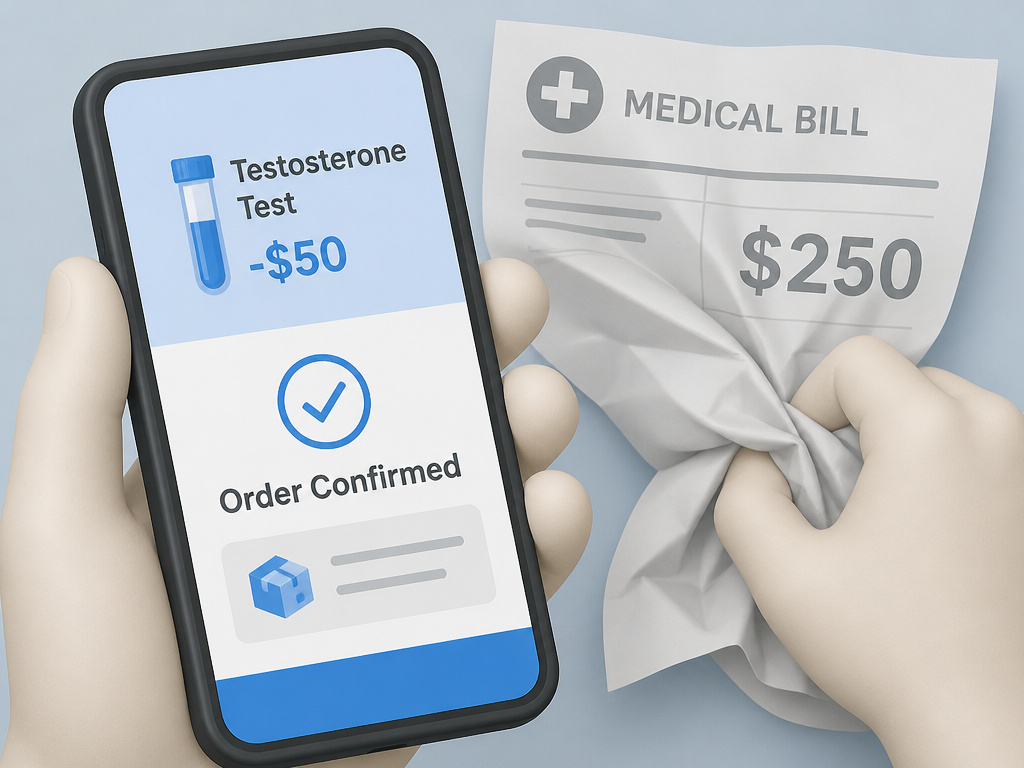
The bottom line on cost: if you have insurance and meet medical necessity, use it. If you don’t, shop around. A $50 direct-order test from a certified lab provides the same data as a $250 test billed through a clinic. For a full walkthrough of the self-order process, see our resource on getting a testosterone test without a doctor.
The Nuts and Bolts: CPT Codes, Labs, and Prior Authorization
This is the unsexy, practical layer that decides whether your claim gets paid. Ignore it at your own financial peril.
Essential CPT Codes
These are the billing codes for the tests themselves. Your doctor or lab uses them.
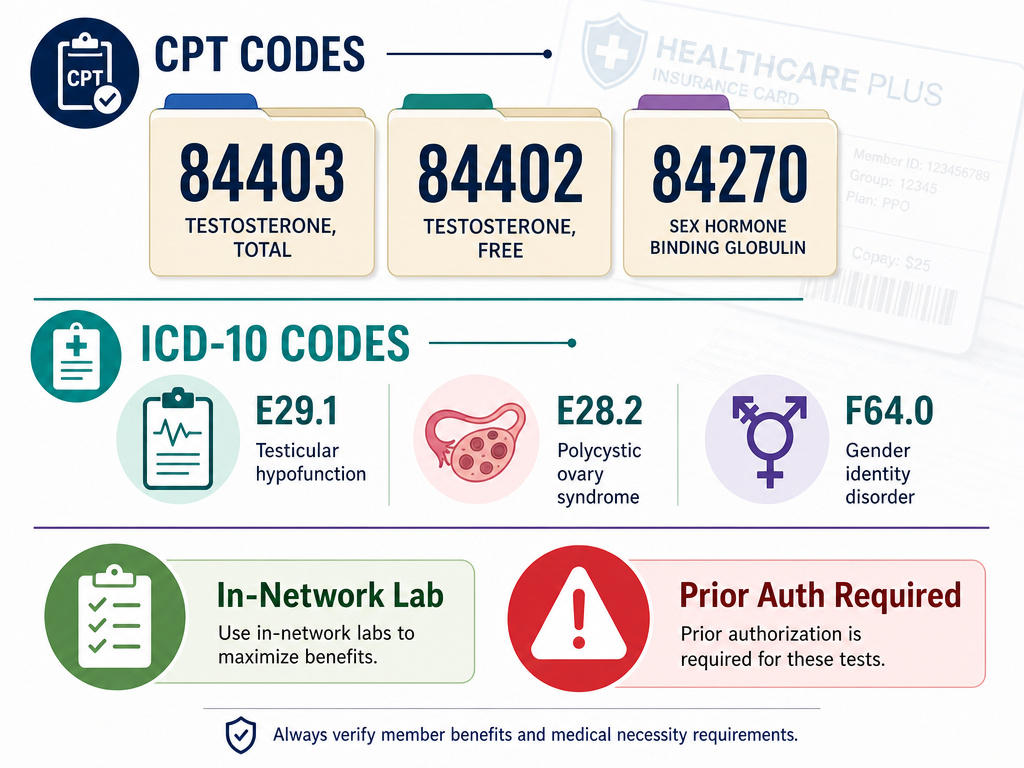
- 84403: Total testosterone (the usual first test)
- 84402: Free testosterone (usually only covered if total T is low first)
- 84270: Sex hormone-binding globulin (SHBG)
Crucial ICD-10 Codes
These are the diagnosis codes that justify why the test is needed. They must align with covered scenarios.
- E29.1: Testicular hypofunction (male hypogonadism)
- E28.2: Polycystic ovary syndrome (PCOS)
- F64.0: Gender dysphoria
Lab Network Status
This is critical. Even if everything is coded correctly, if the blood draw is done at an out-of-network lab, you could be balance-billed for the full amount. Always ask: “Is this lab in-network for my plan?” When you get a testosterone blood test ordered, you can often choose which lab to use. Call your insurer or check their online provider directory to confirm.
Prior Authorization
Prior authorization requirements vary. For example, the Washington State Department of Labor & Industries requires prior authorization for all testosterone testing, while other insurers may have different pre-approval processes. Your doctor’s office handles this. If they don’t, and it was required, the claim will be denied. Always ask your doctor, “Does my plan require prior auth for this?” It’s a simple question that can save hundreds.
Frequently Asked Questions
How can I get my insurance to cover a testosterone test?
You need a doctor to order it based on specific symptoms that suggest a covered condition like hypogonadism. Schedule an appointment, clearly describe your symptoms (low energy, low libido, etc.), and ask if testing is appropriate. Your doctor must use the correct diagnosis and procedure codes when submitting the order to the lab.
What is the difference between a covered test and an at-home test kit?
Covered test is a blood draw performed at a clinical lab (like Labcorp or Quest) following a doctor’s order, billed to your insurance. An at-home kit is usually a saliva or finger-prick blood sample you mail to a lab, paid for out-of-pocket. Crucially, most insurers do not cover at-home kits, and many doctors question the accuracy of at-home testosterone tests.
Will insurance cover testosterone testing for low libido?
For men, yes, if low libido is part of a cluster of symptoms leading to an evaluation for androgen deficiency. For women, no. Major insurer policies, like BCBSNC’s, explicitly state testing for androgen deficiency in women is “not medically necessary.” Low libido in women is rarely attributed to low testosterone alone in standard clinical guidelines.
How often will insurance pay for testosterone tests on TRT?
It depends on your insurer, but a typical pattern is every 2-3 months during the first year of therapy, then once a year for stable patients. Always refer to your plan’s specific clinical policy. Regular blood work for testosterone replacement therapy (TRT) is required for safety, so this coverage is standard.
What if my insurance denies the test?
First, get the specific reason for the denial from your insurer. Then, ask your doctor to submit an appeal with a “letter of medical necessity” that details your symptoms, the applicable clinical guidelines, and why the test is essential. Many denials are overturned on first appeal. If you pay cash, keep the receipt; you can sometimes apply it to your deductible.
Before You Go
Insurance coverage isn’t a mystery. It’s a set of published rules. The single most important thing you can do is move the conversation with your doctor from “I’d like a test” to “Here are my symptoms, which align with condition X, and I believe testing is medically necessary per guideline Y.”
If you get a denial, appeal it. A well-documented appeal referencing the insurer’s own clinical policy works more often than people think. And if you choose to pay cash, know that you have options far cheaper than the hospital lab’s sticker price. The goal is the data, the number that tells you what’s actually happening. Whether you use insurance or not, that number is worth getting right.
Start with a doctor’s visit. Document your symptoms. Know the codes. That’s the sequence that gets you an answer, and often, gets the bill covered.
