
Can Low Testosterone Cause Anemia? Evidence and Treatment
This post contains affiliate links. As an Amazon Associate, we earn from qualifying purchases.
Yes, low testosterone can cause anemia. Older men and women with low bioavailable testosterone levels are 4.7 times (men) and 4.4 times (women) more likely to develop anemia over three years. For men with hypogonadism and unexplained anemia, testosterone replacement therapy (TRT) corrects the anemia in 58.3% of cases, compared to 22.2% on placebo. The link is strongest for unexplained anemia, where other common causes like iron deficiency have been ruled out.
That 4-5 times higher risk is a specific finding from a population-based study that followed people for years. The connection makes biological sense, as testosterone stimulates the bone marrow to produce red blood cells, which is why researchers ask: can low testosterone cause anemia? The clinical data is what turns a theory into a treatment pathway.
What follows: a breakdown of the peer-reviewed evidence, a clear look at how testosterone and anemia symptoms overlap (and where they don’t), the practical steps for diagnosis, and what the treatment data actually says about correcting low red blood cell counts.
Key Takeaways
- Older adults with the lowest bioavailable testosterone levels face a 4.7x (men) and 4.4x (women) higher risk of developing anemia over three years.
- In men with unexplained anemia and low T, testosterone replacement therapy (TRT) corrected anemia in 58.3% of cases within a year, versus 22.2% on placebo.
- The fatigue from anemia and low T fatigue feel identical, but anemia adds paleness, shortness of breath, and a rapid heart rate, especially with exertion.
- Always test for iron deficiency and other common causes first; low testosterone is often a contributing factor, not the sole culprit.
- TRT can also prevent new-onset anemia, with studies showing a lower incidence in treated men versus placebo over four years.
The Evidence: What the Research Shows
The data is documented in multi-year studies with clear thresholds and outcomes. I spent a year treating lab ranges as pass/fail lines before I learned to read the whole picture, symptoms, secondary hormones, and trends matter more than a single number hovering above a cutoff. The same principle applies here: the association between low T and anemia is about risk and mechanism, not a guaranteed one-to-one link.
A 2007 study published in the NIH archives provides the foundational risk data. Researchers followed 905 adults aged 65 and older for three years. At the start, 7.8% of men and 11.2% of women were anemic. Crucially, many of those anemic individuals had no other evident cause like iron or vitamin deficiency.
Technical Snippet: In a cohort of 396 men and 509 women aged ≥65, participants in the lowest quartile of bioavailable testosterone had a significantly elevated risk of developing anemia over a 3-year follow-up. Men were 4.7 times more likely (95% CI, 1.3–16.8), and women were 4.4 times more likely (95% CI, 1.7–11.2), compared to those in the higher three quartiles. The study concluded low testosterone should be considered a potential cause when other plausible causes are excluded.
The more recent and interventional data comes from the Testosterone Trials. This research involved men 65 or older with two confirmed testosterone readings averaging under 275 ng/dL. Men with baseline hemoglobin levels of 12.7 g/dL or lower were enrolled in the Anemia Trial. The results were striking for men whose anemia had no other explanation.
| Anemia Type | TRT Group Improvement (≥1.0 g/dL Hb) | Placebo Group Improvement | Adjusted Odds Ratio (TRT vs. Placebo) |
|---|---|---|---|
| Unexplained Anemia | 54% | 15% | 31.5 (95% CI, 3.7-277.8) |
| Anemia of Known Cause | 52% | 19% | 8.2 (95% CI, 2.1-31.9) |
The magnitude of the odds ratio for unexplained anemia, 31.5, is enormous. It suggests testosterone deficiency isn’t just a minor player in those cases; it’s often the central problem. Also, 58.3% of men with unexplained anemia on TRT were no longer anemic after 12 months, compared to 22.2% on placebo.
A 2023 analysis of a larger trial with 5204 men with hypogonadism confirmed the long-term benefit. For the men with anemia at the start, TRT consistently led to higher correction rates at every check-in over four years. Perhaps just as importantly, TRT prevented new anemia in men who started with normal levels, with a consistently lower incidence versus placebo at all time points.
How Low Testosterone Leads to Anemia
The link is a direct hormonal signal to your bone marrow, which is why the can low testosterone cause anemia question is so pertinent. Testosterone stimulates the kidneys to produce more erythropoietin (EPO), the primary hormone that tells your bone marrow to make red blood cells. It also appears to make the bone marrow progenitor cells more sensitive to EPO’s effects. Think of it like turning up the volume on the factory’s production orders and making the machinery more efficient.
When testosterone is chronically low, that signal weakens. Red blood cell production slows. Your body makes fewer red blood cells, and each cell lives its normal lifespan of about 120 days. The gradual drop in total red cell mass is what labs measure as low hemoglobin or hematocrit.
This is distinct from anemia caused by blood loss or nutrient deficiencies. In iron-deficiency anemia, the factory has the orders but lacks the raw material (iron) to build hemoglobin. In anemia of chronic disease, inflammation actively blocks the factory’s operations. Testosterone-related anemia is a problem with the production order itself.
Where this goes sideways: Assuming fatigue means low T and skipping a complete blood count (CBC). Anemia from any cause will crush your energy. Treating hypothetical low T without checking for anemia misses a treatable root cause that shares the same symptom.
Symptoms: Untangling Fatigue from Low T vs. Anemia
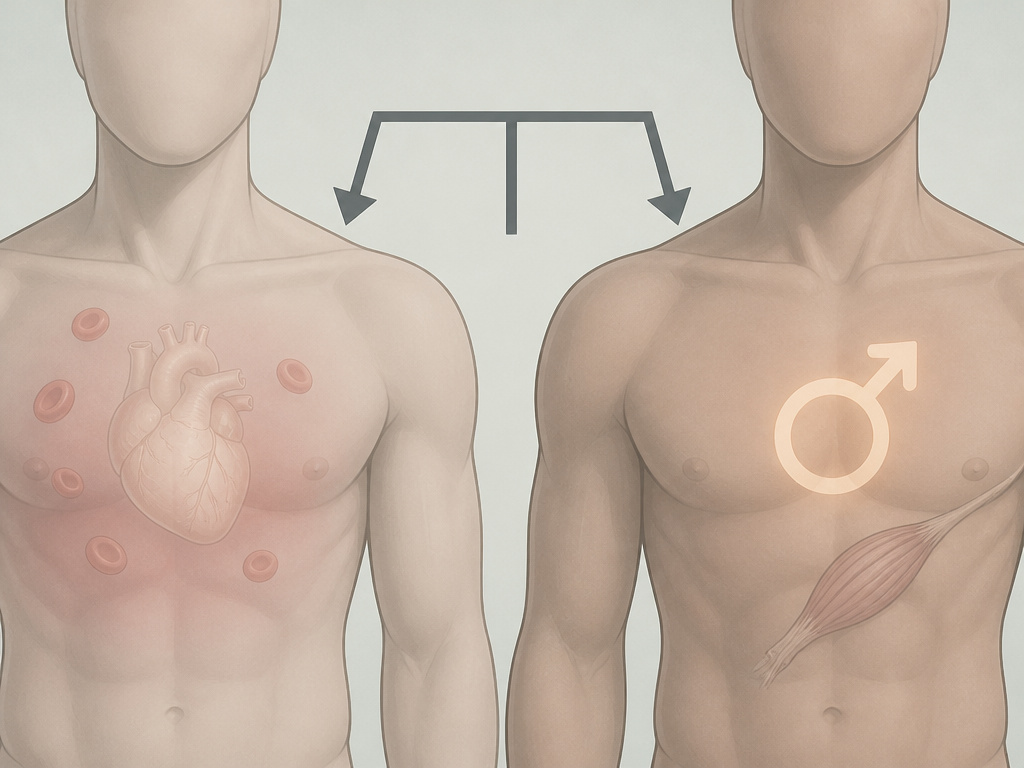
This is where people get stuck. The fatigue from low testosterone and the fatigue from anemia are functionally identical, a deep, persistent drain that sleep doesn’t fix. You can have both, one, or neither. Relying on symptoms alone is a guessing game.
However, anemia adds specific physical signs that pure low T usually doesn’t.
- Pale skin: Look at your inner eyelid or your fingernail beds. A healthy pink color is good. A pale, washed-out shade suggests lower red blood cell count.
- Shortness of breath: This happens with less exertion than usual, like climbing a flight of stairs.
- Rapid or irregular heartbeat: Your heart works harder to move fewer oxygen-carrying cells around your body.
- Dizziness or lightheadedness: Especially when standing up quickly.
Low T fatigue, on the other hand, often pairs with a specific loss of motivation or drive, changes in mood, reduced muscle mass, and sexual dysfunction. The overlap is in the tiredness; the differentiating clues are in these other signals. If your main complaint is crushing fatigue plus getting winded easily, the CBC is your first stop.
Diagnosis: The Tests You Actually Need
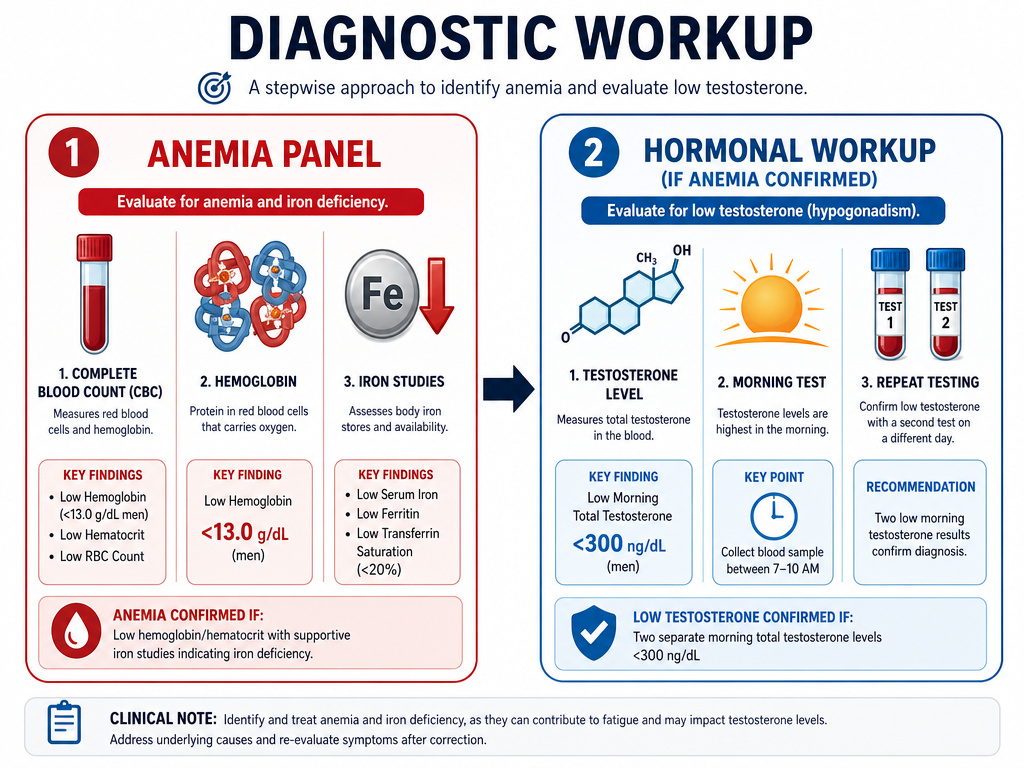
You need two parallel workups: one for anemia and one for hormonal status to answer the can low testosterone cause anemia question. Jumping straight to testosterone testing when you’re anemic can be a waste of time and money if you have an untreated iron deficiency.
First, the anemia panel (CBC and Iron Studies):
- Complete Blood Count (CBC): This gives your hemoglobin, hematocrit, and red blood cell indices. It confirms if you’re anemic and offers clues about the type.
- Iron Studies (Ferritin, Iron, TIBC): Rules out iron deficiency as the primary cause. Low ferritin is a clear sign.
- Vitamin B12 and Folate Levels: Rules out these less common nutritional causes.
Second, the hormonal workup (if anemia is confirmed and not easily explained):
- Total Testosterone: Drawn in the morning, ideally on two separate days.
- Bioavailable or Free Testosterone: This is the fraction not bound to sex hormone-binding globulin (SHBG) and is clinically active. The study that found the 4.7x risk used bioavailable T.
- LH and FSH: These pituitary hormones tell you if the problem is primary (testes) or secondary (brain signaling). This single split informs treatment options.
Common mistake: Getting a single, non-morning testosterone test and making decisions from it. Testosterone has a diurnal rhythm and can vary day-to-day. Two morning draws are the bare minimum for a reliable baseline.
The goal is to see the whole picture. Are you anemic with low testosterone and low LH? That points toward a secondary hormonal issue. Are you anemic with low T but high LH? That suggests your testes aren’t responding properly. Your doctor uses this map to choose a path.
Treatment and Management
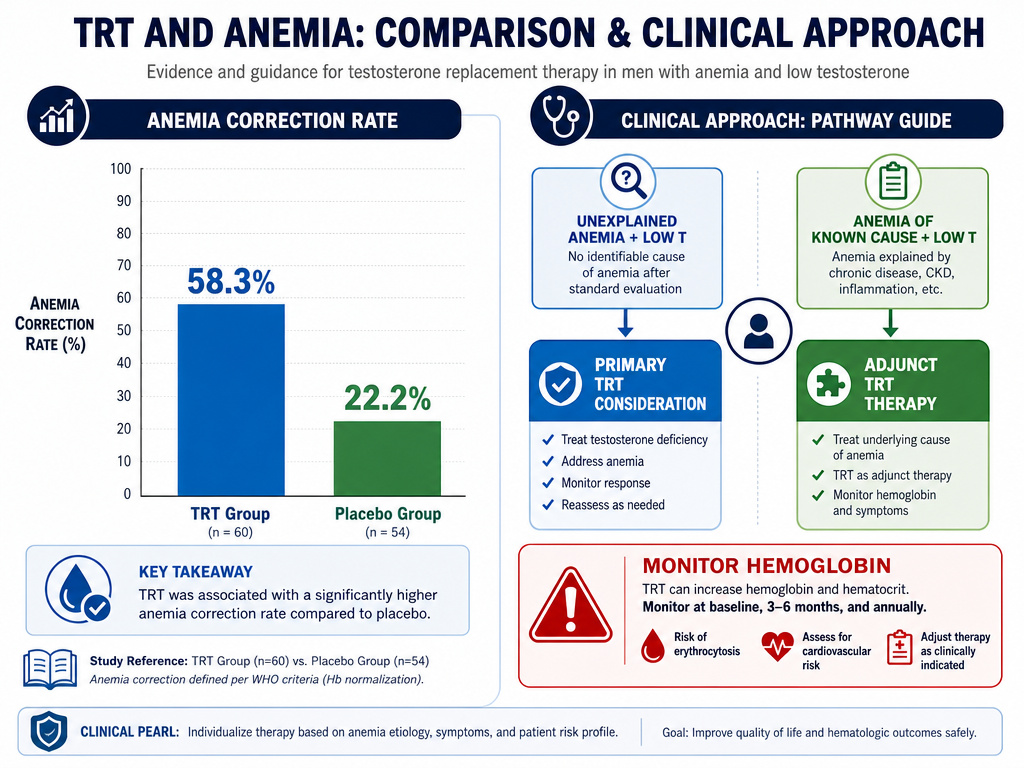
Treatment depends entirely on the diagnosed cause. If iron deficiency is the cause, you supplement iron. If it’s untreated celiac disease, you address that. If the workup points to testosterone deficiency as a key driver, especially in cases of unexplained anemia, then testosterone replacement therapy becomes a valid option to discuss with your doctor.
The clinical data on TRT for anemia is robust. The 2017 Testosterone Trial showed that for men 65+ with low T and unexplained anemia, one year of TRT led to a hemoglobin increase of ≥1.0 g/dL in 54% of men, compared to 15% on placebo. The correcting anemia rate was 58.3% vs. 22.2%.
The 2023 large-scale trial showed these benefits persist. At the 12-month mark, 45.0% of anemic men on TRT had corrected their anemia versus 33.9% on placebo. The between-group least square mean difference in hemoglobin increase for anemic men at 12 months was 0.33 g/dL (95% CI, 0.13 to 0.53 g/dL) favoring testosterone.
It’s not a magic pill for all anemia. But for the specific subset of men with hypogonadism and low red blood cell counts, it’s a targeted therapy that addresses the hormonal signal failure.
| Consideration | For Unexplained Anemia + Low T | For Anemia of Known Cause + Low T |
|---|---|---|
| TRT Efficacy | High (OR for correction = 17.0) | Moderate (OR for ≥1.0 g/dL increase = 8.2) |
| Action | TRT is a primary treatment consideration after excluding other causes. | TRT may be an adjunct therapy alongside treatment for the primary cause (e.g., iron supplementation). |
| Monitoring | Hemoglobin must be monitored to avoid polycythemia (excessively high red blood cells). | Monitor hemoglobin and the primary condition (e.g., iron stores). |
What about women? The 2007 observational study found a significant 4.4x risk association between low bioavailable testosterone and anemia in older women. However, most other large studies and trials focus exclusively on men, leaving the clinical significance in women less defined. TRT is not a standard treatment for anemia in women, and the focus remains on finding and treating the primary cause.
What about risks? The main risk of TRT related to blood is polycythemia, too many red blood cells, which thickens the blood. This is why regular monitoring of hemoglobin and hematocrit is essential during treatment. In the Testosterone Trial, six non-anemic men developed hemoglobin levels over 17.5 g/dL, highlighting the need for oversight.
Frequently Asked Questions
Can anemia be caused by low testosterone?
Yes. Low testosterone is a recognized cause of anemia, particularly in older men. It accounts for a significant portion of cases labeled “unexplained anemia of aging.” The mechanism involves reduced stimulation of red blood cell production in the bone marrow.
What are the symptoms of extremely low testosterone?
Extremely low testosterone (hypogonadism) symptoms include severe fatigue, loss of muscle mass, increased body fat, depressed mood, low libido, erectile dysfunction, and reduced bone density. Many of these, especially fatigue, overlap with anemia, making blood tests essential for differentiation.
Does testosterone affect hemoglobin levels?
Absolutely. Testosterone directly boosts hemoglobin levels by stimulating erythropoiesis. Clinical trials show that testosterone replacement therapy in men with low T reliably increases hemoglobin concentration, often correcting mild anemia within several months.
Can low testosterone go back to normal?
It depends on the cause. If low testosterone is secondary to factors like obesity, poor sleep, or certain medications, addressing those can often restore levels. If it’s due to primary testicular failure, levels typically won’t normalize without replacement therapy. Anemia related to low T will generally improve if the testosterone deficiency is corrected.
The Bottom Line
Low testosterone doesn’t just cause low energy, it can directly cause anemia by shutting down red blood cell production. The evidence is clear: for older men with unexplained fatigue and a low red blood cell count, checking testosterone is a logical step.
If your hemoglobin is low and your testosterone is low, treating the hormone deficiency might be the key to fixing your blood count. But the sequence matters. Check the iron, B12, and folate first. Get the proper hormone labs. Then, with a full picture, you and your doctor can decide if TRT is the right tool for your specific case.
The goal is to correct the oxygen-carrying capacity of your blood and resolve the fatigue that comes with it. For a large group of men, that fix is hormonal.
