
Do SSRIs Lower Testosterone? Evidence and Next Steps
This post contains affiliate links. As an Amazon Associate, we earn from qualifying purchases.
Yes, selective serotonin reuptake inhibitors (SSRIs) can lower testosterone. A 2022 meta-analysis of human studies found SSRIs reduce sperm concentration and motility within three months. Animal research shows specific drugs like sertraline and fluoxetine disrupt testicular steroidogenesis, lowering serum testosterone. However, the effect is dose-dependent and the evidence is not uniform, some studies show no change or even an increase, highlighting a complex interaction.
The key is the dose and the duration. In rats, a fluoxetine dose of 20 mg/kg for 11 days has been reported to both increase and decrease testosterone, while 10 mg/kg for two months has been reported to show no effect in one study and a decrease in another. This dosage specificity is the gap between alarming headlines and your actual prescription. It means the standard clinical dose for depression might operate in a different hormonal space than the high doses used in preclinical models. The question of whether do SSRIs lower testosterone is complex.
What follows is a breakdown of the research, separated by human and animal data, the specific timeline for sperm damage, and the practical steps you can take if you’re on an SSRI and worried about your levels. This isn’t about scaring you off medication, it’s about giving you the specifics on the do ssris lower testosterone question to have an informed conversation with your doctor.
Key Takeaways
- A systematic review and meta-analysis found SSRIs reduce sperm concentration, motility, and normal morphology, and increase sperm DNA damage, with effects visible within a 3-month period.
- Animal studies point to a mechanism of disrupted steroidogenesis, where SSRIs interfere with the testicles’ ability to produce testosterone, sometimes triggering a state of compensatory hypogonadism.
- A 2021 review notes the evidence is conflicting, with studies showing ‘increase, others decrease or no effect.’ However, other sources, including multiple primary studies and meta-analyses, report consistent decreases in testosterone or sperm parameters.
- If you’re concerned, do not stop your medication. The first step is discussing these studies with your prescriber and exploring options like dose adjustment, medication switching, or adding supportive lifestyle measures.
- Sperm parameters may improve after discontinuation, with some case studies showing recovery within 1-2 months, suggesting the effects on sperm transport and production can be reversible.
The Conflicting Evidence on SSRIs and Testosterone
You’ll find studies that flatly contradict each other on the do ssris lower testosterone issue. This isn’t bad science, it’s a sign of a biologically complex system where dose, duration, and individual biology create different outcomes.
A 2021 review in the journal Psychoneuroendocrinology concluded that while most antidepressants can influence sex hormone levels, “the evidence is conflicting with some studies showing an increase, others decrease or no effect.” This directly acknowledges the lack of a single, universal answer.
One rat study in the NIH database reported that 20 mg/kg of fluoxetine for 11 days increased plasma testosterone. Another study, using the same dose and duration, reported it decreased serum testosterone. A third study also using 20 mg/kg fluoxetine in Holtzman rats found a significant decrease. When you see that, the takeaway isn’t that one is right and the other is wrong. It means the outcome is sensitive to the animal model, the method of measurement (plasma vs. Serum), and subtle experimental conditions.
The human data adds another layer. The most robust conclusions come from pooled analyses. A 2022 systematic review and meta-analysis in Frontiers in Pharmacology gave us clear, aggregate numbers. It analyzed four studies with 222 men and found SSRIs had a statistically significant negative impact on several semen parameters.
| Semen Parameter | Effect of SSRIs | Statistical Significance (p-value) |
|---|---|---|
| Normal Sperm Morphology | Reduced | p = 0.002 |
| Sperm Concentration | Reduced | p = 0.02 |
| Sperm Motility | Reduced | p = 0.04 |
| Sperm DNA Fragmentation Index (DFI) | Increased | p = 0.0002 |
| Semen Volume | No significant effect | p = 0.89 |
This table tells a specific story: SSRIs affect sperm cell quality and DNA integrity, but not the volume of seminal fluid. That distinction points to an effect on the testicles and sperm maturation process, not the accessory glands.
How SSRIs Affect Sperm Health (The 3-Month Rule)
The meta-analysis revealed a critical timeline. The negative impacts on sperm morphology and concentration were observed within the 3-month period of SSRI use, but not after just one month.
This aligns almost perfectly with the human spermatogenesis cycle, which takes about 72 days. A drug that disrupts sperm production wouldn’t show its full effect on ejaculated sperm until a full cycle has passed. This is a crucial detail for any man concerned about fertility while on medication. It means a semen analysis done after four weeks might look normal, but one at 12 weeks could reveal the issue.
Where this goes sideways: Assuming a one-month check-up is enough. If you’re tracking fertility, you need to wait at least three months after starting or changing an SSRI dose to get a meaningful semen analysis.
The study also found nuanced differences based on why the drug was prescribed. SSRIs negatively affected sperm motility in patients being treated for depression, but not in those using them for premature ejaculation. Conversely, the increase in sperm DNA damage (DFI) was significant in the premature ejaculation subgroup but not the depression subgroup. This suggests the underlying condition or perhaps differences in drug choice or dosage play a role in the specific type of damage.
Animal Studies: The Mechanism of Hormonal Disruption

Human studies show the “what,” but animal models help us understand the “how.” The research here is more consistent, showing SSRIs can directly interfere with the hormonal machinery in the testes.
A clear mechanism involves the H295R human adrenocortical cell line, a standard model for studying endocrine disruption. An in vitro study found that the six most prescribed SSRIs, citalopram, escitalopram, fluoxetine, fluvoxamine, paroxetine, and sertraline, all decreased androgen production and increased estrogen production in these cells. This is a direct, drug-induced shift in the steroidogenic pathway.
In live rats, the effects are dose-dependent and drug-specific:
- Sertraline: In live rats, the effects are dose-dependent and drug-specific. The pituitary gland responded by pumping out more Luteinizing Hormone (LH) in a failed attempt to stimulate the testes, a state known as compensatory hypogonadism.
- Fluoxetine: At 20 mg/kg for 11 days, studies show decreased testicular weight, reduced Leydig cell numbers, and lower serum testosterone. At 10 mg/kg for two months, one study found no significant drop, while another reported reductions. Again, dose and context matter.
- Citalopram: Rats given 5 or 10 mg/kg daily for 28 days had decreased testosterone.
- Paroxetine: Research indicates it can impair Leydig cell function, skewing the estrogen-to-testosterone ratio. Paroxetine: Research indicates it can impair Leydig cell function, skewing the estrogen-to-testosterone ratio.
Specific SSRIs and Their Track Records
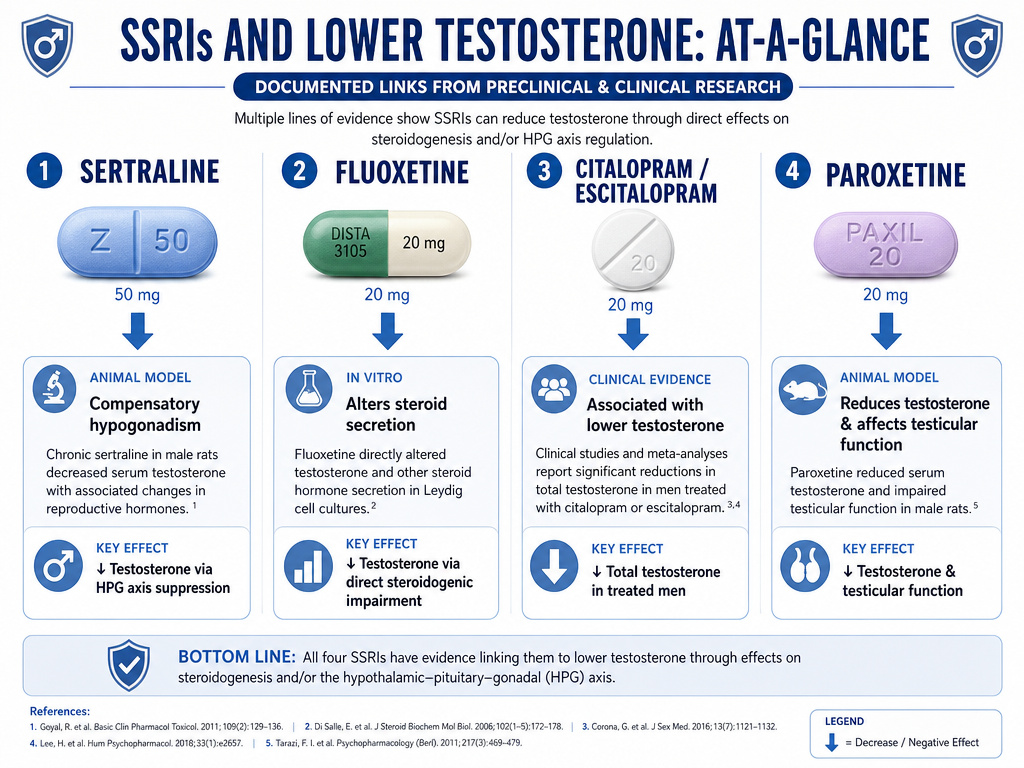
Not all SSRIs are identical in their endocrine footprint. While the class effect is real, some drugs have more documented evidence than others.
- Sertraline (Zoloft): Has perhaps the strongest data for endocrine disruption. The animal model showing compensatory hypogonadism is compelling. In men, a study of those taking 25 or 50 mg/day for three months showed a significant reduction in sperm concentration and normal morphology.
- Fluoxetine (Prozac): Its long half-life (96 hours) means it lingers in the system. The high-dose rat data is clear, but the relevance to standard human dosing is part of the ongoing debate.
- Citalopram/Escitalopram (Celexa/Lexapro): Rat studies show testosterone reductions at certain doses (5-10 mg/kg for citalopram, 10 mg/kg for escitalopram). The human meta-analysis on sperm parameters included these drugs.
- Paroxetine (Paxil): The in vitro data shows it can alter steroid secretion, and it’s often cited as having a higher incidence of sexual side effects, which may be hormonally linked.
If you’re looking at this list and thinking, “That’s basically all of them,” you’re right. The research suggests this is a broad class effect. The choice between them may come down to which has the least impact for you as an individual, a discussion for you and your doctor.
What About Low T Symptoms, Muscle Building, and Mood?
This is the practical fallout. If SSRIs can lower testosterone, what does that actually feel like?
The symptoms would mirror those of other causes of low testosterone and depression: persistent fatigue, loss of libido, difficulty building or maintaining muscle mass, and a dampened mood. This creates a vicious cycle for some men, they take an SSRI for depression, which may then subtly lower testosterone, which can exacerbate low energy and drive, potentially worsening the very mood state they’re trying to treat.
Common mistake: Blaming all low energy on depression. If you started an SSRI and months later your gym progress stalled and your drive vanished, the medication could be a contributing factor. It’s not always the illness.
The link between testosterone and mood is well-established. So, a drug that affects testosterone is, indirectly, a drug that can affect mood. This doesn’t mean SSRIs don’t work, for many, the primary antidepressant effect powerfully outweighs any secondary hormonal shift. But it complicates the picture.
For muscle building, the science is straightforward. Testosterone is a primary anabolic hormone. A substance that reduces testosterone synthesis or increases its clearance will make it harder to build muscle and recover from workouts. It’s not impossible, but it’s an uphill battle against a shifted hormonal baseline.
What To Do If You’re Concerned (A Stepwise Plan)

This is where panic is useless but action is valuable. Do not stop your medication abruptly. That can cause severe withdrawal and a rapid return of depressive symptoms. Follow a plan.
1. Talk to Your Prescriber.
Bring this research to your doctor or psychiatrist. Frame it as a collaboration: “I’m responding well to this medication for my mood, but I’m concerned about these long-term fertility and hormonal studies. Can we discuss it?” Your goal is to open a dialogue, not issue an ultimatum.
2. Consider Dose Adjustment or Switching.
Sometimes, a lower effective dose minimizes side effects. Alternatively, switching to a different SSRI or a different class of antidepressant (like bupropion, which has a different mechanism and is not associated with these endocrine effects) might be an option. This is a complex medical decision that your doctor must guide.
3. Get a Baseline.
If you’re planning for fertility, ask for a semen analysis and a hormone panel (Total Testosterone, Free Testosterone, LH, FSH) before starting medication or as soon as possible if you’re already on one. This gives you a personal baseline. Remember the 3-month rule, if you’re already on SSRIs, testing now shows your current reality.
4. Support Your System Naturally.
While you navigate the medical path, optimize the factors you control. This is about damage control and support.
- Manage Stress: Chronic stress elevates cortisol, which directly competes with testosterone production. Techniques to lower stress are essential. The impact of chronic stress on testosterone is profound.
- Sleep & Nutrition: Prioritize 7-9 hours of quality sleep and ensure adequate intake of zinc, magnesium, and vitamin D, all co-factors in hormone synthesis.
- Review Other Medications: Be aware that SSRIs might be part of a larger picture. Other common medications that lower testosterone include opioids, glucocorticoids, and certain antipsychotics.
5. Understand the Role of TRT.
For some men with confirmed, symptomatic low testosterone that is linked to SSRI use, testosterone therapy for depression might be discussed as an add-on treatment. This is a significant medical intervention with its own benefits and risks of TRT. It is not a first-line solution and should only be considered after thorough evaluation by an endocrinologist or knowledgeable physician, never as a self-prescribed fix.
Effects of low testosterone in women
The fact sheet does not contain specific information about the effects of low testosterone in women. If you are concerned about your hormone levels, discuss your symptoms with your doctor. They can evaluate your situation and recommend appropriate tests or management strategies based on your individual health profile.
Safety of combining testosterone therapy with antidepressants
The fact sheet does not contain specific information on the safety of combining testosterone therapy with antidepressants. Evidence on how antidepressants affect sex hormones is conflicting, with studies showing increases, decreases, or no effect. If you are considering or using testosterone therapy while taking an antidepressant, you must consult your prescribing physician. They can assess potential interactions and monitor your health based on your specific medications and medical history.
Frequently Asked Questions
Do SSRIs make it harder to build muscle?
Yes, they can. Since SSRIs may lower testosterone, a key hormone for muscle protein synthesis and recovery, you will likely find muscle growth more challenging and slower. Your effort-to-result ratio will change. Focus on consistency, nutrition, and recovery even more diligently.
How much does sertraline lower testosterone?
There is no fixed percentage for humans. The animal data shows clear dose-dependent suppression. In the 2022 human meta-analysis, sertraline was included in the pool of drugs that significantly reduced sperm concentration and quality. The effect on your serum testosterone level is individual and can range from negligible to significant.
Does serotonin lower testosterone?
Indirectly, yes. Serotonin is involved in regulating the hypothalamic-pituitary-gonadal (HPG) axis. Excess serotonin signaling from SSRI use can inhibit the release of Gonadotropin-Releasing Hormone (GnRH), which in turn reduces the release of LH and FSH from the pituitary. Lower LH means less stimulation for the Leydig cells in your testes to produce testosterone.
Are the effects on testosterone permanent?
The evidence suggests they are often reversible, but not instantly. The evidence suggests the effects on sperm are often reversible, but the timeline varies. However, some animal research, particularly on paroxetine, hints that some testicular changes might be longer-lasting. The general consensus is that function returns for most men after cessation, but the timeline varies.
Before You Go
The research is clear enough to warrant attention but complex enough to forbid simple answers. SSRIs are a vital tool for mental health, and for many, their benefits are life-changing. The potential impact on testosterone is a significant side effect to manage, not a reason to abandon effective treatment.
Change one thing at a time. If you’re worried, start with the conversation with your doctor. Get the bloodwork. Look at your lifestyle supports. This is a manageable part of your health picture, not a deterministic sentence. The goal is informed treatment, where you understand the trade-offs and can work with your provider to find the best overall path for your mental and physical well-being.
