
Nutrient Deficiencies That Lower Testosterone
This post contains affiliate links. As an Amazon Associate, we earn from qualifying purchases.
The nutrient deficiencies that lower testosterone are zinc, vitamin D, and vitamin A, but the evidence for each is different. Zinc deficiency has a direct, causal link shown in controlled studies where low intake (1.4 mg/day) lowered serum testosterone within 20 weeks. Vitamin D’s role is associative, and supplementation may not raise levels in replete men. Vitamin A emerged from large population data as a significant factor, though its mechanism is less clear.
The 1.4 mg/day zinc figure comes from a metabolic ward study where everything was measured. That kind of data changes the conversation from “zinc is good” to “below this intake, your levels drop on a predictable timeline.” The rest of the advice you read often misses that specificity.
What follows: the three clinical thresholds, the six-month timeline for correction, the study that found vitamin D supplements did little, and the one nutrient that large-scale data says matters more than zinc for population-level deficiency. We’ll also untangle why symptoms overlap and how to start fixing one thing at a time.
Key Takeaways
- A dietary zinc intake of 1.4 mg/day led to measurably lower serum testosterone in young men, showing a direct cause-and-effect relationship.
- Correcting a marginally zinc-deficient state can take 3 to 6 months of consistent supplementation to see a meaningful rise in serum testosterone.
- The large NHANES environment-wide study found dietary vitamin A, protein, and fats were inversely associated with testosterone deficiency, while zinc did not emerge as a top factor in this specific epidemiological analysis, in contrast to clinical studies showing zinc’s direct impact.
- A 2020 systematic review concluded vitamin D supplementation had little or no effect on testosterone in middle-aged and older adults, challenging common assumptions.
- Symptoms of nutrient deficiency (fatigue, low drive) mirror low testosterone, so testing, starting with vitamin D and zinc, is the only way to know the root cause.
Zinc: The Most Direct Link
The link between zinc and testosterone is one of the few areas in nutritional endocrinology where you can point to a controlled, dose-dependent cause and effect. The mechanism is straightforward: zinc is a cofactor for the enzyme aromatase, which converts testosterone to estrogen, and it’s crucial for luteinizing hormone production. Without enough zinc, the hormonal assembly line jams.
A controlled metabolic ward study published on PubMed found that a dietary zinc intake of 1.4 mg/day (compared to 10.4 mg/day) led to decreased serum testosterone (21.9 vs. 26.9 nmol/L) and semen volume in young men. This study establishes a specific intake threshold for deficiency effects.
The data from that study is the anchor. It tells us that in a controlled environment, dropping zinc that low has a measurable consequence. In the real world, a study of marginally zinc-deficient elderly men (mean age 64) showed what happens when you add it back. Supplementation with 459 μmol/day of elemental zinc (as zinc gluconate) for six months increased serum testosterone from 8.3 to 16.0 nmol/L.
The timeline is the part most people miss. Dietary zinc restriction induced a significant decrease in serum testosterone after 20 weeks. Reversing a deficiency isn’t fast, either, the significant effect of zinc supplementation was demonstrated over 3 to 6 months. You don’t fix a five-month slide in five days.
Where this goes sideways: Taking a high-dose zinc supplement without being deficient. The effect of zinc supplementation on serum testosterone varies depending on basal zinc and testosterone levels. If you’re already replete, adding more does nothing for your hormones and can cause nausea or copper deficiency. This is why reviewing the peer-reviewed evidence on zinc and testosterone is so critical; it shows the effect exists, but only when there’s a gap to fill.
The Vitamin D Controversy: Association vs. Causation
Here is what the evidence actually says. Severe vitamin D deficiency is associated with lower testosterone levels. The vitamin D receptor is present in the testes, suggesting a role. But, and this is the crucial distinction, giving vitamin D supplements to people who aren’t severely deficient generally doesn’t move the needle on testosterone.
A 2020 systematic review & meta-analysis in PMC looked at randomized controlled trials and concluded that supplementation with vitamin D had little or no effect on testosterone concentrations in middle-aged and older adults. That’s a direct challenge to the blanket “vitamin D boosts testosterone” claim you see everywhere.
The disagreement in the sources is real and worth laying out clearly:
- Position A (Association): Some clinical practice reviews state that severe vitamin D deficiency may contribute to lower testosterone.
- Position B (No Causal Effect from Supplementation): The 2020 meta-analysis of RCTs found little to no effect from supplementation.
This doesn’t mean vitamin D is unimportant for health. It’s vital for immunity and bone density. But for testosterone, the PMC meta-analysis on vitamin D suggests the relationship is more about being severely deficient causing general system-wide dysfunction, not vitamin D being a direct hormonal lever. If your level is below 20 ng/mL, correcting it is a health priority. If vitamin D levels are already sufficient, supplementation for the purpose of increasing testosterone is likely ineffective according to a meta-analysis.
The Overlooked Factor: Vitamin A and Macronutrients
While clinical trials hammer on zinc, large-scale epidemiological data tells a different story about what matters for the population. An environment-wide association study using NHANES data (a massive US health survey) identified dietary intake of vitamin A, protein, and fats as inversely associated with testosterone deficiency. In their multivariable model, vitamin A remained a significant factor.
. It came from a brute-force analysis of thousands of data points, not a hypothesis about a single nutrient. The study defined testosterone deficiency as a total testosterone level ≤ 3.5 ng/mL. In that framework, zinc didn’t emerge as a top factor. Why the disconnect?
Clinical studies isolate one variable. Life doesn’t. The NHANES finding suggests that for overall hormonal health, your general dietary pattern, enough quality protein, adequate healthy fats, and sufficient vitamin A, may provide a more robust foundation than obsessing over a single micronutrient. It’s a building block, not just a catalyst.
| Nutrient | Evidence Type | Key Finding | Population Where Effect is Clear |
|---|---|---|---|
| Zinc | Clinical Intervention | Direct cause-and-effect; low intake (1.4 mg/day) lowers T. | Marginally deficient individuals (esp. Elderly). |
| Vitamin D | Observational & RCTs | Severe deficiency associated with low T; supplementation often ineffective. | Those with serum levels <20 ng/mL. |
| Vitamin A | Epidemiological (NHANES) | Strong inverse association with testosterone deficiency in population data. | General population with poor dietary intake. |
The takeaway is to understand the lens. If you’re looking at a specific, measurable deficiency, zinc is king. If you’re looking at broad dietary patterns linked to low testosterone risk, vitamin A and macronutrients take the spotlight. This NHANES environment-wide association study is the kind of research that reframes the whole conversation.
How Deficiencies Interact and Compound
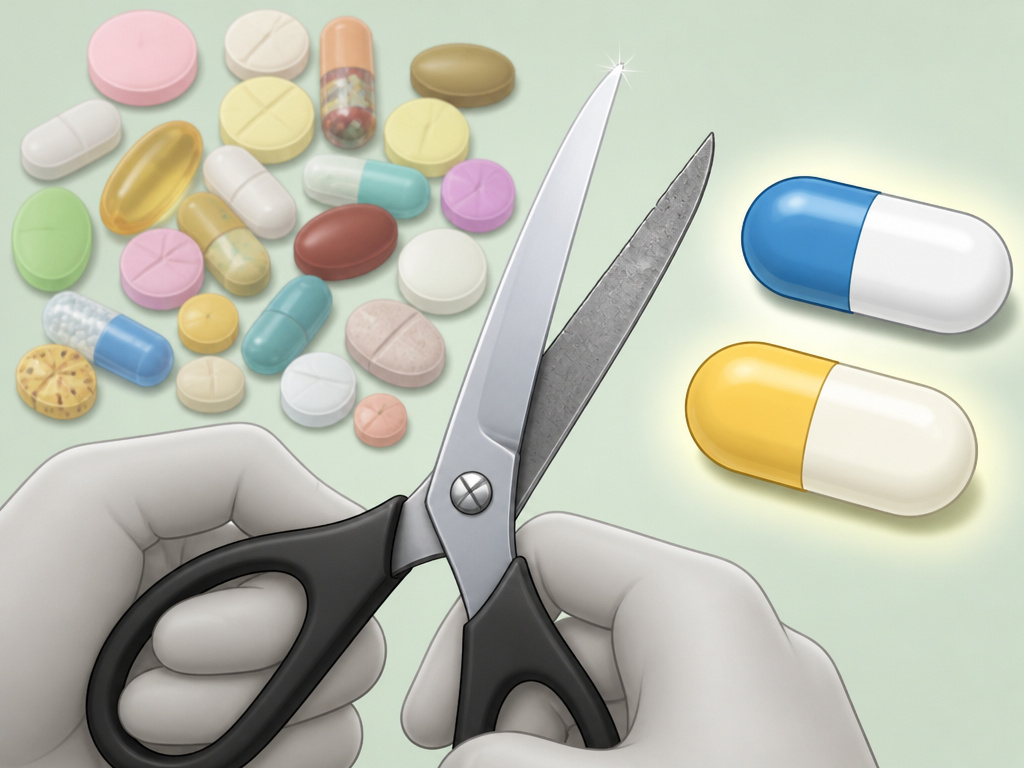
Nutrient deficiencies rarely travel alone. They pack together, and their effects on hormone pathways can compound.
They work in concert. Fixing one while ignoring the other is like sharpening one blade on a pair of scissors. This is why shotgun approaches with “testosterone booster” blends fail. They throw 20 underdosed ingredients at a problem that might be one or two specific, measurable deficiencies.
The sensory reality is in the timeline. A genuine correction for nutrient deficiencies that lower testosterone doesn’t feel like a sudden surge. It feels like the slow return of something you forgot was missing, steady energy by mid-afternoon, a quieter mind, sleep that actually feels restorative. That shift happens on the scale of weeks and months, not days. It’s the difference between treating a symptom and rebuilding a foundation.
Testing: The Only Way to Know
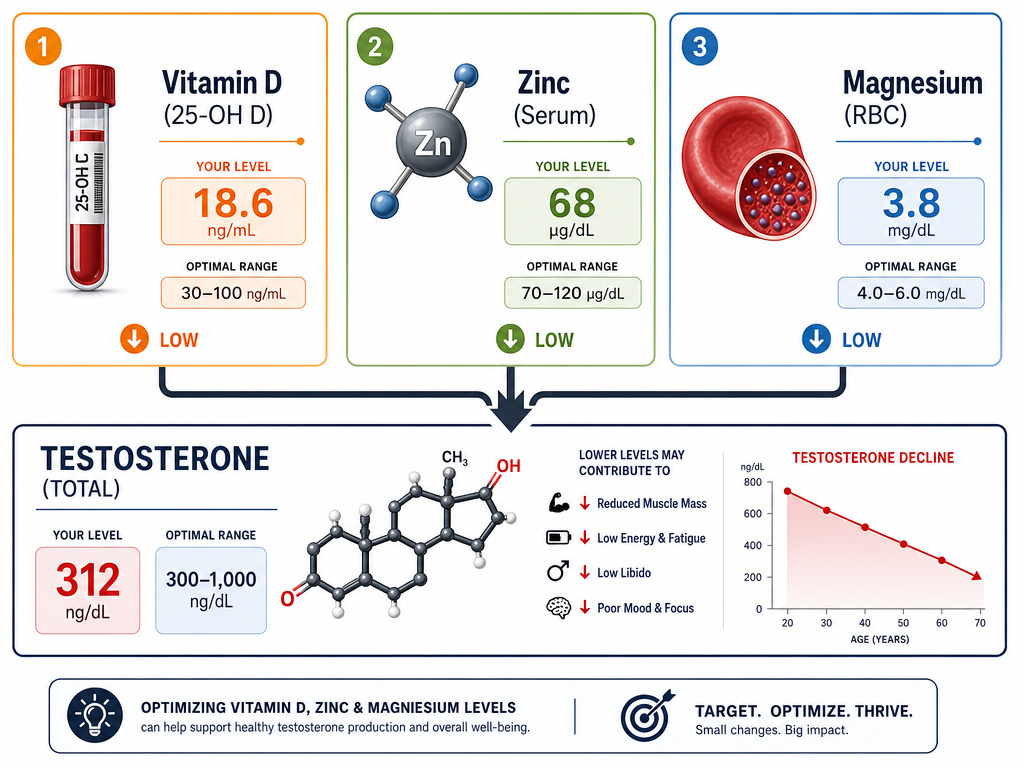
You cannot guess your way out of this. Fatigue, low libido, and brain fog are the universal symptoms of a hundred different issues, from poor sleep to high stress to, yes, nutrient deficiencies that lower testosterone. Assuming your low energy is automatically low testosterone is the first and most expensive mistake.
Start with the basics. Get a blood test. For nutrients, the most actionable panels check:
- Vitamin D (25-OH D): This is the standard test. Know your number.
- Zinc (Serum or Plasma): Serum zinc is a standard test, though it can fluctuate.
- Magnesium (RBC Magnesium): This measures magnesium inside your red blood cells, which is a better indicator of body status than serum magnesium.
The NHANES environment-wide study used a threshold of ≤ 3.5 ng/mL to define deficiency. Your doctor can interpret your results in context. The goal isn’t to play diagnostician but to gather data. Are you deficient in a key nutrient? Is your testosterone actually low? The answers dictate two completely different paths.
This is where I learned the expensive way. I used to assume and supplement blindly. Now, I test first. Data beats intuition every single time for hormones. It turns a vague feeling into a solvable equation.
Correcting Deficiencies: A Practical Framework
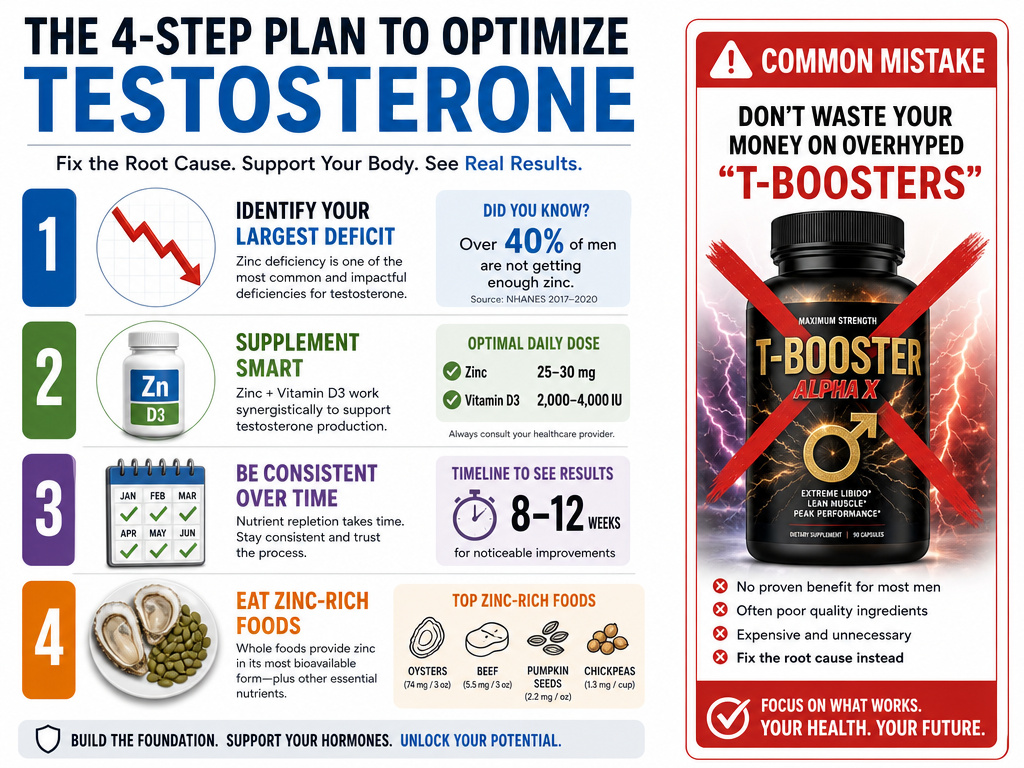
Once you have data, the protocol is simple, sequential, and slow. Change one thing at a time. This is the core principle. If you start taking zinc, vitamin D, magnesium, and a B-complex all on the same Monday, you’ll have no idea what’s working, or what’s causing an upset stomach.
- Address the largest deficiency first. Address the most severe deficiency first, based on clinical guidance. Re-test in 3-4 months.
- Use a dose based on clinical need, such as 459 μmol/day of elemental zinc (as zinc gluconate) for deficient elderly men. For zinc, supplementation should be based on clinical need, as studies used specific doses like 459 μmol/day of elemental zinc (as zinc gluconate) in deficient elderly men.
- Allow time. Re-test the nutrient after 3-6 months of consistent supplementation. Hormones change slowly. The dietary zinc depletion effects study showed drops over 20 weeks; expect a similar scale for recovery.
- Support with diet. Supplements correct a deficit; food maintains it. This is where testosterone-boosting foods become your long-term strategy, not a quick fix.
Common mistake: Jumping straight to a “testosterone booster” blend. These products often contain tiny, ineffective amounts of zinc, vitamin D, and other ingredients wrapped in aggressive marketing. You’ll spend more money for less of the actual compound you need.
This framework turns the abstract concept of “nutrient support” into a measurable project. It’s how you move from guessing to knowing. For a deeper look at specific products, our guide on the best supplements for deficiencies breaks down forms and quality markers.
What foods can lower testosterone levels?
While the fact sheet does not list specific foods that lower testosterone, clinical studies show that nutrient deficiencies directly impact hormone synthesis. A diet lacking in key nutrients can create a hormonal imbalance. To support healthy testosterone, focus on a whole-foods diet that provides adequate vitamins and minerals. Limiting processed foods, which are often low in essential nutrients, and moderating alcohol intake are practical steps. Ensuring sufficient intake of nutrients like zinc and vitamin A, which studies link to testosterone levels, is more effective than avoiding specific foods without a clear deficiency.
Do mint, licorice, or flaxseed lower testosterone?
The provided fact sheet contains no specific data on mint, licorice, or flaxseed affecting testosterone. The research focuses on the impact of nutrient deficiencies, such as zinc, on hormone levels. Without clinical evidence from these sources, it is not possible to confirm their effect. For practical guidance, concentrate on ensuring adequate intake of nutrients proven to support testosterone, like zinc and vitamin A, rather than eliminating specific herbs or foods without a documented, study-backed reason for your individual physiology.
What about selenium and boron for testosterone?
The fact sheet does not include any information on selenium or boron in relation to testosterone levels. The clinical data presented centers on the role of zinc and, to a lesser extent, vitamin A, protein, and fats. A systematic review noted that the effect of supplementation can depend on an individual’s baseline nutrient and hormone status. Therefore, while selenium and boron are often discussed, their impact is not supported by the provided research. Focus first on correcting well-documented deficiencies like zinc, as its mechanism in testosterone synthesis is clearly established.
Frequently Asked Questions
What is the #1 testosterone killer nutritionally?
From a clinical, cause-and-effect standpoint, severe zinc deficiency is the closest thing to a direct nutritional “killer.” The controlled study showing a drop to 1.4 mg/day of zinc lowering serum testosterone provides a clear mechanism and timeline. However, for the general population, the NHANES data suggests chronic low intake of vitamin A, protein, and dietary fats presents a bigger overall risk factor for testosterone deficiency.
What depletes your testosterone fastest?
Severe calorie deficit tells your body to down-regulate non-essential functions like reproduction. Nutrient deficiencies work on a slower scale of weeks to months.
Do vitamin D supplements increase testosterone?
Sources disagree. A 2020 meta-analysis concluded vitamin D supplementation had little or no effect on testosterone in middle-aged and older adults, while other reviews suggest severe deficiency may contribute to lower levels. If you have a severe deficiency (below 20 ng/mL), correcting it is important for overall health and may help normalize hormonal function, but it is not a direct testosterone booster.
How long after fixing a deficiency will testosterone improve?
Based on the intervention studies, allow 3 to 6 months. Research in marginally zinc-deficient elderly men showed increased serum testosterone after supplementation for that duration. Hormonal systems are slow to shift; consistent correction over multiple cycles is what yields a measurable change.
Should I take a multivitamin for low testosterone?
Multivitamin can help cover general gaps, but it is rarely the solution for a specific, clinically significant deficiency that is lowering testosterone. Multivitamins often contain lower doses of zinc and vitamin D, which may be insufficient to correct a documented deficit. Targeted supplementation based on blood work is more effective.
The Bottom Line
The evidence points to three clear tiers. Zinc has the strongest direct evidence, get below 1.4 mg/day and your levels will drop. Vitamin D’s role is murkier; fix a severe deficiency, but don’t expect supplements to act as a booster. Vitamin A, protein, and fats form the essential dietary bedrock that large-scale data links to lower deficiency risk.
Start with a blood test for vitamin D and zinc. It’s the only way to move from internet guesses to a real plan. If you’re deficient, correct it with a specific supplement for 3-6 months, then re-test. Support that with real food, oysters, eggs, beef, liver. This is slow, unsexy work.
Skip the proprietary-blend testosterone boosters. Get a lab test and two or three single-ingredient supplements with known doses. That’s the path that works. The rest is just noise.
