
Do Parabens Lower Testosterone? The Science and Your Risk
This post contains affiliate links. As an Amazon Associate, we earn from qualifying purchases.
The evidence that parabens lower testosterone is strongest in lab and animal studies, which show direct anti-androgenic effects, but human observational studies present a mixed picture. Some report significant associations between paraben exposure and lower testosterone or sperm quality, while others find no link, highlighting the complexity of real-world exposure and individual variability.
That gap between the controlled lab and the messy real world is where most of the confusion lives. The lab data is clear on mechanism, but translating a rat dose or a cell-culture concentration to a daily spritz of lotion requires a few careful steps. A common question is: do parabens lower testosterone?
What follows: a breakdown of the key studies on both sides, the specific biological mechanism at play, how your actual exposure likely compares to concerning doses, and a practical, ranked list of steps to reduce your risk without losing sleep over every label.
Key Takeaways
- Lab studies show a clear mechanism: Methylparaben, propylparaben, and butylparaben can act as anti-androgens, directly interfering with testosterone’s cellular action, as demonstrated in vitro assays.
- Human data is conflicting: The Jurewicz et al. (2017) study of 315 men linked paraben exposure to lower testosterone, while the Meeker et al. (2011) study of 190 men found no statistically significant associations between urinary methyl or propyl paraben concentrations and serum hormone levels.
- Mixture effects may be key: A 2023 study of 795 men found that exposure to a mixture of parabens was associated with declining sperm quality, suggesting assessing chemicals in isolation underestimates risk.
- Check product labels first: Parabens are listed as methylparaben, propylparaben, butylparaben, or ethylparaben in ingredients. They are common in lotions, shampoos, and cosmetics with water content.
- Prioritize known large factors: For most men, addressing sleep, stress, alcohol intake, and obesity will have a far greater impact on testosterone than eliminating trace paraben exposure alone.
The Core Evidence: What Studies Actually Say
You will find two types of studies on this topic: tightly controlled lab experiments and broader human observational research. They often seem to disagree, but they are answering different questions.
The lab work establishes capability to answer the question do parabens lower testosterone. A 2007 cell assay found that at a concentration of 10 µM, methylparaben inhibited testosterone-induced activity by 40%, propylparaben by 33%, and butylparaben by 19%. This is the “anti-androgenic” mechanism in a dish, the parabens block the hormone receptor.
In vitro assays provide the clearest mechanistic evidence. At 10 µM, methylparaben inhibited testosterone-induced transcriptional activity by 40%, propylparaben by 33%, and butylparaben by 19%, demonstrating direct receptor interference (Chen et al., 2007).
Animal studies bridge the gap to living systems. A 2002 rat study showed that dietary butylparaben at 0.1% of food weight significantly lowered serum testosterone in a dose-dependent manner. The researchers noted this intake level was similar to the lower end of the Acceptable Daily Intake set in the European Community and Japan.
Human studies are messier regarding the do parabens lower testosterone query. A 2017 study of 315 men reported urinary paraben concentrations were significantly associated with a decrease in serum testosterone. Yet, a 2011 study of 190 men found no statistically significant associations between urinary methyl or propyl paraben levels and serum hormones.
This isn’t a case of one study being right and the other wrong. The 2011 authors pointed out substantial temporal variability in an individual’s paraben levels, a single urine sample might not capture their true average exposure. This variability can obscure real associations.
| Study Type | Finding | Key Limitation / Insight |
|---|---|---|
| In Vitro (Chen et al., 2007) | Methyl-, propyl-, butyl-paraben inhibit testosterone activity at 10 µM. | Shows mechanism, not real-world body burden. |
| Animal (Oishi, 2002) | 0.1% dietary butylparaben lowered rat testosterone. | Dose was similar to lower end of human ADI. |
| Human Observational (Jurewicz et al., 2017) | Urinary parabens linked to lower testosterone in 315 men. | Shows association, not causation. |
| Human Observational (Meeker et al., 2011) | No significant link found in 190 men. | Single urine samples may miss exposure variability. |
The most compelling recent human data looks at mixtures. A 2023 study of 795 men found that exposure to a combination of parabens, with butyl- and methyl-paraben as main contributors, was associated with declining sperm concentration and count. The study concluded that assessing individual compounds might underestimate the risk.
How Parabens Could Interfere with Testosterone
The term “endocrine disruptor” gets thrown around loosely. For parabens, the proposed pathway is reasonably specific: they are weak anti-androgens. They don’t stop your body from making testosterone. Instead, they mimic the hormone’s shape just well enough to bind to the androgen receptor, but not well enough to activate it properly. It’s like putting the wrong key in a lock, it jams the mechanism so the right key can’t turn.
This receptor blockade is what the 2007 in vitro study measured. The cellular signal gets dampened. In a living animal, this can trigger a feedback loop; the body senses lower androgen activity and may try to compensate, but the system’s set-point can drift.
The other potential route is through oxidative stress. Some research suggests these chemicals can increase reactive oxygen species, which damage Leydig cells in the testes, the cells responsible for testosterone production. This is a less direct but plausible contributing pathway, often discussed alongside other endocrine-disrupting chemicals like BPA.
It’s a two-part problem: direct signaling interference and potential long-term tissue damage. The first happens quickly. The second accumulates.
Where Human Exposure Actually Comes From
Parabens are preservatives. They prevent mold and bacteria growth in products that contain water. If you use a lotion, shampoo, shaving gel, or liquid soap, you have likely used parabens.
Common mistake: Worrying about parabens in dry foods or supplements. They are almost exclusively used in water-based personal care and cosmetic products.
Your skin absorbs them. Studies measure urinary paraben metabolites because the body processes and excretes them relatively quickly. This is also why exposure is so variable, what you put on your skin yesterday shows up in your urine today, but it might be gone tomorrow if you switch products.
The dose from a single product is low, but the combined load from multiple sources is a concern, as highlighted in mixture studies. The concern, highlighted in the 2023 mixture study, is the combined load from multiple sources: shampoo, conditioner, body wash, face cream, and sunscreen all applied daily. This “cocktail effect” is what most safety assessments struggle to quantify.
It’s a different exposure profile than something like BPA, which comes from food containers and receipts. Paraben exposure is topical and voluntary. You can see it on the label and choose differently.
Parabens vs. Other Lifestyle Factors: A Realistic Risk Ranking
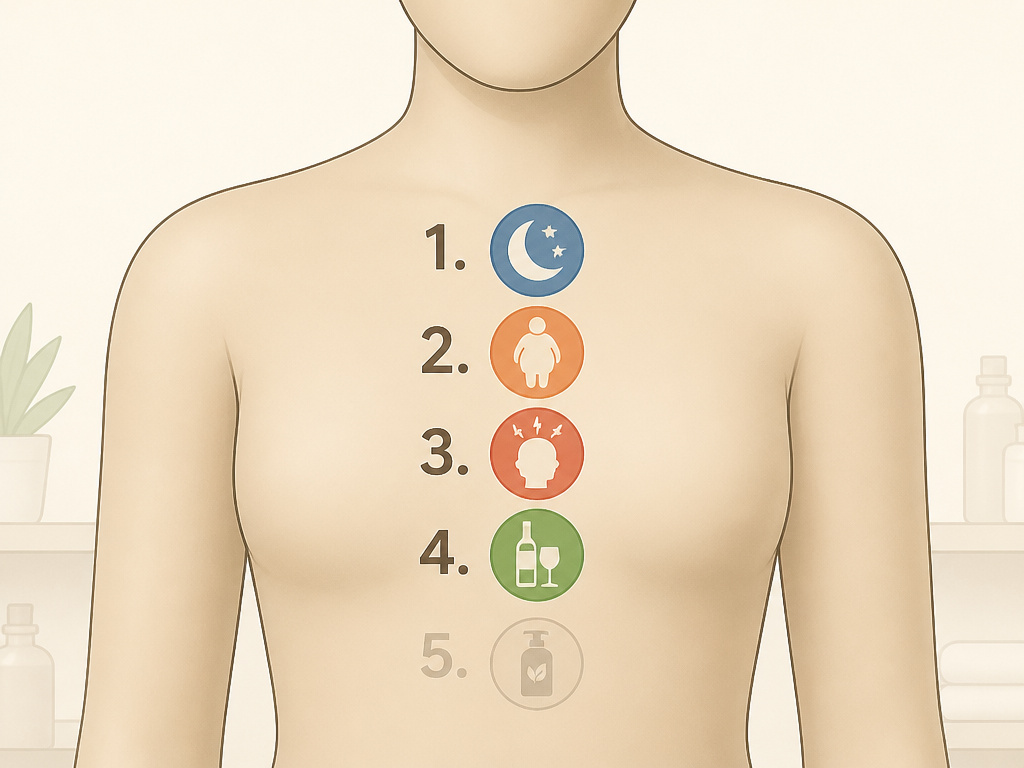
To be direct. If your testosterone is low, parabens are unlikely to be the primary driver. They are a potential modulator, a piece of the puzzle. Treating them as the main villain misses larger, proven targets.
I rank factors by the strength of evidence and the magnitude of their effect. It is a brutal but necessary exercise.
- Sleep Quality & Duration. Chronic sleep restriction can significantly lower testosterone. The effect is large, fast, and reproducible.
- Obesity & Body Fat Percentage. Adipose tissue aromatizes testosterone into estrogen. This is one of the strongest and most direct suppressors.
- Chronic High Stress & Elevated Cortisol. The hormonal axis that manages stress directly inhibits the one that manages reproduction.
- Heavy Alcohol Consumption. Alcohol is a direct testicular toxin. It damages Leydig cells and increases estrogen conversion.
- Other Chemical Exposures (e.g., heavy metals, certain pesticides). These often have more potent and established toxicity.
- Paraben & Phthalate Exposure. A plausible contributor, especially at high cumulative doses, but with a likely smaller effect size per unit of exposure.
This isn’t permission to ignore parabens. It is a framework for action. If you are sleeping five hours a night, drinking heavily, and never exercising, fixing those will do more than swapping your body wash. Do the big things first. Then, if you want to optimize further, look at the smaller levers like personal care products with parabens.
How to Identify and Reduce Your Paraben Exposure

The action step is straightforward because the source is labeled. You do not need a degree in chemistry.
First, read the ingredient list (the “INCI” list). Look for:
- Methylparaben
- Propylparaben
- Butylparaben
- Ethylparaben
- Any word ending in “-paraben”
They are often near the end of the list, as they are used in small concentrations. I keep a note on my phone. When I find a product I like without them, I save the name. It saves the mental load of checking every time.
Second, prioritize products that stay on your skin. A rinse-off body wash has less contact time than a leave-on lotion or sunscreen. If you want to make one switch, start with your daily moisturizer.
Third, do not assume “natural” or “organic” means paraben-free. Some brands use them. Some use alternative preservatives that may have their own issues. The label is the only truth.
Here is a simple, tiered approach to reducing exposure without overhauling your life in a weekend:
- Tier 1 (Easy Swap): Replace your leave-on face moisturizer and body lotion with paraben-free versions.
- Tier 2 (Moderate Effort): Add your shampoo, conditioner, and deodorant to the swap list.
- Tier 3 (Comprehensive): Audit all rinse-off products (body wash, shaving cream) and cosmetics.
You do not need to do Tier 3. For most people, Tier 1 eliminates the majority of meaningful dermal exposure. This is where the 80/20 rule applies perfectly.
Frequently Asked Questions
Do parabens mess with hormones?
Yes, that is the core of the concern. Laboratory evidence shows they can act as endocrine disruptors, specifically as weak anti-androgens by binding to and blocking testosterone receptors. Human data on whether typical exposure levels cause meaningful hormonal disruption is less consistent.
What is the #1 testosterone killer?
Among lifestyle factors, chronic sleep deprivation and obesity have the most severe and well-documented suppressive effects on testosterone. Among chemicals that disrupt hormones, heavy alcohol use and exposure to certain agricultural chemicals like some organophosphate pesticides have stronger evidence for direct testicular toxicity than parabens.
How long after avoiding parabens might testosterone recover?
There is no specific study tracking testosterone recovery after paraben cessation in humans. Given their relatively short half-life in the body, any direct receptor-blocking effect would cease quickly. However, if parabens contributed to longer-term issues like oxidative stress, recovery would follow the timeline of cellular repair. The most impactful changes would still come from addressing larger factors like sleep and diet.
Are parabens bad for your body?
Regulatory bodies like the FDA and the Cosmetic Ingredient Review (CIR) expert panel consider them safe at current approved use levels. The debate centers on whether those approved levels adequately account for cumulative exposure from multiple products and potential mixture effects with other endocrine disruptors. For a cautious individual, reducing exposure is a low-cost, harmless precaution.
What chemicals can lower testosterone levels?
Range of chemicals are studied for potential anti-androgenic effects. These include phthalates (found in plastics), BPA (in some plastics and can linings), certain pesticides like atrazine, heavy metals like lead and cadmium, and polyfluoroalkyl substances (PFAS). Parabens are part of this broader category of environmental hormone-disrupting chemicals.
Before You Go
The paraben question is a lesson in scientific nuance. The lab shows a clear, mechanistically plausible risk. The human population studies show a signal, but it is inconsistent and tangled up with everything else we are exposed to.
So here is the stance: it is rational to reduce your exposure because it is easy to do. Read a label, pick a different lotion. But do not let this concern overshadow the fundamentals. No amount of paraben-free shampoo will offset the testosterone crash from terrible sleep or a 40-pound weight gain.
If you are making changes, track one thing. Before you switch products, get a baseline testosterone test if you can. Make your lifestyle and product changes over a period of time, then test again. That is the only way to know what is moving the needle for you. Let the evidence lead, starting with your own.
TL;DR: Parabens can lower testosterone in lab models, but real-world human impact is less clear. Swap out leave-on lotions first if you’re concerned, but fix sleep, weight, and stress long before you worry about your shampoo.
