
Does Accutane Lower Testosterone? What the Studies Show
This post contains affiliate links. As an Amazon Associate, we earn from qualifying purchases.
Accutane (isotretinoin) can lower total testosterone and DHT levels in some people, but the effect is inconsistent and depends heavily on gender, dosage, and treatment duration. In a key study of 36 women, total testosterone dropped from a mean of 1.06 ng/mL to 0.79 ng/mL after three months. For men, research is conflicting, with some studies showing no change in testosterone but a clear reduction in DHT.
That 25% drop in women is a specific number from a real study. It’s not a universal rule, and it doesn’t mean Accutane is an anti-androgen drug. Its primary job is to shrink oil glands. A common question is does Accutane lower testosterone.
The rest of this guide walks through the raw data, the disagreements between studies, and what this means for managing your energy and mood if you’re on the medication. We’ll compare it to true hormonal treatments and outline the one thing you should track beyond your skin.
Key Takeaways
- Research shows gender-specific effects: Women may see a drop in total testosterone and DHT, while men’s results are mixed, often showing a greater impact on DHT.
- The primary mechanism isn’t hormonal: Accutane works by shrinking sebaceous glands; any hormone changes are likely secondary effects, and the FDA label states its exact mechanism is unknown.
- Effects appear dose- and duration-dependent: Lower doses over shorter periods may show minimal change, while higher, longer courses could have a more pronounced impact.
- Monitor more than testosterone: If you feel fatigued or have low libido during treatment, track sleep, diet, and mood, these common side effects can mimic low-T symptoms without a hormonal cause.
- Never stop a prescription abruptly due to hormone concerns. Discuss any side effects with your prescribing doctor or dermatologist to adjust your plan safely.
What Does the Research Actually Say?
Few topics in men’s health have more conflicting online claims than medications and hormones, and the does Accutane lower testosterone debate is a prime example. You’ll find forum posts swearing Accutane destroyed someone’s testosterone and medical sites stating it has no effect. The evidence points to a complicated middle ground. The data we do have is specific, but it doesn’t paint one clear picture.
A 2020 study published in PMC treated 36 women with moderate-to-severe acne using 20 mg of isotretinoin daily for three months. Blood work showed serum testosterone fell from a mean of 1.06 ng/mL to 0.79 ng/mL, a 25% decrease. Dihydrotestosterone (DHT) levels fell more dramatically, from 754.57 pg/mL to 307.58 pg/mL.
This is a concrete finding. But it’s just one study, with one dose, in one gender. It immediately clashes with older research. A 1988 study cited within that same paper found isotretinoin elevated free testosterone in women, while the 2020 study on 36 women found no significant change in free testosterone levels. When you dig into the peer-reviewed acne treatment study archives, the results are, as the 2020 authors noted, “inconclusive and at times conflicting.”
Why the conflict? Studies vary in dose (from 0.5 mg/kg/day to 1 mg/kg/day, with adjustments for severe cases up to 2 mg/kg/day, or fixed low doses like 20 mg), duration (4 weeks to 6 months), and the population (men vs. Women, severe vs. Moderate acne). Your body’s response isn’t just about the drug; it’s about your starting point and how the drug is delivered.
| Study Focus | Key Hormonal Finding | Important Context |
|---|---|---|
| Women, Low Dose (20 mg/day, 3 months) | Total Testosterone & DHT significantly decreased. | N=36. DHEA levels increased simultaneously. |
| Women, Standard Dose (1 mg/kg/day, 20 weeks) | Free Testosterone elevated; DHT depressed. | Older study (1988). Highlights gender difference. |
| Men, Standard Dose (0.5-1 mg/kg/day) | Mixed results: No change in testosterone in some studies; significant reduction in others. | Effect on DHT is more consistent across studies. |
| General Mechanism | Not a direct anti-androgen. Reduces sebum production via gland shrinkage. | FDA label states the exact mechanism of action is unknown. |
This table isn’t a definitive answer, it’s a map of the disagreement. It shows why you can’t take a single blog post’s conclusion as gospel. If you’re looking at your own lab results or feeling off, this context matters more than a yes-or-no headline.
The Gender Split: Men vs. Women
The hormonal systems in men and women respond differently to the same compound. This isn’t unique to Accutane; it’s a basic principle of endocrinology. With isotretinoin, the split is a key reason for the confusing data.
For women, the research, though conflicting, points toward Accutane having a measurable impact on specific androgens like testosterone and DHT, while DHEA increased and free testosterone showed no significant change in one study. The 2020 study we keep coming back to is the clearest window: testosterone down, DHT down sharply, but DHEA (an androgen precursor) up. The authors’ hypothesis is that isotretinoin might alter how testosterone binds to sex hormone-binding globulin (SHBG), freeing some up while blocking its conversion to the more potent DHT. This could explain both lower DHT and higher DHEA. It’s a secondary hormonal ripple effect, not the drug’s main job.
For men, the story is less about testosterone and more about what happens to it downstream. Several studies, including one often-cited male acne patients investigation, found “no change in serum testosterone” after months of treatment. However, that same study and others found significant drops in DHT and its metabolites. Another PubMed clinical study on receptors from 1995 confirmed this pattern. Think of it like this: the testosterone factory (your testes) might still be running at the same output, but the distribution network (conversion to DHT in tissues like the skin) is being dialed down.
This is crucial for understanding why Accutane works for acne without being a classic anti-androgen like spironolactone, even as the does Accutane lower testosterone question persists. Acne is heavily driven by DHT in the sebaceous gland. If you reduce the local tissue levels of DHT, you can clear skin without tanking systemic testosterone. This is a totally different pathway from drugs that directly block testosterone production or receptors.
Accutane’s Real Job: It’s Not a Hormone Blocker
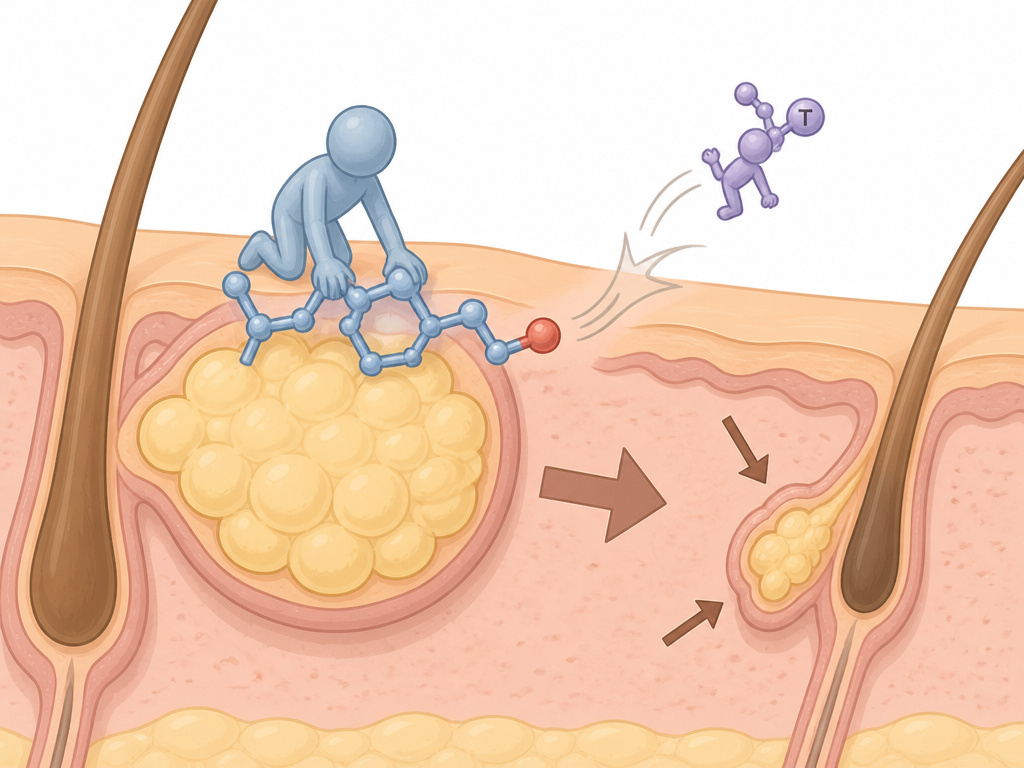
Let’s reset. Every discussion about Accutane and testosterone risks missing the forest for the trees. Isotretinoin is a retinoid, a derivative of Vitamin A. Its profound effect on severe acne comes from its ability to permanently shrink sebaceous glands and reduce sebum production by about 90%. The official FDA-approved isotretinoin prescribing information is unambiguous: “The exact mechanism of action of isotretinoin is unknown.”
Common mistake: Confusing correlation with causation. Because Accutane can affect some androgen levels and it clears acne, people assume it works like hormonal therapy. It doesn’t. Hormonal therapies for acne (e.g., birth control, spironolactone) target the androgen receptor directly. Accutane targets the gland’s size and activity.
The hormonal changes we see are likely side effects of this massive shift in skin biology, not the primary therapeutic action. Your skin is a major site of androgen metabolism. When you dramatically alter its architecture and oil output, it makes sense that local hormone conversion gets disrupted. This spills over into measurable blood changes sometimes, but it’s a downstream consequence.
This is why comparing Accutane to true testosterone-lowering medications is misleading. Drugs like opioids or glucocorticoids directly suppress the hypothalamic-pituitary-gonadal (HPG) axis. Accutane doesn’t work that way. Its mechanism is localized to the skin, which is why its systemic hormonal impact is inconsistent and secondary.
Managing Low-T Symptoms During Treatment
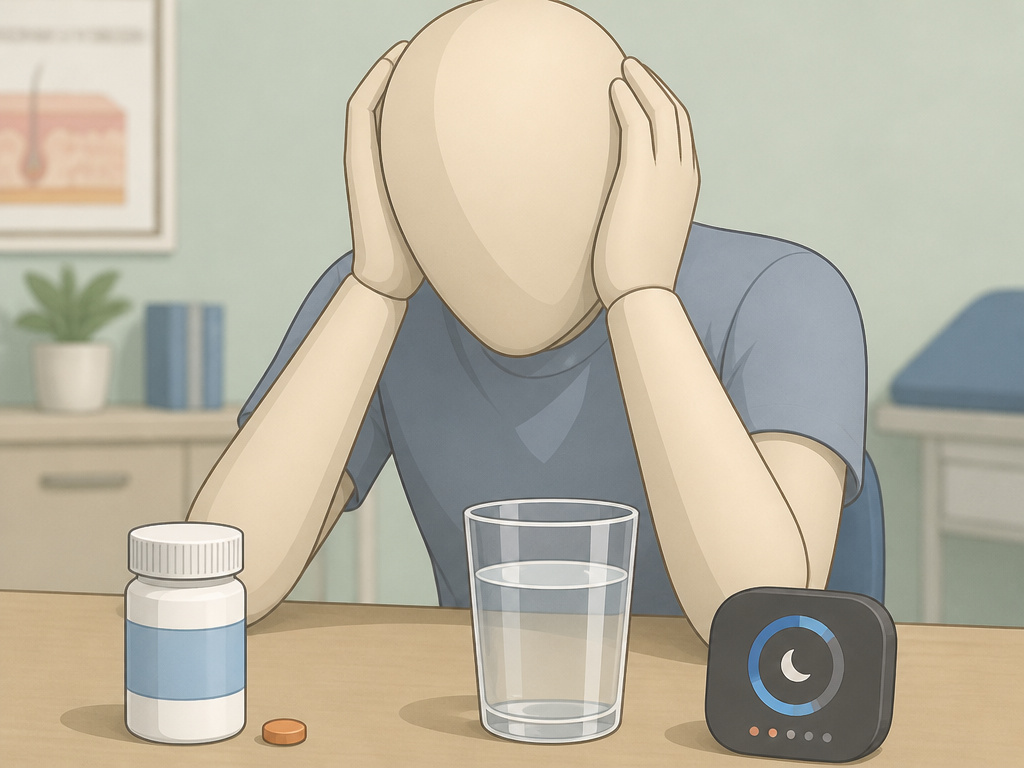
So you’re on Accutane, and you’re feeling fatigued, foggy, or dealing with a low libido. Your first thought might be, “My testosterone is crashing.” It’s a logical fear, but it’s not the only possible cause, or even the most likely.
The medication itself is harsh. Common side effects include profound dryness, joint aches, headaches, and mood changes. Fatigue and low mood are listed side effects independent of any proven hormonal cause. Before you assume it’s your hormones, rule out the basics that get overlooked when you’re focused on a pill and your skin.
- Sleep Quality: Isotretinoin can cause dryness in mucous membranes, leading to poor sleep from chapped lips, nosebleeds, or general discomfort. Track your hours and how rested you feel.
- Diet and Hydration: The drug is fat-soluble and should be taken with a high-fat meal for absorption. If you’re taking it on an empty stomach or not drinking enough water to combat dryness, your energy will plummet.
- Underlying Mood: There is a documented, though complex, link between isotretinoin and mood changes. Feelings of depression or anxiety can manifest as fatigue and kill libido.
I learned this the hard way with other supplements. The usual advice when energy is low is to add more pills. In my case, it was inconsistent sleep timing, and fixing that did more than anything on my shelf. The principle is the same here: test one variable at a time.
If you’ve checked these boxes and symptoms persist, that’s the time to talk to your doctor. Do not order your own hormone tests and self-interpret. The fluctuations we’ve discussed mean that a single snapshot is hard to interpret without clinical context. Your dermatologist or GP can help decide if testing is useful and, more importantly, if your dose needs adjustment or if the symptoms warrant stopping the drug.
How This Compares to Other Acne Treatments
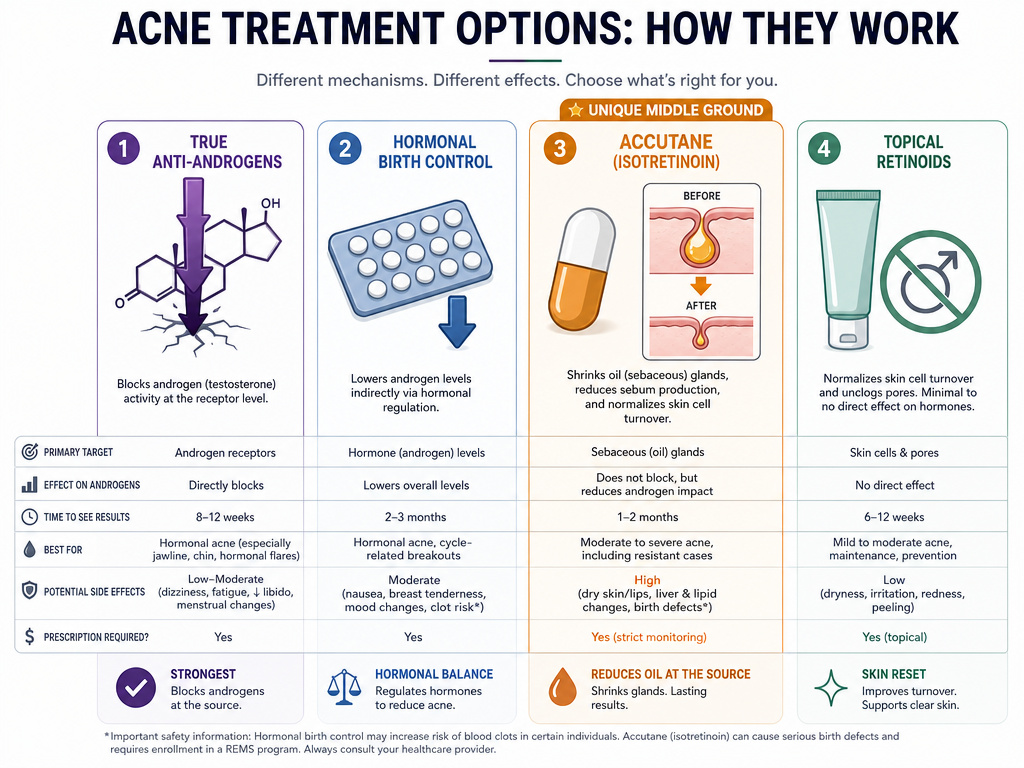
If you’re worried about hormonal impact, it helps to see where Accutane fits on the spectrum. It’s not in the same category as direct hormonal therapies.
True Anti-Androgens (e.g., Spironolactone): These are prescription drugs lowering testosterone (or blocking its receptor) as their primary mechanism. They are used off-label for women with hormonal acne and will cause predictable, significant changes in androgen levels. This is a deliberate hormonal intervention.
Hormonal Birth Control: Certain pills suppress ovarian androgen production, lowering testosterone as a direct effect to clear skin.
Topical Retinoids (Tretinoin, Adapalene): Like Accutane, these are vitamin-A derivatives, but they work only on the skin’s surface. They have no measurable systemic hormonal effect.
Accutane (Isotretinoin): Sits in the middle. It’s systemic and can cause secondary hormonal ripples, but its core job is gland shrinkage, not hormone suppression. Its profile is unique, more systemic impact than a topical, but a different kind of impact than a true anti-androgen.
For men specifically, the choice is often between Accutane and long-term antibiotics. When you view it through that lens, Accutane’s potential for a short-term, reversible hormonal ripple might be weighed against the gut microbiome disruption and antibiotic resistance risk of long-term tetracyclines. It’s not a simple choice, but understanding the mechanism helps frame the trade-offs, especially if you’re already managing conditions like acne on TRT.
Impact on male fertility and sperm health
The fact sheet contains no specific data on Accutane’s effects on male fertility or sperm parameters. The primary study referenced focuses on hormonal changes in women. Because the exact mechanism of action of isotretinoin is unknown, its direct impact on male reproductive health is not clearly defined by these sources. If you are concerned about fertility while using this medication, this is a critical topic to discuss with your prescribing doctor. They can provide guidance based on your individual health profile and the most current clinical information.
Dosage and individual variability in hormonal response
Standard dosing for Accutane is based on body weight, and adjustments can be made for severe cases. The PMC7105656 study used a fixed daily dose of 20 mg for three months in women and found specific changes in testosterone, DHT, and DHEA. In that study, serum levels of testosterone, DHT, and prolactin significantly decreased, DHEA significantly increased, and no significant change was found in free testosterone, 17-hydroxyprogesterone, LH, or FSH levels. This highlights individual variability. Your hormonal response to the medication may depend on your dosage, treatment length, baseline hormone levels, and personal physiology. Discussing these factors with your doctor can help set realistic expectations.
Frequently Asked Questions
Does Accutane ruin testosterone?
No, evidence does not suggest it “ruins” testosterone. Studies show effects are often modest, potentially reversible, and not the drug’s intended action. Any changes observed during treatment typically return to baseline after the course is completed, as the drug leaves your system.
How does Accutane affect males?
Research in males is mixed. Some studies show no significant change in total testosterone levels. The more consistent finding is a reduction in dihydrotestosterone (DHT), a potent androgen derived from testosterone that drives sebum production and oily skin. This local DHT reduction in the skin is likely a key part of how it clears acne without broadly suppressing systemic testosterone.
Does Accutane mess with your hormones?
It can cause measurable changes in certain hormones, like DHT, DHEA, and prolactin, as seen in studies. However, “messing with” implies a disruptive, primary action. Accutane’s main target is the sebaceous gland; hormonal shifts are secondary effects of altering skin biology. It does not work like a traditional hormone therapy.
Does Accutane fix TRT acne?
It can be a highly effective treatment for TRT-induced acne, which is often driven by high conversion of testosterone to DHT in the skin. By reducing sebum production and potentially lowering local DHT levels, Accutane can clear severe acne that doesn’t respond to topicals. It’s considered a nuclear option due to its side-effect profile, but it works when other treatments fail. Anyone on TRT considering it must coordinate closely between their dermatologist and hormone doctor.
Before You Go
The data shows Accutane’s relationship with testosterone is a side conversation, not the main event. It’s a reminder that when you change one major system in your body, like your skin’s oil production, other systems can echo the change.
If you take one thing from this, let it be this: track your symptoms, not just your assumptions. Fatigue on Accutane is more likely from poor sleep due to dry sinuses than from a 25% drop in a hormone you haven’t measured. The drug has a long list of well-documented side effects that perfectly mimic low-T symptoms.
For men concerned about hormones, the bigger picture is your overall stack. Are you on other medications known to affect testosterone? Have you checked your Vitamin D or zinc status? These are the levers that, for most people, have a larger and more predictable impact on hormonal health than a temporary course of isotretinoin. Start with the simple, consistent things first. The evidence for them is far less conflicting.
