
Does Cardio Lower Testosterone? The Evidence-Backed Answer
This post contains affiliate links. As an Amazon Associate, we earn from qualifying purchases.
A single cardio session typically causes a brief testosterone spike followed by a return to baseline within an hour, but chronic, high-volume endurance training can suppress resting levels in some men. The effect flips for men with obesity or type 2 diabetes, where cardio often raises low testosterone. The answer hinges on your training volume, intensity, recovery, and starting health.
That distinction between a temporary workout response and a lasting change in your baseline is where the does cardio lower testosterone question lives. The headline “cardio kills testosterone” usually points to studies of elite endurance athletes, while the claim “cardio boosts T” often cites research on metabolically unhealthy men. Your own result sits in the middle, dictated by dose.
What follows breaks down the specific numbers from the clinical trials: the 35-mile-a-week threshold linked to decreases, the 370-minute weekly dose that left total testosterone unchanged, and the 14.5% DHT increase in a year-long study. We’ll also cover how to structure your training to support, not sabotage, your hormonal health.
Key Takeaways
- The acute post-workout testosterone spike is short-lived and has little bearing on long-term muscle growth or hormonal health.
- Chronic suppression is linked to high-volume endurance training, with one classic study noting decreases at volumes around 35 miles of running per week.
- For men with obesity or type 2 diabetes, aerobic exercise is a therapeutic intervention that moderately increases testosterone concentrations.
- Recovery is essential. Extended high-intensity work can suppress testosterone via elevated cortisol for up to 72 hours.
- The most balanced approach for hormonal health combines resistance training with moderate cardio (like Zone 2 work) and prioritizes sleep and nutrition.
The Acute vs. Chronic Timeline
You finish a hard run and feel amped up. That sensation has a hormonal component, a transient rise in testosterone. A 2024 systematic review in Frontiers in Physiology notes this spike typically subsides within 1 hour after moderate aerobic exercise. Your body treats it as a short-term stressor, mobilizing resources.
Testosterone levels typically recover within 1 hour after aerobic exercise, but extended high-intensity exercise can cause suppression during recovery for up to 72 hours.
This is the critical separation: the acute response versus the chronic adaptation. The one-hour bounce-back is normal physiology. The problem starts when you don’t allow for that recovery. The same review points out that prolonged, intense sessions, think a marathon or a multi-hour cycling race, can flip the script. Cortisol, the primary stress hormone, stays elevated and antagonizes testosterone production, leading to a suppression window that can last up to three days.
That’s the mechanism behind “overtraining” symptoms: stacking hard cardio days without adequate rest can lead to hormonal changes, as extended high-intensity exercise can cause testosterone suppression during recovery for up to 72 hours. It’s not that cardio is inherently bad; it’s that excessive volume without recovery is.
What the Long-Term Studies Actually Show
Here’s where the research gets messy, because the population studied changes everything. You can’t compare a sedentary office worker starting to jog with a collegiate rower in peak training season when you consider the does cardio lower testosterone outcome.
We’ll begin with the study that fuels the “cardio lowers testosterone” fear. A 1991 randomized controlled trial had previously sedentary men ramp up to running an average of 56 km (about 35 miles) per week over six months. At that volume, their total testosterone and free androgen index dropped significantly. This is the classic high-volume endurance model.
But then a 2012 12-month clinical trial prescribed a different dose: 60 minutes a day, 6 days a week of moderate-to-vigorous aerobic exercise. The participants actually averaged 370 minutes per week, exceeding the goal. After a full year, this regimen had no significant effect on total testosterone. It did, however, increase DHT (a more potent androgen) by 14.5% at 3 months and 8.6% at 12 months.
Why the different results? The 1991 study used a running-only protocol. The 2012 trial prescribed ‘moderate/vigorous-intensity aerobic activity’. The dose and the nature of the stressor differed.
| Study & Population | Cardio Protocol | Effect on Resting Total Testosterone |
|---|---|---|
| Sedentary Men (1991 RCT) | ~35 miles/week running for 6 months | Significant decrease |
| General Men (2012 RCT) | 370 min/week moderate aerobic for 12 months | No significant change |
| Male Rowers (2023 Study) | Competitive season training | Decrease from 7.12 to 6.59 ng/mL |
| Men with Obesity/T2D (2024 Meta-Analysis) | Aerobic exercise training | Moderate increase |
The most recent data adds another layer. A 2023 study on competitive male rowers showed their testosterone declined over a season, with SHBG (sex hormone-binding globulin) also dropping. Meanwhile, a 2024 meta-analysis in Sports Medicine found that for men with obesity or type 2 diabetes, aerobic exercise moderately increased testosterone. For them, cardio is medicine, correcting a metabolic dysfunction that was suppressing their hormones in the first place.
Cardio vs. Weights for Hormonal Impact
This is the comparison most guys are actually trying to navigate. Should you skip the treadmill to protect your gains? The hormonal pathways for cardio and resistance training are different, and they aren’t mutually exclusive.
This is a signal for muscle protein synthesis. It’s a positive feedback loop: lifting supports hormones that support more lifting.
Aerobic exercise, particularly in the lower-intensity “Zone 2” heart rate zone, works differently. Its primary hormonal benefit is improving metabolic health, increasing insulin sensitivity, improving blood lipid profiles, and reducing visceral fat. Since excess body fat is associated with lower testosterone, losing fat through cardio can help support healthy hormone levels.
Where this goes sideways: Piling high-volume, high-intensity endurance work on top of a heavy lifting regimen while in a calorie deficit. This triple stressor, metabolic, mechanical, and psychological, is a surefire way to elevate cortisol and suppress your HPG axis.
The winner isn’t one or the other. For overall hormonal health, strength training builds the anabolic foundation, and moderate cardio protects the metabolic environment that foundation sits on. Dropping cardio entirely to “save testosterone” ignores the fact that poor metabolic health is a major driver of low T in the general population.
How Much Cardio Is Too Much?

There is no universal number, but the research gives us guardrails. The 1991 study’s 35 miles per week of running (roughly 5 miles, 5 days a week) is a reasonable upper-bound threshold for noticing potential suppression in a previously untrained person. For general health, the 2012 trial’s ~300-400 minutes per week of moderate activity showed no negative impact and some positive androgen changes.
The more practical framework isn’t about minutes alone; it’s about managing total stress load and recovery. This includes your lifting volume, your job stress, and your sleep.
- This improves cardiovascular health and recovery without imposing a significant neuroendocrine stress.
- Signs you’re overdoing it: Persistent fatigue, irritability, decreased libido, insomnia, and a plateau or regression in strength. These are signs of elevated cortisol and possible HPG axis suppression.
- The essential rule: Your calorie intake must support your activity. Combining heavy training with severe dieting is perhaps the most common way men tank their hormones.
I learned this through my own miscalculation. I skipped cardio for years, buying into the idea it would hurt my progress. When I finally added three easy Zone 2 bike sessions per week, my recovery between heavy lifting days actually improved. The trouble, in my experience, comes from piling high-volume, hard endurance work on top of heavy lifting and under-eating.
Special Populations and Edge Cases
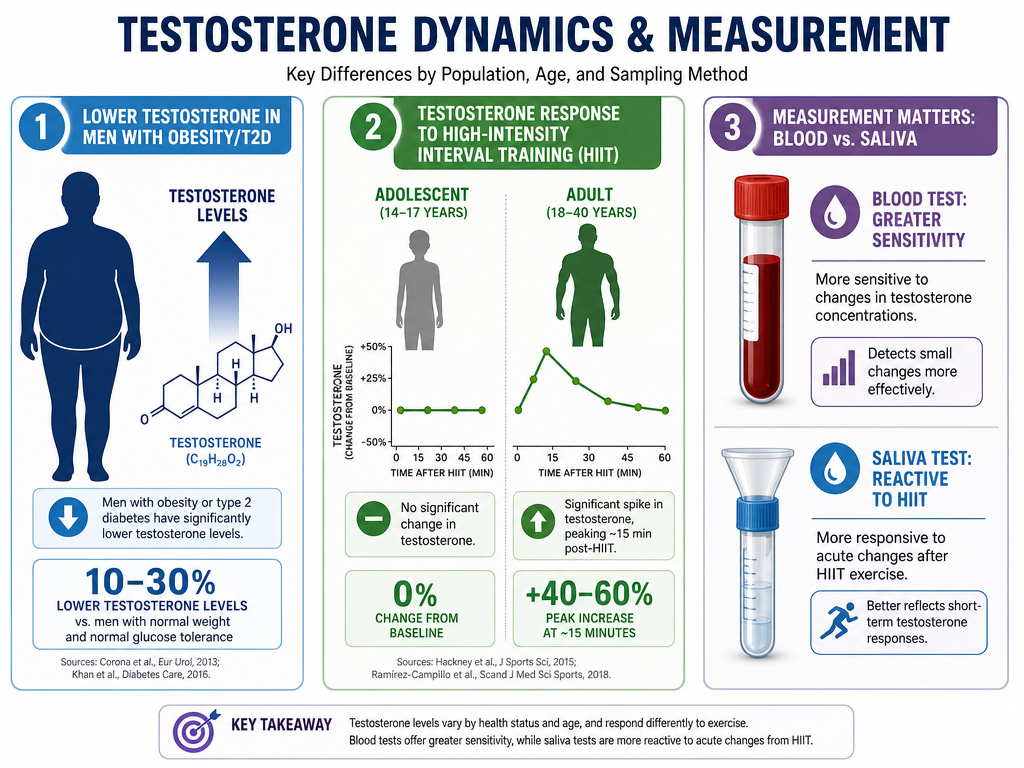
The “does cardio lower testosterone” question has two major exceptions that flip the answer on its head. Ignoring these is how oversimplified advice gets people into trouble.
First, men with obesity or type 2 diabetes. For this group, the baseline issue is often insulin resistance and chronic inflammation, which directly suppress Leydig cell function in the testes. For this group, a 2024 meta-analysis finds aerobic exercise moderately increased testosterone concentrations. For them, not doing cardio is what keeps testosterone low.
Second, adolescents versus adults. That 2024 systematic review also noted the acute testosterone response to exercise is negligible in adolescents compared to young adult males. Their hormonal systems are still developing and respond differently.
Finally, even how you measure matters. The same review states that blood tests have greater sensitivity for detecting changes in testosterone, while saliva tests are more reactive to high-intensity exercise. If you’re tracking your levels, know that the testing method influences the result.
A Sensible Plan for Balanced Training

The goal isn’t to avoid cardio; it’s to integrate it intelligently so it supports your hormonal and overall health. This plan prioritizes recovery and mitigates unnecessary stress.
1. 2. 3. 4. 5. 6.
Does lifting weights increase testosterone?
A 2021 meta-analysis concludes exercise training has a negligible effect on resting total testosterone in insufficiently active, healthy men. This means that while a challenging resistance workout may cause a temporary, acute rise in hormones, it is unlikely to permanently raise your baseline testosterone.
How does HIIT affect testosterone?
The acute testosterone response to exercise varies. A 2024 review notes that blood tests are more sensitive for detecting these changes, though saliva tests may react more to high-intensity bouts. Recovery is the central idea: while moderate exercise may cause a testosterone spike that subsides within an hour, extended high-intensity exercise can lead to a suppression of testosterone during recovery for up to 72 hours. Therefore, the impact of HIIT depends heavily on the session’s duration and intensity, as well as the recovery period that follows. Structuring HIIT with adequate rest is crucial to avoid extended hormonal suppression.
What affects how exercise changes testosterone?
Several factors determine your hormonal response to training. Age is a major one; the acute testosterone spike from exercise is negligible in adolescents compared to a more pronounced response in younger adult males. Your starting health and fitness level also matter. While research shows inconsistent effects in healthy men, aerobic exercise can moderately increase testosterone in men with conditions like obesity or type 2 diabetes. Also, the type and volume of exercise are critical. A 1991 study found significant decreases after high-volume endurance training, while a 2012 study of moderate aerobic activity found no significant effect on total testosterone. Individual responses vary widely.
Frequently Asked Questions
Is cardio bad for testosterone levels?
For the average person doing moderate amounts, no, it’s beneficial. Cardio becomes a potential problem at very high volumes characteristic of elite endurance athletes (e.g., running 35+ miles per week for months). For men with low testosterone related to obesity, cardio is often part of the solution.
What workouts decrease testosterone?
Workouts that drastically increase your total stress load without adequate recovery can decrease testosterone. This is less about a specific workout type and more about chronic overtraining: consistently combining high-volume weight training with high-intensity or long-duration cardio while in a calorie deficit and sleeping poorly.
Does 10,000 steps increase testosterone?
Directly, it’s unlikely to cause a significant spike. However, achieving a high daily step count is strongly associated with better metabolic health, lower body fat, and better sleep, all of which support healthy testosterone levels. It’s an indirect, foundational support.
What is the #1 testosterone killer?
Chronic, unmanaged life stress is arguably the most pervasive suppressor. This stress can be physical (overtraining, poor sleep), nutritional (severe calorie deficit), or psychological (job pressure, relationships). It all funnels through elevated cortisol, which directly inhibits testosterone production. You can’t out-train or out-supplement a high-stress lifestyle.
The Bottom Line
Cardio doesn’t have a single, universal effect on testosterone. It has a dose-dependent relationship mediated by your overall recovery status. The acute spike is meaningless for long-term levels. The chronic adaptation can be positive, neutral, or negative based on volume and your starting point.
If you’re a healthy man lifting weights, adding a few sessions of easy cardio each week will almost certainly help, not hurt, your hormonal health by improving your metabolic baseline. The 35-mile-per-week runner’s threshold is a useful warning sign, not a prescription for the average gym-goer.
Start by fixing the fundamentals you can control: get consistent, quality sleep, manage your life stress, and eat enough nutritious food. Then, add cardio thoughtfully, not fearfully. Your hormones are a reflection of your total environment, not just your time on the treadmill.
