
Does Intermittent Fasting Increase Testosterone?
This post contains affiliate links. As an Amazon Associate, we earn from qualifying purchases.
Intermittent fasting does not increase testosterone for everyone. The effect depends entirely on who you are and how you fast. For lean, active young men, multiple studies show it consistently lowers total and free testosterone. For obese men, it may increase levels or have no effect, primarily through weight loss. A single missed meal can cause an immediate drop, while longer protocols trigger different adaptations.
That’s the short, frustrating answer. The long one involves three variables: your starting body fat, the fasting method you pick, and whether you measure hormones after one day or eight weeks. The top search results often miss this nuance, presenting a simple “yes” or “no” that doesn’t match the messy human data.
What follows is a walk through that data. This review examines the studies that found decreases, those that found increases, and the major factor that explains the difference. By the end, you’ll know which camp you likely fall into and how to approach fasting without guessing about your hormones.
Key Takeaways
- The clearest signal for a testosterone decrease comes from studies on lean, active young men doing time-restricted eating.
- For obese men, fasting may lead to weight loss. One study found an 8-week trial of IF combined with resistance training resulted in a significant increase in testosterone levels within the IF group, though post-test levels were not significantly different from the control group doing resistance training alone.
- A single missed evening meal can cause a rapid drop in morning testosterone, showing the reproductive axis reacts quickly to acute energy deficits.
- Fasting impacts other critical hormones: it reliably lowers insulin and thyroid hormone (T3) while increasing cortisol, which complicates the overall picture.
- If you get bloodwork, time your test carefully. Fasting before a blood draw can skew your testosterone reading downward compared to your normal, fed state.
Does Intermittent Fasting Increase Testosterone? A Look at the Data
The evidence isn’t unified. It points in opposite directions because the people in the studies were not the same.
A 2022 review in Nutrients looked at human trials on intermittent fasting and reproductive hormones. Its conclusion for one group was blunt. The authors stated that time-restricted eating “consistently reduced total testosterone levels in lean, physically active, young men.” This happened across four trials lasting 4 to 44 weeks, even when the men were doing resistance training. Their weight loss was mild, just 1 to 3 percent, and they didn’t lose muscle, but their testosterone dropped.
This 2022 review of human trials concluded that time-restricted eating consistently reduced total testosterone levels in lean, active young males. In separate trials on lean, active young males, weight loss with TRE was mild (1–3% from baseline).
Now, open a different study. A 2022 trial had active young men follow a two-week time-restricted eating protocol, fasting from 8 a.m. To 4 p.m. This study reported an increase in fasting morning testosterone. Another study from 2026 on obese males found that eight weeks of intermittent fasting combined with resistance training led to a significant increase in testosterone within the fasting group.
So which is it? You have to look at the subjects. The first review focused on lean, already-active guys. The second study used active subjects for a two-week duration. The third study used obese men, where the benefits of weight loss can override other signals, making the does intermittent fasting increase testosterone query highly individual. The population dictates the result.
How Your Body Composition Changes the Outcome
This is the single most important variable. Your body fat percentage acts like a switch, changing how your endocrine system responds to a lack of food.
For men with obesity, intermittent fasting is often a tool for significant weight loss. Carrying excess fat promotes inflammation and increases the conversion of testosterone to estrogen. Shedding that fat can reverse those processes. In the 2026 study, an 8-week trial of intermittent fasting combined with resistance training resulted in a significant increase in testosterone levels within the IF group of obese males. The driving factor wasn’t the fast itself, but the weight loss and improved metabolic health that came with it.
For lean men, the story flips. Their bodies aren’t primed for fat loss as a primary signal. When you’re already at a low body fat percentage, an energy deficit, even a mild one from shortening your eating window, is read by the body as a potential threat to resources. The evolutionary priority shifts from reproduction (supported by high testosterone) to conservation. The hormone axis downregulates. This explains why the lean, active cohorts in studies saw drops in testosterone with minimal changes on the scale.
The takeaway is personal. If you are carrying excess body fat, the testosterone reduction from fat is likely a bigger problem for you than any temporary effect from fasting. If you are lean and active, introducing a daily fast might be the stressor that pushes your levels in the wrong direction.
The Acute Shock vs. The Chronic Adaptation
Your body’s response on day one is not its response on day thirty. This is the second major reason for conflicting data.
Think about a single missed meal. A 2011 study had young men skip their evening meal once. The next morning, their salivary testosterone was significantly lower than on baseline days. Their urinary luteinizing hormone (LH), the brain signal that tells the testes to produce testosterone, also dropped. This is the acute shock: the reproductive axis is sensitive and reacts to a short-term energy deficit by dialing back production.
Now, stretch that deficit into a scheduled, weeks-long protocol. The body adapts. The initial “alarm” state may settle. In the two-week study that showed an increase, the subjects’ bodies had time to adjust to the new eating schedule. The key is that the acute dip and the chronic change are measuring two different physiological states.
This is why asking the does intermittent fasting increase testosterone question is too simple. You must also ask “when?” and “for how long?”.
The Other Hormones in the Room: Insulin, Cortisol, and Thyroid
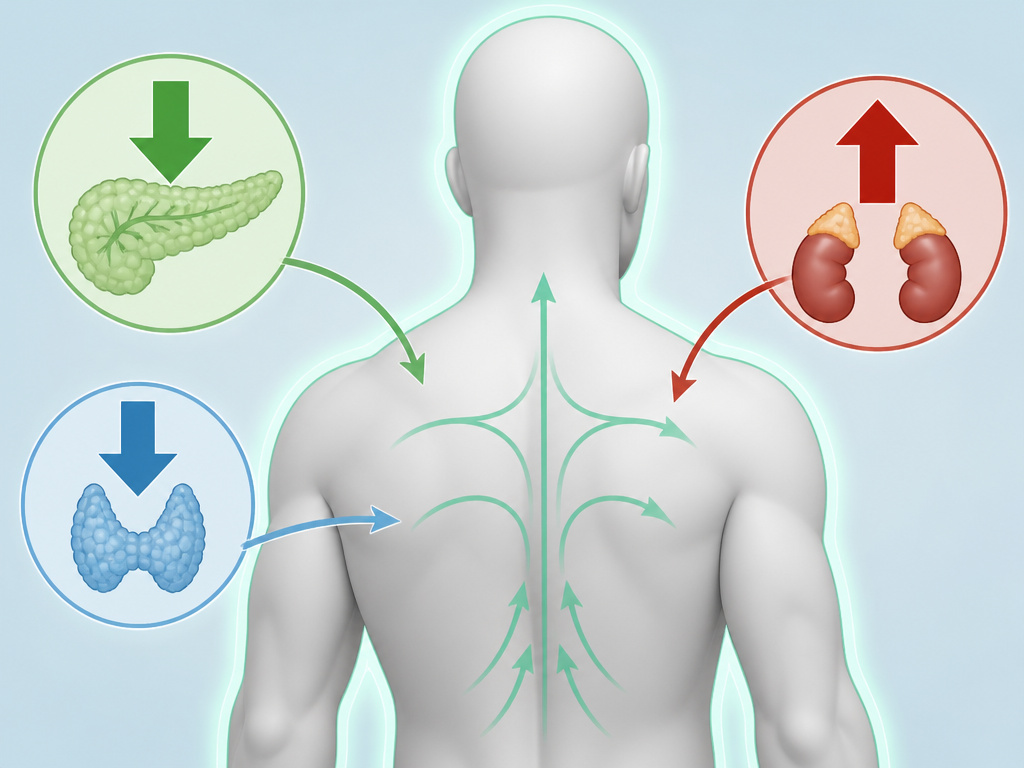
Testosterone doesn’t exist in a vacuum. Fasting powerfully affects several other hormones that create the overall hormonal environment. Ignoring them gives you an incomplete picture.
Insulin drops dramatically. During a 72-hour fast, plasma insulin dropped by about 35% during the first 24 hours and reached half of baseline levels by the end of fasting. Alternate-day fasting for 22 days dramatically suppressed insulin secretion by 50%. Lower insulin is generally good for metabolic health and can improve insulin sensitivity, which is beneficial for hormone function.
Thyroid hormone (T3) also falls. This is a conserved energy-saving measure. One study found serum T3 decreased up to 55% after 24 hours of fasting. 8-hour time-restricted eating for eight weeks reduced circulating T3. This drop correlates with a slower metabolism, which is part of why people often feel colder and have less energy when fasting long-term.
Cortisol rises. This stress hormone begins to increase immediately when fasting starts. A five-day fast increases cortisol levels and shifts the peak from the morning to the afternoon. Early TRF (feeding between 8:00 AM–2:00 PM) for 4 days slightly but significantly increases serum cortisol levels in the morning.
So, you have a cascade: lower anabolic signals (testosterone, T3), higher catabolic stress (cortisol), and improved metabolic efficiency (low insulin). For a lean person, this cascade might tilt too far toward stress and conservation. For an obese person, the metabolic improvements might outweigh the downsides.
A Practical Guide to Fasting (If You Care About Testosterone)
Given the complexity, here’s a decision framework. It’s based on the evidence, not on biohacking trends.
First, be honest about your starting point. Use a body fat estimate or simply look at your waistline. If you have significant weight to lose, the benefits of fasting for losing weight likely outweigh the risks of a temporary hormonal dip. Your primary goal should be improving metabolic health, which will raise your hormonal baseline.
If you are lean and active, ask yourself why you want to fast. If it’s for body composition, know that the effects of a calorie deficit are potent. A sustained deficit, however you create it, will likely lower your testosterone. The fasting method isn’t the magic part; the energy shortage is.
Second, choose your method with the hormone data in mind.
| Fasting Method | Best For | Potential Hormone Impact |
|---|---|---|
| 16:8 Time-Restricted Eating | Beginners, weight loss in obese individuals. | Risk of lowering T in lean men; may improve T in obese men via weight loss. |
| Early TRE (8 a.m.–2 p.m.) | Those wanting to align with circadian rhythm. | Higher chance of increased cortisol; limited long-term T data. |
| Alternate-Day Fasting | Significant, rapid weight loss. | Dramatic insulin suppression; strong stress (cortisol) response; not studied long-term for T. |
| 5:2 Diet | Sustainable weekly calorie reduction. | Promotes weight loss; one study showed increased SHBG in women after 24 weeks. |
Third, support the process. Do not fast in a severe calorie deficit for months. Ensure adequate dietary fat and protein intake during your eating windows. Consider a targeted multivitamin for fasting to cover micronutrient gaps that could further stress your system.
How to Time Your Testosterone Blood Test

This is a common point of confusion that most guides ignore. If you get your blood drawn while in a fasted state, you are capturing a snapshot of your “energy-conservation” hormone profile, not necessarily your everyday baseline.
The acute study proves this: a single missed evening meal lowered morning testosterone. If you fast for 12-16 hours before your 8 a.m. Lab appointment, you might see a lower number than if you had eaten a normal dinner and breakfast, as a single missed evening meal led to a significant decrease in morning salivary testosterone.
Common mistake: Getting a testosterone blood test after a 12-hour fast. This can capture the acute suppression from missing a meal, giving you a reading that doesn’t reflect your typical, fed hormone levels.
For the most accurate picture of your baseline, try to mimic your normal routine. If you usually eat breakfast, have it before your test. If you want to see the impact of your fasting protocol, get tested at the end of your fasting window, but be sure to compare it to a test taken under the same conditions next time. Consistency is more important than an arbitrary “fasted” state.
How Testosterone Works in the Body

Testosterone is a key hormone for muscle growth, bone density, and libido. It’s produced primarily in the testes in men and in smaller amounts in the ovaries and adrenal glands in women. The process is regulated by signals from the brain. Fasting can influence this system, as seen when a single missed evening meal led to a significant decrease in morning salivary testosterone and a drop in urinary LH, a hormone that signals testosterone production. However, other fasting patterns can lead to different outcomes, showing the body’s hormonal response is sensitive to the timing and duration of fasting.
What Is Intermittent Fasting and How Is It Done?
Intermittent fasting is an eating pattern that cycles between periods of fasting and eating. Popular methods include time-restricted eating, where you consume all your daily calories within a specific window like 8 hours, and alternate-day fasting, which involves alternating between fasting days and regular eating days. Studies have examined various approaches, such as an 8-hour eating window, a 4:3 schedule (fasting three days a week), and even eating all food before 4 pm. The effects on hormones like testosterone can vary significantly depending on the specific method used, the duration, and the individual’s starting point.
Common Side Effects When Starting to Fast
When beginning intermittent fasting, people often report side effects like headaches, fatigue, and irritability. These are common as the body adjusts to new eating patterns. Research on fasting shows it triggers hormonal shifts that may contribute to these feelings. For instance, cortisol, a stress hormone, begins to increase immediately after fasting starts and can shift its daily peak. Thyroid hormone levels can also drop during fasting periods. To manage these effects, start with shorter fasting windows, stay hydrated, and ensure you eat nutrient-dense foods during your eating periods. If side effects persist, consider adjusting your approach.
Frequently Asked Questions
Does a 16-hour fast increase testosterone?
Not reliably. For lean men, a daily 16-hour fast may decrease testosterone over time, as shown in studies on time-restricted eating. For obese men, the weight loss from consistent 16-hour fasting can improve metabolic health and potentially increase testosterone as a secondary effect. The duration of the fast is less important than your body’s overall energy balance and composition.
Why is 16 hours the magic number for fasting?
The “16-hour” mark is popular because it’s long enough to deplete liver glycogen and increase fat burning (a state called ketosis) for many people. It’s also socially practical, skipping breakfast and eating between noon and 8 p.m. This window aligns with the circadian rhythm theory that eating earlier in the day is beneficial. However, from a testosterone standpoint, there’s no clinical evidence that 16 hours is a special threshold for hormone optimization.
What is the best intermittent fasting method for testosterone?
There is no single “best” method. For obese individuals seeking weight loss, any method you can stick to (like 16:8 or 5:2) that creates a sustained calorie deficit is beneficial. For lean, active men concerned about testosterone, the best approach may be no daily fasting at all, or a very short feeding window (like 14 hours) that minimizes energy stress. Your body composition is the deciding factor.
Can intermittent fasting lower testosterone permanently?
The studies show changes during the intervention periods. There is no evidence from human trials that the testosterone changes from intermittent fasting are permanent after you resume a normal, calorie-adequate eating pattern. Hormone levels are dynamic and should recover once the stress of the energy deficit is removed, provided there are no underlying health issues.
Before You Go
If you take one thing from this, let it be this: your current body fat percentage is the lens through which you should view all fasting advice.
If you have weight to lose, stop worrying about a temporary hormone dip. Focus on using fasting as a sustainable tool to create the calorie deficit you need. The long-term hormonal upgrade from losing fat will far outweigh short-term fluctuations. Pair it with a testosterone-supporting diet full of nutrient-dense foods.
If you’re already lean, the calculus changes. The mild energy deficit from a daily fast is more likely to be a stressor than a benefit for your testosterone. Your goal should be fueling performance and recovery, not chasing an eating window that might undermine your hormonal baseline. In that case, your best “fasting” protocol might be a consistent 12-hour overnight window, with plenty of carbohydrates and healthy fats during the day to signal abundance.
The research is clear on one final point: extreme, prolonged calorie restriction is damaging. Don’t let a fasting protocol become a disguise for under-eating. That path leads to low energy, high cortisol, and low testosterone, no matter what the clock says.
