
Does the Carnivore Diet Increase Testosterone?
This post contains affiliate links. As an Amazon Associate, we earn from qualifying purchases.
The carnivore diet does not reliably increase testosterone. The best available evidence, a 2024 scoping review and a documented case report, shows no boost and a potential for decline. A single case saw total testosterone drop by half within three weeks on the diet. Any short-term perceived benefits are likely from weight loss or ketosis, not from the diet’s meat-only composition, and are offset by substantial long-term health risks.
That’s the direct answer. The idea that eating only meat will flood your system with testosterone is a powerful piece of dietary folklore, but it doesn’t hold up when you line up the numbers from blood tests and peer-reviewed journals.
The core mechanism everyone misses is sex hormone-binding globulin, or SHBG. This liver protein is the body’s thermostat for testosterone availability. When SHBG rises, it locks up more total testosterone, often leaving the amount your tissues can actually use, free testosterone, unchanged. Diets, especially extreme ones, shift SHBG first. The question of does the carnivore diet increase testosterone, or lack thereof, runs through this single protein.
What follows breaks down the three studies you need to know, explains why the carnivore vs. Vegan debate is a distraction, and gives you a realistic framework for testing any dietary change on your own hormones without wrecking your health in the process.
Key Takeaways
- The carnivore diet did not increase testosterone in the only published case report tracking it, where levels fell from ~600 to ~300 ng/dL in three weeks.
- Diet changes affect sex hormone-binding globulin (SHBG) first; this protein binds testosterone and often keeps free, usable levels stable despite total testosterone fluctuations.
- A 2024 scoping review in MDPI Nutrients concluded the carnivore diet carries substantial risks of nutrient deficiencies and elevated LDL cholesterol, and long-term adherence cannot be recommended.
- Observed short-term benefits like improved mood or energy are likely from ketosis and weight loss, not a specific testosterone-boosting property of meat.
- If you experiment, change one variable at a time, get baseline bloodwork, and retest after 8-12 weeks to see what actually moved for you.
What the Research Actually Shows
Forget the podcasts and social media testimonials for a minute. When you look for published, measurable data on the carnivore diet and testosterone, the pickings are incredibly slim. That alone is a red flag. Promoters have discussed whether the carnivore diet increases testosterone for years, but almost no one has published their bloodwork in a verifiable way.
We have three key pieces of evidence, and none support the idea that an all-meat diet boosts testosterone.
The Paul Saladino Case Report (2019): In the only detailed public case, total testosterone dropped from ~600 ng/dL to ~300 ng/dL three weeks after starting a carnivore diet of 3-4 lbs of meat per day.
First, the case report. In 2019, an independent blog analyzed blood tests shared by Paul Saladino, a prominent carnivore diet advocate. The data is stark. After three weeks of eating 3-4 lbs (1.35-1.8 kg) of meat per day, his total testosterone fell by roughly half. This is an N=1 study, just one person, so you can’t draw population-wide conclusions. But it’s the only real-world data we have, and it points in the opposite direction of the claim.
Second, the broader scientific review. A 2024 carnivore diet scoping review published in MDPI Nutrients (and hosted on the NIH’s PMC site) synthesized all available human studies. Its conclusion on hormones is telling: the quality of evidence is “very limited” due to tiny sample sizes and short durations. The review identified potential short-term benefits like weight loss but flagged “substantial risks” including nutrient deficiencies and elevated LDL cholesterol. It explicitly states, “At this time, long-term adherence to a CD cannot be recommended.” Not a word about testosterone increases.
Third, we have a counterintuitive comparison point. This isn’t a pro-vegan argument; it’s a demonstration of the SHBG mechanism. It shows that removing animal products can raise total testosterone, directly contradicting the carnivore premise. Both findings are explained by the same protein.
| Evidence Source | Key Finding on Testosterone | What It Actually Shows |
|---|---|---|
| Saladino Case Report | Total T dropped ~50% in 3 weeks. | A high-meat diet did not increase, and may have decreased, testosterone in one person. |
| 2024 Scoping Review | No evidence of a T boost; warns of long-term risks. | The scientific literature does not support the testosterone claim. |
| Vegan vs. Omnivore Study | Vegans had 7% higher total T and 13% higher SHBG than meat-eaters, with no difference in free T. | Diet composition changes SHBG and total T, but free testosterone remained the same. |
The link between dietary fat or dietary cholesterol and hormone production is real, but it’s not linear. Your body needs these nutrients to make testosterone, but there’s a ceiling. Once you’re meeting basic requirements, flooding the system with more steak and butter doesn’t trigger more production. It’s like trying to water a plant that’s already sitting in a full pot.
The Role of SHBG: The Real Hormone Regulator
If you take one thing from this article, let it be this: stop looking at total testosterone as the scoreboard. Your liver produces a protein called sex hormone-binding globulin (SHBG) that acts like a taxi service for testosterone and estrogen. When testosterone is bound to SHBG, it’s inactive, it can’t dock with receptors in your muscles, brain, or elsewhere. Only the small fraction that is “free” or loosely bound to albumin is biologically active.
This changes the entire diet conversation. The goal isn’t to maximize total testosterone; it’s to optimize free, bioavailable testosterone. And SHBG is the lever that controls that.
Diet-induced changes in SHBG are primary, leading to compensatory changes in total testosterone to maintain a stable level of circulating bioavailable androgens. This lack of effect may be partly explained by the body’s negative feedback mechanism.
That quote comes from a peer-reviewed hormone diet research article that reviewed decades of evidence. The body’s endocrine system is a closed-loop feedback system. It fights to keep free testosterone levels in a tight range. If your diet causes SHBG to spike (as seen in the vegan study and the Saladino case), your pituitary gland may signal your testes to produce more total testosterone to compensate, keeping free levels steady. The opposite can also happen. This is why two people on wildly different diets can have similar free testosterone levels.
So what moves SHBG? It’s less about meat vs. Plants and more about systemic factors:
- Liver function: SHBG is made in the liver. Anything that stresses it, certain medications, excessive alcohol, very high protein intakes, can affect production.
- Insulin resistance: Low insulin levels (as seen in ketosis or with significant weight loss) are associated with higher SHBG.
- Thyroid hormones: Hyperthyroidism increases SHBG; hypothyroidism decreases it.
- Major weight loss: This is a huge one. Losing a substantial amount of body fat reliably increases SHBG.
This last point is critical. Many people start a carnivore diet and lose weight quickly. If they get a blood test afterward, they might see higher total testosterone. But that increase is likely a side effect of the weight loss and the subsequent rise in SHBG, not a direct effect of ribeyes. It’s a correlation-causation error that fuels the hype.
Carnivore vs. Keto vs. Vegan: Untangling the Confusion
The diet wars online would have you believe your testosterone destiny is a simple choice: team steak or team salad. The data says it’s nowhere near that simple. The carnivore, ketogenic, and vegan diets all manipulate overlapping metabolic levers, and their effects on hormones often have more to do with those levers than with the presence or absence of a specific food group.
We need to separate the signal from the noise.
Carnivore and Keto: The Ketosis Overlap. The carnivore diet is often a de facto ketogenic diet because it eliminates carbohydrates. The initial “high” people report, more energy, mental clarity, is a classic symptom of entering nutritional ketosis, where the body burns fat for fuel. This state lowers insulin, which can raise SHBG.
The Vegan Paradox. The Cambridge study is the wrench in the gears. It found higher total T in vegans. However, a review of the evidence notes that observational studies have not demonstrated that variations in dietary composition have any long-term important effects on circulating bioavailable sex hormone levels in men. The proposed mechanism from the Cambridge study is that higher fiber and lower saturated fat intake may increase SHBG, and the body’s feedback loop may then increase total T production to maintain free T. This doesn’t mean a vegan diet is “better” for testosterone; it illustrates the complexity and shows the relationship between diet and total testosterone is not what the carnivore community claims.
The Common Thread: Calorie Balance and Weight. Across all these diets, the most powerful factor affecting testosterone is energy balance. Chronic calorie restriction, regardless of diet type, is a surefire way to suppress testosterone. This is where I got it wrong early on. I focused so hard on eating “clean” egg-white omelets and lean chicken that I accidentally undereat by 300-400 calories a day for months. My energy and drive flatlined. Conversely, someone who goes carnivore after coming from a standard American diet full of processed foods may start eating more protein and healthy fats, inadvertently fixing a calorie or nutrient deficiency. The perceived “boost” is just a return to baseline.
The real takeaway isn’t that one diet is the winner. It’s that the body’s priority is homeostasis. It will adjust SHBG and total testosterone to protect free testosterone levels. Obsessing over meat as the key misses the forest for the trees.
Substantial Risks Beyond Hormones
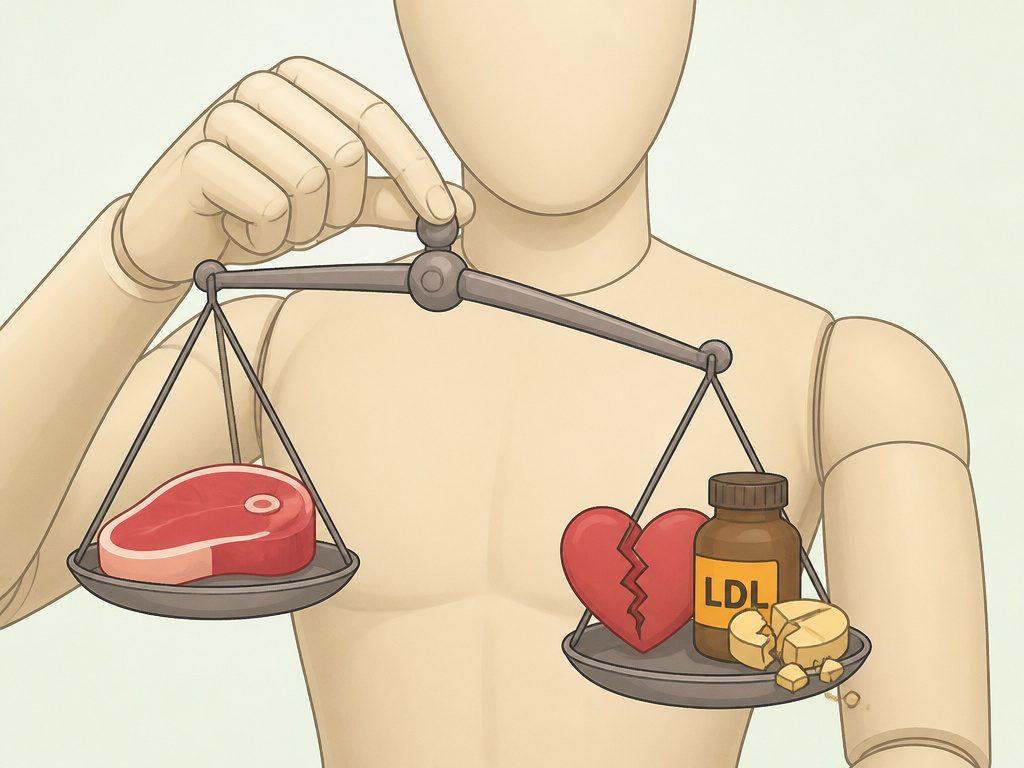
Focusing solely on testosterone is a dangerous way to evaluate any extreme diet. Your hormones are one system in a complex whole. The 2024 scoping review laid out a clear list of risks associated with long-term carnivore diet adherence, and they are not minor.
Where this goes sideways: Assuming short-term well-being guarantees long-term health. Nutrient deficiencies and elevated cardiovascular risk markers develop silently over months and years, not days.
The diet is, by design, deficient in several key nutrients found primarily in plants, including vitamins C and D, calcium, magnesium, iodine, and dietary fiber, as noted in a scoping review.
Perhaps the most significant risk is to cardiovascular health. The review noted that potential risks of the Carnivore Diet include elevated low-density-lipoprotein (LDL) and total cholesterol levels. While the long-term implications of very high LDL on an otherwise healthy, keto-adapted individual are debated, it is a measurable risk factor that requires monitoring. You are making a trade-off, and you need to know what’s on the other side of the scale.
You’re not supplementing to “boost” something; you’re supplementing to prevent a clinical deficiency. Even then, replicating the full spectrum of plant-based nutrients with pills is impractical and expensive.
A Practical Framework for Testing Diet & Hormones
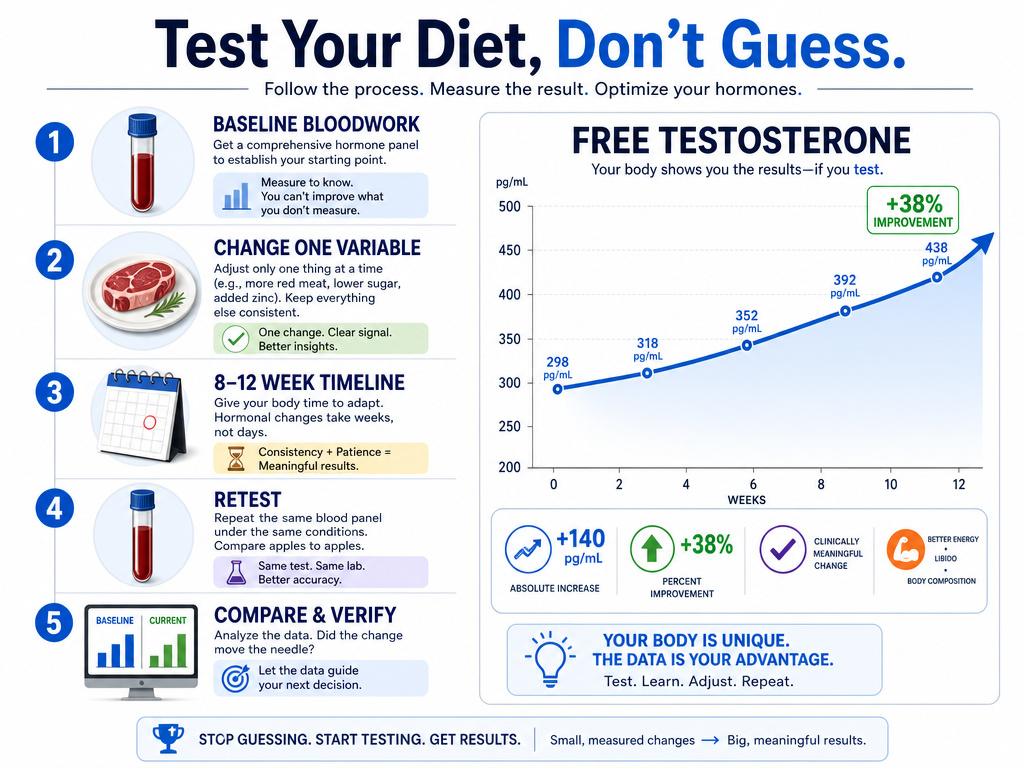
I don’t expect you to take my word for it, or anyone else’s. The only opinion that matters about your body is the one formed by your own data. If you’re curious about how a dietary change affects you, you can test it safely and intelligently. Throwing out all plant foods on day one is the opposite of that.
Here is a responsible, step-by-step approach. It’s boring. It requires patience. It works.
- Establish Your Baseline. Before you change a single thing, get full bloodwork. You must test Total Testosterone, Free Testosterone (preferably by equilibrium dialysis), and SHBG. A standard “testosterone test” often only gives you total, which is useless on its own. Also check lipids, liver enzymes, and a basic metabolic panel.
- Change One Major Variable. Do not overhaul everything at once. If you want to test lower carbs, reduce them gradually while keeping protein and fat consistent. If you want to test higher fat, increase it while watching carb and protein intake. This isolates the variable.
- Commit to a Minimum Timeline. Your body needs 8-12 weeks to adapt to a significant dietary change and for hormones to stabilize. Give it that time. Stick to the plan consistently.
- Retest and Compare. After 8-12 weeks, get the same bloodwork done. Compare the results to your baseline. Did free testosterone move? Did SHBG change? Did your LDL cholesterol spike?
- Listen to Your Body, But Verify. Note how you feel, energy, sleep, libido, digestion. Then see if those subjective reports align with the objective numbers. Often, they don’t.
I learned this the hard way with zinc supplementation. I took a high dose daily for months because I read it was great for testosterone. I felt nothing different, but I stuck with it. When I finally retested, my zinc levels were excessively high, my copper was low, and my testosterone was unchanged. I was solving a problem I didn’t have and creating a new one. The same principle applies to a wholesale diet change. You need the before and after picture.
Change one thing. Track it. Then decide.
Does the carnivore diet affect sperm health and fertility?
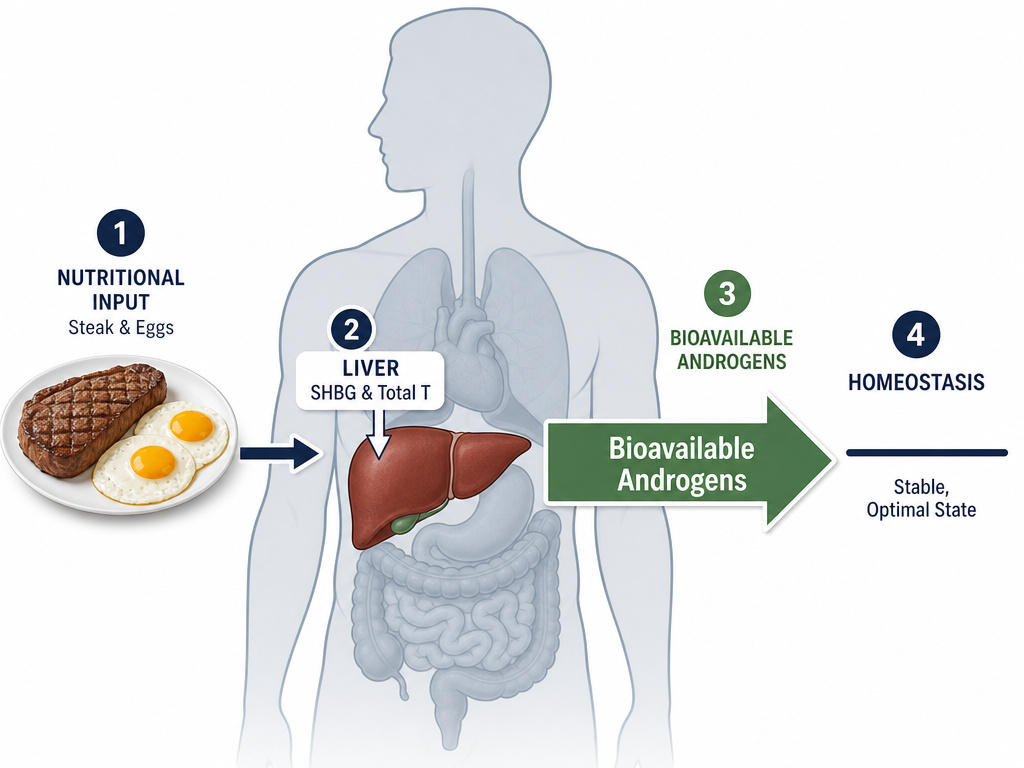
There is no specific research linking the carnivore diet directly to sperm health or fertility. The available evidence on diet and male hormones suggests that dietary changes primarily affect sex hormone-binding globulin (SHBG) and total testosterone, not the bioavailable hormone levels that tissues, including those involved in reproduction, can use. A review notes that the body’s negative feedback mechanism works to maintain stable levels of circulating bioavailable androgens. Given the carnivore diet’s substantial risks of nutrient deficiencies, particularly in vitamins and minerals that support overall health, any potential impact on fertility would likely be indirect through these nutritional gaps rather than a direct hormonal effect.
Can you do the carnivore diet while on Testosterone Replacement Therapy (TRT)?
No studies examine the carnivore diet’s interaction with TRT. The diet’s primary proposed hormonal mechanism involves changes in SHBG, which binds to testosterone. For men on TRT, exogenous testosterone can alter the body’s natural feedback loops. Introducing an extreme dietary pattern known to potentially elevate LDL cholesterol and cause nutrient deficiencies could complicate overall health management while on therapy. Practical guidance is to prioritize stability. Any major dietary shift while on TRT should be discussed with a healthcare provider to monitor lipids, nutrient status, and hormone levels, ensuring the therapy’s efficacy isn’t undermined by dietary-induced changes in health markers.
Frequently Asked Questions
Does the carnivore diet increase testosterone?
No, the carnivore diet does not reliably increase testosterone. The best available evidence shows no boost, and a documented case saw total testosterone drop by half within three weeks. Any perceived benefits are more likely from weight loss or entering ketosis than from the meat itself.
Why did Joe Rogan quit carnivore?
Some individuals have reported experiencing elevated LDL cholesterol levels while on the carnivore diet, which is a concern noted in the scientific review. This aligns with the “substantial risks” noted in the 2024 scoping review, which highlighted elevated LDL cholesterol as a common finding among carnivore diet adherents.
What diet produces the most testosterone?
No specific diet “produces the most” testosterone in a reliable way for everyone. The most reliable dietary support for healthy testosterone involves consuming adequate calories, sufficient protein (including sources like beef liver for nutrient density), healthy fats, and a variety of micronutrients while maintaining a healthy body weight. Chronic undereating or extreme restriction is the fastest way to lower it.
Are the benefits just from weight loss?
In many cases, yes. Significant weight loss, especially from a starting point of obesity, is one of the most potent ways to improve hormone profiles, including increasing SHBG and potentially total testosterone. The rapid initial weight loss on carnivore can create a false impression of a diet-specific testosterone effect when it’s really a weight-loss effect.
How long should I try it to see if it works for me?
If you are determined to experiment, commit to a minimum of 8-12 weeks for your hormones to stabilize. Crucially, you must get bloodwork (Total T, Free T, SHBG, lipids) done before you start and again after the 12-week period. Without before-and-after testing, you are guessing.
Before You Go
The carnivore diet for testosterone is a solution in search of a problem. The mechanism is misunderstood, the evidence is absent or negative, and the long-term risks are real and documented.
If your goal is to optimize your hormones, start with the fundamentals that have overwhelming evidence: prioritize sleep quality, manage chronic stress, lift heavy weights, and eat enough food to support your activity level. Get your vitamin D level checked. Before you spend a dollar on grass-fed ribeye or another supplement, get your vitamin D level checked to see where you actually stand.
The body’s hormonal system is robust and designed for stability. It resists dramatic shifts from a single dietary input. The promise of a simple, meat-based fix is compelling, but it’s a distraction from the more complex, less glamorous work of building sustainable health habits. That work doesn’t fit in a tweet or a podcast clip, but it’s the only thing that actually moves the needle.
