
HIV and Low Testosterone: Diagnosis, Treatment, and Safety
This post contains affiliate links. As an Amazon Associate, we earn from qualifying purchases.
HIV and low testosterone are closely linked, with a prevalence ranging from 13% to 40% in men aged 20-60. Diagnosis is complex because standard total testosterone tests miss up to 30% of cases due to elevated SHBG, making calculated free testosterone the more accurate measure. Treatment with testosterone replacement therapy (TRT) is effective, but requires specific thresholds and careful monitoring of cardiovascular and prostate health.
That wide range—13% to 40%—isn’t just statistical noise. It reflects a fundamental diagnostic split. Studies that defined low testosterone using free testosterone found higher prevalence rates than those using only total testosterone. The prevalence of hypogonadism is higher in studies that defined low serum testosterone using free testosterone than in those using total testosterone. This academic distinction determines whether a man is told his hormones are “fine” or gets an explanation for his crushing fatigue.
The rest of this guide walks through the evidence. This guide explains how common it is, why the standard lab test often fails this population, the specific thresholds that matter, and what treatment looks like when it’s done right.
Key Takeaways
- The reported prevalence of hypogonadism in men with HIV is between 13% and 40%, with a recent meta-analysis settling on 26%.
- Relying solely on a total testosterone test misses about 30% of cases because elevated SHBG can mask a true free testosterone deficiency.
- For symptomatic men with HIV, some research, such as a 2013 study in Postgraduate Medicine, suggests a free testosterone threshold below 100 pg/mL may be more appropriate, while the Endocrine Society guidelines use < 64 pg/mL.
- Secondary (hypogonadotropic) hypogonadism accounts for 80% to 100% of cases, indicating a problem with signaling from the brain to the testes.
- Follow-up for TRT must include checking PSA and hematocrit every six months initially, then yearly, due to the elevated cardiovascular risk profile in this population.
How Common Is Low Testosterone in Men with HIV?
The numbers tell a clear story about hiv and low testosterone, but you have to read them carefully. A recent meta-analysis in Frontiers in Endocrinology pinned the overall prevalence at 26%. Look closer, and that figure comes from a pool of studies showing a range from 13% to 40%.
Why the spread? It mostly comes down to what you measure. Studies that defined low testosterone using calculated free testosterone found higher rates. Studies using only total testosterone found lower ones. This lab technicality is central to why many men feel terrible but have “normal” lab reports.
A 2024 meta-analysis confirmed that the prevalence of hypogonadism is higher in studies using free testosterone than in those using total testosterone. This is due to frequent elevations in sex hormone-binding globulin (SHBG) in men living with HIV, which binds testosterone and makes less of it biologically available.
A commonly accepted estimate of hypogonadism prevalence before the introduction of combined antiretroviral therapy ranges from 30 to over 40%. The introduction of effective ART improved general health and brought that number down. But it’s crucial to understand that a 26% rate indicates hypogonadism is a common issue among men living with HIV. Hypogonadism in this context isn’t just about aging. It often appears earlier.
I spent about a year treating the lab’s printed range like a pass/fail line. Then I saw two guys with nearly identical total testosterone numbers, one barely functioning and one fine. The difference was their symptoms and their SHBG level, not the cutoff. My rule now: a number at the bottom of the range with no symptoms usually gets a recheck, not a fix. A mid-range number with fatigue, poor sleep, and low drive gets a closer look at free T and SHBG. This is especially true in the context of a chronic illness and low testosterone, where the body’s stress responses directly impact hormone production.
Why HIV Increases the Risk of Low T
The connection is not fully mapped, but researchers see several roads leading to the same destination in HIV and low testosterone, with rarely one single cause. Think of it as a functional hypogonadism—a system-wide issue driven by the body’s overall health status, not just a broken gland.
The primary mechanism is secondary hypogonadism, where the problem is in the brain’s signaling (the hypothalamus and pituitary), not the testes themselves. This accounts for 80% to 100% of overt cases. The body’s stress response from chronic infection and inflammation seems to dampen the signals that tell the testes to make testosterone.
A few key factors are in play:
- Chronic Inflammation: Even well-controlled HIV maintains a state of low-grade systemic inflammation. This inflammation can disrupt the hypothalamic-pituitary-gonadal (HPG) axis and also drive up SHBG levels.
- Medication Effects: Certain antiretroviral drugs, particularly older ones like efavirenz, have been associated with hormonal disruption. The data on modern regimens is less clear, but the long-term metabolic impact of any chronic therapy can play a role.
- Comorbidities and Frailty: Men with HIV often experience an accelerated aging process, accumulating conditions like cardiovascular disease, insulin resistance, and weight changes earlier. This cluster of health issues—sometimes called frailty or multimorbidity—is a known driver of low testosterone in any population.
- Direct Viral Impact: In rare cases, especially with advanced, uncontrolled infection, opportunistic infections can directly damage the testicles, causing primary hypogonadism.
This multifactorial origin is why the approach can’t be simplistic. You’re not just replacing a missing hormone. You’re often treating a hormone system that’s been suppressed by the body’s larger struggle. This interaction between testosterone and the immune system is a two-way street, where each influences the other.
Diagnosing Low T in HIV: Why the Standard Test Fails
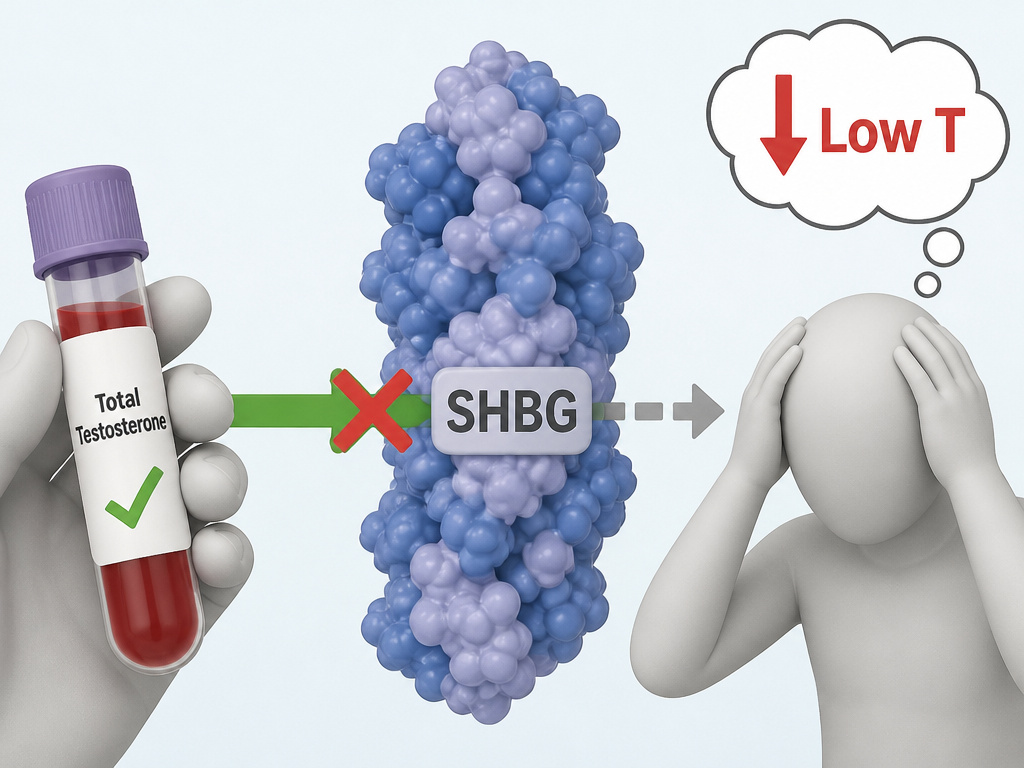
This is where most of the confusion and missed diagnoses happen. The standard playbook doesn’t work here.
The 2013 HIV Medicine Association primary care guidelines recommend measurement of morning serum total testosterone as the initial test. However, other analyses, such as a 2014 MACS study, conclude that using total testosterone alone misses many cases and that free testosterone is more sensitive. A 2014 analysis from the Multicenter AIDS Cohort Study (MACS) concluded that using total testosterone alone misses about 30% of cases among HIV-infected men. A 2021 study stated that ‘TT alone reliance may lead to half of diagnoses missing.’
The culprit is Sex Hormone-Binding Globulin (SHBG). This protein, produced by the liver, binds to testosterone in the blood. Only the unbound “free” testosterone is biologically active. In men with HIV, SHBG is often elevated due to chronic inflammation and other factors. The result? A man can have a normal total testosterone level but a critically low free testosterone level. Studies report 30-32% of HIV-infected men with biochemical hypogonadism have normal Total Testosterone but low Free Testosterone.
| Test | What It Measures | Pitfall in HIV | Why It Matters |
|---|---|---|---|
| Total Testosterone (TT) | All testosterone in blood (bound + free) | Elevated SHBG can make TT look normal while free T is low. | Misses up to 30-50% of true hypogonadism cases. |
| Calculated Free Testosterone (cFT) | Bioactive, unbound hormone. | Requires a separate SHBG test for calculation. | The gold standard for diagnosis in this population. |
| Luteinizing Hormone (LH) | Signal from pituitary to testes. | Distinguishes primary (high LH) from secondary (low/normal LH) hypogonadism. | Critical for understanding the cause. |
Where this goes sideways: Skipping the SHBG and free testosterone calculation. If you only check total testosterone, you risk a false reassurance that delays treatment for years while symptoms grind on.
The diagnostic process itself has specific rules:
- Timing: Blood must be drawn between 7 and 10 a.m., when levels are highest.
- Confirmation: A low level should be verified with a second test, at least a week apart, before diagnosis.
- The Full Picture: A baseline needs TT, SHBG (to calculate cFT), and LH. Early on, I skipped straight to the ‘what do I take’ question. Now I see a baseline comes first. LH and FSH are the part everyone forgets. Low T with high LH points one direction (testicular issue), low T with low or normal LH points another (brain signaling issue). That single split decides the entire treatment conversation.
What Thresholds Actually Matter for Diagnosis?
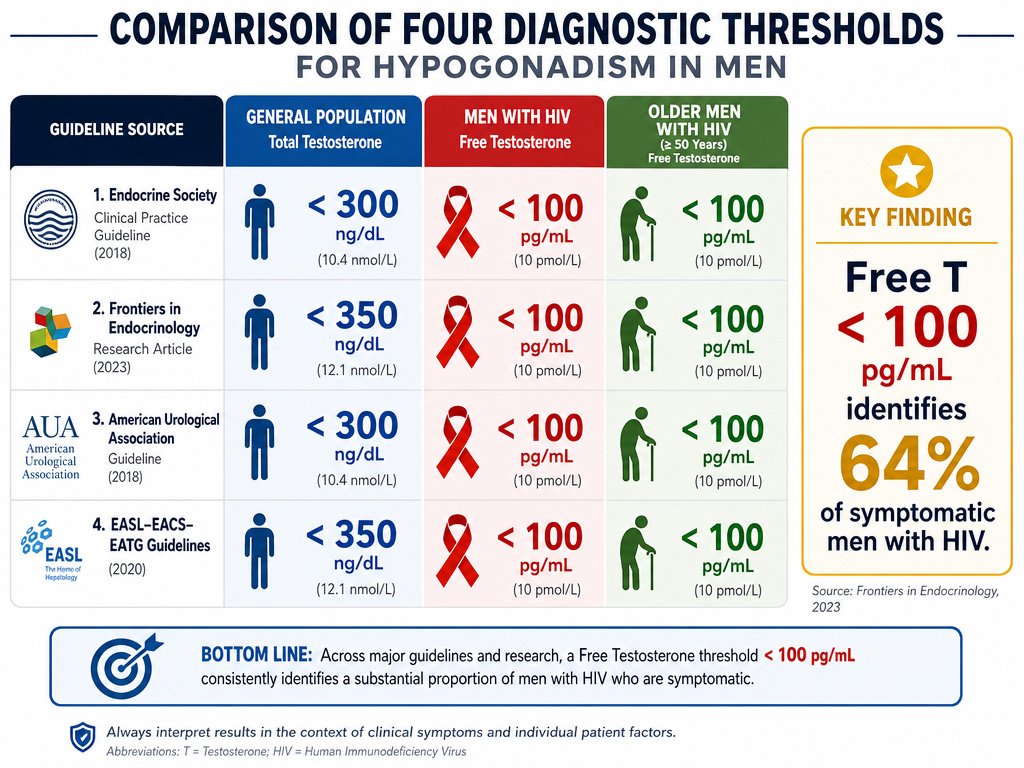
Here’s where sources disagree, and your doctor’s approach matters. There is no single universal number.
For the general population, the Endocrine Society guidelines define biochemical hypogonadism as Total Testosterone < 320 ng/dL and/or calculated Free Testosterone < 64 pg/mL. Research specific to men with HIV proposes various thresholds, with some sources recommending higher values like 350 ng/dL for total T or 100 pg/mL for free T in symptomatic men.
A pivotal 2013 study in Postgraduate Medicine looked specifically at symptomatic men with HIV/AIDS. It found:
- Using free testosterone < 100 pg/mL identified 64% of symptomatic men as hypogonadal.
- Using total testosterone < 300 ng/dL identified only 24%.
- Using a stricter free testosterone < 50 pg/mL identified just 19%.
The Frontiers in Endocrinology review recommends for MLWH a higher threshold of 350 ng/dL for total testosterone and 63 pg/mL for calculated free testosterone for diagnosis. For older MLWH (>60 years), more restrictive thresholds of 300 ng/dL for total testosterone and 50 pg/mL for calculated free testosterone should be considered.
| Guideline/Source | Recommended Threshold (Total T) | Recommended Threshold (Free T) | Population Note |
|---|---|---|---|
| Endocrine Society | < 320 ng/dL | < 64 pg/mL | General male population. |
| Frontiers in Endocrinology (2023) | < 350 ng/dL | < 63 pg/mL | Men with HIV under 60. |
| Postgraduate Medicine (2013) | < 300 ng/dL | < 100 pg/mL | Symptomatic men with HIV/AIDS. |
| Frontiers (for >60 years) | < 300 ng/dL | < 50 pg/mL | Older men with HIV. |
The takeaway? A 2013 study specific to men with HIV/AIDS found the most useful diagnostic threshold was a Free Testosterone level < 100 pg/mL, identifying 64% of symptomatic men as hypogonadal. It acknowledges that their symptoms may appear at higher hormone levels than in the general population.
Treatment Options and Testosterone Replacement Therapy (TRT)
TRT is an effective option for men with confirmed biochemical hypogonadism and consistent symptoms. The goal is to relieve symptoms and improve quality of life, not to chase a specific number on a lab report.
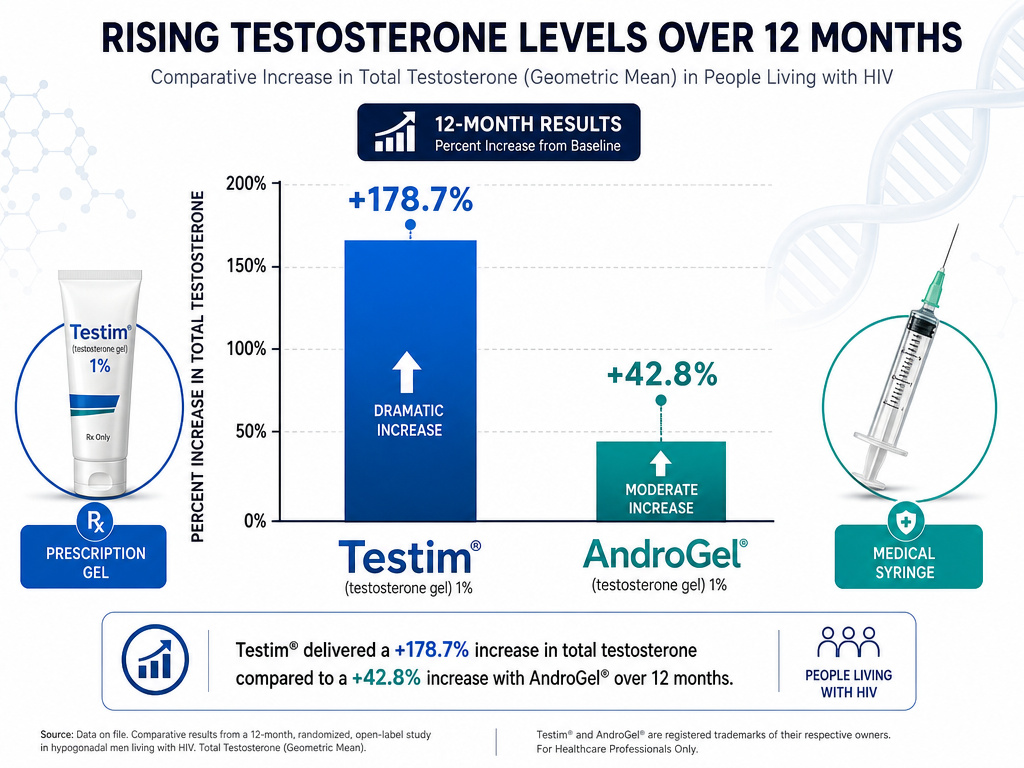
All standard TRT formulations (gels, injections, patches) are available. The choice depends on patient preference, cost, and lifestyle. However, not all gels are the same. That same 2013 study provided a striking comparison of two common gels over 12 months:
- Testim® increased mean total testosterone by +178.7% and free testosterone by +191%.
- AndroGel® increased mean total testosterone by +42.8% and free testosterone by +66.9%.
The difference was statistically significant. What works for one person may not for another.
Starting TRT requires a careful risk-benefit discussion. A thorough evaluation of qualifying for TRT should be done with a knowledgeable physician.
It’s also vital to view TRT as part of a larger management plan. TRT can be added if those measures aren’t sufficient. This is especially true given the strong link between metabolic syndrome and low T.
The Critical Importance of Monitoring and Safety
TRT isn’t a “set it and forget it” treatment. Structured follow-up is essential for safety.
The Frontiers in Endocrinology review states that follow-up for TRT should include checking prostate specific antigen (PSA) and hematocrit every six months at the beginning of therapy and then yearly. Why?
- Hematocrit: TRT can stimulate red blood cell production (a connection explained in our article on low testosterone and anemia). Excessively thick blood (polycythemia) increases the risk of clots, stroke, and heart attack.
- PSA: Testosterone can stimulate prostate tissue growth. Monitoring PSA helps catch any concerning changes early.
Beyond labs, effective monitoring tracks symptom improvement in sexual function, energy, and mood. It also involves watching for potential side effects like acne, sleep apnea worsening, or breast tenderness.
Patients and doctors should also be aware of the possibility of assay interference. Some older lab methods (immunoassays) can be less accurate. If lab results don’t match clinical symptoms, asking how the testosterone was measured is a valid question.
Does low testosterone increase other health risks for men with HIV?
Low testosterone in men living with HIV is often linked to other health conditions. The majority of cases are secondary hypogonadism, where the brain’s signaling to the testes is impaired. This type is strongly associated with chronic illness, inflammation, and other metabolic issues common in HIV. It is not an isolated problem; it can be part of a broader pattern affecting overall health and resilience. Managing testosterone levels, therefore, is often considered alongside managing the person’s complete health picture to address underlying contributors and improve well-being.
Do men with HIV get low testosterone earlier than other men?
Research indicates that low testosterone is more common and can occur at a younger age in men living with HIV compared to the general population. A Frontiers in Endocrinology review states the prevalence of hypogonadism in men living with HIV (MLWH) ranges from 13% to 40% in the age group of 20-60 years, and according to a recent meta-analysis, the prevalence is 26%. An Endocrine Practice study notes a commonly accepted estimate of hypogonadism prevalence before the introduction of combined antiretroviral therapy ranges from 30 to over 40%.
Should you try lifestyle changes before medication for low testosterone?
Addressing lifestyle factors is a foundational step before considering pharmacological treatment like testosterone replacement therapy (TRT). For men with HIV, low testosterone is frequently secondary, meaning it’s driven by other health issues such as chronic inflammation, obesity, or poor sleep. Improving diet, increasing physical activity, managing weight, and optimizing HIV treatment can sometimes improve testosterone levels. If TRT is started, the Frontiers in Endocrinology review recommends follow-up should include checking prostate specific antigen (PSA) and hematocrit every six months at the beginning of therapy and then yearly.
Frequently Asked Questions
Do people with HIV have low testosterone?
Yes, at a significantly higher rate than the general population. Recent research indicates a prevalence of about 26%, with rates ranging from 13% to 40% depending on the diagnostic criteria used. It’s a well-established complication of chronic HIV infection.
What are the most specific symptoms of low T in someone with HIV?
The most specific symptoms are those less likely to be caused by HIV or medication alone: loss of morning erections, reduced testicular size, decreased body or facial hair growth, and hot flashes. More general symptoms like fatigue, low mood, and low libido are common but overlap heavily with other conditions.
Can antiretroviral therapy (ART) cause low testosterone?
Some specific drugs, particularly older ones like efavirenz, have been associated with hormonal disruption. The effect of modern ART regimens is less clear. Often, the low testosterone is more related to the chronic inflammatory state and metabolic changes associated with long-term HIV infection rather than a direct side effect of current medications.
Is testosterone replacement therapy safe for men with HIV?
Current evidence suggests it is as safe for men with HIV as for the general population when prescribed and monitored correctly. The key is careful patient selection (addressing contraindications like unstable heart disease) and strict adherence to monitoring protocols for red blood cell count and prostate health.
How long does it take to feel better on TRT?
Symptom improvement follows a timeline. Changes in mood and energy may be felt within 3-6 weeks. Increases in muscle mass and strength take 3-6 months. Improvements in bone density require 6-24 months of consistent therapy. Sexual function symptoms like libido and erectile function can improve within the first few months.
Before You Go
The evidence is clear, but the path isn’t simple. If you’re a man living with HIV and struggling with persistent fatigue, low drive, or other symptoms, don’t dismiss them as just “part of the deal.”
Bring it up with your doctor. Frame the conversation around symptoms, not just a lab test. Ask specifically about checking calculated free testosterone, not just total testosterone, because that’s where the real answer often hides. Understand that this could be a sign of your body managing a heavier overall load, linked to other causes of low testosterone like chronic inflammation.
If you and your doctor decide on TRT, commit to the monitoring. The six-month and yearly blood checks are your safety net. This is one area where the data is robust enough to guide good decisions, but only if you use all of it.
