
What Is Testosterone Propionate? Uses, Effects, and FAQs
This post contains affiliate links. As an Amazon Associate, we earn from qualifying purchases.
Testosterone propionate is a synthetic androgen and anabolic steroid, specifically the C17β propionate ester of testosterone. It is a short-acting injectable medication historically used for testosterone replacement therapy (TRT) and breast cancer treatment, requiring injections every two to three days. According to the United States Pharmacopeia, it must contain between 97.0% and 103.0% of C22H32O3 and melts between 118°C and 123°C.
The specific chemical properties, like its solubility and melting point, aren’t just trivia. They dictate how the compound is formulated, stored, and ultimately, how it behaves in the body. A propionate ester is a short carbon chain, and that length is the single biggest factor behind its rapid action and frequent dosing schedule.
What follows is a breakdown of its chemistry, medical history, practical administration, and how it compares to the longer-acting testosterone esters that replaced it.
Key Takeaways
- Testosterone propionate is a short-acting testosterone ester, requiring injections as often as every 2–3 days due to its rapid metabolism.
- Its key chemical specs are defined by the United States Pharmacopeia (USP), including a purity range of 97–103% and a melting point of 118–123°C.
- It is practically insoluble in water but dissolves in oils and solvents like chloroform, which is why it’s formulated as an oil-based injection.
- While historically significant, it has been largely superseded by longer-acting esters like enanthate and cypionate for modern testosterone replacement therapy.
- The elimination half-life is debated, with sources citing ~2 days or approximately 4.5 days, highlighting variability in pharmacokinetic data.
Key Chemical and Physical Properties
You can’t answer the question of what is testosterone propionate without looking at its specs. The United States Pharmacopeia (USP) monograph sets the hard rules for its identity and purity as a pharmaceutical compound.
According to the USP, testosterone propionate must contain not less than 97.0 percent and not more than 103.0 percent of C22H32O3, calculated on a dried basis. Its melting range is between 118°C and 123°C, and loss on drying must not exceed 0.5%.
This isn’t just paperwork. That tight purity band (97–103%) is how pharmacists and compounding labs verify they’re working with the correct, uncontaminated substance. The melting point is a fingerprint; if a sample melts outside that 5-degree window, it’s either impure or a different compound altogether.
Solubility dictates formulation. The Sigma-Aldrich product specification sheet shows it’s practically insoluble in water. This is why you’ll never see an aqueous shot of it. Instead, it dissolves in oils and organic solvents for injection. Here’s where it does mix:
| Solvent | Solubility |
|---|---|
| Chloroform | 50 mg/mL |
| Ethanol | 1 part in 6 parts |
| Acetone | 1 part in 4 parts |
| Ethyl Oleate | 1 part in 20 parts |
| Propylene Glycol | 1 part in 30 parts |
This table explains the classic formulation: a small amount of testosterone propionate powder dissolved in a carrier oil. The drug slowly precipitates out of the oil at the injection site, creating a short-lived depot. Get the solvent wrong, and the compound crashes out in the vial.
Storage is straightforward but essential. The USP, National Toxicology Program (NTP) data, and Sigma-Aldrich all agree: store at room temperature in a well-closed, light-resistant container. Light and air degrade steroids over time. The Sigma sheet adds one specific warning: it’s incompatible with alkalis and oxidizing agents. Don’t mix it with basic solutions or strong cleaners.
Medical Uses and Historical Context
To understand what is testosterone propionate, know it wasn’t just another steroid. It was the first. Discovered in 1936 and introduced for medical use in 1937, it was the original injectable testosterone therapy for decades.
Its primary medical uses were for treating male hypogonadism (clinically low testosterone) and, in higher doses, breast cancer in women. The logic for breast cancer was that androgens could counteract estrogen-driven tumor growth. It was also used for delayed puberty in boys and low sexual desire. The Wikipedia entry on testosterone propionate notes it was approved by the FDA on February 5, 1974, cementing its place in the American pharmacopeia.
The dosing schedules from that era look brutal by today’s standards. Protocols called for 50–100 mg injections three times per week or even 25 mg once every 1–2 weeks. Compare that to modern testosterone cypionate vs enanthate protocols of 100–200 mg every 7–14 days. The propionate ester’s short tail forced that frequent pinning.
Where this goes sideways: Assuming all testosterone injections are the same. The propionate ester’s rapid release means missing a dose by a day can cause noticeable hormonal fluctuation, while longer esters have more forgiveness in their dosing schedule.
Its reign ended because of pharmacology, not ineffectiveness. Starting in the 1950s, longer-chain esters like testosterone enanthate and cypionate were developed. These created a slower, more sustained release from the injection depot. For patients and doctors, swapping a painful shot every other day for one every week or two was an obvious win. By the 1970s, propionate was largely obsolete in mainstream medicine.
Today, its status is nuanced. According to Wikipedia, it is discontinued for human use in the United States, while PubChem states it is no longer available commercially except via a compounding pharmacy. You cannot get a brand-name prescription for it. However, it may be available through specialized compounding pharmacies. This is a key distinction often missed in forum discussions: “not commercially available” doesn’t always mean “impossible to obtain legally under medical supervision.”
Pharmacology and How It Works
Testosterone propionate is a prodrug. The injectable ester is inactive until enzymes in your blood cleave off the propionate chain, releasing free testosterone. That free testosterone then binds to androgen receptors throughout the body.
The speed of this process is everything. The propionate ester is a short, three-carbon chain. This makes it highly soluble in fat but also easily hydrolyzed by esterase enzymes. The result is a quick spike and a rapid decline in testosterone levels.
This is where sources disagree on a key number: the elimination half-life.
- Wikipedia cites an elimination half-life of ~2 days.
- The PubChem compound record lists a half-life of approximately 4.5 days.
This isn’t an error. It highlights how pharmacokinetics can vary based on the study, the oil vehicle, and the individual. The PMC peer-reviewed journal article on testosterone formulations notes that different oil vehicles (castor oil vs. Tea seed oil) can dramatically change release profiles for other esters. The same principle applies here. A half-life between 2 and 4.5 days is the realistic range, which still firmly places it in the “short-acting” category.
The clinical goal of any TRT, including with propionate, is to restore serum levels to a physiological range. Modern guidelines, like those noted in the NIH PubMed Central study, aim for 400–700 ng/dL. With propionate’s peaks and troughs, hitting that steady middle is a challenge. Levels would spike high shortly after injection and could dip low before the next dose was due, potentially causing mood and energy swings.
Its metabolism is standard for testosterone. Approximately 90% of a dose is excreted in urine as conjugates, primarily through the liver. This is why monitoring liver enzymes was (and is) a part of responsible androgen therapy.
Administration: The Practical Realities of Injection
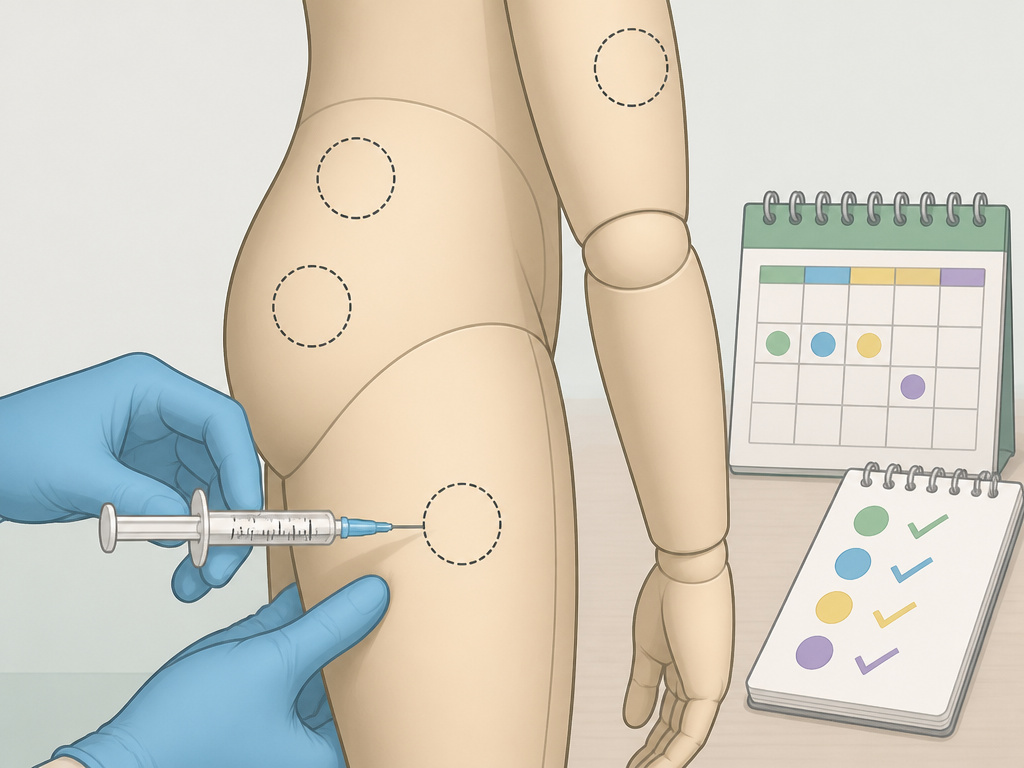
The theory is one thing. The practice of injecting an oil-based compound every other day is another. Administration is strictly via intramuscular injection, though some historical protocols mentioned subcutaneous.
The most cited drawback is injection-site pain. Some user reports describe propionate as causing injection-site pain. This pain factor is a major practical reason it fell out of favor compared to other testosterone injections.
Common mistake: Not rotating injection sites diligently. With injections required every 48–72 hours, you run out of fresh muscle quickly. Scar tissue builds up, making future injections harder and potentially affecting absorption.
A rotation schedule that tracks your sites and allows each area sufficient time to recover before using it again is critical. Common injection sites include the ventrogluteal, dorsogluteal, and vastus lateralis (thigh) muscles. The deltoid can be used for smaller volumes. The key is to track your sites and allow each area sufficient time to recover before using it again, which is a complex dance on a thrice-weekly schedule.
The process itself is standard for injection methods: draw the oil into a syringe, switch to a fresh needle for the injection, insert into the muscle at a 90-degree angle, aspirate slightly to ensure no blood return, and then depress the plunger slowly. Injecting oil too quickly can cause a painful lump.
Testosterone Propionate vs. Other Testosterone Esters

The real-world choice for therapy almost always involves comparing esters. Here’s how propionate stacks up against the modern long-acting standards.
| Ester | Carbon Chain | Typical Injection Frequency | Key Characteristic |
|---|---|---|---|
| Propionate | 3 (Short) | Every 2–3 days | Fast onset, short duration, frequent injections |
| Cypionate | 8 (Long) | Every 7–14 days | Slow release, stable levels, common in US TRT |
| Enanthate | 7 (Long) | Every 7–14 days | Similar to cypionate, common globally |
The difference is night and day for lifestyle. Propionate demands you structure your week around injection days. Cypionate or enanthate can become a simple, forgettable weekly routine. For medical testosterone replacement therapy, stability is preferred to mimic natural hormone patterns and improve compliance.
There’s a crucial regulatory note. The pharmacology of testosterone replacement therapy review explicitly states that testosterone cypionate and enanthate are not therapeutically equivalent (rated AO by the FDA). This means they are not automatically interchangeable, as their different oil vehicles affect release. This principle extends to propionate; it’s a distinct drug, not a direct substitute.
In the context of TRT vs steroids, propionate occupies a middle ground. At prescribed doses for hypogonadism, it’s TRT. At the higher, more frequent doses sometimes used in bodybuilding cycles to rapidly increase mass, it crosses into anabolic steroid use. The molecule is the same; the intent and dose define the category.
Legal status / controlled substance

Testosterone propionate is no longer commercially available as a mass-produced pharmaceutical in the United States. It has been discontinued for human use by major manufacturers. However, it may still be accessible through specialized compounding pharmacies, which can prepare the medication on a per-prescription basis. As an anabolic-androgenic steroid, it is classified as a controlled substance, meaning its possession and use without a valid prescription is illegal. This legal framework governs its distribution to prevent misuse for performance enhancement or bodybuilding outside of legitimate medical treatment.
Drug interactions
Specific drug interaction data for testosterone propionate is limited in the provided facts. Specific drug interaction data for testosterone propionate is limited. Always consult a healthcare provider about all medications and supplements you are taking before using any form of testosterone therapy. It is chemically incompatible with alkalis and oxidizing agents, which is relevant for pharmaceutical preparation and storage. Always consult a healthcare provider about all medications and supplements you are taking before using any form of testosterone therapy.
Frequently Asked Questions
What is testosterone propionate good for?
Its historical medical uses were treating male hypogonadism (low testosterone) and breast cancer. In hypogonadism, it replaces missing testosterone. For breast cancer, it was used in high doses to counteract estrogen-sensitive tumors. Today, its use is rare in medicine but it may be discussed in the context of certain types of TRT or performance enhancement.
What is the difference between testosterone cypionate and propionate?
The core difference is the ester chain length, which dictates duration. Cypionate has a long 8-carbon chain, leading to a slow release and injections every 1–2 weeks. Propionate has a short 3-carbon chain, causing a fast release and requiring injections every 2–3 days. Cypionate offers more stable blood levels and is the standard for modern therapy.
How long does testosterone propionate take to kick in?
Because it’s a short ester, the active testosterone is released quickly. Users often report feeling effects like increased energy or libido shortly after the first injection. However, for sustained therapeutic benefits like improved mood or muscle mass, it takes consistent dosing over time to reach stable saturation.
Is testosterone propionate still used today?
It is not a first-line treatment and is discontinued for mainstream human use in the United States. It may be available through compounding pharmacies for specific cases. Its primary contemporary discussion is in bodybuilding circles due to its rapid action, but it remains a controlled substance when used without a prescription.
Before You Go
The data on half-life disagreement is the most practical takeaway. Sources disagree on the value: Wikipedia cites an elimination half-life of ~2 days, while PubChem lists a half-life of approximately 4.5 days. This variability means individual response is king; a schedule that works for one person might cause trough symptoms for another.
For anyone considering testosterone therapy today, the conversation almost always starts with the longer esters. The frequent injection burden and notable pain of propionate make it a historical footnote in mainstream testosterone replacement therapy. Modern medicine traded the rapid precision of short esters for the steady, livable convenience of long ones.
That said, its role as the first successful testosterone ester is undeniable. It proved the depot injection concept, paving the way for every longer-acting formulation that followed. In pharmacology, sometimes the prototype’s greatest contribution is showing what not to do next.
