
How Often to Inject Testosterone on TRT: A Dosing Guide
This post contains affiliate links. As an Amazon Associate, we earn from qualifying purchases.
How often you inject testosterone on TRT depends entirely on the specific ester, the chemical tail attached to the testosterone molecule that controls its release time. Testosterone cypionate or enanthate is typically injected every 3.5 to 7 days. The long-acting ester testosterone undecanoate (brands like Aveed or Nebido) is injected every 10 to 14 weeks after initial loading doses.
The half-life of the ester dictates your schedule. Cypionate and enanthate have half-lives of about 8 days, which means hormone levels drop noticeably within a week. A key question is how often to inject testosterone on TRT. Spreading your total weekly dose into two smaller injections, say every 3.5 days, keeps levels far more stable than one larger weekly shot. This stability is the whole game, it’s what minimizes side effects like estrogen conversion, mood swings, and high red blood cell counts.
What follows is a breakdown of the two main protocols: the frequent, short-acting injections and the infrequent, long-acting shots. We’ll cover the official dosing ranges, the practical schedules that work, and the critical monitoring step that decides whether your interval is right.
Key Takeaways
- The injection schedule is dictated by the testosterone ester: cypionate/enanthate (weekly/bi-weekly) vs. Undecanoate (every 10-14 weeks).
- For cypionate/enanthate, splitting a weekly dose into two injections every 3.5 days (e.g., Monday/Thursday) creates more stable blood levels than one larger weekly shot.
- The official FDA label for testosterone cypionate suggests 50-400 mg administered every 2 to 4 weeks, but modern practice leans toward more frequent, lower doses.
- For testosterone undecanoate, sources disagree: the FDA Aveed label mandates a fixed 10-week interval, while other authorities recommend a 10-14 week range with individual titration.
- You must monitor trough levels, the blood test taken just before your next injection, to see if your dose and interval are correct. Your target is to keep the trough in a range appropriate for your symptoms and health.
The Core Rule: It’s About the Ester
You don’t inject “testosterone.” You inject testosterone cypionate, or testosterone enanthate, or testosterone undecanoate. That last word changes everything. An ester is a fatty acid chain attached to the hormone; it acts like a time-release capsule. Your body’s enzymes slowly snip this chain off in muscle tissue, releasing active testosterone into your bloodstream. A longer ester chain means a slower release and a longer half-life.
The ester’s half-life directly determines injection frequency. Testosterone cypionate and enanthate have half-lives of approximately 8 days. Testosterone undecanoate has a terminal half-life of about 90 days. This 10-fold difference is why one protocol calls for shots every few days and the other every few months.
This isn’t a minor detail. Picking the wrong frequency for your ester guarantees a rollercoaster. With cypionate, a single weekly injection creates a sharp peak 24-48 hours after the shot, followed by a steady decline. By day 7, your levels are often at their lowest point. If that trough dips too low, you’ll feel the fatigue and brain fog creeping back in before your next shot is due. The goal is to flatten that curve.
Short-Acting Esters: Cypionate & Enanthate
For testosterone cypionate and enanthate, the old-school guideline is one injection every 7 to 14 days. The FDA label for testosterone cypionate states a range of 50-400 mg should be administered every two to four weeks, though modern clinical practice often uses more frequent dosing.
Modern practice has moved toward more frequent injections. Here’s why: pharmacokinetics. A 2015 study often cited in individualizing injectable TRT guide literature shows that splitting a weekly dose into two injections cuts the peak-to-trough variation in half. This smaller swing means fewer estrogen-related side effects and more consistent energy. That smaller swing means fewer estrogen-related side effects (like water retention or moodiness) and more consistent energy.
Practical Injection Schedules
For a weekly total of 100 mg of testosterone cypionate:
- Once Weekly: Inject 100 mg every 7 days (e.g., every Monday morning).
- Twice Weekly (Recommended): Inject 50 mg every 3.5 days. This is the “Monday morning, Thursday evening” schedule. It’s easier to remember and leads to smoother levels.
For a weekly total of 150 mg:
- Once Weekly: 150 mg every 7 days.
- Twice Weekly: 75 mg every 3.5 days.
| Schedule | Dose Example | Peak-Trough Swing | Best For |
|---|---|---|---|
| Once Weekly | 100 mg every 7 days | Large (~50% variation) | Those who strongly prefer fewer injections and don’t experience mid-week lows. |
| Twice Weekly | 50 mg every 3.5 days | Moderate (~25% variation) | Most men seeking stable mood, energy, and minimized side effects like estrogen conversion. |
| Every 5 Days | ~70 mg every 5 days | Moderate-Large | A compromise for those who find 3.5-day scheduling difficult. |
Where this goes sideways: Injecting cypionate every two weeks as the old FDA label allows. The long trough period at the end of the second week almost guarantees a return of low-T symptoms for most men. It’s a dated protocol that persists mainly in insurance formularies, not in updated clinical guidance.
The method matters too. While traditional labeling specifies deep intramuscular (IM) injections, subcutaneous (SubQ) administration with insulin syringes is now common for these frequent, small-volume doses. The Society for Endocrinology guidelines note that SubQ administration of testosterone cypionate is comparable in pharmacokinetics and often preferred for self-administration. The choice between IM vs SubQ often comes down to personal comfort and injection volume.
Long-Acting Ester: Testosterone Undecanoate
Testosterone undecanoate (brands: Aveed in the US, Nebido or Gonadron elsewhere) is a different beast. Its half-life is approximately 90 days, allowing for injection intervals measured in months, not days. This appeals to men who want minimal hassle and don’t mind visiting a clinic for a larger, deeper intramuscular injection.
The Loading Phase & Maintenance Conflict
Here’s where sources directly disagree, a crucial point most overviews miss.
- FDA Aveed Protocol (750 mg): The FDA label specifies a fixed regimen: 750 mg at initiation, a second 750 mg dose at 4 weeks, and then every 10 weeks thereafter. It explicitly states, “Dosage titration is not necessary.”
- EU/UK/NZ Protocol (1000 mg): Authorities like New Zealand Medsafe, the UK EMC, and the Irish HPRA recommend a 1000 mg dose. The loading dose is at 6 weeks, not 4. The maintenance interval is a 10 to 14 week range, and they emphasize that the interval must be individualized based on trough serum testosterone levels and symptoms.
A 2022 PMC study on injection intervals of nearly 7,000 injections supports individualization. It found the median optimal interval was 12.0 weeks, but only 70% of patients were optimized within the 10-14 week range. A full 23% required intervals of 14 weeks or longer, and 7.4% needed 10 weeks or less. The study’s takeaway is that a one-size-fits-all 10-week schedule will be wrong for about 30% of men.
What Steady-State Looks Like
The New Zealand Medsafe datasheet for Gonadron provides the pharmacokinetics: after a 1000 mg injection, steady-state is reached between the 3rd and 5th dose. At that point, peak levels (Cmax) average about 42 nmol/L and trough levels (Cmin) average about 17 nmol/L. Your target is to keep that trough in a range appropriate for your symptoms and health. If your trough at week 12 is 200 ng/dL, your interval is too long. If it’s 800 ng/dL, it’s too short.
How to Find Your Frequency: The Role of Monitoring
You don’t set your schedule once. You calibrate it with blood work. The single most important test is the trough level, drawn immediately before your next scheduled injection. This tells you the lowest point your hormones reach on your current protocol.
For cypionate/enanthate on a twice-weekly schedule, this means getting your blood drawn on injection day, but before you take your shot. If your trough is consistently too low, you might need a slight dose increase or a slightly shorter interval. If your trough is consistently too high and you’re having adverse effects, your dose might be too high.
For testosterone undecanoate, you check the trough at the end of your current interval. If your level at week 10 is perfect but you feel terrible by week 12, your interval is too long. The solution isn’t always a higher dose; it’s a shorter interval. This is the essence of titration that the FDA Aveed label dismisses but other authorities insist upon.
Common mistake: Getting blood work at the wrong time. A level checked 2 days after a cypionate injection shows a peak, not a trough. It’s useless for judging your protocol’s stability. Mark your calendar: test on injection day, before you inject.
Other markers matter just as much: hematocrit, hemoglobin, estradiol (E2), and PSA. Rising hematocrit is a common reason to reduce dose or increase injection frequency, as more stable levels produce less of a stimulatory effect on red blood cell production. This is a key advantage of more frequent daily testosterone injections or twice-weekly protocols.
Fixed vs. Flexible: When Schedules Need to Change
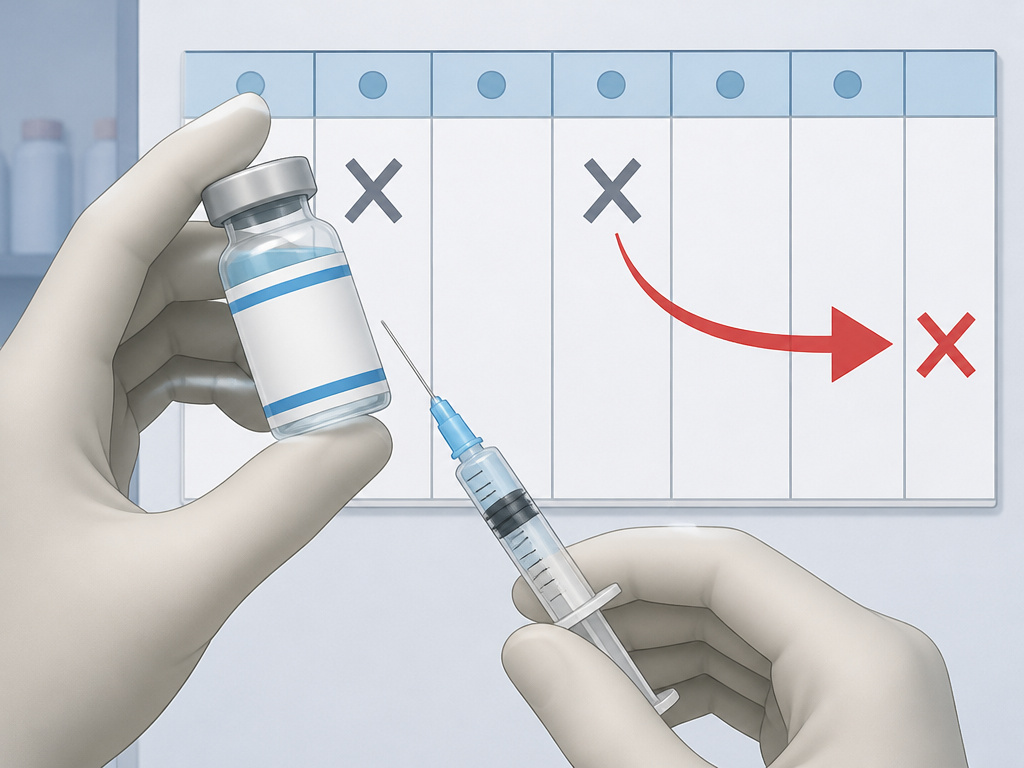
Life happens. You travel, get sick, or simply forget. What then?
For short-acting esters, a delay of a day or two isn’t a crisis. If you miss a Monday/Thursday schedule and inject on Friday, just resume your next dose on the following Monday. The shorter half-life means your body clears the hormone relatively quickly. For a deeper dive, our guide on what to do after a missed TRT injection walks through the scenarios.
For testosterone undecanoate, the long half-life provides a buffer. A delay of a week or two likely won’t crash your levels, but it will shift your entire schedule. The bigger risk with long-acting injections is the potential for a post-injection oil embolism, a rare but serious reaction where oil enters the bloodstream. This is why the FDA mandates a 30-minute observation period after each Aveed injection.
Your schedule may also need to change long-term. As you age or your body composition changes, your metabolism of testosterone can shift. A protocol that worked for five years might need adjustment. This is why an annual review of your trough levels and symptoms is essential, even on a stable regimen.
Typical TRT dosage ranges
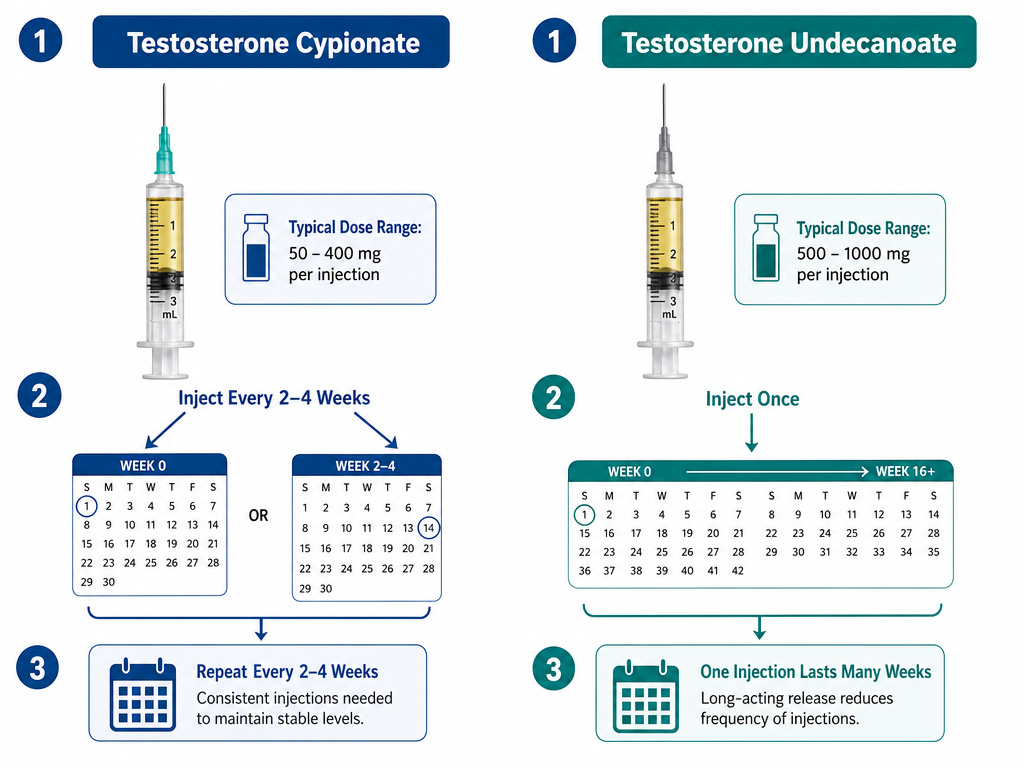
Official dosage ranges for testosterone vary significantly by the specific ester used. For the commonly prescribed testosterone cypionate, the labeled replacement dose for hypogonadal men is between 50 to 400 milligrams administered every two to four weeks. This wide range exists because the dosage must be adjusted according to the individual patient’s response and the appearance of any adverse reactions. It is a starting framework, not a fixed prescription. For the long-acting ester testosterone undecanoate, dosing is measured in larger amounts but given far less frequently, with maintenance intervals typically measured in weeks, not days.
Signs a dose may be too high or too low

Your body will give you clear signals if your testosterone dose is not correctly matched to your needs. A dose that is too low often fails to resolve the symptoms of low testosterone, such as persistent fatigue, low mood, or reduced libido. Conversely, a dose that is too high can introduce new problems. Commonly reported adverse reactions from excessive levels include acne, increased irritability, mood swings, insomnia, and fatigue. Other signs like increased hemoglobin or elevated PSA are measurable through blood tests. Monitoring both how you feel and your lab results is how you and your doctor determine if an adjustment is needed.
Discussion of microdosing
Microdosing refers to injecting very small amounts of testosterone very frequently, such as daily or every other day. This approach is almost exclusively used with shorter-acting esters like cypionate or enanthate. The goal is to mimic the body’s natural, more rhythmic hormone release and avoid the large peaks and troughs associated with weekly or bi-weekly injections. By keeping serum levels extremely stable, some men report fewer side effects related to estrogen conversion or mood fluctuations. It is a practical schedule chosen for its potential to smooth out the experience, though it requires more frequent injection site rotation.
Frequently Asked Questions
Is it better to inject TRT 2 or 3 times a week?
For testosterone cypionate or enanthate, twice a week (every 3.5 days) is the sweet spot for most men. It offers dramatically more stable levels than once a week with only one extra injection. Injecting three times a week (e.g., every other day) flattens the curve further and can be beneficial for those extremely sensitive to hormonal fluctuations or who struggle with high estrogen conversion. The trade-off is the frequency itself, three times a week starts to feel like a daily habit.
What is the most common TRT injection schedule?
The most common schedule is 100 mg of testosterone cypionate injected once per week. However, the most commonly recommended schedule by informed clinicians and patients seeking stability is 50 mg of testosterone cypionate injected twice per week (every 3.5 days). The once-weekly habit persists due to simplicity and older prescribing patterns.
Can I inject testosterone cypionate every 10 days?
You can, but you likely shouldn’t. The 8-day half-life means that by day 10, your serum levels will be near their absolute bottom. This creates a long period of sub-optimal testosterone exposure each cycle, which can lead to a return of symptoms like low energy and moodiness at the end of each interval. It’s generally less effective than more frequent dosing.
How long after a testosterone injection do you feel better?
This depends on how low you were. For a man with profoundly low levels, some notice an improvement in mood and energy within 24-48 hours of the first injection, this is often a placebo or psychological effect. Real, sustained physiological improvements in libido, strength, and cognitive function typically begin after 3-6 weeks of consistent therapy, as your body adjusts to stable, normalized levels.
Does injecting testosterone more often reduce side effects?
Yes, often significantly. More frequent injections with lower doses per shot lead to lower peak testosterone levels. This reduces the substrate available for conversion to estrogen via the aromatase enzyme, helping manage estradiol-related side effects like water retention, gynecomastia, and emotional lability. It also appears to produce a lesser stimulatory effect on red blood cell production, helping keep hematocrit and hemoglobin in check.
The Bottom Line
Your injection frequency isn’t a random choice. It’s a direct function of the testosterone ester you’re using, and it should be a deliberate tool to achieve stable blood levels. Start with the evidence-based standard: for cypionate or enanthate, that’s twice-weekly injections; for undecanoate, that’s a 10-14 week interval with a plan to titrate.
Then, prove it with a trough blood test. The number on that lab report, taken just before your next shot, is the only objective measure that your schedule is correct. If your trough is consistently in the target range (usually the lower third of normal) and you feel well, you’ve found your frequency. If not, adjust the interval or the dose, not based on how you feel on day two after a shot, but based on that trough value.
This process turns TRT from a guessing game into a calibrated treatment. The goal isn’t just to inject testosterone; it’s to replicate the stable, physiologic secretion of a healthy endocrine system. Your schedule is the primary lever you have to make that happen.
