
Does HIIT Increase Testosterone? When It Might Suppress T
This post contains affiliate links. As an Amazon Associate, we earn from qualifying purchases.
Yes, a single HIIT session reliably causes a short-term spike in testosterone, measured in blood or saliva. The increase is most evident immediately after exercise and within 30 minutes, and it happens after moderate or high-intensity work, not mild activity. However, this acute spike is temporary and does not directly translate to a permanent rise in your baseline testosterone levels. For long-term hormonal health, managing workout intensity and recovery to avoid a suppressed testosterone/cortisol ratio is more critical than chasing the post-workout spike.
That 30-minute window is the key. The body treats intense exertion as a stressor, and the testosterone release is part of that acute fight-or-flight response. It’s a signal, not a sustainable building block.
What follows is a breakdown of that signal: the exact timing of the spike, the conflicting research on cortisol, and how to structure your training so HIIT supports, rather than sabotages, your hormonal health. By the end, you’ll know whether to use HIIT for a quick boost or focus on it as a conditioning tool.
Key Takeaways
- A single HIIT session causes a measurable testosterone increase, but it is not evident after 30 minutes post-exercise.
- The spike requires moderate or high intensity; light activity like walking doesn’t trigger it.
- Very-high–intensity sessions can suppress testosterone due to elevated cortisol; one systematic review notes suppression for up to 72 hours, while other research suggests a return to baseline within 24 hours.
The 30-Minute Window: When the Spike Happens (and When It Doesn’t)
The data on timing is remarkably specific. A 2020 meta-analysis of 48 studies found the testosterone increase is “evident when measured immediately at the end of exercise and within 30 min.” Check the clock after 30 minutes, and that statistical significance vanishes. The numbers are back to baseline.
Testosterone increases are evident when measured immediately at the end of exercise and within 30 minutes (p < 0.001), but not after 30 minutes (p = 0.930). This holds true whether the sample is drawn from blood (serum) or saliva.
This isn’t a gradual decline. It’s a sharp peak followed by a return to normal. Think of it like an adrenaline rush, it’s over quickly. That post-workout “boost” you feel? It’s likely a mix of endorphins and psychological accomplishment, not a sustained hormonal tide.
The intensity threshold is just as clear. The same analysis showed testosterone rose after moderate and high-intensity exercise, but not after mild physical activity. A brisk walk won’t cut it. Your body needs to perceive a significant physiological challenge to trigger this particular endocrine response.
| Time After HIIT Session | Typical Testosterone Response | What It Means For You |
|---|---|---|
| Immediately (0 min) | Significant increase (peak) | Acute stress/arousal response is active. |
| Within 30 minutes | Increase still detectable | The “window” for the spike is closing. |
| After 30 minutes | Returns to baseline | The acute hormonal effect is complete. |
| 60+ minutes | May dip below baseline | Recovery and stabilization phase begins. |
This timeline explains why the acute spike has little proven link to long-term muscle growth or hormonal adaptation. The signal is too brief. It’s why studies on weight lifting and heavy compound lifts show more promise for sustained anabolic signaling, the mechanical stress and volume create a different, longer-lasting stimulus.
The Cortisol Question: When HIIT Might Suppress Testosterone
Here’s where the research gets messy, and where most generic articles gloss over the details. Cortisol, your primary stress hormone, complicates the picture.
The straightforward narrative says HIIT spikes both testosterone and cortisol. A 2021 acute HIIT effect systematic review of controlled studies concluded exactly that. But other quality studies disagree. A 2018 RCT on overweight men found a HIIT session decreased cortisol and improved the testosterone/cortisol ratio. Another 2019 study on active men found cortisol stayed level after HIIT, but the T/C ratio dropped significantly 12 hours later.
So which is it? The conflict points to two major variables: the individual’s fitness level and the sheer intensity of the session.
Where this goes sideways: Pushing “all-out” efforts daily. A systematic review notes that very-high–intensity exercise can cause testosterone suppression during recovery “due to cortisol antagonism for up to 72 h.”
This is the suppression risk. If your HIIT sessions are so brutal that they leave you wrecked for days, you’re likely pushing into a zone where the cortisol response overwhelms any short-term testosterone benefit. The smell of that kind of overreach isn’t metaphorical, it’s the faint, sharp scent of stress sweat that lingers on next-day gym clothes. Your body is screaming for a break.
For the average person, a well-structured HIIT session (like 4 rounds of 4-minute work intervals) probably yields a balanced, temporary rise in both hormones. But if you’re already under-recovered, from poor sleep, a calorie deficit, or other life stress, adding high-intensity intervals can tip the scale toward suppression. This is why rest periods and overall recovery management aren’t optional extras; they’re the foundation that determines whether exercise is a hormetic stressor or a chronic burden.
HIIT vs. Other Training: What Actually Moves the Needle Long-Term?
This is the core question the searcher really wants answered. Does HIIT increase testosterone more than other forms of exercise?
For acute spikes, HIIT is effective. But acute spikes are not the goal. The goal is a healthy, robust baseline level of testosterone that supports energy, body composition, and well-being over years. For that, the exercise hierarchy looks different.
Heavy resistance training is the clear leader for positive long-term hormonal adaptation. Lifting weights, especially with compound movements, creates a strong anabolic signal that can enhance receptor sensitivity and support a healthier hormonal milieu. It’s a slow, cumulative effect, not a transient spike. This is why programs built around effective exercises like squats and deadlifts are cornerstones.
Steady-state cardio often gets a bad rap, with concerns that long-duration cardio can lower testosterone. This is generally a risk only at extreme volumes (think marathon training) or in a severe calorie deficit. For most, moderate cardio is hormonally neutral or beneficial for overall health.
So where does HIIT fit? It’s a potent tool for cardiovascular conditioning and metabolic health. Its value for testosterone is indirect: by improving insulin sensitivity and reducing body fat, it can support a healthier endocrine environment. But it’s not a direct “T-booster” in the long-term sense.
| Training Modality | Acute Testosterone Response | Long-Term Basal T Influence | Best Primary Use |
|---|---|---|---|
| Heavy Resistance Training | Moderate to high spike | Positive (supports adaptation) | Building muscle, strength, anabolic signaling |
| HIIT | High spike | Neutral to Negative (if overdone) | Cardiovascular conditioning, metabolic health |
| Steady-State Cardio | Mild or no spike | Neutral | General health, endurance, active recovery |
| Mild Activity (e.g., walking) | None | Neutral (positive for health) | Daily movement, recovery |
The practical takeaway: don’t use HIIT as your primary driver for testosterone. Use it as a conditioning supplement to a foundation of strength training. If your choice is between an extra HIIT session or an extra lifting session for hormonal health, the weights win every time.
Programming for Hormonal Health, Not Just a Spike
Knowing the spike is temporary changes how you should schedule your high-intensity work. The goal is to harness the conditioning benefits without triggering long-term suppression.
First, frequency matters. I learned this by stacking sprint intervals on top of four lifting days, my legs never recovered, and my overall energy flatlined. The conditioning was great, but the cost to my recovery was too high. Two hard conditioning sessions max is where I landed.
Second, manage your intensity. True “all-out” efforts are incredibly taxing. Save the 100% efforts for rare, planned tests.
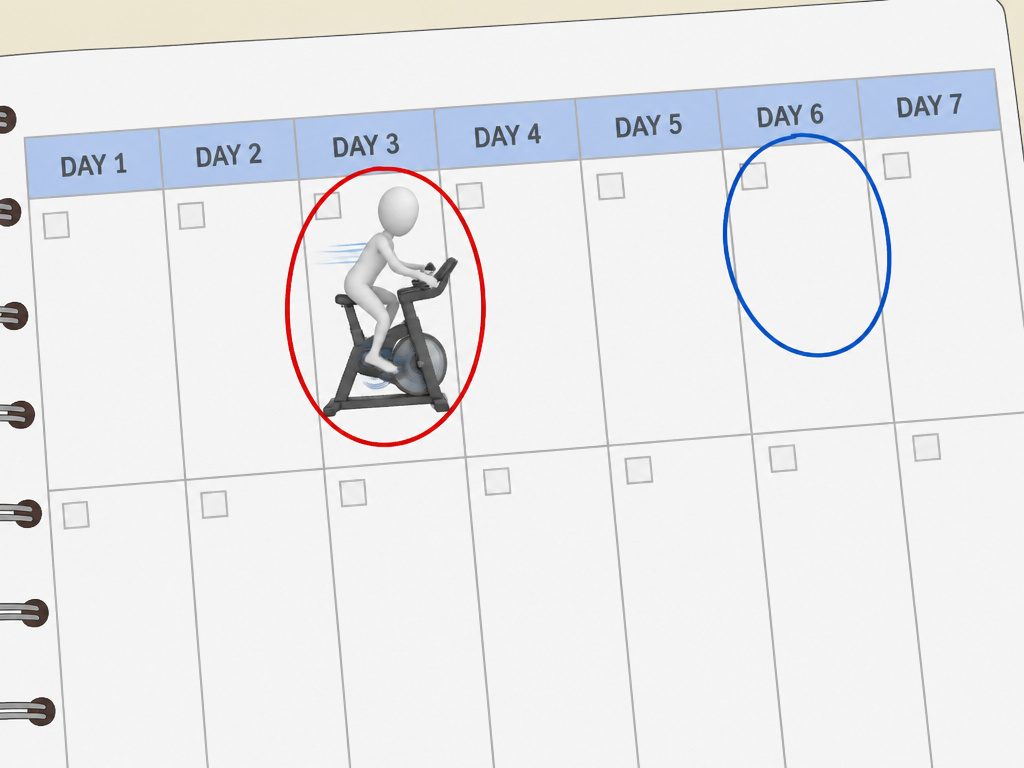
Here’s a sample weekly structure that prioritizes hormonal balance:
- Day 1: Heavy Lower Body Lifting (Squats, Deadlifts)
- Day 2: Upper Body Lifting + Light Cardio or Mobility
- Day 3: HIIT Session (e.g., 6 rounds of 30s bike sprint/90s easy)
- Day 4: Rest or Active Recovery (walking)
- Day 5: Full Body Lifting (moderate volume)
- Day 6: HIIT Session or Sport
- Day 7: Rest
Notice the spacing. The HIIT days follow lighter or rest days, and they aren’t placed after the heaviest lifting sessions. This protects your recovery capacity.
Finally, listen to more than your motivation. Track your sleep quality, morning resting heart rate, and general mood. If these metrics tank after introducing or increasing HIIT, it’s a sign you’re overshooting. The short-term spike isn’t worth a week of suppressed recovery.
The Foundational Levers: What Matters More Than Your Workout

Chasing a 30-minute hormonal spike is a distraction if the fundamentals are broken. No amount of HIIT can overcome chronic sleep deprivation, a nutrient-poor diet, or unmanaged life stress.
Sleep is the most powerful lever. Inconsistent or poor-quality sleep directly suppresses testosterone production and elevates cortisol, wrecking the very ratio you’re trying to manage.
Nutrition provides the building blocks. This isn’t about magical “testosterone foods.” It’s about avoiding deficiencies and supporting overall health. A common early mistake is undershooting calories and nutrients out of fear, like the year I spent eating egg-white omelets, tossing the yolks that held most of the choline, vitamin D, and selenium. I felt flat. Whole eggs aren’t a testosterone food; they’re just a cheap, efficient nutrient package. Similarly, the oyster hype usually boils down to their high zinc content, which fixes a deficiency rather than acting as a superfood.
Managing stress is essential. Chronic mental and emotional stress keeps cortisol elevated, which can directly inhibit testosterone production over time. HIIT is a physical stressor. If your life is already high-stress, adding more intense physical stress can be counterproductive. Sometimes, the best “training” for your hormones is a walk in nature, not another sprint interval.
Think of it like this: your hormones are the engine. Training is the throttle. But sleep, nutrition, and stress management are the oil, coolant, and fuel quality. You can press the throttle all you want, but if the other systems are failing, the engine will seize.
Difference between total and free testosterone
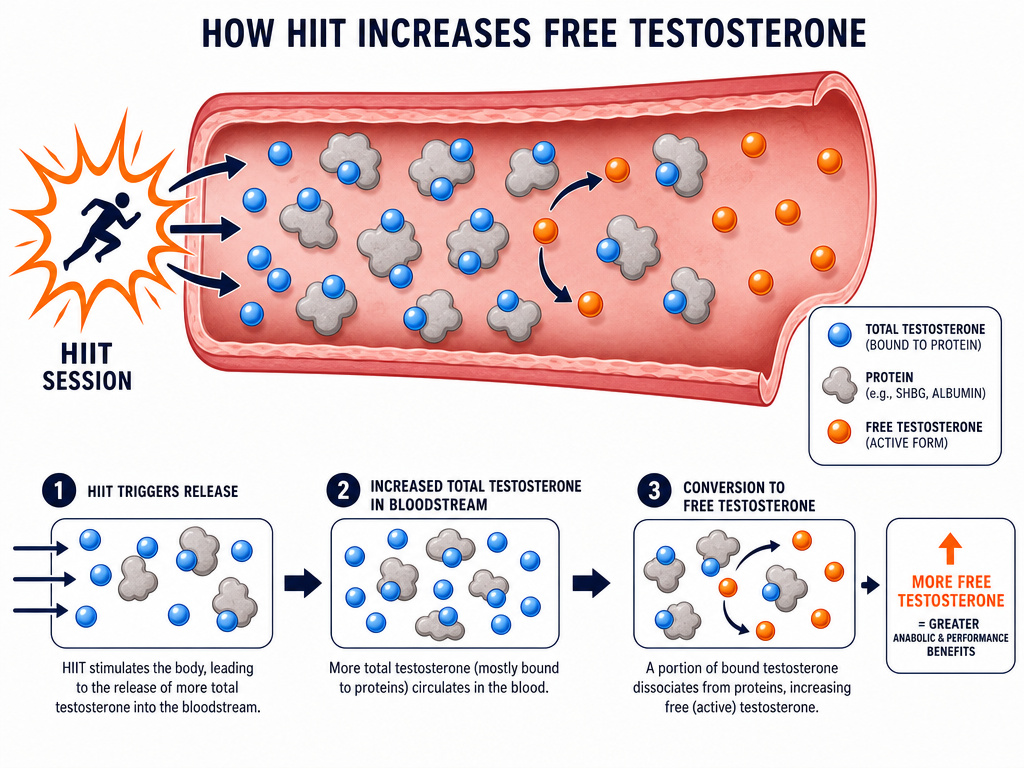
When you see studies reporting testosterone changes from HIIT, they are usually measuring total testosterone. This is the total amount of the hormone in your bloodstream, including the portion that is bound to proteins and is not immediately available for use. Free testosterone is the small, unbound fraction that is biologically active and can directly influence muscle growth, energy, and libido. Exercise-induced spikes, like the immediate increase seen after high-intensity work, primarily affect total testosterone levels. However, the practical impact on your body depends on how much of that total converts to the active, free form. For optimizing the benefits of a HIIT session, focusing on factors that support healthy free testosterone, like adequate recovery and managing overall stress, is key.
Frequently Asked Questions
Does HIIT increase testosterone more than lifting weights?
For a short-term spike immediately after exercise, both HIIT and high-intensity resistance exercise can increase testosterone. For long-term, sustainable elevation of your baseline testosterone levels, heavy resistance training (weight lifting) is far more effective and evidence-backed. The mechanical stress from lifting promotes better long-term anabolic adaptation.
How long does testosterone stay elevated after HIIT?
According to meta-analyses, the elevation is statistically significant for up to 30 minutes after the session ends. After the 30-minute mark, levels typically return to baseline. This post-workout spike is transient.
Can too much HIIT lower testosterone?
Yes, particularly if the sessions are excessively intense and you are not recovering adequately. Overtraining with HIIT can lead to elevated cortisol levels, which antagonizes testosterone production and can suppress levels for up to 72 hours. This is why managing volume and frequency is crucial.
Is HIIT good for testosterone in women?
The research on acute testosterone spikes in women is less consistent. Women have much lower baseline testosterone, so the relative impact of a spike is different. HIIT remains excellent for women’s cardiovascular and metabolic health, but it should not be undertaken with the primary goal of significantly altering testosterone levels.
Before You Go
The research delivers a clear, two-part answer to the does HIIT increase testosterone question. That fact is well-established by the PMC systematic review of RCTs and other meta-analyses. But that brief spike is not a lever for long-term hormonal change.
The real lever is managing the balance between stress and recovery. If you use HIIT as a tool for fitness, respect its intensity. Cap your sessions, space them away from heavy lifting days, and watch your recovery metrics like a hawk. Its greatest benefit for your hormonal health is indirect, through improving body composition and metabolic efficiency.
So, program your HIIT for conditioning. Build your hormonal foundation with strength training, sleep, and nutrition. And let the 30-minute spike be what it is: a biological footnote, not a training goal.
