
Does Fadogia Agrestis Increase Testosterone?
This post contains affiliate links. As an Amazon Associate, we earn from qualifying purchases.
While animal studies report increases in testosterone, Fadogia agrestis does not have proven efficacy for increasing testosterone in humans due to a lack of clinical trials. While several rat studies show the aqueous stem extract can raise serum testosterone and improve sexual function markers, no published human clinical trials exist to confirm these effects or establish a safe, effective dose. The most recent systematic review of “testosterone boosters” did not even include Fadogia agrestis in its analysis due to this lack of human data.
That gap between promising animal data and zero human trials is the whole story. It means every claim you see is extrapolated from rats given specific doses of a specific extract. The mechanism appears solid, the extract influences key pathways for erection and hormone production, but a mechanism in a rat is not a result in a man. A common question is: does Fadogia agrestis increase testosterone?
What follows is a breakdown of the exact doses and biomarkers from the rat research, the concerning liver and kidney toxicity signals from longer-term animal studies, and a practical framework for deciding if this supplement is a calculated experiment or an unjustified risk for you.
Key Takeaways
- The evidence comes from rat studies using an aqueous stem extract (AEFAS) at doses of 18, 50, and 100 mg per kg of body weight.
- Research shows it works by increasing nitric oxide (NO) and cyclic GMP while inhibiting enzymes like PDE5 and arginase, similar to how erectile dysfunction drugs function.
- A major 2023 systematic review of human trials on testosterone boosters did not analyze Fadogia agrestis, highlighting a complete absence of published human clinical data.
- A 28-day toxicity study in male rats linked the extract to elevated liver enzymes and markers of oxidative stress, raising clear safety questions for long-term human use.
- Without human trials, any recommended dosage is an extrapolation from rat weights, and cycling the supplement (e.g., 8 weeks on, 4 weeks off) is a precaution, not a proven protocol.
What the Animal Studies Actually Show
The entire case for Fadogia agrestis, and the core does fadogia agrestis increase testosterone question, rests on a series of animal studies, primarily from one research group. The most recent, a 2023 study published in Reproductive Sciences, is the most detailed. Researchers used a model of erectile dysfunction in male Wistar rats induced by paroxetine (an SSRI antidepressant). They then treated groups with either sildenafil citrate (Viagra) or one of three doses of the aqueous extract of Fadogia agrestis stem (AEFAS): 18 mg/kg, 50 mg/kg, and 100 mg/kg body weight.
The results were striking. The extract performed similarly to sildenafil in restoring key biomarkers. It increased levels of nitric oxide (NO) and cyclic guanosine monophosphate (cGMP) in penile and testicular tissue. These two molecules are the core of the erection pathway; NO signals smooth muscle to relax, and cGMP is the secondary messenger that executes that relaxation. At the same time, AEFAS reduced the activity of phosphodiesterase type 5 (PDE5), the enzyme that breaks down cGMP, which is exactly how sildenafil works.
The 2023 study concluded that AEFAS restored the NO/cGMP pathway and erectile dysfunction-associated key enzymes in the penile and testicular tissues of male rats via antioxidant means and recommended its use in managing ED after clinical trials.
But the mechanism goes further. The extract also lowered the activity of arginase, an enzyme that competes with nitric oxide synthase for the same substrate (L-arginine). Less arginase means more raw material is available for NO production. It even reduced acetylcholinesterase (AChE), which can influence neural signals involved in sexual response. This multi-target action, coupled with a measured increase in antioxidant markers like glutathione, paints a picture of a substance that actively supports the underlying physiology of sexual function and hormone production in a compromised animal model.
Earlier studies from the same team, like the Fadogia agrestis rat study on aphrodisiac effects and the research on testicular function indices, showed dose-dependent increases in serum testosterone, mounting frequency, and intromission frequency in healthy rats. The 100 mg/kg dose was used in the studies. This is where the “testosterone booster” claim originates. The animal data is coherent and mechanistically plausible. Your body isn’t a rat’s, though.
The Glaring Human Evidence Gap
Here is where the story pivots. In 2023, a rigorous systematic review of testosterone boosters was published in the International Journal of Impotence Research. The authors analyzed 27 substances commonly marketed for this purpose, from D-aspartic acid to Tribulus terrestris. Their conclusion was blunt: most fail to increase total testosterone in human trials.
Fadogia agrestis was not included in the analysis.
Not because it was reviewed and found ineffective, but because the reviewers found no published human clinical trials that met their inclusion criteria. That reframes the entire conversation. The supplement exists in a state of evidence limbo: promising preclinical data and a total vacuum of human clinical verification.
This gap has real consequences. Without human trials, we don’t know:
- Effective Dose: Is the human equivalent of the rat’s 100 mg/kg dose 500 mg or 5 grams? Conversions are speculative.
- Safety Profile in Humans: Rat livers and human livers process compounds differently. Toxicity seen in rats at high doses for 28 days may not translate directly, but it’s a red flag, not a reassurance.
- Long-Term Effects: No one has studied people taking this extract for months or years.
- Interactions: How does it interact with medications, other supplements, or pre-existing conditions?
When you look at the field of testosterone booster efficacy, this pattern is common. Many ingredients with animal data never graduate to human proof. Fadogia agrestis sits squarely in that category. The lack of human data isn’t a minor footnote; it’s the central fact that should dictate extreme caution.
The Safety and Toxicity Profile
The animal research provides clear, concerning signals about safety that most promotional content glosses over. A pivotal 2009 study investigated the “mode of cellular toxicity” of the aqueous stem extract in male rat liver and kidney over 28 days.
The findings weren’t subtle. The extract caused a significant, dose-dependent increase in serum malondialdehyde (MDA), a key marker of lipid peroxidation and oxidative stress. It also altered the activity of critical liver and kidney enzymes, including alkaline phosphatase, lactate dehydrogenase, and gamma-glutamyl transferase. Elevated levels of these enzymes in blood tests are classic clinical indicators of liver strain or injury.
Where this goes sideways: Assuming animal toxicity data doesn’t apply to you. The 28-day rat study showed clear oxidative stress and liver enzyme changes. In a human, that kind of stress might manifest as persistent fatigue, dull pain under the right ribs, or darker urine long before a blood test catches it.
The study authors concluded that the toxicity likely occurred through oxidative stress-mediated mechanisms. This is crucial. It suggests the very antioxidant effects seen in the short-term, 7-day efficacy studies might be overwhelmed by pro-oxidant effects under longer-term, higher-dose exposure. The body’s systems are flipping from defended to damaged.
This creates a paradox for users. The supposed benefits, supported by short-term rat studies, might be undone by the toxicity seen in longer-term rat studies. There is no human data to tell us where that tipping point is, or if it even exists for us. This is why evaluating any Fadogia Agrestis supplements requires more than just checking for a high milligram count. You need a brand that acknowledges this risk and provides transparency.
Fadogia Agrestis vs. Other Herbs (Tongkat Ali, Ashwagandha)
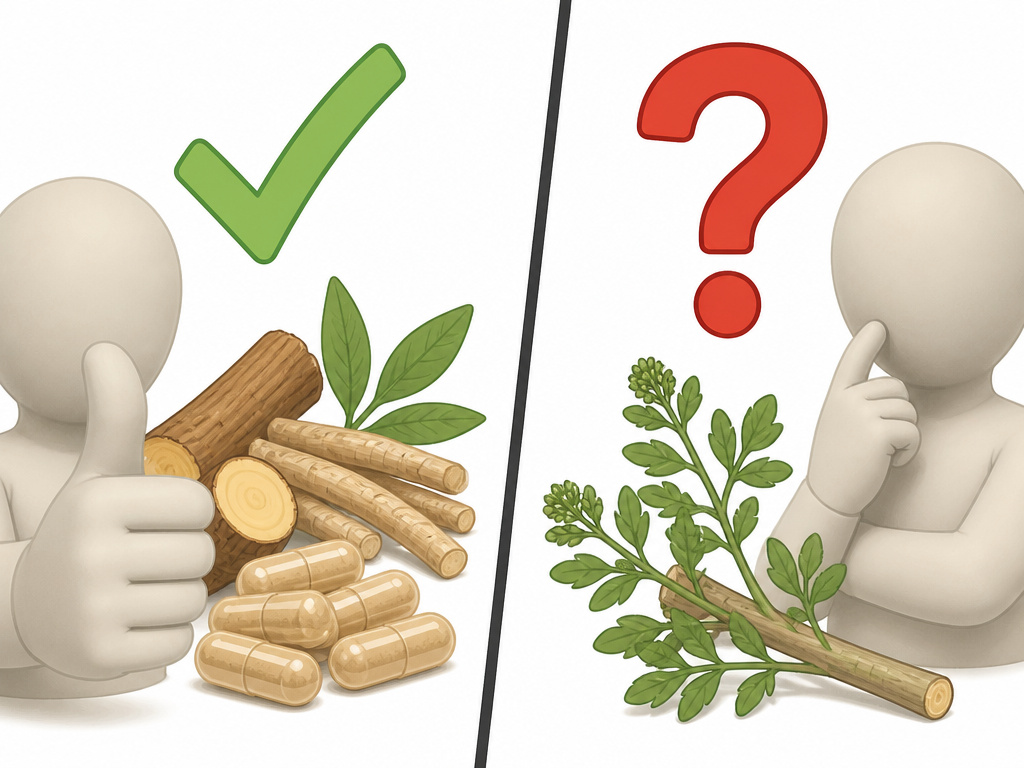
When you line up Fadogia agrestis against other popular herbs, its evidence profile looks uniquely sparse. This is most apparent in a direct Tongkat Ali vs Fadogia Agrestis comparison.
Tongkat Ali (Eurycoma longifolia) has multiple human randomized controlled trials (RCTs) to its name. A 2021 RCT in Maturitas found it significantly improved testosterone levels and erectile function scores in aging men with androgen deficiency over six months. Another study in Andrologia showed it raised testosterone in men with late-onset hypogonadism. The human dose (typically 200-400 mg of a water-soluble extract) is standardized and studied.
Ashwagandha (Withania somnifera) also has human RCTs, though its primary effects are more reliably on reducing stress and cortisol, improving sleep, and enhancing recovery, which can secondarily support healthier testosterone levels. Its mechanism is adaptogenic, not directly hormonal.
Fadogia Agrestis has zero human RCTs. Its mechanism, while interesting, is only documented in rats. The table below highlights this critical disparity.
| Herb | Best Human Evidence | Primary Proposed Mechanism | Known Safety Data in Humans |
|---|---|---|---|
| Tongkat Ali | Multiple RCTs showing increased testosterone in hypogonadal men. | Appears to stimulate Leydig cell production of testosterone; may reduce SHBG. | Generally well-tolerated in clinical trials; mild agitation possible. |
| Ashwagandha | RCTs for stress reduction, sleep, and recovery; secondary testosterone benefits. | Adaptogenic; lowers cortisol, modulates HPA axis, reduces oxidative stress. | Extensive history of use; very safe at standardized doses (e.g., KSM-66). |
| Fadogia Agrestis | None. Only animal studies. | Increases NO/cGMP, inhibits PDE5/arginase in rat tissue. | None. Reliance on animal toxicity studies showing liver/kidney stress. |
The contrast is stark. If you’re looking for research-backed ingredients, Tongkat Ali and ashwagandha have files. Fadogia agrestis has a promising dossier that’s never been tested in the field. This doesn’t mean it’s ineffective, but it places it in a higher-risk, higher-uncertainty category.
How to Approach Dosing and Cycling (Without Human Data)

Since no human trials establish a dose, any recommendation is a calculated guess based on animal data. The most common approach uses the 100 mg/kg rat dose and applies a standard species scaling factor to estimate a human equivalent dose (HED). Any human equivalent dose is an extrapolation from rat studies.
Commercial capsules vary in their dosage. This leads to the typical advice of “1–2 capsules daily.” It’s an extrapolation, not a prescription.
Common mistake: Taking the “maximum” dose from day one. Starting at the high end of an untested extrapolated range ignores the potential for individual sensitivity and the clear toxicity signals from longer-term animal studies.
Given the toxicity data, a conservative and cyclical approach is the only prudent path.
- Start Low: Begin with a single capsule (e.g., 300 mg) daily, regardless of your size. Observe for any subjective side effects for two weeks.
- Assess Tolerance: If well-tolerated, you could consider a gradual increase. There is no evidence that more is better, and the toxicity study suggests more could be riskier.
- Cycle On and Off: Cycling the supplement is a precautionary measure due to the lack of long-term human safety data. This isn’t based on Fadogia-specific research but is borrowed from the practice of cycling adaptogens and other compounds with limited long-term safety data. The goal is to prevent potential receptor downregulation or cumulative oxidative stress.
- Get Baseline Bloodwork: This is essential. Before starting, get a full metabolic panel (including liver enzymes AST/ALT and kidney markers like creatinine) and a full testosterone panel (total T, free T, SHBG). Repeat after 8 weeks on the supplement to monitor for any adverse changes. This turns an experiment into a monitored trial.
This framework is about harm reduction in the absence of safety data. It treats the supplement as a novel compound with unknown long-term effects, which it is.
How to Choose a Product (If You Proceed)
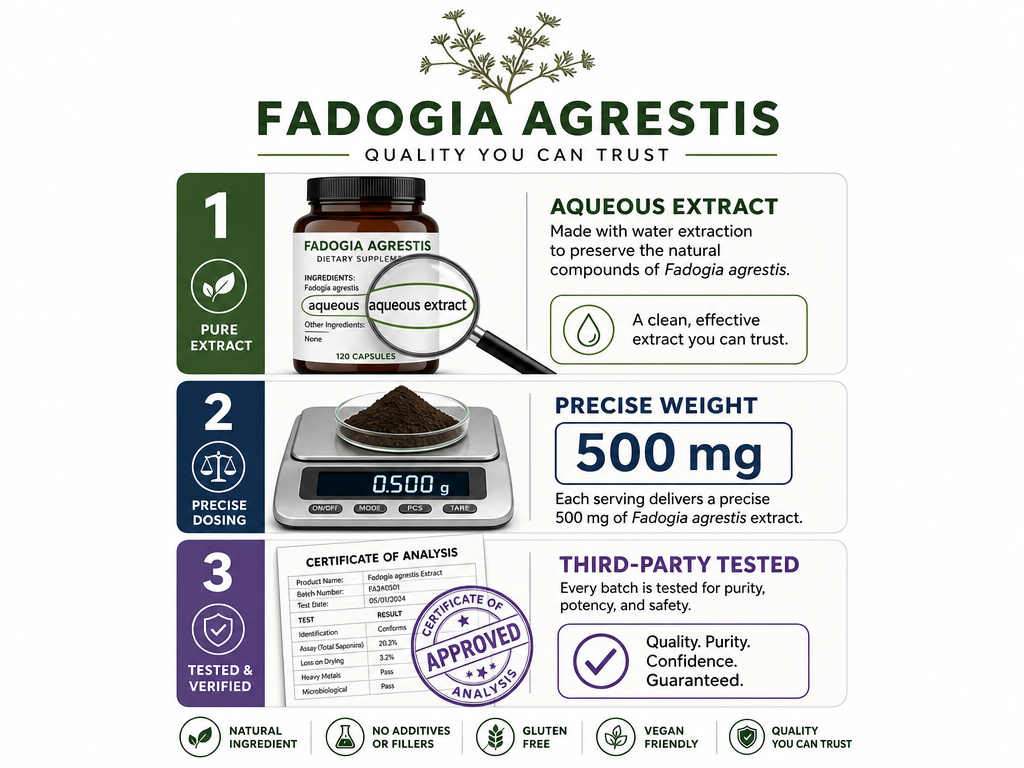
If, after weighing the evidence gap and risks, you decide to proceed, product quality is your first line of defense. The market is unregulated, and the raw material, a dried stem, can vary wildly in potency.
First, reject proprietary blends. Any product that lists “Fadogia Agrestis Blend 1000mg” without specifying the extract ratio or including other ingredients is hiding information you need. You cannot calculate your dose.
Look for standardization. Look for products that provide transparency about their extract. The next best thing is a extract ratio, like “10:1” or “4:1”. This tells you how much raw stem was used to make the extract. An extract ratio indicates how much raw material was used to produce the extract. This allows for some consistency between batches and brands.
Demand third-party testing. A Certificate of Analysis (CoA) from an independent lab like ISO-accredited Eurofins or Labdoor should be available for the batch. It should confirm the product is free from heavy metals, pesticides, and microbial contamination, and verify the stated extract strength.
Consider the solvent. All the key research uses an aqueous (water) extract. While alcohol or glycerin extracts might capture different compounds, they are not what was studied. The key research uses an aqueous extract.
Selecting from the best Fadogia Agrestis products means filtering for these specifics. It narrows the field dramatically, which is the point. You’re not shopping for a magic pill; you’re sourcing a specific, traceable botanical extract for a personal experiment.
Frequently Asked Questions
Does Fadogia Agrestis actually do anything?
In male rats, yes, the aqueous stem extract consistently increases testosterone, sexual activity, and biomarkers for erectile function. In humans, we have no clinical trial data to confirm these effects. Any perceived benefit in people is currently anecdotal and could be due to placebo, lifestyle changes, or other factors.
What’s better, Tongkat Ali or Fadogia Agrestis?
Based on available evidence, Tongkat Ali is the clear choice. It has multiple positive human clinical trials showing it can raise testosterone levels, while Fadogia Agrestis has none. The safety profile of Tongkat Ali is also better understood from these human studies. Fadogia’s mechanism is fascinating, but it remains a preclinical compound.
What is the most powerful herb for testosterone?
“Powerful” is a marketing term. The herb with the most consistent human evidence for directly increasing testosterone levels in deficient men is Tongkat Ali. However, foundational supplements like Vitamin D (if you are deficient) and Zinc (if you are deficient) can have a more dramatic and essential impact on hormonal health, as they correct a underlying nutrient gap. A list of best testosterone supplements starts with these basics before adding herbs.
What is the #1 testosterone killer?
Chronic lifestyle factors are the biggest suppressors. The top contenders are consistently poor sleep (less than 6 hours per night), chronic, unmanaged stress (elevated cortisol), obesity (excess body fat aromatizes testosterone into estrogen), and nutrient deficiencies (especially Vitamin D and Zinc). No supplement can overcome these. Addressing them is the first and most powerful step in any protocol.
Before You Go
The data creates a clear boundary. Fadogia agrestis is a research compound, not a proven supplement. Its mechanism in rats is compelling enough to justify human trials, but those trials haven’t happened. The 28-day toxicity study in rats is a bright red warning light that cannot be ignored.
If you choose to experiment, do so with the rigor it demands. That means starting with a high-quality, transparently labeled product, beginning with a minimal dose, committing to an on/off cycling protocol, and, most importantly, getting bloodwork before and during to monitor your liver enzymes and hormone levels. This turns a blind gamble into a measured, personal n=1 trial.
Otherwise, direct your focus and funds toward the ingredients with research and the lifestyle fundamentals that we know move the needle. The promise of an unknown herb is rarely worth the risk of ignoring the basics that are guaranteed to work.
