
Which Testosterone Booster Ingredients Are Backed by Research?
This post contains affiliate links. As an Amazon Associate, we earn from qualifying purchases.
The ingredients in testosterone boosters backed by research are a short list: zinc and magnesium show effects in deficient men or athletes under stress; Tongkat Ali (Eurycoma longifolia) has evidence for men with late-onset hypogonadism; and β-hydroxy β-methylbutyrate (HMB) and betaine work for athletes. The evidence for popular ingredients like D-Aspartic Acid and Tribulus terrestris is weak or population-specific; for vitamins like D, evidence is mixed and depends on the population.
That short answer matters because the supplement aisle is a minefield of overpromise. A 2023 systematic review in the International Journal of Impotence Research concluded that many commercial claims are not supported by the academic literature, which raises the question of which testosterone booster ingredients are backed by research. An ingredient’s efficacy isn’t universal—it depends entirely on who is taking it. A dose that helps a sleep-deprived, deficient athlete may do nothing for a healthy, well-nourished man.
This guide cuts through the marketing to answer the which testosterone booster ingredients are backed by research question. You’ll get a three-tier framework to sort real evidence from hype, learn how to read a label to spot under-dosed or hidden ingredients, and understand the realistic timeline and lifestyle context that determines whether any pill in a bottle will work for you.
Key Takeaways
- The strongest evidence supports correcting a documented deficiency (zinc, vitamin D, magnesium) before adding anything else.
- Population dictates results: Tongkat Ali shows promise for men with late-onset hypogonadism; HMB and betaine help athletes. Broad claims like “boosts T in all men” are false.
- Check the studied dose: Many commercial products contain extreme, unsafe doses (e.g., 1,291% RDA of B12) or hide ingredients in proprietary blends dosed below effective levels.
- A systematic review concluded that D-Aspartic Acid (DAA) fails to increase testosterone in most human trials, though other reviews may present conflicting evidence.
- Realistic changes, if they occur, take consistent use over a period of time (e.g., a 6-month trial for Tongkat Ali) alongside good sleep, diet, and exercise. There is no overnight fix.
The 3-Tier Framework for Evidence
Not all research is created equal. A headline about a “50% increase in testosterone” could be from a rodent study, a tiny human trial, or research on a specific sick population. To make sense of it, you need a filter.
The academic literature stratifies evidence by population: what works for an athlete in a calorie deficit may not work for a sedentary older man with late-onset hypogonadism, and vice versa. This population-specificity is the single most important concept for evaluating any claim.
I sort ingredients into three tiers based on the human evidence. This isn’t about hype; it’s about where the data actually points.
| Evidence Tier | What It Means | Key Ingredient Examples | Who It’s For |
|---|---|---|---|
| Tier 1: Correction | Replenishing a verified, lab-tested deficiency. This is the most reliable “boost.” | Zinc, Vitamin D, Magnesium | Anyone with a confirmed deficiency via bloodwork. |
| Tier 2: Population-Specific Aid | Shows benefit in rigorous human trials for a defined group (e.g., athletes, hypogonadal men). | Tongkat Ali, HMB, Betaine | Men who match the study population (athletes, those with late-onset hypogonadism). |
| Tier 3: Marketing Over Evidence | Popular in blends but human data is weak, inconsistent, or shows no effect on testosterone. | D-Aspartic Acid, Tribulus Terrestris, Boron | No one, based on current testosterone-specific evidence. |
Start with Tier 1. It’s not sexy, but it works. If your serum zinc or vitamin D is low, correcting that will do more for your hormonal baseline than any exotic herb. I learned this the hard way early on, chasing complex blends while ignoring a basic vitamin D insufficiency shown on my own labs. Fixing that deficiency provided a clearer shift in daily energy than any subsequent “booster” ever did.
Tier 2 ingredients require you to honestly assess if you fit the profile. Are you an aging man with symptoms and bloodwork suggesting late-onset hypogonadism? Tongkat Ali might be relevant. Are you a trained athlete pushing through intense blocks of volume? Then HMB and betaine have data for you. Taking them outside those contexts is a gamble.
Tier 3 is where most marketing budgets are spent, often obscuring which testosterone booster ingredients are backed by research. The gap between the supplement label and the claims found in the academic literature is widest here.
The Dose Dictates the Response
A studied ingredient is useless if the bottle contains a fraction of the effective dose. This is the most common sleight of hand in the testosterone booster category.
Research uses specific doses. For Tongkat Ali, a 6-month, double-blind, placebo-controlled, randomized trial evaluated its effect. A study on the fenugreek extract Furosap showed efficacy in enhancing testosterone level and improving sperm profile. If a proprietary blend lists only a total milligram weight for multiple ingredients, you cannot determine if each component is dosed at the level used in research.
Common mistake: Trusting a proprietary blend. A blend that lists only a total milligram weight for multiple ingredients prevents you from comparing each component to the research. It is a deliberate obfuscation.
The opposite problem also exists: dangerously high doses. An analysis of popular online supplements found extreme vitamin and mineral levels, with a median 1,291% of the Recommended Dietary Allowance (RDA) for vitamin B12 and 272% for zinc. Some doses even exceeded the FDA’s Tolerable Upper Intake Level (UL). More is not better; it’s a risk.
Your first step when evaluating any product is to skip to the Supplement Facts panel. Look for two things:
- Every active ingredient listed with its own specific dose in milligrams (mg) or micrograms (mcg).
- That dose matched against the doses used in human clinical trials.
If you can’t complete step one because the product uses a proprietary blend, put it back. The brand has chosen marketing over transparency. This rule alone will eliminate many products on the shelf and save you money.
Ingredients With Real Data (Tiers 1 & 2)
Apply the framework to the ingredients you’ll see most often. This is where you match the evidence to your situation.
Zinc and Magnesium: The Foundation (Tier 1)
These minerals are not “boosters.” They are essential co-factors. If you’re deficient, your body cannot produce testosterone efficiently.
- Zinc: Studies show it can support testosterone levels in deficient men or athletes under extreme physical stress. One study on cyclists found zinc and selenium supplementation had an effect on serum testosterone and plasma lactate after exhaustive exercise. However, a study on a high-dose zinc supplement given to men did not reliably increase serum testosterone. The takeaway: it helps if you need it, but megadosing without a deficiency offers no benefit and can cause copper deficiency.
- Magnesium: Similar story. Research shows magnesium supplementation can affect testosterone levels in athletes and sedentary subjects at rest and after exhaustion. It plays a role in sleep quality and metabolic function, which indirectly support hormonal health. Again, the benefit is clearest in those with inadequate intake or high losses through sweat.
The short version: Get bloodwork. If your zinc or magnesium is low, supplementing to reach the middle of the reference range is the single most evidence-backed “testosterone support” move you can make. Guessing and taking high doses long-term is a mistake.
Tongkat Ali (Eurycoma longifolia): A Contender for Specific Men (Tier 2)
This Malaysian herb has the most consistent human data in the “booster” space, but with a big caveat.
- The Evidence: A 6-month, double-blind, placebo-controlled trial found Tongkat Ali plus training improved erectile function and testosterone levels in men with androgen deficiency of aging (ADAM). Another study called it a “testosterone booster for managing men with late-onset hypogonadism.” The International Journal of Impotence Research systematic review labels it “possibly effective for men with late-onset hypogonadism and healthy men.”
- The Caveat: “Possibly effective” and “for men with late-onset hypogonadism” are the key phrases. The evidence is not for young, healthy, eugonadal men looking for a supra-physiological edge. It’s for an older, symptomatic population. The mechanism seems related to reducing sex hormone-binding globulin (SHBG), freeing up more bioactive testosterone.
If you are a man with late-onset hypogonadism, Tongkat Ali is the ingredient with research for your situation. For a 25-year-old with robust levels, the effect may be negligible.
Ashwagandha and Fenugreek: Stress and Performance (Tier 2, But Not Directly)
These are often misrepresented.
- Fenugreek: The data is mixed. Some studies, like one on the extract Furosap, show it can enhance testosterone level and improve sperm profile in volunteers. Others find its primary benefit is on libido and energy, with an “absent relationship with serum testosterone levels.” It may work by inhibiting enzymes that convert testosterone to other hormones. It belongs in the “maybe, for some” category, not the “proven” list.
For both, I view them as support for lifestyle and recovery. They are not direct levers on your testosterone production machinery.
The Overhyped and Underwhelming (Tier 3)
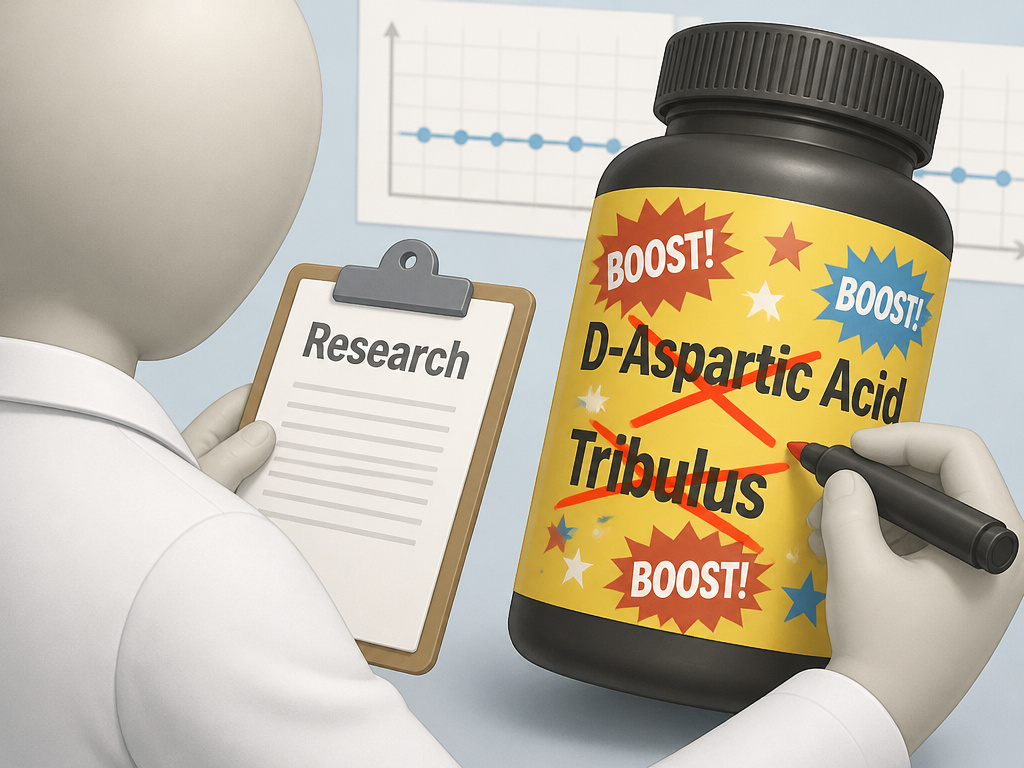
This tier is crowded. It’s where hope and marketing outpace science.
D-Aspartic Acid (DAA): The Poster Child for Failed Replication
DAA is a perfect case study in why early, promising research needs verification.
- The Promise: Early, small studies in infertile men and rats showed dramatic increases in testosterone and luteinizing hormone (LH).
- The Reality: Follow-up studies in trained, healthy men consistently showed no significant increase in testosterone. Some even noted a decrease at higher doses. The 2023 systematic review states plainly: DAA has been studied in two reports, with the overall finding that “most fail to increase total testosterone.”
My own experience mirrors this. My training didn’t improve, my libido didn’t change, and follow-up bloodwork was unremarkable. Later, when the better-controlled trials were published, the picture became clear. DAA teaches a critical lesson: wait for replication before you buy.
Tribulus Terrestris: The Libido Distraction
Tribulus is one of the most common ingredients in testosterone booster blends, and its reputation is built on a misunderstanding.
- The Claim: It boosts testosterone by increasing luteinizing hormone (LH).
- The Evidence: Human trials are inconsistent. Some small studies, like a pilot on men with partial androgen deficiency (PADAM), note improvements in erectile function. A prospective analysis in men with unexplained infertility looked at its effect on semen parameters. However, a major review in the Journal of Ethnopharmacol concluded that evidence for its direct testosterone-boosting effect in humans is limited. Its effects on libido are likely independent of significant serum testosterone changes.
It might make you feel more interested, but it’s not reliably moving your hormone numbers. This is a key distinction that supplement label marketing blurs on purpose.
Boron and DHEA: The Specialized Tools
These have narrow, specific uses and are often misapplied.
How to Build a Smart Protocol (And Avoid Side Effects)
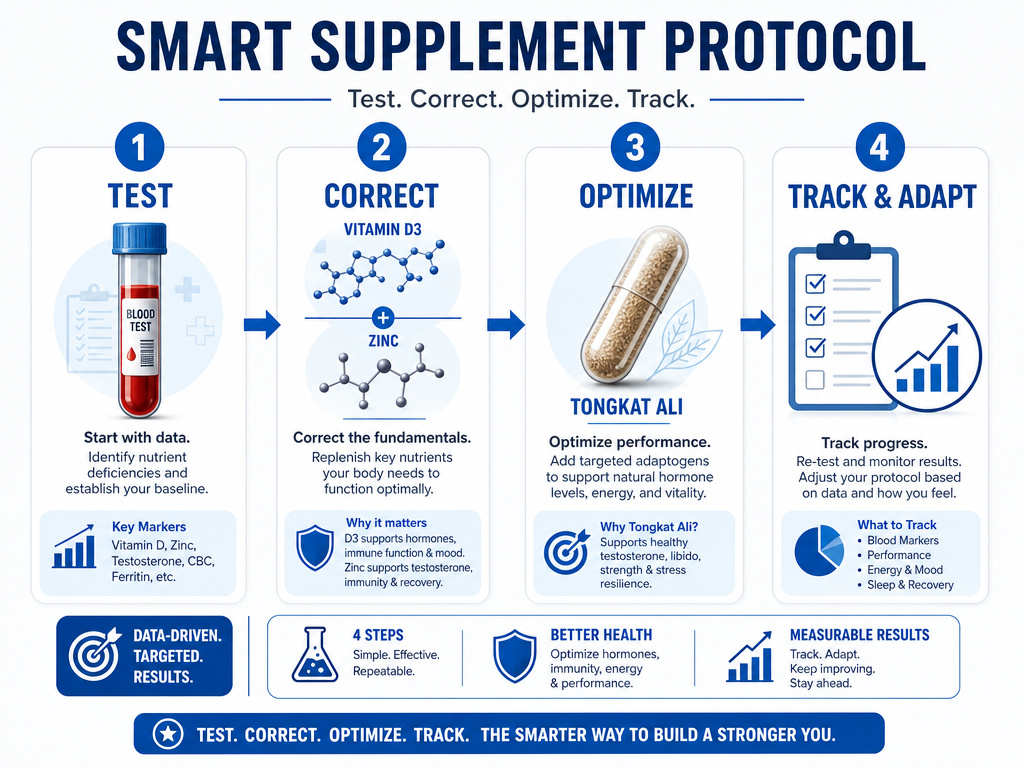
Throwing a dozen ingredients at the wall is expensive, confusing, and risky. A smart protocol is sequential and minimalist.
- Test, Don’t Guess. Get full bloodwork (Total T, Free T, SHBG, LH, FSH, Estradiol, Vitamin D, Zinc, Magnesium). This tells you if you have a correctable Tier 1 deficiency or a profile that matches a Tier 2 ingredient’s target population.
- Correct Deficiencies First. If vitamin D is low, start a sensible dose (2000-5000 IU/day) and retest in 3 months. If zinc is low, supplement with 15-30 mg of zinc glycinate for a few months. This alone may resolve symptoms.
- Add One Ingredient at a Time. If your profile suggests a Tier 2 ingredient like Tongkat Ali could help, add it alone. Use a product from a transparent brand like Thorne or Pure Encapsulations. Give it a full trial period consistent with the research (e.g., 6 months for Tongkat Ali).
- Re-assess. Note any subjective changes (energy, libido, recovery) and consider repeat bloodwork after 3 months. Did the numbers move? Do you feel better? This data informs your next step.
Where this goes sideways: Stacking multiple unproven ingredients from the start. If you feel better (or worse), you’ll have no idea which component was responsible. You also multiply your risk of side effects and nutrient imbalances.
Potential side effects are ingredient-specific. High-dose zinc can cause nausea and copper deficiency. Tongkat Ali may be stimulating and disrupt sleep if taken too late. DHEA can increase estrogenic effects like acne or mood swings. This is why single-ingredient testing is a safety practice as much as an efficacy one.
Are the high doses in testosterone boosters safe?
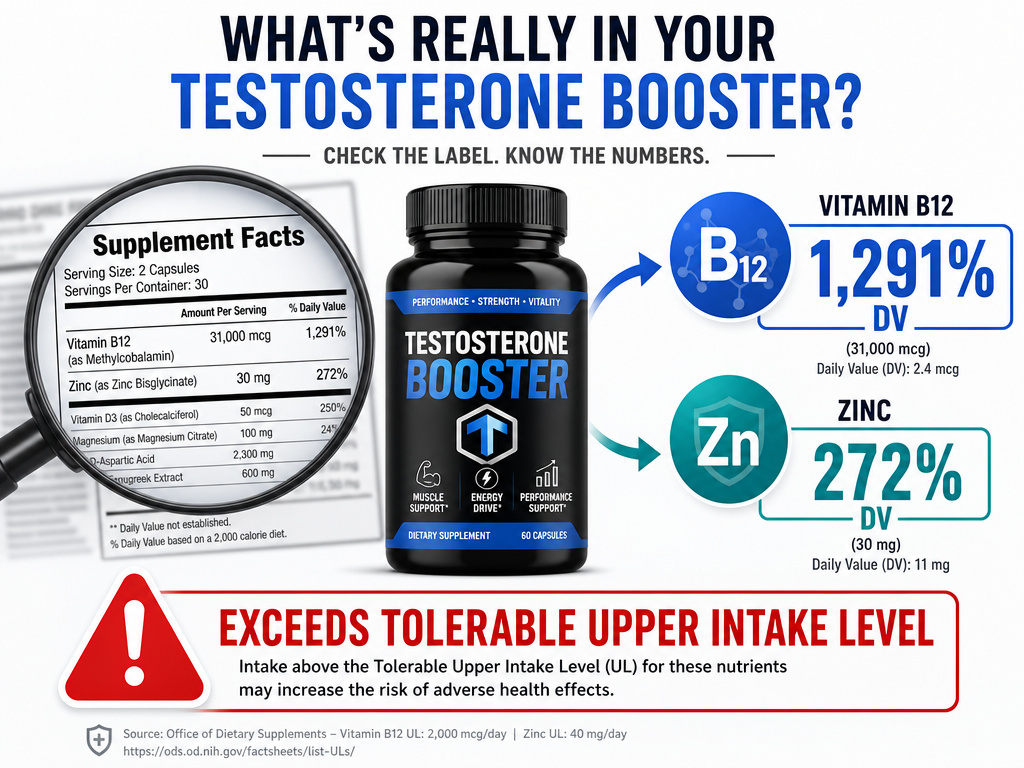
Research analyzing popular commercial products found they often contain extreme doses of vitamins and minerals. One analysis reported a median dose of 1,291% of the Recommended Dietary Allowance for vitamin B12 and 272% for zinc in these supplements. Some products even contain doses that exceed the FDA’s established Tolerable Upper Intake Level. This practice of mega-dosing is not supported by evidence for boosting testosterone in healthy individuals and introduces an unnecessary risk of side effects. When evaluating a product, check the supplement facts panel against the daily values to identify potentially excessive intakes.
Frequently Asked Questions
Are there any scientifically proven testosterone boosters?
Yes, but the definition of “proven” is narrow. Correcting a documented deficiency of zinc, vitamin D, or magnesium is scientifically proven to restore testosterone to normal levels in deficient individuals. For non-deficient populations, Tongkat Ali has promising evidence for men with late-onset hypogonadism, and HMB/betaine are proven effective for athletes. There is no ingredient proven to significantly boost testosterone in all healthy men.
Which ingredient is best for testosterone boosters?
There is no single “best” ingredient. The most effective ingredient is the one that addresses your specific, verified need. For a deficient man, zinc is best. For a stressed athlete, ashwagandha might be best for recovery. For an older man with low free testosterone, Tongkat Ali has the best data. The question should be “Which ingredient is best for me, based on my bloodwork and situation?”
What is the strongest natural testosterone booster?
The strongest natural lever is not a supplement—it’s lifestyle. Consistent, quality sleep (7-9 hours), managing chronic stress, resistance training, and maintaining a healthy body weight have a far greater impact on testosterone than any over-the-counter pill. The strongest supplemental “boost” comes from correcting a major nutrient deficiency, which can have a dramatic effect if your levels are critically low.
How long does it take for a testosterone booster to work?
If an ingredient is going to work, you should notice subjective changes (improved mood, energy, libido) within 4-8 weeks. Measurable changes in blood testosterone levels, if they occur, are typically seen after 8-12 weeks of consistent use. This is why testing a single ingredient for a full 3-month cycle is the minimum sensible trial period. Expecting results in days or a couple of weeks is unrealistic.
The Bottom Line
Ignore the hype and follow the evidence trail, which is shorter than you think. Start with a blood test to rule out a basic deficiency—that’s Tier 1, and it’s non-negotiable. If you move to Tier 2, be brutally honest about whether you match the study population. Are you really a late-onset hypogonadism candidate, or just a tired 35-year-old who needs better sleep?
Finally, treat any supplement as a single variable in an experiment. Change one thing at a time, track the outcome for three months, and let your own response (and labs, if possible) be the judge. The goal isn’t to find a magic pill; it’s to use disciplined, evidence-informed steps to build a foundation of health that allows your hormones to function optimally on their own. That process is slower, but it’s the only one that actually works.
