
How to Read a Testosterone Booster Label: Step-by-Step
This post contains affiliate links. As an Amazon Associate, we earn from qualifying purchases.
To read a testosterone booster label, ignore the marketing and go straight to the Supplement Facts panel. Check three things: the “Proprietary Blend” line (a red flag), each ingredient’s exact dose, and whether that dose matches the amounts used in published research. A 2018 study found that 90% of these products claimed to boost testosterone, but only 24.8% of ‘T booster’ supplements had published data supporting their testosterone-boosting claims.
That gap between claim and evidence is where the real reading happens, and it’s key to know how to read a testosterone booster label. The label is a legal document, but its design is often a sales tool. Your job is to see past the bold “MAX STRENGTH” fonts and find the numbers that actually matter.
What follows: a three-step decoder for the Supplement Facts panel, the truth about proprietary blends, and how to cross-check ingredient doses against the studies they cite. By the end, you’ll be able to scan any bottle in ten seconds and know whether it’s worth your money.
Key Takeaways
- Ignore the front panel hype and turn the bottle to the Supplement Facts — that’s the only regulated part of the label.
- Treat any “Proprietary Blend” as a major red flag; it legally hides individual ingredient doses, making efficacy impossible to verify.
- Cross-reference ingredient doses with the amounts used in clinical studies; a common trick is to include a researched ingredient at a fraction of the effective dose.
- Look for third-party testing seals like NSF or USP, which verify that what’s on the label is actually in the bottle.
- While dietary supplements are not FDA-approved drugs and the manufacturer is responsible for proving its claims are truthful, a peer-reviewed study found 90% of ‘T booster’ supplements claimed to ‘boost T’, which is a treatment-like claim for a condition.
The 3-Part Supplement Facts Decoder
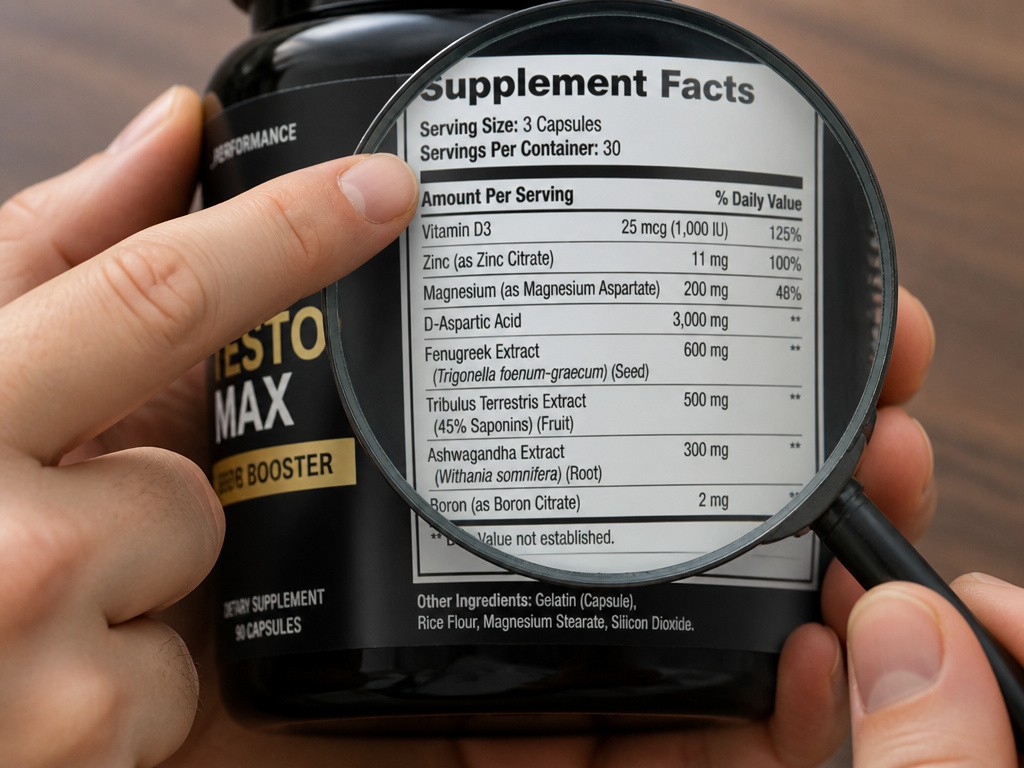
Ever wondered why two boosters with similar front-label promises have wildly different prices? The answer is never in the marketing copy. It’s in the tiny print of the Supplement Facts panel, the only section with any legal weight under FDA labeling rules.
The Supplement Facts panel is required to list dietary ingredients, the amount per serving, and the % Daily Value if one exists. Ingredients must be listed in descending order by weight. A “Proprietary Blend” is a single ingredient entry that groups multiple components, with only the total blend weight disclosed.
Start at the top with the Serving Size. This is the first place manufacturers play games. One capsule might contain a “serving,” but the recommended use is three capsules daily. You’re buying a one-month supply that lasts ten days. Check it.
Next, scan the list of dietary ingredients. They must be listed in order of prominence. If “Tongkat Ali Extract” is the fifth item, there’s less of it in there than the four ingredients above it. That order is a visual dose indicator before you even see the milligram amounts.
Finally, look at the % Daily Value (%DV) column. For vitamins and minerals, this shows how much of your recommended daily intake one serving provides. This is where that 2018 PMC study on supplement composition found a critical issue: many boosters contained “supra-therapeutic doses of vitamins and minerals, occasionally over the Tolerable Upper Intake Level (UL).” A dose at 150% DV of Zinc might look impressive, but consistently exceeding the UL can cause toxicity. The numbers here aren’t just suggestions; they are ceilings.
| Label Section | What It Tells You | The Common Trick to Watch For |
|---|---|---|
| Serving Size | The manufacturer-defined amount to consume at one time. | The serving size is one capsule, but the directions say “take 3 capsules daily,” tripling your cost and intake. |
| Ingredient List | Ingredients in descending order by weight. | A researched ingredient like “D-Aspartic Acid” appears near the bottom, meaning its dose is likely too low to be effective. |
| % Daily Value (%DV) | Percentage of the recommended daily intake for vitamins/minerals. | Mega-doses (e.g., 500% DV of Vitamin B6) that exceed safe upper limits, which the study noted as a risk. |
The panel is a map. You just need to know how to read a testosterone booster label to understand the landmarks.
The Proprietary Blend Trap
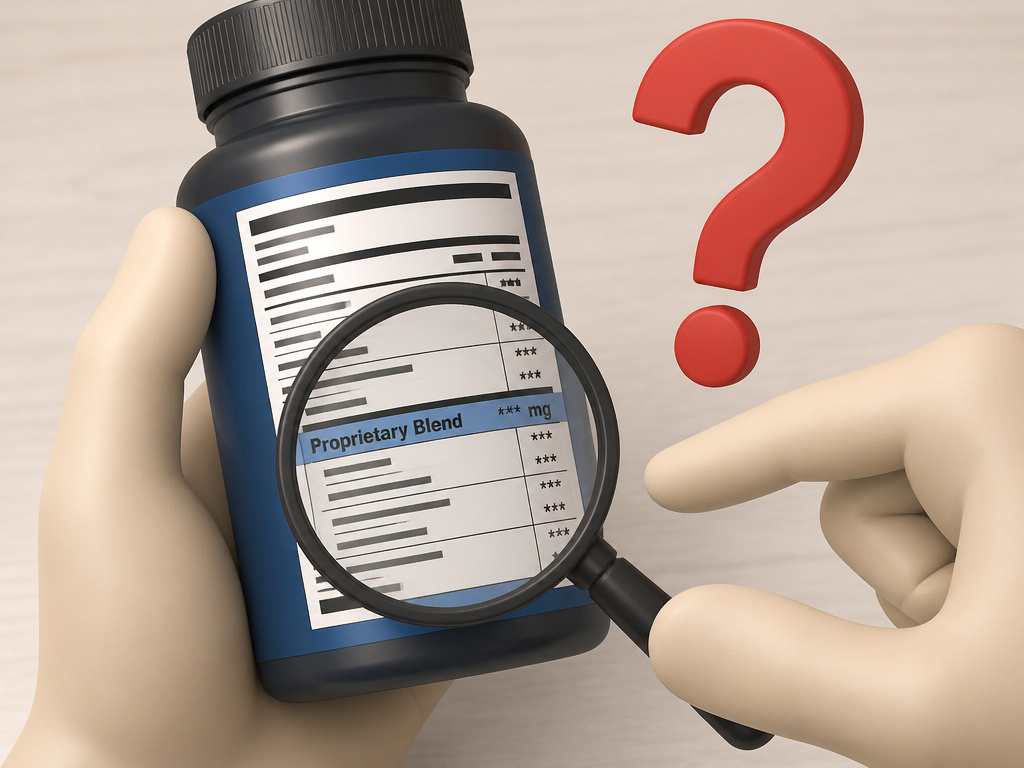
This is the single biggest red flag on any supplement label. A proprietary blend is a trademarked mixture of ingredients where only the total weight of the blend is listed, not the individual amounts of each component inside it. Manufacturers love them. As someone who values transparent labeling, I treat them with default suspicion.
The logic from brands is that they’re protecting a unique, synergistic formula. They protect you from knowing how little of the expensive, effective ingredient you’re actually getting. You cannot verify efficacy without a dose. If a blend totals 1000mg and contains five ingredients, is the first-listed item 900mg and the last four a 25mg dusting each? You have no way to know. This practice makes a mockery of the idea of identifying quality supplements.
Common mistake: Buying a booster because a “Proprietary Blend” has a cool, science-sounding name like “Anabolic Matrix” or “Libido Complex.” You are paying for a trademark, not a transparent recipe.
I learned this the hard way with D-aspartic acid years ago. Early, small human studies suggested a benefit, so I tried a booster featuring it in a proprietary blend. Three grams a day for three months. My training logs showed no change, and follow-up bloodwork was just normal day-to-day noise. Later, larger trials in trained men showed no real testosterone increase, and some even showed a dip at higher doses. The booster I took could have contained a clinically irrelevant dose—the blend hid it. I wasted four months.
If you’re evaluating ingredients backed by research, knowing how to read a testosterone booster label reveals a proprietary blend is a dead end. Skip it and look for products that disclose every dose. Your ability to evaluating supplement quality depends on that transparency.
How to Cross-Check Ingredient Doses with Research
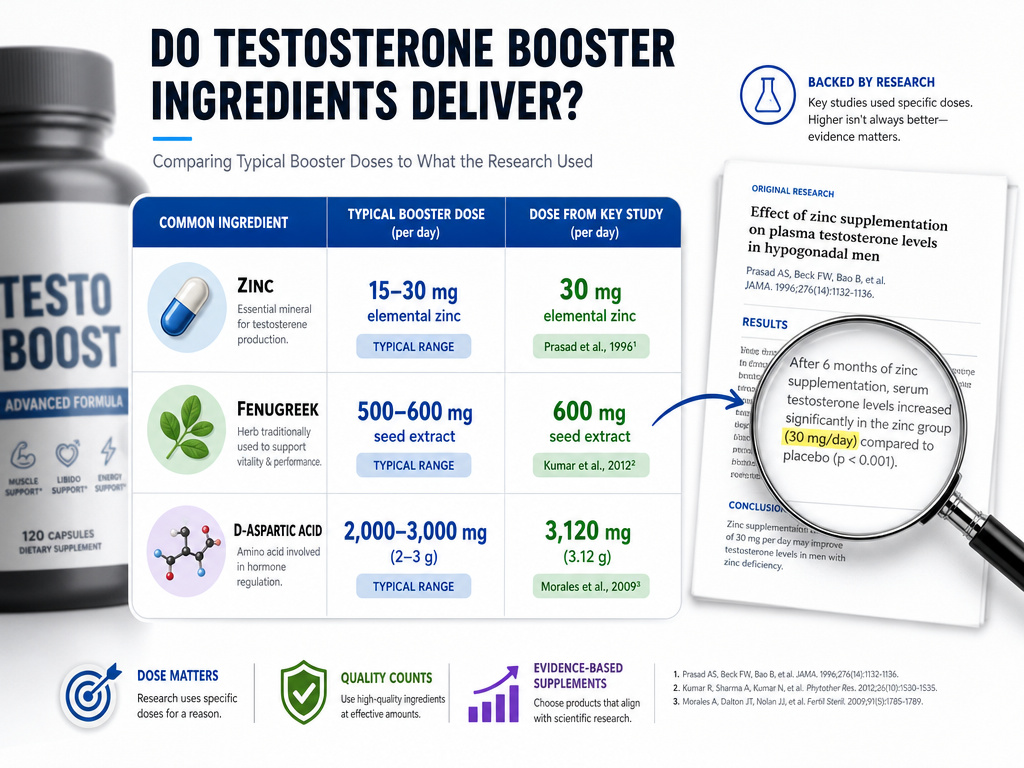
A label can list all the right ingredients. Fenugreek, Zinc, Ashwagandha. The trick isn’t their presence; it’s their dose. An ingredient included at 10% of the amount used in a positive study is functionally a placebo, but it lets the brand say “clinically studied ingredients!” on the front.
Here’s your method. First, identify the key active ingredient. For example, it might be Zinc. The label says “Zinc (as Zinc Citrate) – 15mg (136% DV).” Good, a specific dose.
Second, search for the human study. You’re looking for the dosage used in the trial that showed a benefit for testosterone parameters. For Zinc, research on deficient men has used specific doses over time to restore levels. If your booster’s dose is lower than the amount used in relevant research, its effect may be reduced. Context matters wildly—the study was on deficient men, not already-sufficient gym-goers. The claim “supports healthy testosterone” might be technically true, but it’s stretching the evidence thin.
I won’t recommend a product that uses a 50mg study dose and includes 5mg. It’s a marketing garnish, not a therapeutic amount. The scientific analysis of supplement labels found 61.5% of ‘T booster’ supplement ingredients had no published data on their effect on testosterone.
Build a simple table as you research. It cuts through the noise.
| Common Ingredient | Typical Booster Dose | Dose from Key Supporting Study | Verdict |
|---|---|---|---|
| Zinc | 10-30 mg | 30 mg daily for 6 months (in deficient men) | May be effective only if you are deficient. |
| Fenugreek Extract | 500-600 mg | 600 mg daily of a standardized extract (Testofen) in several trials. | Must be a standardized extract at the studied dose. |
| D-Aspartic Acid | 2-3 g | 3g daily showed mixed results; later studies in athletes showed no effect. | Evidence is highly conflicted; consider it unproven. |
This is why third-party testing matters. A seal from NSF or USP doesn’t mean the product works. It means the 15mg of Zinc on the label is actually in the capsule, and it’s not contaminated with heavy metals. Verification is the first step; efficacy is a separate, harder question.
Understanding “Other Ingredients” and Safety Warnings
The “Other Ingredients” list is the backstage area. This is where binders, fillers, flowing agents, and coloring live. For most people, it’s ignorable. But if you have sensitivities, allergies, or just prefer a clean supplements approach, this section is critical.
Look for unnecessary additives. Magnesium stearate and silicon dioxide are common and generally safe flowing agents. Artificial colors (like FD&C Blue #2) or preservatives like sodium benzoate are less benign for some. If you’re choosing between two otherwise equal products, the one with a shorter, simpler “Other Ingredients” list is usually the better pick.
Then there are the warnings. Legally mandated statements like “These statements have not been evaluated by the Food and Drug Administration. This product is not intended to diagnose, treat, cure, or prevent any disease” are not just fine print. They are a direct reminder of the regulatory chasm between supplements and drugs. A prescription testosterone product like the one described in the FDA label for Depo-Testosterone injection undergoes rigorous review for safety and efficacy. A supplement does not.
Where this goes sideways: Missing the warning about potential drug interactions. Some ingredients, like St. John’s Wort (rarely in boosters) or high-dose Zinc, can interfere with medications. The label might have a generic “consult your physician” line. Take it seriously.
Finally, look for allergen statements: “Manufactured in a facility that also processes milk, soy, wheat, and tree nuts.” If you have a severe allergy, this is a hard stop. Even with thorough cleaning, cross-contamination is a real risk in shared facilities. This is another layer where third-party tested supplements from certified facilities provide an extra safety net.
Testosterone Booster Labels vs. Prescription Labels
This contrast is the masterclass in label literacy. It shows you what true regulation looks like. A dietary supplement label is governed by the DSHEA act of 1994, which places the burden of proof for safety and truthful claims on the manufacturer after the product is on the market. The FDA regulations are primarily about policing false claims and reacting to adverse events.
A prescription drug label, like the official testosterone gel labeling information, is a document of pre-market verification. It is dense with specific, FDA-reviewed data:
- Indications and Usage: Exactly which diagnosed conditions it treats (e.g., hypogonadism).
- Dosage and Administration: Precise dosing instructions, often based on blood test results.
- Warnings and Precautions: Detailed risks, like the potential for increased blood pressure or the serious warning about secondary exposure to children.
- Clinical Studies: Data from trials, including the percentage of patients who achieved specific testosterone levels.
Where a booster might say “supports healthy testosterone levels,” a drug label will state: “In a clinical trial, 77.5% of patients had average testosterone concentration within the normal range (300-1140 ng/dL) on Day 90.” One is a vague structure/function claim; the other is a measurable outcome from a controlled study.
This isn’t to say prescriptions are always the answer. They are for diagnosed medical conditions. But understanding the difference in label rigor shows you exactly what evidence looks like. It makes the vague language on supplement labels easier to spot and contextualize. When you wonder do testosterone boosters work, you’re asking for evidence that almost never reaches the standard demonstrated on a prescription label.
Types of testosterone tests (total, free, bioavailable)
When checking your levels, you’ll encounter different test types. Total testosterone measures all the hormone in your blood, both bound and unbound. Free testosterone measures only the fraction that is not attached to proteins and is immediately available for your body to use. Bioavailable testosterone includes both the free hormone and the portion loosely bound to albumin, representing the testosterone that is readily accessible to tissues. Prescription testosterone products, like Jatenzo, require confirming hypogonadism by measuring serum testosterone concentrations in the morning on at least two separate days before starting treatment.
How to read/interpreting lab report numbers and units (e.g., ng/dL)
Your lab report will show a number next to a unit, typically nanograms per deciliter (ng/dL). This unit tells you the concentration of testosterone in a specific volume of your blood. When interpreting these numbers, you must compare them to the reference range provided by the lab performing the test, as ranges can vary. For prescription therapies, specific timing matters; for example, when using Jatenzo, serum testosterone is measured 6 hours after the morning dose for dose adjustment. The goal of prescription testosterone treatment is to get your level into the normal range, which is assessed through clinical monitoring.
Normal/reference ranges for testosterone levels
A normal or reference range is the span of values a lab considers typical for a healthy population. These ranges are not universal and can differ between laboratories. For testosterone, a common reference range used in clinical trials for prescription gels like Fortesta is 300 to 1140 ng/dL. It’s crucial to use the range provided by your own lab report for accurate interpretation. Remember, a single number outside the range does not automatically indicate a problem; diagnosis requires a clinical evaluation by a healthcare provider, often based on multiple tests as specified for prescription medications.
Frequently Asked Questions
What is the most important thing to look for on a testosterone booster label?
The Supplement Facts panel, specifically the disclosed dose of each ingredient. Ignore the proprietary blend and front-label marketing. Your first move is to turn the bottle around and look for exact milligram amounts. If you can’t find them, the product fails the basic transparency test.
Are “Proprietary Blends” always bad?
Not always, but you should treat them as guilty until proven innocent. They legally obscure individual ingredient doses, making it impossible for you or any third party to verify if the amounts are effective. Some reputable companies use them for truly novel, patented complexes. But in the testosterone booster space, they are far more often used to hide cheap filler ingredients and underdose expensive ones. When in doubt, choose full disclosure.
How can I tell if the claims on the label are true?
You must do the cross-checking yourself. Note the ingredient and its dose on the label. Then search for published human clinical trials on that specific ingredient at that specific dose. Look for studies in reputable journals, not just citations on the brand’s website. Remember the statistic: only 24.8% of booster ingredients have published data supporting testosterone-boosting claims.
What do third-party testing seals like NSF or USP mean?
These seals mean the product has been audited by an independent laboratory. They verify that what is on the label is in the bottle (accuracy), that the product is free from specific contaminants (purity), and that it was manufactured under safe conditions. They do not certify that the product is effective or will boost your testosterone. They are a verification of quality control, not a guarantee of efficacy.
The Bottom Line
Reading a testosterone booster label is a skill in defensive shopping. The goal isn’t to find a miracle pill; it’s to avoid wasting money on overpriced multivitamins wrapped in masculine marketing.
Start with the basics. Reject proprietary blends outright—your search for effective vs ineffective pills begins with this one filter. Then, take the five minutes to cross-reference the top two or three ingredient doses with the actual studies. You’ll be ahead of 90% of buyers.
The most honest label in the world still can’t guarantee a result in your body. But a dishonest or opaque label guarantees you’re flying blind. Choose transparency every time. This is the only way you can test, track, and learn what actually works for you.
