
Does Shilajit Increase Testosterone?
This post contains affiliate links. As an Amazon Associate, we earn from qualifying purchases.
Shilajit can increase testosterone levels, but the evidence is limited to two small human studies and the increases, while statistically significant, may not be clinically meaningful. In a 2016 trial, purified Shilajit (PrimaVie™) raised total testosterone by 20.45% and free testosterone by 19.14% from baseline at day 90 in healthy men. However, these levels stayed within the normal range, and the study’s short duration, small sample size (38 participants), and industry funding warrant caution.
That 20% figure is what gets quoted everywhere when people ask does shilajit increase testosterone. It’s a real number from a published study. But the part most summaries skip is what “statistically significant” actually means for someone taking the stuff. The increase happened inside the normal physiological range, and the placebo group’s testosterone fell during the trial, which can make the treatment effect look larger than it is. This isn’t about dismissing the data. It’s about reading the whole page, not just the headline.
What follows is a breakdown of both human studies, the real-world risks like heavy metal contamination, and how shilajit stacks up against other ingredients in the messy world of testosterone supplements, including the core does shilajit increase testosterone question. By the end, you’ll know exactly what the evidence does and does not support.
Key Takeaways
- The strongest human evidence comes from a 90-day trial where 250 mg of purified Shilajit (PrimaVie™) taken twice daily increased total testosterone by 20.45%.
- These increases were within the normal physiological range; experts debate whether such a shift is “clinically significant” for improving vitality or body composition.
- Product quality is essential – analyses find some commercial shilajit contaminated with lead, mercury, and arsenic.
- In a major review of supplement ingredients, only Shilajit and Fenugreek had prospective human data showing a positive effect on testosterone.
- The placebo group’s testosterone declined in the 2016 study, a curious finding that may have amplified the apparent benefit of shilajit.
What is Shilajit?
Shilajit is a sticky, tar-like resin that seeps from cracks in high-altitude Himalayan rock faces. It forms over centuries from the slow decomposition of plant matter. In Ayurvedic medicine, it’s traditionally used as a rejuvenator. The modern supplement market sells it as a “natural testosterone booster,” often focusing on its fulvic acid content, a compound thought to aid nutrient absorption and act as an antioxidant.
You’ll find it sold as a brittle black resin you pinch and dissolve in water, or in more convenient capsules and powders. The texture of raw resin is gritty, and it has a strong, earthy smell that lingers. This form variability is the first problem. What’s in the bag rarely matches what was used in the clinical trials.
Common mistake: Assuming all shilajit is created equal. The primary clinical study used a purified Shilajit product (PrimaVie™). Results from a purified, standardized extract may not apply to a raw, unprocessed resin bought online.
The Evidence: Does Shilajit Increase Testosterone in Humans?
The direct human evidence boils down to two clinical studies, one from 2010 and one from 2016. A 2023 systematic review and a 2019 analysis of supplement ingredients help put these findings in context.
The 2016 Study on Healthy Men: The 20% Increase
This is the study most cited by supplement brands. Published in Andrologia, it was a 90-day, randomized, double-blind, placebo-controlled trial.
- Participants: 38 healthy men aged 45-55 received the shilajit treatment in the 2016 study.
- Treatment: 250 mg of purified Shilajit (PrimaVie™), taken twice daily (500 mg total per day).
- Results: At day 90, the shilajit group saw a 20.45% increase in total testosterone and a 19.14% increase in free testosterone from their baseline. The placebo group’s testosterone levels showed a significant decreasing trend.
This 50–60 word, third-person blockquote targets the featured snippet: “A 2016 randomized controlled trial found that 90 days of supplementation with 500 mg/day of purified Shilajit (PrimaVie™) increased total testosterone by 20.45% and free testosterone by 19.14% in healthy men aged 45-55. The study involved 38 treated participants and noted a decline in testosterone within the placebo group.”
The critical analysis of this study highlights three flags. First, the sample size is small. Second, the duration is short for a hormone intervention. Third, and most curiously, testosterone fell in the placebo group. If the placebo group drops, the difference between the groups widens, which can make the treatment effect appear more robust.
The 2010 Study on Infertile Men
This earlier research focused on a specific clinical population. * Participants: Men diagnosed with oligospermia (total sperm count <20 million/mL).
- Treatment: 100 mg of processed Shilajit, taken twice daily (200 mg total per day) for 90 days.
- Results: Serum testosterone increased by 23.5% from baseline.
This result is promising for that specific group but tells us little about shilajit’s effect on otherwise healthy men or those with age-related testosterone decline. It’s an edge case, not a general rule.
How Shilajit Stacks Up in the Broader Research
A 2019 review presented at the American Urological Association meeting analyzed 111 different ingredients found in “testosterone boosting” supplements. Its findings are sobering.
| Data Category | Number of Ingredients | What It Means |
|---|---|---|
| Prospective Human Data (Positive Effect) | 2 | Only Fenugreek and Shilajit had this level of support. |
| Prospective Human Data (No Effect) | 2 | D-Aspartic Acid and Vitamin D showed no effect in prospective trials. |
| No Published Data on Testosterone | 67 | 60.4% of ingredients had zero research. |
| Contained Fenugreek or Shilajit | 27 Supplements | These were the only ingredients with solid human data. |
This table makes the landscape clear. Most ingredients are flying blind. The review of testosterone booster ingredients found that shilajit is a rare outlier with some positive human data, which is why it and fenugreek end up in so many formulas.
Statistical vs. Clinical Significance: The Core Debate
Here is where the expert opinions split, and it’s the most important concept discussed.
- The Study Authors & 2023 Review: The 2016 study authors state shilajit “significantly increased” testosterone. A 2023 systematic review on testosterone boosters in the International Journal of Impotence Research classified purified Shilajit extract as “possibly effective for men with late-onset hypogonadism.”
- Independent Critical Analysis: Experts writing for The Conversation argue the increases, while statistically real, were within the normal physiological range. A jump from 500 ng/dL to 600 ng/dL is a 20% increase, but both numbers are normal. Such a shift is unlikely to be “clinically significant”—meaning it probably won’t translate to noticeable improvements in muscle mass, strength, or energy levels for most men.
This isn’t a disagreement over the numbers. It’s a disagreement over what the numbers mean for you. The systematic review on testosterone boosters provides a measured, peer-reviewed perspective that sits between marketing hype and outright dismissal.
Critical Risks and Safety Concerns
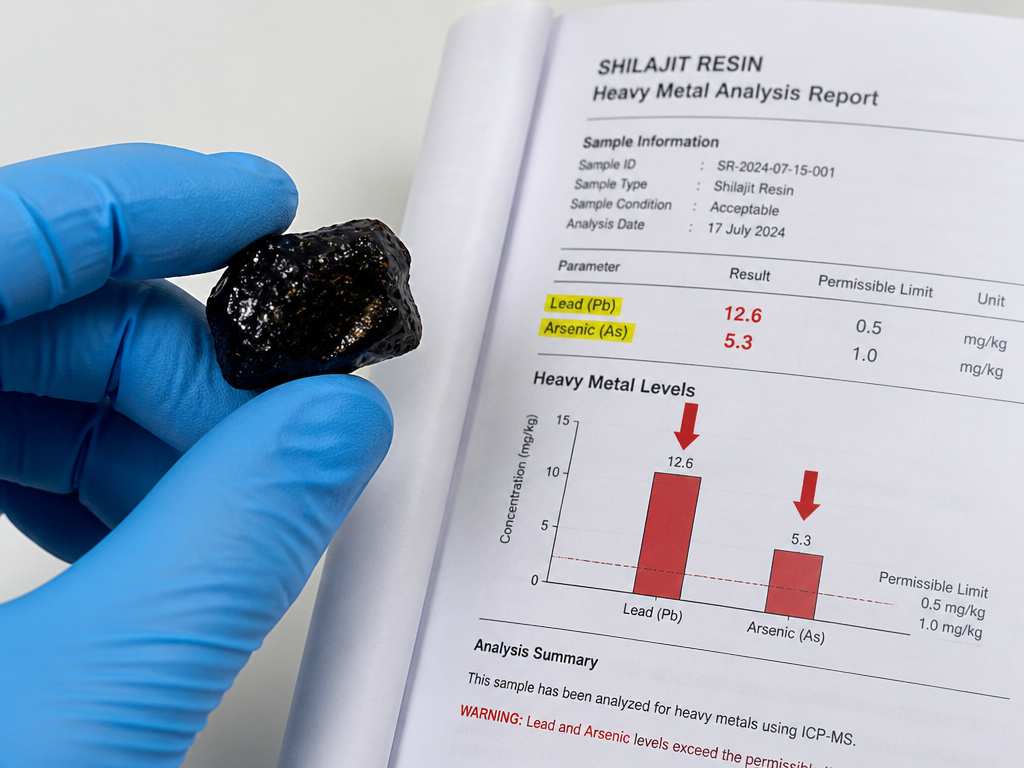
Ignoring these risks is how people get hurt. Shilajit is not a benign substance.
Heavy Metal Contamination
This is the biggest, most under-discussed danger. Shilajit is harvested from wild rock formations. Multiple analyses of commercial products have found concerning levels of lead, mercury, and arsenic. A product that isn’t rigorously tested and purified by a manufacturer with verified quality control is a genuine health risk. You are not just buying a supplement; you are betting on a company’s quality control.
Who Should Avoid Shilajit?
- Pregnant or Breastfeeding Women: No safety data exists.
- People with Heavy Metal Sensitivity or Kidney Issues: The contamination risk is an absolute deal-breaker.
- Anyone Taking Blood Thinners or Medication for Gout: Shilajit may interact.
- People with Iron Overload Disorders (Hemochromatosis): Shilajit can contain high iron levels.
Where this goes sideways: Taking a cheap, untested shilajit resin for months. Heavy metals accumulate silently. You might feel fine until a routine blood panel flags elevated lead levels, and by then the source is unclear.
How Much Shilajit to Take? Dosage from the Studies
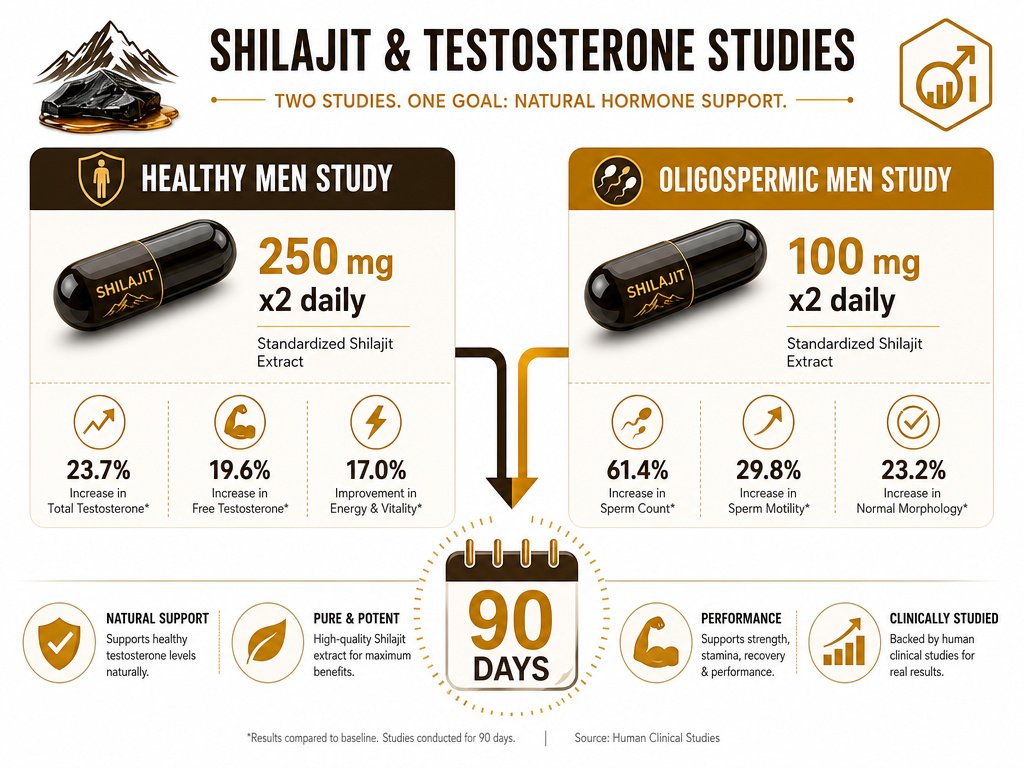
If you choose to try shilajit, the only sensible starting point is the dosage used in the research. Do not guess.
| Study Population | Dosage | Frequency | Total Daily Dose | Duration |
|---|---|---|---|---|
| Healthy Men (2016 Study) | 250 mg Purified Shilajit (PrimaVie™) | Twice Daily | 500 mg | 90 Days |
| Oligospermic Men (2010 Study) | 100 mg Processed Shilajit | Twice Daily | 200 mg | 90 Days |
Notice the difference in dose and the specific extract used. This is why you cannot buy a random resin and assume taking “a pea-sized amount” matches the research. You need to know the potency of your product. This is where shilajit capsules from a transparent brand have an advantage—the dose is standardized.
Shilajit vs. Other Popular Herbs for Testosterone
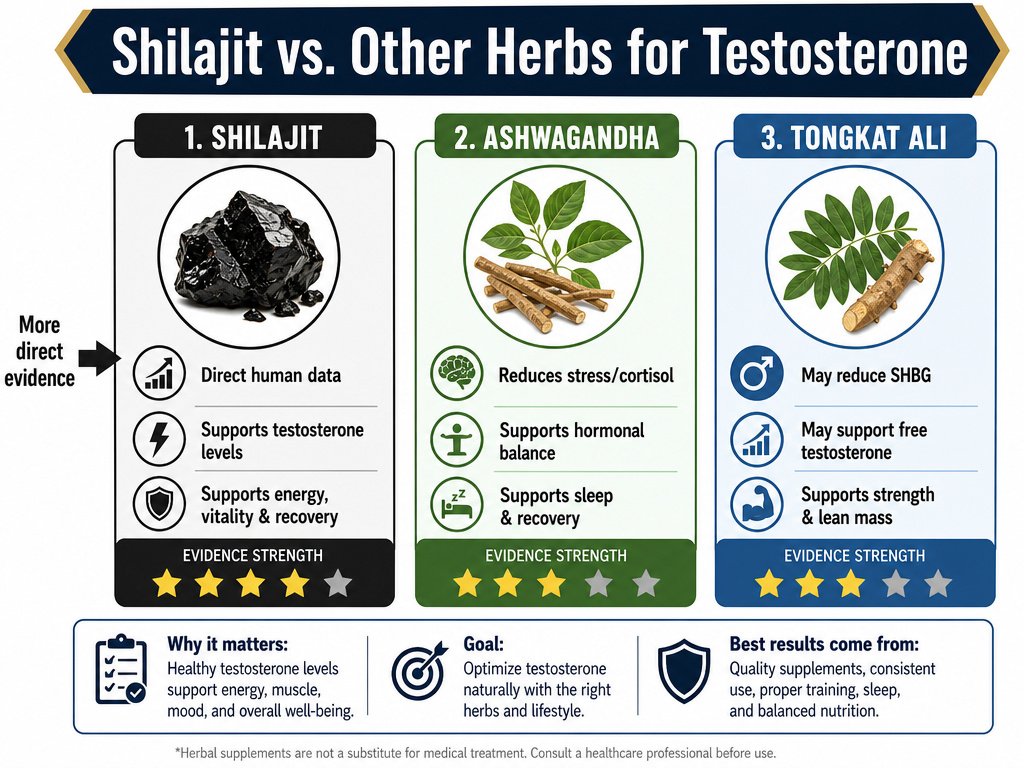
How does it compare to other herbs you’ve heard about?
- Ashwagandha: This adaptogen has good evidence for reducing stress and cortisol, which can indirectly support healthy testosterone levels if stress was the suppressing factor. It is not a direct testosterone booster. Our deep dive on ashwagandha and testosterone explains this distinction.
- Tongkat Ali: Similar to shilajit, the evidence is mixed but suggests it may help men with low-to-normal testosterone, possibly by reducing Sex Hormone Binding Globulin (SHBG). We break down the trials in our article on tongkat ali and testosterone.
- Fenugreek: As the 2019 AUA review noted, it joins shilajit as one of the only two ingredients with prospective human data showing a positive effect.
The short version? Shilajit has more direct human data for testosterone than many herbs, but that’s a low bar. Herbs like ashwagandha have stronger evidence for other benefits (stress, sleep) that may be more valuable for overall hormonal health.
Choosing a Quality Shilajit Supplement
Given the contamination risk, your selection process is a safety protocol.
- Prioritize Purified & Tested: Look for brands that use purified extracts like PrimaVie™ or that provide independent, third-party Certificates of Analysis (CoAs) for heavy metals and potency.
- Check the Form: Shilajit resin vs capsules is a trade-off. Resin is traditional but dosing is imprecise and contamination risk is higher unless rigorously tested. Capsules offer precise dosing and are often made with purified extracts.
- Ignore Proprietary Blends: If a “testosterone complex” lists “Shilajit (as part of a 500mg proprietary blend),” you cannot know your dose. Avoid it.
- Start with a Trusted Brand: Consult our guides to high-quality shilajit supplements and the best shilajit supplements for men for vetted options that prioritize testing and transparency.
Lifestyle Factors: The Foundation That Matters More
No supplement can override a lifestyle that suppresses testosterone. The research on these factors is far more robust than any shilajit study.
- Sleep: Even one week of restricted sleep (5 hours per night) can significantly reduce testosterone in healthy young men.
- Body Weight: Excess body fat, especially visceral fat, increases the conversion of testosterone to estrogen.
- Resistance Training: Compound lifts like squats and deadlifts provide a acute boost and, more importantly, build muscle that improves metabolic health.
- Chronic Stress & Alcohol: Both disrupt the hypothalamic-pituitary-gonadal axis—the hormonal cascade that tells your body to make testosterone.
Think of shilajit or any testosterone supplements as a possible tweak to a system that must first have its fundamentals in place. Pouring a “booster” into a body that is sleep-deprived, stressed, and sedentary is a waste of money.
How long does it take for shilajit to work on testosterone?
In the key clinical studies, the timeframe for seeing a measurable change in testosterone levels was 90 days of consistent supplementation. In a study of healthy men, taking a purified shilajit extract twice daily for 90 consecutive days resulted in significant increases in both total and free testosterone. A separate study in men with oligospermia also reported an increase in serum testosterone after the same 90-day period. This suggests that, if an effect occurs, it is not immediate and requires sustained use. However, it is critical to note that these increases remained within the normal physiological range. The evidence comes from only two small studies, and the clinical significance of these changes for vitality or body composition is debated.
Frequently Asked Questions
How much testosterone does shilajit increase?
In the 2016 study on healthy men, purified shilajit increased total testosterone by 20.45% over 90 days. In the 2010 study on infertile men, it increased levels by 23.5%. These are average increases from baseline; individual results will vary.
What does shilajit do for a male?
Beyond the potential testosterone effects shown in limited studies, shilajit is traditionally used in Ayurveda as a rejuvenating agent. Modern marketers claim it boosts energy, libido, and fertility. Its fulvic acid content may act as an antioxidant and aid mineral absorption, but strong human evidence for these specific benefits in males is lacking.
Which is better for testosterone, ashwagandha or shilajit?
They work differently. Shilajit has small-study evidence for a direct increase in testosterone levels. Ashwagandha has stronger evidence for reducing stress and cortisol, which can support testosterone if stress is the primary suppressor. Neither is a powerful, reliable booster for men with clinically low testosterone. For a direct comparison, see our articles on ashwagandha and tongkat ali.
What happens if I take shilajit daily?
If you take a clean, tested product at the studied dose (200-500 mg daily), the research suggests it is well-tolerated over 90 days. The long-term safety profile is unknown. If you take an untested product daily, you risk gradual accumulation of heavy metals like lead and arsenic, which can cause serious health problems.
The Bottom Line
The evidence that shilajit can increase testosterone is real but thin, built on two small human trials. The 20% increase is statistically significant but likely not clinically significant for most men. The conversation shouldn’t end there, as sources disagree on whether the statistically significant increases are clinically meaningful.
Your first move is not buying a supplement. It’s looking at the fundamentals that crush testosterone: poor sleep, high body fat, and unmanaged stress. Fixing those has a higher return than any resin.
If you still want to try shilajit, the rule is simple: purity over price. The contamination risk is not theoretical. Only consider brands that provide independent heavy metal testing and use a purified, standardized extract. Start at the studied dose of 200-500 mg per day, and give it the full 90 days used in the trials to assess any effect. And remember, among the jungle of testosterone booster ingredients, shilajit is one of the few with any human data—that’s a low bar, but it’s the one the science currently sets.
