
Does Ashwagandha Increase Testosterone?
This post contains affiliate links. As an Amazon Associate, we earn from qualifying purchases.
Ashwagandha (Withania somnifera) can increase testosterone in men, but the effect is specific, temporary, and dose-dependent. Clinical trials show increases in testosterone; for example, one study found a 17% increase (about 72 ng/dl) after 8 weeks of taking 300 mg twice daily, and a meta-analysis reported a mean difference of 57.43 ng/dl in men. This effect is not observed in women, and levels typically drop back to baseline within 8 weeks of stopping the supplement.
The key isn’t the herb’s name on the bottle. It’s the specific extract, the studied dose, and the person taking it. Most of the positive data for the does ashwagandha increase testosterone question comes from trials on men who were overweight, stressed, or in resistance training, not already healthy, recreationally active guys.
What follows is a breakdown of the actual study numbers, the three variables that decide if it works for you, and the safety lines you don’t want to cross. By the end, you’ll know exactly which product spec to look for and which popular claims to ignore.
Key Takeaways
- In one crossover study, increases in DHEA-S and testosterone from an 8-week ashwagandha period were not sustained 8 weeks after switching to placebo.
- Dose and extract matter. Studies have used various doses, such as 300 mg twice daily, 600 mg daily of a specific extract, 240 mg daily, and 500 mg daily.
- It works for men, not women. A 2024 meta-analysis found a significant increase in men but no meaningful change in women’s testosterone levels.
- Safety has clear red zones. The NCCIH advises avoiding ashwagandha if you are pregnant, breastfeeding, have autoimmune or thyroid disorders, or are taking medications for diabetes, blood pressure, or seizures.
- Research on ashwagandha’s effect on sexual well-being vs. Hormonal changes shows disagreement: one study found significant improvements in both serum testosterone and subjective sexual well-being, while another found significant hormonal increases but no significant between-group differences in self-reported sexual well-being.
The Clinical Evidence: What the Studies Actually Show
Look past the headline “ashwagandha boosts testosterone.” The real story for the does ashwagandha increase testosterone query is in the study details, the participant profile, the exact extract used, and what was actually measured. The data isn’t uniform, and that’s where most guides stop.
A 300 mg root extract taken twice daily led to a 17% increase in serum testosterone (a rise of about 72 ng/dl) compared to a 2% increase in the placebo group over 8 weeks. This same study, published in PMC, also noted significant improvements in self-reported sexual well-being.
That’s a strong result. But another study using a 500 mg extract (10% withanolides) for 12 weeks found no significant change in testosterone versus placebo in recreationally active men. Why the difference? The first study involved men seeking help for sexual performance; the second involved healthy, active men. Ashwagandha often works best when there’s a deficit or stressor to correct.
Here’s a breakdown of key trials to show the spread:
| Study & Participants | Dose & Extract | Duration | Testosterone Outcome |
|---|---|---|---|
| Lopresti et al. (2019) – Overweight/obese men with fatigue | 2 × 300 mg (35% withanolides) | 8 weeks | Significant increase in testosterone and DHEA |
| Wankhede et al. (2015) – Men in resistance training | 2 × 300 mg (5% withanolides) | 8 weeks | Significant increase in testosterone |
| Ziegenfuss et al. (2018) – Recreationally active men | 1 × 500 mg (10% withanolides) | 12 weeks | No significant change vs. Placebo |
| Lopresti et al. (2019) – Mixed-gender group with anxiety | 1 × 240 mg (35% withanolides) | 60 days | No significant change vs. Placebo |
The pattern is clearer when you separate the signal from the noise. If you’re a stressed, overweight man or you’re pushing hard in the gym, the evidence is promising. If you’re a healthy, active guy with normal hormone levels, the herb might not move the needle. This is why blanket claims are useless.
The mean difference reported in a meta-analysis was 57.43 ng/dl in men. That’s a modest but meaningful shift for someone on the lower end of the normal range. It’s not going to double anyone’s levels.
Does It Work for Women?
The short answer is no, not for testosterone. The 2024 systematic review and meta-analysis that pooled data from multiple randomized-controlled trials concluded the increase was significant in men but not in women. For women wondering about ashwagandha for PCOS or libido, the hormonal mechanism appears different. The research on female-specific outcomes like sexual function is thinner and shouldn’t be extrapolated from the male testosterone data.
How Ashwagandha Might Raise Testosterone: The Why Layer
It’s not a direct hormone. Think of it as a support agent that tweaks the systems influencing your hormonal balance. The primary proposed mechanisms involve stress reduction and direct glandular support.
First, it’s a potent adaptogen. Chronic stress elevates cortisol, which can suppress the hypothalamic-pituitary-gonadal (HPG) axis, the command chain that tells your testes to produce testosterone. By helping the body manage stress, ashwagandha may lower cortisol and remove this brake on natural production. Some studies show cortisol reductions, others don’t, but the stress-modulation effect is well-documented.
Second, some animal and in vitro studies suggest it may stimulate the release of gonadotropin-releasing hormone (GnRH) from the hypothalamus. This is the master signal that kicks off the entire chain leading to testosterone synthesis. A more efficient signal can lead to more efficient output.
Finally, its antioxidant properties might protect Leydig cells in the testes from oxidative damage, helping them function optimally. This is more of a supportive, long-term role than a direct stimulant effect.
So it’s a multi-tool: potentially reducing the negative input (stress) while supporting the positive output (signaling and gland health). This explains why effects are most pronounced in men under stress or with room for improvement in those areas.
The Critical Variables: Dosage, Extract, and Duration
You can’t just buy “ashwagandha.” You’re buying a specific formulation, and getting this wrong is the most common reason people see no results. The difference between a 5% withanolide extract and a 35% extract isn’t minor, it’s the difference between a studied dose and a guess.
Common mistake: Buying raw root powder or a generic “standardized extract” without checking the withanolide percentage and dose per serving. This almost guarantees you won’t match the conditions of the successful clinical trials.
Effective Dosage Ranges:
- For studied testosterone outcomes: 600 mg daily of a Shoden extract (delivering 21 mg of withanolide glycosides) was used in one study, and 300 mg taken twice daily of a root extract was used in another.
Extract Type is Everything.
- KSM-66: A root extract standardized to 5% withanolides, used in the Wankhede et al. (2015) resistance training study.
- Shoden: A concentrated extract (from leaves and roots) used in the PMC6438434 crossover study. It’s standardized for a high percentage of withanolide glycosides.
- Sensoril: Another popular extract, often used for stress and sleep. Its testosterone-specific data is less robust than KSM-66 or Shoden.
When you’re evaluating best ashwagandha supplements, the label must list both the amount of extract and the withanolide percentage. If it doesn’t, you’re flying blind. A proprietary blend that hides these details hasn’t earned your trust, or your money.
Timeline for Results.
Don’t expect changes in a week. Significant increases in testosterone were observed in trials lasting 8 weeks. This is a medium-term supplement. Start low to assess tolerance, then stick with a consistent dose for at least two months before judging its effects. Patience is part of the protocol.
Safety, Side Effects, and Who Should Avoid It

Ashwagandha may be safe when taken in the short term (up to 3 months) for some people, but the exceptions are serious and must be followed. The NCCIH safety overview is the authority here, and its warnings are based on case reports and known pharmacology.
Common Side Effects:
These are usually mild and often dose-dependent: drowsiness, stomach upset, diarrhea, and vomiting. If you feel overly sedated, try taking it at night or reducing the dose.
Where this goes sideways: Combining ashwagandha with sedatives, anti-anxiety meds, or alcohol. The additive drowsiness can be significant and dangerous.
Who Should NOT Take Ashwagandha:
This list is from the NCCIH and is not a suggestion:
- Pregnant or breastfeeding women. It should be avoided entirely.
- People with autoimmune diseases (like rheumatoid arthritis, lupus, Hashimoto’s thyroiditis). It may stimulate the immune system.
- People with thyroid disorders. It may increase thyroid hormone levels and interfere with medication.
- Those scheduled for surgery. Stop at least two weeks beforehand due to potential effects on blood pressure and central nervous system depression.
- Individuals with hormone-sensitive prostate cancer. Because it may increase testosterone, it could theoretically promote cancer growth.
- People on specific medications: This includes drugs for diabetes, high blood pressure, immunosuppressants, sedatives, anti-seizure drugs, and thyroid hormone meds. It can potentiate or interfere with their effects.
The Liver Injury Note.
Although rare, the NCCIH states there have been “a number of cases that link liver injury to ashwagandha supplements.” If you have pre-existing liver conditions or start noticing symptoms like unusual fatigue, yellowing skin, or dark urine, discontinue use and consult a doctor.
Ashwagandha vs. Other Testosterone Supplements
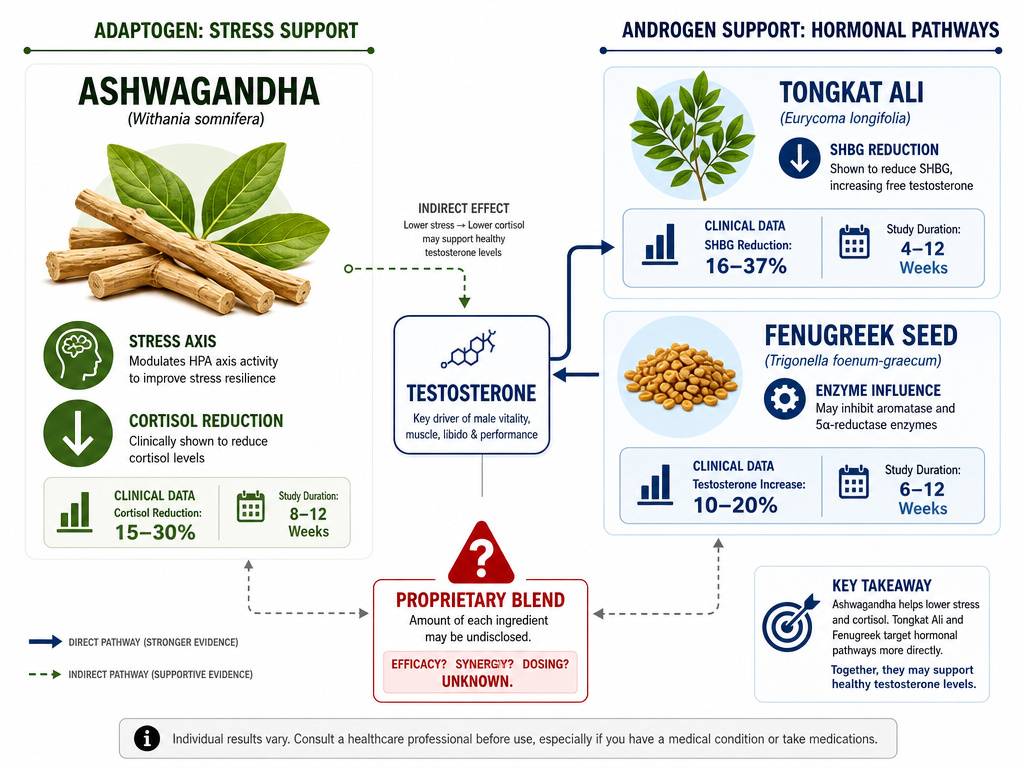
Ashwagandha isn’t the only player in the game. Compared to other popular natural testosterone supplements, its evidence profile is relatively strong for stress-related low T, but weaker for direct anabolic or performance effects.
Ashwagandha vs. Tongkat Ali
The tongkat ali vs ashwagandha debate is common. Tongkat ali (Eurycoma longifolia) often shows more dramatic increases in free testosterone in studies, potentially by reducing Sex Hormone Binding Globulin (SHBG). Ashwagandha’s effects seem more tied to the stress axis. They work through different pathways and could be complementary, but tongkat ali might have a stronger direct effect on the hormone number for some men.
Ashwagandha vs. Fenugreek
Fenugreek is another herb with test-supportive data, often linked to libido. Its mechanism is different, possibly influencing enzymes that convert testosterone. Ashwagandha’s adaptogenic edge gives it a broader base of research for overall stress and well-being, which for many is the root cause.
The “Blend” Problem.
Many over-the-counter testosterone boosters throw ashwagandha into a proprietary blend with a dozen other evidence-backed ingredients like zinc, magnesium, and vitamin D. This makes it impossible to know if you’re getting a clinical dose of anything. If your goal is to test ashwagandha’s effect, use it solo first. “Start low and go slow” applies here, change one variable at a time so you know what’s working.
How to Use Ashwagandha for Testosterone: A Practical Guide
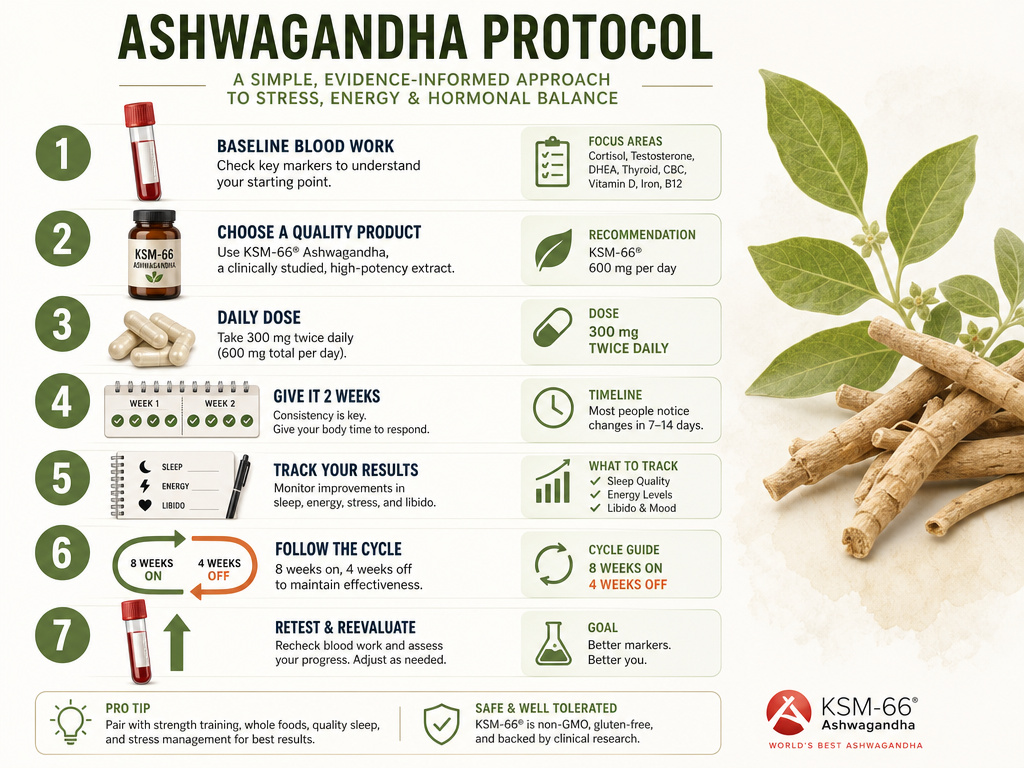
If you’ve checked the safety list and you’re a candidate, here’s how to proceed methodically. This isn’t about optimism; it’s about creating a clean experiment.
- Get a Baseline. If you’re serious about hormones, get bloodwork done before you start. Test total testosterone, free testosterone, SHBG, and cortisol if possible. Guessing is expensive hoping.
- Choose Your Extract. Select a brand that uses a studied extract like KSM-66 or Shoden and clearly states the withanolide percentage and ashwagandha dosage per serving.
- Start Low. Begin with 300 mg daily, taken with a meal to minimize stomach upset. Take it in the evening if you’re sensitive to drowsiness.
- Assess and Adjust. After two weeks, if tolerated, increase to the studied dose of 600 mg daily (either as one dose or split). Stick with this for a full 8-week cycle.
- Monitor Subjectively. Keep notes on energy, sleep quality, stress, and libido. The hormonal change might be silent, but how you feel matters.
- Consider Cycling. Given that the hormonal gains are not permanent, some users choose to cycle, 8 weeks on, 4 weeks off. There’s no strong research on optimal cycling, but it’s a prudent approach to avoid potential receptor desensitization and reassess your baseline.
- Retest. After 8-12 weeks, get follow-up bloodwork. This is the only way to know objectively if it moved your numbers.
This protocol turns anecdote into data. It’s how you move from wondering if do testosterone boosters actually work to knowing what works for you.
Frequently Asked Questions
Does ashwagandha actually raise testosterone?
Yes, but with important caveats. Clinical evidence shows it can raise testosterone in men; for example, one study found a 17% increase (about 72 ng/dl) after 8 weeks, and a meta-analysis reported a mean difference of 57.43 ng/dl. This effect is not seen in women, and it may not occur in already healthy, recreationally active men.
What are the side effects of ashwagandha?
Most side effects are mild and include drowsiness, stomach upset, diarrhea, and vomiting. More serious but rare risks include potential liver injury. It is not safe for pregnant or breastfeeding women, people with autoimmune or thyroid disorders, or those taking medications for diabetes, blood pressure, or seizures.
Which is better, shilajit or ashwagandha?
They are different. Ashwagandha has stronger clinical evidence for reducing stress and supporting testosterone in stressed or overweight men. Shilajit is a mineral-rich compound often used for energy and vitality, with some studies showing it can boost testosterone, possibly by improving mitochondrial function. Ashwagandha is better researched for hormonal outcomes linked to stress.
How long does it take for ashwagandha to increase testosterone?
Significant increases in testosterone were observed in clinical trials lasting 8 weeks. You should not expect noticeable hormonal changes before this timeframe. Consistency with the correct dose is critical.
Does ashwagandha increase testosterone permanently?
No. Research indicates the increase is temporary. In a crossover study, testosterone and DHEA-S levels that rose during an 8-week ashwagandha period dropped back toward baseline within 8 weeks of switching to a placebo. Continued supplementation is required to maintain the elevated levels.
Before You Go
The takeaway isn’t a simple yes or no. Ashwagandha is a tool, not a miracle. For the right person, a man under chronic stress, with room to improve his hormonal baseline, a high-quality, standardized extract taken at a clinical dose for 8 weeks can provide a measurable, though temporary, boost.
But that boost has walls. It doesn’t cross over to women, it fades when you stop, and it’s unreliable if you’re already healthy and active. Your first step shouldn’t be buying a bottle. It should be asking why your levels might be low. Is it sleep? Nutrition? Unmanaged stress? Often, fixing a basic deficiency in vitamin D, magnesium, or zinc does more than any adaptogen.
If you do try it, treat it like an experiment. Pick one product, use it consistently, and track the outcome, both in how you feel and, ideally, with before-and-after labs. Let the evidence lead, not the label. And remember, in the world of adaptogens and hormonal support, patience and specificity beat enthusiasm every time.
