
Boron Dosage for Testosterone: How to Cycle and Stack
This post contains affiliate links. As an Amazon Associate, we earn from qualifying purchases.
To boost testosterone with boron, you have three dosage anchors: a general support dose of 3 mg/day, a study-specific short-term dose of 10 mg/day, and an absolute safety ceiling of 20 mg/day. The evidence is split, one study showed 10 mg/day raised free testosterone in a week, while another found 2.5 mg/day for seven weeks did nothing in bodybuilders. Start at 3 mg.
That 3 mg number isn’t a guess. It’s the threshold below which a major review found no beneficial effects on sex steroids appear. The jump to 10 mg comes from a single, small human trial. The 20 mg limit is a government-set line you shouldn’t cross.
What follows is a walk through the actual studies, the dosage tiers they create, and the mineral interactions that change how you should use boron. This section explains the conflicting data on estradiol, the real upper limit, and why your magnesium status matters more than you think.
Key Takeaways
- Start with 3 mg per day for general hormonal support, beneficial effects on sex steroids don’t appear below this intake.
- The 10 mg per day dose comes from a single 2011 study showing a free testosterone bump in one week; treat it as a short-term, higher-intensity option, not a daily baseline.
- Never exceed the 20 mg per day Tolerable Upper Intake Level (UL) set by the Food and Nutrition Board; this is a safety ceiling, not a target.
- Boron’s effects are inconsistent: one study showed it lowered estradiol, another suggested it could raise it, and a bodybuilder trial found it did nothing for T.
- Your results depend on baseline diet and other minerals; boron works with vitamin D and magnesium, and ignoring copper balance can backfire.
The 3 Dosage Tiers That Frame the Evidence
Forget a single “best” dose. The research gives you three distinct tiers, each with a different job. The 3 mg mark is the baseline for any hormonal activity. The 10 mg dose is the short-term experimental one. The 20 mg line is the stop sign.
The Tolerable Upper Intake Level (UL) for boron is 20 mg/day for adults aged 19 years and older. This is not a recommendation, it’s the maximum daily intake unlikely to cause harm, established by the Food and Nutrition Board of the Institute of Medicine.
The 3 mg tier comes from the work of researcher Forrest H. Nielsen. His 2014 review in the journal Integrative Medicine states point-blank: “In none of the numerous studies conducted to date, however, do boron’s beneficial effects appear at intakes < 3 mg/d.” This is your entry point. If you are consuming a diet lacking in fruits and vegetables, your boron intake may be low. Hitting 3 mg requires intention, either through more fruits and vegetables or a small supplement.
The 10 mg tier is the headline-grabber. In the 2011 study by Naghii and colleagues, eight healthy men took 10 mg of boron daily for seven days. That’s a notable jump in a short window. But it’s one study with eight people. The 10 mg dose is substantially higher than the amounts used in deprivation studies (e.g., 0.23-0.25 mg/2000 kcal). It’s a signal, not a law.
The 20 mg UL is your guardrail. It’s based on animal data showing potential reproductive toxicity at very high, chronic intakes. You don’t get extra benefits by edging toward it. You just increase the risk of doing something we don’t fully understand with a mineral that’s not well mapped in human physiology.
| Dosage Tier | Source & Purpose | Key Context & Limitation |
|---|---|---|
| 3 mg/day | Nielsen (2014) review. Baseline for any observed benefit on sex steroids. | Found in research on postmenopausal women and general supplementation. Effects may not appear below this level. |
| 10 mg/day | Naghii et al. (2011) study. Short-term, higher-intensity intervention. | Single study (n=8) over 7 days. Free T increased, estradiol decreased. Not studied long-term. |
| 20 mg/day (UL) | Food and Nutrition Board, Institute of Medicine. Absolute safety ceiling. | Based on animal toxicity data. Not a therapeutic dose—exceeding it increases potential risk. |
Your starting point is 3 mg. It’s the dose with the broadest research backing for initiating a change in hormone metabolism. For a deeper look at the specific research on boron and testosterone, we’ve broken down the major studies.
Mechanism of Action: How Boron Might Move the Hormonal Needle
Boron doesn’t directly tell your testes to make more testosterone. The current best guess is that it tweaks the system in two ways: by influencing sex hormone-binding globulin (SHBG) and by boosting active vitamin D levels. Both actions could free up more testosterone for your tissues to use.
Sex hormone-binding globulin is a transport protein that locks onto testosterone and estradiol, making them inactive. Some lab and animal research suggests boron compounds might weakly bind to SHBG themselves. If boron sits in the parking spot, it could prevent SHBG from grabbing as much testosterone, leaving more free hormone in circulation. This is a theoretical model, it hasn’t been proven conclusively in humans, but it’s a clean explanation for the rapid free T increase seen in the Naghii study.
The vitamin D connection is more straightforward. A boron research summary details a trial where people on a low-boron diet saw their 25-hydroxyvitamin D3 levels rise by 39% after taking 3 mg/day for 49 days. Vitamin D is a direct precursor to sex hormone synthesis. More active vitamin D can mean a more robust hormonal production line. This mechanism is slower and more systemic than the SHBG idea, which aligns with the longer-term studies on postmenopausal women.
Where this goes sideways: Assuming boron is a direct testosterone precursor. It’s not. It’s a modulator of the hormones you already produce, and its effect depends entirely on your existing status, diet, SHBG levels, and vitamin D stores.
This is why the bodybuilder study by Ferrando and Green is so important to the boron dosage for testosterone question. They gave athletes 2.5 mg/day for seven weeks and saw no difference in testosterone compared to the placebo group. Both groups got stronger and gained lean mass from training, but boron added nothing. One interpretation: in young, training males with already-optimized systems, a low dose of boron doesn’t move the needle. Their SHBG might already be low, their vitamin D sufficient. The mineral had no lever to pull. This is a crucial contrast to the Naghii study and is a key part of any honest boron’s effects on testosterone discussion.
Conflicting Evidence: The Estradiol Puzzle and the Null Study
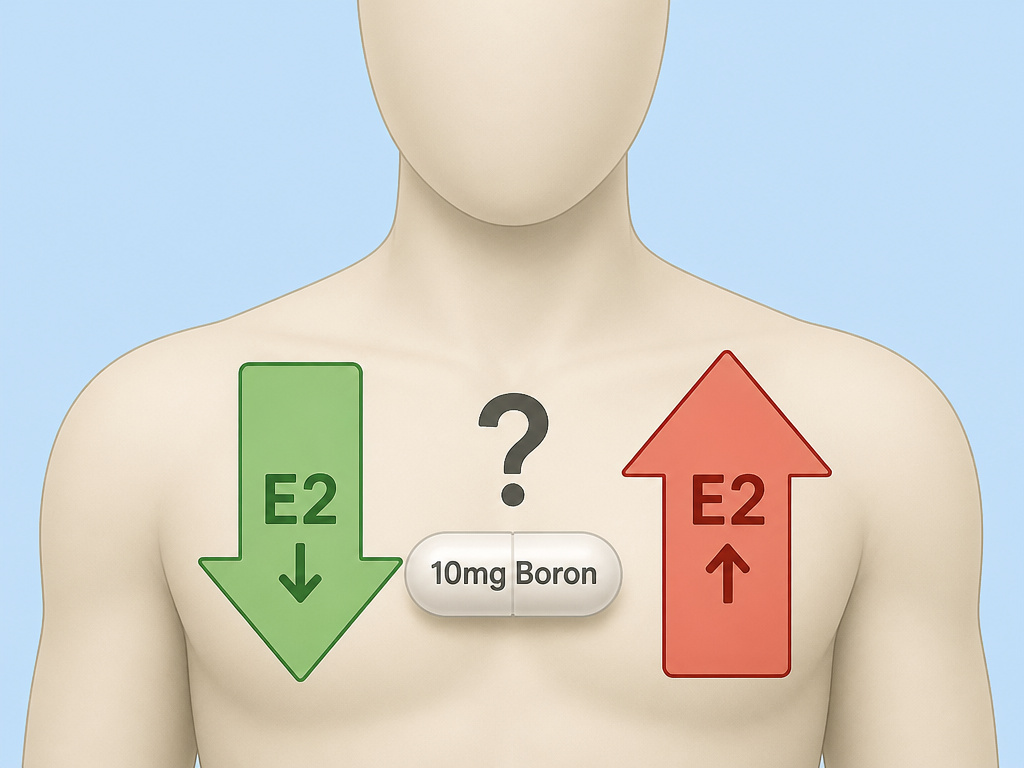
If you only read the headlines, boron lowers estradiol. Dig into the older literature, and it might raise it. This is the estradiol puzzle, and it’s a perfect example of why supplement protocols need nuance. You can’t copy a dose from a single paper and expect a guaranteed outcome.
The 2011 Naghii study reported a significant decrease in estradiol alongside the increase in free testosterone. The ratio of free testosterone to estradiol improved. This is the “boron lowers E2” story that fills forums.
But a 2009 study by some of the same researchers (Naghii & Mofid) found that 10 mg/day of boron supplementation for 4 and 8 weeks increased levels of 17‑β oestradiol. The direction of change flipped. We don’t have the full text of that paper from our sources, but its abstract is cited in other reviews as showing an increase. We can’t resolve the contradiction. We can only report it.
The null study is the 1993 bodybuilder trial. Ten men took 2.5 mg of boron daily for seven weeks. The plasma boron supplementation study concluded: “boron supplementation affects these variables not at all.” Total testosterone, free testosterone, lean mass, and strength gains were identical between the boron and placebo groups. Both groups improved from training, boron just didn’t help.
What does this mean for you? The body’s response to boron is not a simple on/switch. It likely depends on:
- Your hormonal starting point (postmenopausal vs. Young male).
- The duration of supplementation (one week vs. Two months).
- Your overall mineral status (especially magnesium, discussed next).
The takeaway is caution when you compare a boron dosage for testosterone. Boron might nudge your hormones in a desired direction, or it might do nothing. It could potentially shift estradiol in a way you didn’t intend. This isn’t a reason to never try it. It’s a reason to start low, pay attention, and get labs if you can.
The Mineral Interplay: Why Magnesium and Copper Are Non-Negotiable
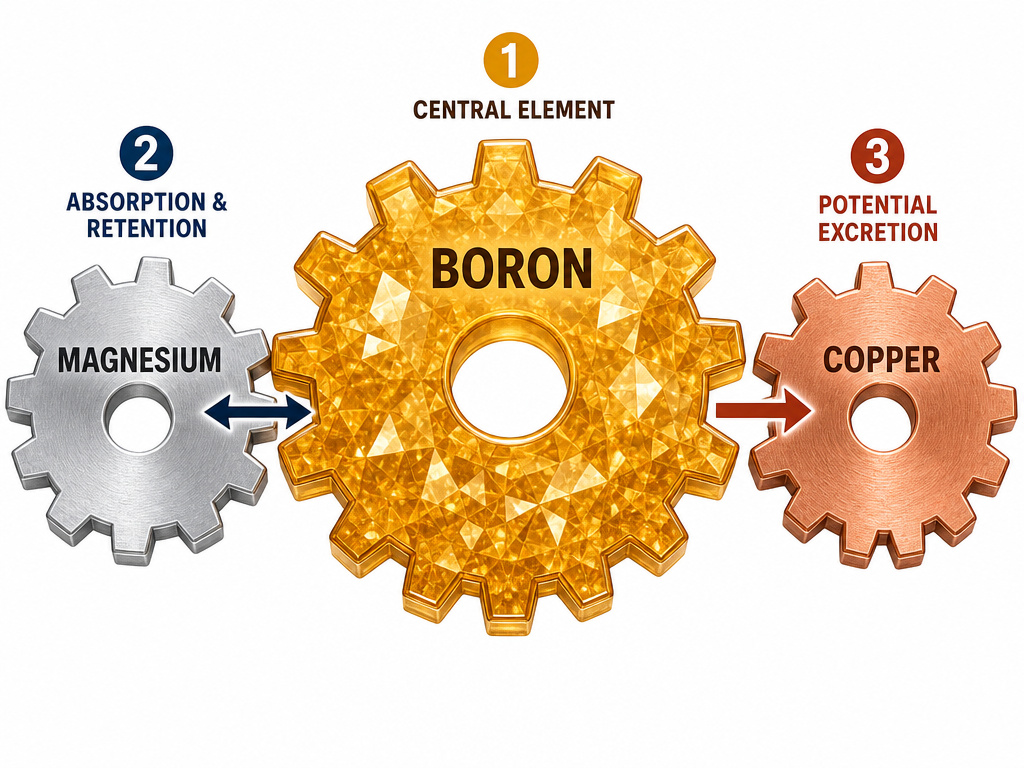
Boron doesn’t work in a vacuum. Its most important partnerships are with magnesium and copper. Ignoring these can turn a well-intentioned protocol into a case of robbing Peter to pay Paul. I learned this the hard way with another mineral.
Years ago, I took about 50 mg of zinc daily for months. The logic was “more is more.” I ended up with a persistent metallic taste and a run-down feeling that I couldn’t shake. A blood test showed my copper had dipped low. I was so focused on one mineral that I wrecked the balance of another. Now, if I supplement zinc past 25 mg total, I either add a small amount of copper or just stop. It’s boring, but nothing breaks.
Boron has a similar co-factor story. The research shows it significantly improves magnesium absorption and retention. In one of the deprivation studies, boron’s positive effects on hormone metabolism were more pronounced when the diet was also low in magnesium. If you’re low in magnesium, and many people are, boron’s potential benefits might be muted. Conversely, taking boron could help you make better use of the magnesium you already get.
Copper matters because boron supplementation, especially at higher doses, might increase urinary excretion of copper. We don’t have strong human data on this, but the biochemical pathways suggest it’s possible. It’s a precaution, not a proven fact. The rule is simple: if you’re supplementing with any mineral long-term, you should be aware of its common antagonists.
Here’s a quick checklist before you start boron:
- Magnesium: Are you getting at least 400 mg daily? A form like magnesium glycinate at night supports sleep and hormonal health.
- Copper: Do you eat copper-rich foods (liver, shellfish, nuts, seeds)? If not, a multi-mineral with 1-2 mg of copper is cheap insurance.
- Zinc: Are you taking high-dose zinc? Revisit our guide on zinc dosage for testosterone to ensure you’re not creating an imbalance.
Treat your mineral intake like a team. Boron might be the new player, but you can’t let the veterans sit on the bench.
Safety, Side Effects, and the 20 mg Ceiling
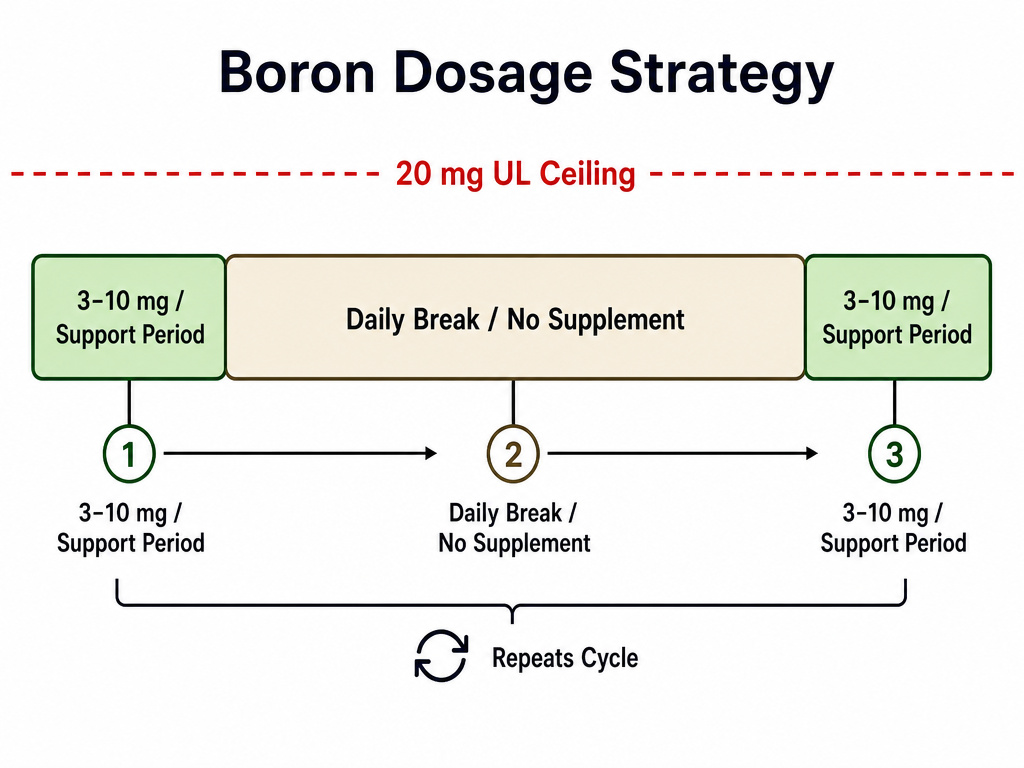
The official upper limit of 20 mg per day exists for a reason. While human studies at moderate doses (3-10 mg) show few acute side effects, chronic high intake is a different story. The UL is based on animal studies showing reproductive and developmental toxicity. You don’t need to flirt with it.
Common side effects of boron supplementation are not detailed in the provided fact sheet.
The more significant risk is the unknown long-term effect of artificially elevating a trace mineral we don’t fully understand. We have short-term studies, one week, seven weeks, a few months. We don’t have decade-long data on otherwise healthy men taking 10 mg of boron daily. That’s why a conservative approach wins.
Common mistake: Chasing the 10 mg dose long-term because one study showed a quick result. That study lasted seven days. We have no idea what happens at 10 mg/day for seven months.
A safer, more sustainable strategy is to treat boron as a periodic support tool, not a daily forever-pill. This is where the forum questions about “cycling” become relevant, even if the clinical literature is silent on it.
Practical Protocol: Cycling, Timing, and Stacking
The research doesn’t tell you when to take boron or whether to cycle it. But practical experience from long-term users and basic nutrient logic fills the gap. The goal is to get the potential benefit without teaching your body to depend on an external regulator.
Cycling: A common approach is to follow a shorter “on” period with an “off” period. The research does not provide guidance on cycling boron supplementation. This mimics the shorter durations of the positive studies and may help prevent any adaptive down-regulation of natural processes. There’s no science proving this is necessary, but it’s a prudent hedge against the unknown.
Timing: Boron is water-soluble and absorbed well with or without food. Taking it with a meal may reduce any chance of stomach upset. Some users report better results taking it in the morning, others prefer evening. The data doesn’t support one over the other. Consistency matters more than the clock.
Stacking: Boron is often stacked with other testosterone-supportive nutrients. The most logical partners are:
- Vitamin D: Since boron can boost 25(OH)D levels, taking them together is synergistic. Check our page on vitamin D dosage for testosterone for dosing.
- Magnesium: As discussed, they work together. Taking magnesium glycinate at night and boron in the morning covers both.
- Zinc: Be cautious. Both can affect copper metabolism. If you stack them, be mindful that both zinc and boron can influence copper metabolism.
Avoid stacking boron with other strong SHBG-modulators (like proviron analogs or certain SARMs) unless you are under medical supervision. You’re experimenting with a key regulatory system.
Boron for erectile dysfunction
Research on boron has not directly investigated its use as a treatment for erectile dysfunction. The available studies focus on boron’s influence on sex hormones like testosterone and estradiol. Some research indicates that supplementation can alter the ratios of these hormones, which are factors in sexual health. However, no clinical trials have measured an improvement in erectile function from boron intake alone. The connection remains theoretical, based on boron’s role in hormone metabolism rather than direct evidence of treating ED symptoms.
Foods high in boron
Boron is naturally present in many plant-based foods, with fruits, vegetables, nuts, and legumes being the primary dietary sources. A diet rich in these foods generally provides sufficient boron for basic nutritional needs. The mineral’s availability depends heavily on the soil content where the plants are grown. For individuals whose diets lack these food groups, boron intake may be lower. In such cases, focusing on a varied diet that includes these whole foods is the most practical way to obtain boron naturally.
Frequently Asked Questions
What is the most effective boron dosage for testosterone?
For a rapid free testosterone increase, Naghii et al. (2011) used 10 mg/day for 7 days, while Ferrando & Green (1993) found 2.5 mg/day for 7 weeks did not affect testosterone, and Nielsen (2014) suggests benefits do not appear below 3 mg/day. However, for general, long-term hormonal support, a dose of 3 mg per day is recommended as the baseline where benefits begin. Never exceed 20 mg per day.
How long does it take for boron to increase testosterone?
In the key human study showing an increase, it took 7 days of supplementation at 10 mg/day to see a statistically significant rise in free testosterone. Other research on postmenopausal women using 3 mg/day showed hormone changes over 48-49 days. The timeline depends on the dose and your individual status.
Does boron lower estradiol?
The evidence is conflicting. The 2011 Naghii study found 10 mg/day for one week significantly decreased estradiol. However, an earlier 2009 study by some of the same authors reported that 10 mg/day for 4-8 weeks increased estradiol. The effect may depend on the duration of supplementation and individual factors.
Can I take boron and zinc together?
You can, but be mindful of dosage. Both zinc and boron can influence copper metabolism. If you take both, keep your total zinc intake moderate (e.g., under 30 mg from all sources) and ensure you consume copper-rich foods. High-dose, long-term zinc without copper can create a deficiency.
What is the best form of boron supplement?
The two most common and well-absorbed forms are boron citrate and boron glycinate (aka bisglycinate). Calcium fructoborate is another form used in some studies. The choice between boron citrate vs glycinate often comes down to personal tolerance and what’s in a quality boron supplement for men.
The Bottom Line
Start with 3 mg. That’s the number the evidence points to for initiating a beneficial shift in hormone metabolism without jumping into the deep end. Research studies showing hormonal effects have used durations ranging from 7 days to several weeks.
If you want to experiment with the 10 mg dose, treat it as a short-term intervention, The 10 mg dose was studied for only 7 days; long-term effects at this dose are unknown. Your body’s mineral balance wasn’t built for a constant, high-dose trickle of a single trace element.
Before you buy a bottle, look at your foundation. A vitamin D dosage for testosterone protocol and a magnesium supplement will do more for most people than chasing the perfect boron dose. Get those right first. Then, if you want to add boron as a fine-tuning agent, you’ll have a stable system to tune.
